
MBA-613 · Lesson 5 of 12 · 24 min
Building a guiding coalition and sponsorship
Leo Brandt has a problem that many growing companies share. When Kestrel Analytics had forty people, decisions happened in a single chat channel and at a Friday lunch. Everyone knew who was working on what, and anyone could raise a problem with a founder. Now Kestrel has 180 people in three cities. Two product teams built overlapping features last quarter without knowing it. Sales promised a large retailer a capability that engineering had decided not to build. Engineers hired in the last year say they cannot tell who decides anything. The founders agree that Kestrel needs managers with clear responsibilities, a quarterly planning process and written decision rights. They asked Leo, who runs operations, to make it happen.
His first draft of a plan was a timeline: design the structure in January, announce it in February, train managers in March. Dr. Morin asks a different question. Who has to support this change for it to work, who could stop it, and who do the people at Kestrel actually listen to? Leo realizes that his plan has no answer. This lesson is about the people who lead change together: sponsors, coalitions, stakeholders and the informal networks through which influence really flows.
Sponsorship
Daryl Conner, a consultant whose 1992 book Managing at the Speed of Change shaped much later practice, distinguished four roles in any change. Sponsors have the authority to legitimize a change: they decide that it will happen, allocate resources and hold people accountable. Agents are responsible for carrying it out. Targets are the people who must change what they do. Advocates want the change but lack the authority to sponsor it. Conner's central observation was that agents without sponsors fail. A change advocate who persuades everyone except the person who controls the budget and the performance reviews will see the change absorbed or reversed.
Sponsorship must also cascade. A chief executive can sponsor a change for the whole company, but each level of management sponsors it for the people who report to them, by setting goals, allocating time and noticing what is done. If a middle manager does not sponsor a change, the people below him receive two messages: the official one from the top and the real one from their boss, and they follow the boss. Conner called a missing level a sponsorship black hole. Gartner's 2025 finding, discussed in lesson 1, that many teams wait to see whether a change will last before acting is partly a measure of weak cascading sponsorship.
Effective sponsors do several things that are easy to describe and hard to sustain. They explain why the change matters, in their own words and repeatedly. They change their own behaviour first, because people watch what leaders do more closely than what they say. They make resources available, including the time of their best people. They remove obstacles, such as conflicting targets. They ask about progress and notice it. And they stay engaged after the launch, when attention naturally drifts to the next priority. Prosci's long-running surveys of practitioners have consistently ranked active and visible sponsorship as among the strongest contributors to change success, although such surveys measure practitioners' perceptions rather than outcomes.
The guiding coalition
No single sponsor, however senior, can lead a large change alone. Kotter's second step is to form a guiding coalition: a group with enough power, expertise, credibility and leadership skill to drive the change. Kotter's four criteria are useful in choosing members. Position power ensures that people who could block the change are inside it. Expertise ensures that the people with relevant knowledge, such as the engineers who understand the products, shape decisions. Credibility ensures that the coalition is trusted by the people who must change, so that its members' views are taken seriously. Leadership ensures that some members can drive the change rather than merely manage it.
Kotter also warned against two kinds of member: people with large egos who leave no room for others, and what he called snakes, who undermine trust by saying one thing in the room and another outside it. And he argued that the coalition must work as a team, not as a committee of representatives defending their units. That usually requires time together, a shared diagnosis and an explicit agreement on what the group is trying to achieve.
Leo's first draft of the coalition was the executive team: the chief executive, the head of engineering, who joined a year ago from a large software company, the heads of sales and customer success, and himself. Dr. Morin asks who among them has credibility with the engineers who built Kestrel's first products. Leo admits that the head of engineering is respected for his experience but seen by the early engineers as someone who wants to turn Kestrel into the company he left. The chief executive is trusted but rarely available. None of the people the early engineers regard as their leaders, the informal technical leads of the original products, is on the list.
Stakeholder analysis
A stakeholder is anyone who can affect or is affected by a change. Stakeholder analysis identifies them, estimates their power and interest and plans how to engage them. The most common tool is the power–interest grid, associated with Aubrey Mendelow's work in the early 1990s. Stakeholders with high power and high interest are key players, who must be engaged closely and ideally brought into the coalition. Those with high power and low interest must be kept satisfied, so that they do not become opponents. Those with low power and high interest must be kept informed, and can become valuable allies. Those with low power and low interest need monitoring with modest effort.
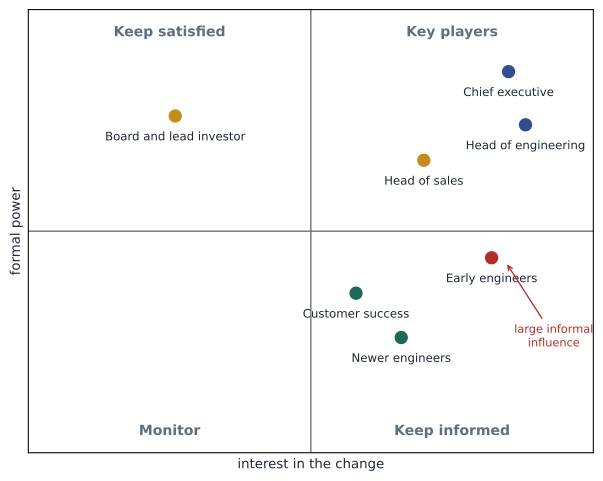
The grid has a limitation that Leo's case exposes. Power on the grid usually means formal power: budget, authority, votes. The early engineers have little formal power, but if they decide the new process is bureaucratic nonsense, most of the engineering organization will follow them, and the best of them may leave. Their informal power is large. Lesson 3's distinction between formal and informal systems applies to influence too.
Commitment charting
Richard Beckhard and Reuben Harris proposed in 1977 a simple tool that Dr. Morin finds more useful than the grid for planning action. For each key stakeholder, the change team records the person's present level of commitment and the minimum level needed for the change to succeed, on a four-point scale: opposes the change, lets it happen, helps it happen, or makes it happen. The gaps between present and required commitment show where effort must go. The chart also guards against a common error: trying to turn everyone into an enthusiastic champion. Some stakeholders need only to let the change happen, and spending effort to move them further wastes time that should go to the people whose active support is essential.
Leo's chart shows that the chief executive is at 'help it happen' but must 'make it happen': she must sponsor the change visibly, chair the first planning sessions and settle the conflict between sales and engineering over commitments to customers. The head of engineering is at 'make it happen' already, which is needed, but his enthusiasm for processes from his previous company may provoke the early engineers. The early engineers are at 'let it happen' at best and some at 'oppose'; Leo needs at least the most respected of them at 'help it happen'. The board is at 'let it happen', which is enough. The head of sales opposes written decision rights because they will limit his ability to promise customers new features; he must reach at least 'let it happen'.
Informal networks and change agents
In 1993 David Krackhardt and Jeffrey Hanson published an article in Harvard Business Review, 'Informal Networks: The Company Behind the Chart', showing that the networks through which people seek advice, trust and information often look nothing like the formal organization chart. Later research on change agents built on this insight. Julie Battilana of Harvard and Tiziana Casciaro of the University of Toronto studied 68 change initiatives in the British National Health Service, published in the Academy of Management Journal in 2012 and summarized for managers in Harvard Business Review in 2013. They found that change agents who were central in the informal network, regardless of their formal rank, were more successful at getting changes adopted. They also found that the best network shape depended on the change. Agents with bridging networks, connected to people who were not connected to each other, did better with changes that departed sharply from existing norms, because they could tailor arguments to each group. Agents with cohesive networks, whose contacts all knew each other, did better with modest changes, because trust spread quickly. And agents who had close ties to people who were ambivalent about a change, rather than to clear opponents or supporters, were more likely to win them over.
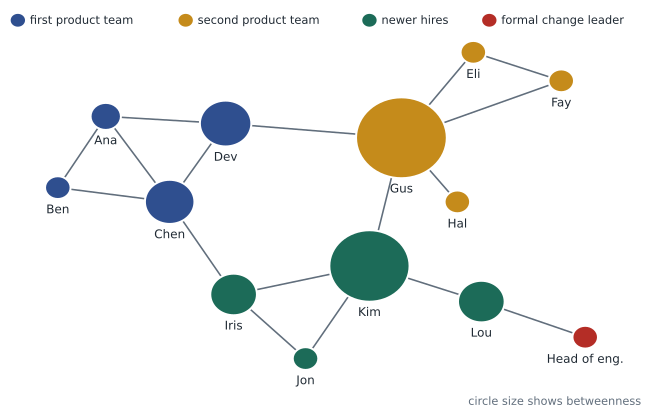
Network analysis can identify these people. Leo asks twelve engineers and the head of engineering a single question: whom do you go to for advice about how work should be done at Kestrel? The answers form a network. Two measures help. Degree centrality counts how many people name a person as an advisor: it identifies people who are widely consulted. Betweenness centrality counts how often a person lies on the shortest path between two others: it identifies brokers who connect groups that would otherwise be separate. Brokers are especially valuable in a change that must cross boundaries, because they carry information and persuasion from one group to another.
# Advice network at Kestrel: who do people go to for advice about how work should be done?
from collections import deque
from itertools import combinations

ties = [("Ana","Ben"),("Ana","Chen"),("Ana","Dev"),("Ben","Chen"),("Chen","Dev"),   # original product A team
        ("Eli","Fay"),("Eli","Gus"),("Fay","Gus"),("Gus","Hal"),                   # original product B team
        ("Iris","Jon"),("Iris","Kim"),("Jon","Kim"),("Kim","Lou"),                 # newer hires
        ("Dev","Gus"),("Gus","Kim"),("Chen","Iris"),                               # cross-group ties
        ("Lou","HeadEng")]                                                          # head of engineering
people = sorted({p for t in ties for p in t})
nbrs = {p: set() for p in people}
for a, b in ties:
    nbrs[a].add(b); nbrs[b].add(a)

def bfs(source):
    # distances and number of shortest paths from one person to everyone else
    dist, sigma = {source: 0}, {source: 1}
    q = deque([source])
    while q:
        u = q.popleft()
        for v in sorted(nbrs[u]):
            if v not in dist:
                dist[v] = dist[u] + 1; sigma[v] = 0; q.append(v)
            if dist[v] == dist[u] + 1:
                sigma[v] += sigma[u]
    return dist, sigma

info = {p: bfs(p) for p in people}

def betweenness():
    # share of shortest paths between each pair that pass through each other person
    score = {p: 0.0 for p in people}
    for s, t in combinations(people, 2):
        ds, ss = info[s]
        dt, st = info[t]
        for v in people:
            if v in (s, t):
                continue
            if ds[v] + dt[v] == ds[t]:
                score[v] += ss[v] * st[v] / ss[t]
    return score

b = betweenness()
print(f"{'person':8s} degree  betweenness")
for p in sorted(people, key=lambda x: -b[x]):
print(f"{p:8s} {len(nbrs[p]):5d} {b[p]:10.1f}")person degree betweenness Gus 5 34.0 Kim 4 28.5 Dev 3 13.5 Chen 4 12.5 Iris 3 11.0 Lou 2 11.0 Ana 3 2.5 Ben 2 0.0 Eli 2 0.0 Fay 2 0.0 Hal 1 0.0 HeadEng 1 0.0 Jon 2 0.0
The output is revealing. The head of engineering, whom the formal chart puts at the centre of the change, is on the edge of the advice network: he is connected only through one recent hire. Gus, a senior engineer from the second original product, has the highest betweenness: he links the two original product teams and the newer hires, and most advice that crosses group boundaries passes through him. Kim, a newer hire with ties to Gus and to the edge of the network, comes second; Dev and Chen, who connect the first product team to Gus and to the newer hires, follow. Chen is also the most consulted person in the first product team. None of these people is a manager. If Leo's coalition includes Gus, Chen and Kim, and if they help shape the new planning process, the change will travel through the network rather than having to push against it.
Dr. Morin adds two cautions. Network data are sensitive: people may be uncomfortable that their colleagues' advice choices have been mapped, and the results should be used to invite people into the change, not to manipulate them. And central people are often overloaded already; inviting them into a coalition means taking something else off their plates.
Making the coalition work
A coalition is not a steering committee that meets monthly to review a status report. It works best when its members share the diagnosis, agree on a small number of goals, divide responsibilities, meet often in the early stages and represent the change consistently outside the room. Leo's revised coalition has seven members: the chief executive as sponsor, himself as change leader, the head of engineering, the head of sales, and Gus, Chen and Kim as engineering representatives chosen because their colleagues already go to them for advice. The first meeting is not about structure at all. It is a session in which the group reviews the evidence of the problem together: the overlapping features, the broken customer commitment, the engineers' survey comments. Only once they agree on the problem do they start to design solutions.
Including the head of sales, who opposes written decision rights, is deliberate. Dr. Morin distinguishes co-optation, inviting an opponent in to silence him, from genuine inclusion, inviting him in because his concern is real. The head of sales worries that slower commitments will lose deals. The coalition agrees to design a fast path for customer requests, with a forty-eight hour decision rule, which addresses his concern without abandoning decision rights.
| Stakeholder | Present commitment | Needed | Action |
|---|---|---|---|
| Chief executive | Help it happen | Make it happen | Sponsor visibly; chair the first planning cycle; settle the sales–engineering conflict |
| Head of engineering | Make it happen | Make it happen | Pair with Gus and Chen so the design fits Kestrel rather than his old company |
| Early engineers (Gus, Chen, Ana) | Let it happen or oppose | Help it happen | Join the coalition; co-design planning and decision rights |
| Newer engineers | Let it happen | Help it happen | Kim as coalition member; early pilots in two teams |
| Head of sales | Oppose | Let it happen | Include; design a fast path for customer requests |
| Board and investors | Let it happen | Let it happen | Quarterly update; no further action needed |
Worked problem
Building Cedarline's coalition
Cedarline's transformation needs a guiding coalition. The candidates include the chief executive; the chief financial officer; the new chief operating officer, who oversees merchandising, planning and the supply chain; the head of stores; the director of the distribution centre; the head of the repair service; the head of people; the chief digital officer; the president of the warehouse union local; three well-regarded store managers; the lead planner; and the senior repair technician. Using Kotter's criteria, propose a coalition of no more than ten and explain the choices.
Show solution
- Position power: the chief executive (sponsor), chief operating officer, head of stores, director of the distribution centre and chief financial officer control the resources and targets that can block or enable the change.
- Expertise: the lead planner understands the new planning process, and the senior repair technician understands what the repair service needs to grow.
- Credibility: one store manager respected by peers, chosen by asking store managers whom they consult, and the senior technician carry credibility with the people who must change most.
- Leadership: the chief operating officer as day-to-day change leader, supported by the head of people for the people streams.
- The union: the local president should not sit on a management coalition, which would blur roles under the collective agreement, but should co-chair a joint labour–management change committee for the distribution centre (lesson 9).
- Proposed coalition (ten): chief executive, chief operating officer, chief financial officer, head of stores, director of the distribution centre, head of people, chief digital officer, lead planner, one store manager and the senior repair technician.
Answer: The coalition combines formal power with the expertise and credibility of people closer to the work. The union is engaged through a separate joint body, which respects the collective agreement while ensuring that warehouse workers' views shape the change.
Common mistakes
MistakeAgents can lead change if they are good enough.
InsteadWithout sponsors who control resources and accountability, agents' changes are absorbed or reversed.
MistakeThe executive team is the coalition.
InsteadA coalition needs credibility with the people who must change, which often lies outside the executive team.
MistakeEveryone must become a champion.
InsteadCommitment charting shows that some stakeholders need only let a change happen.
MistakeInfluence follows the org chart.
InsteadAdvice and trust networks often differ sharply from formal structure; brokers and widely consulted peers carry change.
Summary and key terms
- Sponsors legitimize change and must cascade through every level; agents without sponsors fail.
- A guiding coalition needs position power, expertise, credibility and leadership, and must work as a team.
- Stakeholder analysis and commitment charting show whose support is needed, how much and where the gaps are.
- Informal networks shape how change spreads; central change agents and brokers, not only senior managers, are more effective.
- Including opponents can be genuine when their concerns are real and are addressed in the design.
- Sponsor
- A person with the authority to legitimize a change and hold people accountable for it.
- Cascading sponsorship
- Sponsorship repeated at each level of management for the people below.
- Guiding coalition
- A group with enough power, expertise, credibility and leadership to drive a change.
- Power–interest grid
- A tool that classifies stakeholders by their power over and interest in a change.
- Commitment chart
- A record of each stakeholder’s present and required commitment to a change.
- Degree centrality
- The number of direct ties a person has in a network.
- Betweenness centrality
- How often a person lies on the shortest paths between others; a measure of brokerage.
Practice problems
Work each problem on paper first, then reveal the answer to check.
Why is a sponsorship black hole at the middle management level so damaging?
Show answer
Employees follow the real signals from their own manager; if that manager does not sponsor the change, they receive conflicting messages and usually follow the boss.
In the network code, add a tie between HeadEng and Gus. Predict what happens to the head of engineering's betweenness.
Show answer
It rises, because he now lies on some shortest paths between newer hires and the original teams, though Gus remains more central.
A stakeholder has high formal power and low interest. What is the risk, and what is the response?
Show answer
The risk is that the stakeholder becomes an opponent if surprised or inconvenienced; keep him or her satisfied with regular, brief updates and no surprises.
Distinguish co-optation from genuine inclusion.
Show answer
Co-optation gives an opponent a role to silence him; genuine inclusion invites him because his concern is real and changes the design to address it.
Lesson quiz · 5 questions
Score 60% or more to complete this lesson.
Create a free account to save your progress, take quizzes and earn a certificate.