
MBA-613 · Lesson 8 of 12 · 23 min
Culture change
When Kestrel Analytics had forty people, its culture needed no description. Everyone had joined because they wanted to build something useful quickly, everyone could see the founders working late, and the unwritten rules were obvious: ship fast, fix it later, help anyone who asks, and never say something is not your job. Leo still loves that culture. He also sees what it is doing to a company of 180. 'Help anyone who asks' means that the most helpful engineers are interrupted all day and the newest ones never know whom to ask. 'Ship fast, fix it later' means that the second product team spends a third of its time fixing problems shipped by the first. 'Never say it is not your job' means that nobody can say no to sales.
Leo's coalition, formed in lesson 5, has designed new decision rights and a planning process. Dr. Morin asks what will happen when a senior engineer, admired for dropping everything to help a customer, ignores the planning process to do exactly that. If the founders praise her, the culture wins and the new process becomes paperwork. If they reprimand her, they risk losing her and confirming the early engineers' fear that Kestrel is becoming the kind of company they left. This lesson is about culture: what it is, how it is formed and held in place, and what leaders can and cannot do to change it.
What culture is
Edgar Schein, whose 1985 book Organizational Culture and Leadership remains the field's foundation, defined culture as the pattern of shared basic assumptions that a group has learned as it solved its problems of adapting to its environment and integrating its members, which has worked well enough to be considered valid and is therefore taught to new members as the correct way to perceive, think and feel. The definition contains three ideas. Culture is shared, a property of groups rather than individuals. It is learned, built from experience of what worked. And it operates largely below awareness, as assumptions that people no longer question.
Schein described three levels. Artifacts are the visible things: offices, dress, language, rituals, stories, published values and observable behaviour. They are easy to see and hard to interpret. Espoused values are what people say they believe: the values on the website, the principles in the handbook, the answers people give when asked why they do things. Basic underlying assumptions are the taken-for-granted beliefs that actually drive behaviour, such as 'helping is more important than finishing your own work' or 'safety means following procedure exactly'. When espoused values and assumptions diverge, behaviour follows the assumptions. A company whose website says it values work-life balance and whose leaders send emails at midnight and praise those who answer has a culture in which the assumption, not the value, rules.
Most organizations have subcultures as well as an overall culture: occupations, sites, divisions and generations each develop their own assumptions. Prairie Ridge's gas and renewables divisions are two subcultures with different assumptions about what safety means. Hospitals typically have distinct physician, nursing and administrative cultures. Subcultures are not a failure of culture; they reflect different work. But they matter for change, because a change that suits one subculture's assumptions may offend another's.
Seeing culture: the culture web
Gerry Johnson and Kevan Scholes developed the cultural web in 1992 as a practical way to surface culture. At its centre is the paradigm, the set of assumptions taken for granted. Around it are six elements that both express and sustain the paradigm. Stories: what people tell newcomers about heroes, villains and turning points. Rituals and routines: what happens at meetings, celebrations and promotions. Symbols: titles, offices, cars, language and logos. Power structures: who actually has influence. Organizational structures: formal and informal. Control systems: what is measured, rewarded and punished.
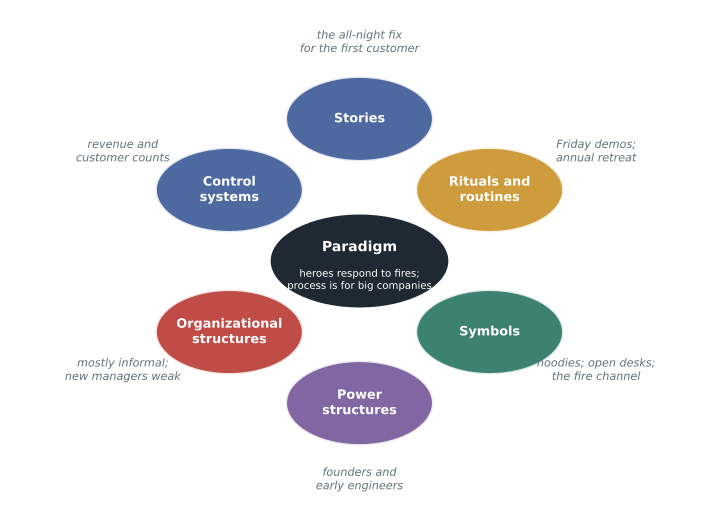
Leo's coalition fills in the web for Kestrel. The most told story is the night the founders and three engineers stayed up until dawn to fix the first customer's data feed; the customer is still Kestrel's largest. The rituals are Friday demos, where anyone shows what they built that week, and the annual retreat where the founders tell the company's story. The symbols are hoodies, the founders' open desks and a chat channel called 'fire', where urgent problems are posted and whoever answers first is a hero. Power lies with the founders and the early engineers; the newer managers have titles but little influence. The structure is mostly informal. The control systems are weak: there are few measures beyond revenue and customer counts. At the centre, the paradigm the coalition writes down is: 'heroes respond to fires; good work is fast work; process is for big companies.'
The web makes plain why a new planning process alone will not change behaviour. Every element of the web celebrates responding to fires, and nothing celebrates preventing them. The coalition needs to add to the web, not just replace the process.
How cultures form and persist
Schein argued that founders and early leaders play the decisive role in forming culture, because their beliefs shape what the group tries and their reactions shape what it learns. Research by James Baron and Michael Hannan in the Stanford Project on Emerging Companies, which followed about 200 young technology firms in Silicon Valley from the mid-1990s, supported this view. Founders' early blueprints for employment relationships, whether built around engineering challenges, stars, commitment, bureaucracy or the founder's personal control, persisted for years and predicted later outcomes. Firms that changed their blueprint experienced higher employee turnover and, in some analyses, weaker performance afterwards, suggesting that changing a culture is costly even when the new model is better suited to the company's stage. Baron and Hannan's work also found that firms founded on a commitment blueprint, emphasizing belonging and emotional attachment, were among the least likely to fail.
Cultures persist because they once worked. The assumptions that Kestrel's founders built were the right ones for a forty-person company racing to prove its product. They now feel like truths rather than choices. Schein's advice was to treat such assumptions with respect: the goal is not to condemn the old culture but to help the group see which of its assumptions still serve it and which have become obstacles.
Can culture be changed directly?
Many culture change programs begin with a new statement of values, a launch event and posters. Dr. Morin doubts the order, though not the values. He cites John Shook, who worked for Toyota during its joint venture with General Motors at the NUMMI plant in Fremont, California, which reopened in 1984 with largely the same workforce that General Motors had laid off two years earlier from one of its worst-performing plants. Within a short time the plant's quality and productivity rose to levels close to Toyota's Japanese plants. Shook wrote in a 2010 MIT Sloan Management Review article that the way to change culture is not to change how people think but to change what they do: give them new ways of working, with the training, tools and support to succeed, and their values and attitudes will follow from the experience of success. At NUMMI, the andon cord that let any worker stop the line, and the managers' response to its use, did more to change the culture than any statement.
Schein reached a compatible conclusion from a different direction. He identified six primary embedding mechanisms through which leaders shape culture: what they pay attention to, measure and control regularly; how they react to critical incidents and crises; how they allocate resources; what they deliberately role model, teach and coach; how they allocate rewards and status; and how they recruit, select, promote and remove people. Secondary mechanisms, including structure, systems, rituals, physical space, stories and formal statements, reinforce the primary ones but cannot replace them. A values statement is a secondary mechanism. If leaders' attention, reactions and promotions contradict it, the statement becomes a source of cynicism.
Microsoft offers a widely discussed example. When Satya Nadella became chief executive in 2014, he emphasized moving from a culture in which people needed to prove they knew everything to one in which they were eager to learn, drawing on the psychologist Carol Dweck's work on growth mindset. Accounts of the change stress not the slogan but the accompanying decisions: changes to performance review practices that had pitted colleagues against each other, a willingness to partner with former rivals, and leaders' visible behaviour. How much of Microsoft's later success came from culture rather than from its cloud strategy is debated, but the case illustrates that culture change is credible when decisions change with words.
Measuring culture
Culture can be studied qualitatively, through interviews, observation and the cultural web, or quantitatively, through surveys. A widely used survey framework is the competing values framework developed by Robert Quinn and John Rohrbaugh in the early 1980s and turned into the Organizational Culture Assessment Instrument by Kim Cameron and Quinn. It describes four culture types along two dimensions, flexibility versus stability and internal versus external focus: clan cultures, collaborative and family-like; adhocracy cultures, entrepreneurial and innovative; market cultures, competitive and results-driven; and hierarchy cultures, controlled and process-oriented. Respondents divide 100 points among descriptions of each type for the current culture and for the culture they would prefer. The gaps show the direction of desired change.
Leo's coalition also runs a simple gap survey: for each of six values the coalition hopes Kestrel will hold, employees rate how important the value is to them and how often they see it in practice, on a five-point scale.
# Culture diagnosis at Kestrel: competing values profile and a value gap survey
types = ["clan", "adhocracy", "market", "hierarchy"]
# average allocation of 100 points, now and preferred, by tenure group
profiles = {
    "early staff (over 3 years)": {"now": [35, 45, 15, 5], "preferred": [35, 40, 15, 10]},
    "newer staff (under 1 year)": {"now": [25, 50, 20, 5], "preferred": [30, 30, 20, 20]},
}
for group, p in profiles.items():
    gaps = [b - a for a, b in zip(p["now"], p["preferred"])]
    print(group)
    for t, a, b, g in zip(types, p["now"], p["preferred"], gaps):
        print(f"   {t:10s} now {a:3d}  preferred {b:3d}  change {g:+3d}")

# Value gap: importance minus how often it is seen (1 to 5), 140 respondents
values = {
    "help colleagues":         (4.6, 4.4),
    "ship quickly":            (4.1, 4.5),
    "keep commitments":        (4.5, 2.9),
    "know who decides":        (4.2, 2.3),
    "fix root causes":         (4.3, 2.6),
    "say no to low priorities": (3.9, 2.1),
}
print("\nvalue gaps (importance - seen), largest first")
for v, (imp, seen) in sorted(values.items(), key=lambda kv: -(kv[1][0] - kv[1][1])):
print(f" {v:26s} importance {imp:.1f} seen {seen:.1f} gap {imp - seen:+.1f}")early staff (over 3 years) clan now 35 preferred 35 change +0 adhocracy now 45 preferred 40 change -5 market now 15 preferred 15 change +0 hierarchy now 5 preferred 10 change +5 newer staff (under 1 year) clan now 25 preferred 30 change +5 adhocracy now 50 preferred 30 change -20 market now 20 preferred 20 change +0 hierarchy now 5 preferred 20 change +15 value gaps (importance - seen), largest first know who decides importance 4.2 seen 2.3 gap +1.9 say no to low priorities importance 3.9 seen 2.1 gap +1.8 fix root causes importance 4.3 seen 2.6 gap +1.7 keep commitments importance 4.5 seen 2.9 gap +1.6 help colleagues importance 4.6 seen 4.4 gap +0.2 ship quickly importance 4.1 seen 4.5 gap -0.4
The profiles show a split by tenure. Early staff are broadly content with Kestrel's adhocracy and want only a small move towards hierarchy. Newer staff want a much larger shift: less adhocracy, somewhat more clan and four times as much hierarchy as now, by which they mean clearer roles and processes. The value gaps point in the same direction. Helping colleagues and shipping quickly are seen as often as they are valued, or more. The largest gaps concern knowing who decides, saying no to low priorities, fixing root causes and keeping commitments, all of which the new operating model is meant to address. The data give the coalition a way to frame the change that respects the old culture: Kestrel is not abandoning its helpfulness or speed, which are thriving, but adding the reliability that its own people say they miss.
Leading culture change
Dr. Morin summarizes what research and experience suggest. Start from what is valuable in the existing culture and make clear that it will be kept; people defend their culture most fiercely when they feel it is being condemned. Define the few behaviours that must change, concretely: not 'be more accountable' but 'when you agree to a date, either meet it or tell the requester two days in advance'. Change the primary embedding mechanisms: what leaders attend to, how they react to incidents, what is rewarded and who is promoted. Create experiences of success with the new behaviours, as at NUMMI. Tell new stories. And expect culture change to take years, not months.
For Kestrel, the coalition chooses three behaviours: keep commitments or renegotiate early; route customer requests through the forty-eight hour decision path; and when you fix a problem, fix its cause. It changes the rituals: Friday demos will now include one 'fire prevented' each week, presented by the team that prevented it. It changes the symbols: the 'fire' channel is replaced by an incident process with a weekly review in which the founders ask what caused the problem, not who fixed it. It changes the control systems: commitments kept becomes a measure reviewed at the monthly leadership meeting. It tells a new story: the coalition asks Gus to tell, at the next all-hands meeting, how the second product team spent a third of its time last quarter fixing preventable problems, and what it built instead this quarter. And the founders agree on a hard test of their own behaviour. When a senior engineer next drops the plan to fight a fire that could have waited, they will thank her for her commitment and ask her, in front of the team, to use the decision path next time.
| Embedding mechanism (Schein) | Current signal at Kestrel | New signal |
|---|---|---|
| What leaders pay attention to | Who responded to the latest fire | Commitments kept; causes fixed |
| Reaction to crises | Praise the hero who fixed it | Thank the responder; review the cause |
| Resource allocation | Engineers pulled to urgent requests | Planned capacity for urgent work, decided weekly |
| Role modelling | Founders jump into fires | Founders use the decision path themselves |
| Rewards and status | Heroes recognized at demos | Fire prevention recognized at demos |
| Selection and promotion | Promote the fastest builders | Promote people who build and also make others effective |
Worked problem
Culture in the Prairie Ridge merger
Prairie Ridge's gas and renewables divisions have different subcultures. Gas: safety means following detailed procedures; supervisors are always present; long service is respected. Renewables: safety means empowered crews who stop work when unsure; managers coordinate remotely; problem-solving speed is respected. Should the merged organization try to create one culture?
Show solution
- Identify the shared basic assumption both subcultures can build on: everyone goes home safe, and safety outranks production.
- Accept that some differences reflect different work: gas processing hazards require strict procedures; distributed wind sites require crew judgement.
- Define a small number of shared behaviours, such as stop-work authority for everyone and joint incident reviews, rather than a full common culture.
- Use embedding mechanisms: regional directors from each division lead joint reviews, promotions recognize cross-division contributions, and stories from both divisions' safety records are told together.
- Measure over time: track near-miss reporting and cross-division collaboration on maintenance, not just attitudes.
Answer: The merged organization should aim for a shared core of values and behaviours while respecting subcultures that fit different work. Forcing a single culture would provoke the strongest resistance from the gas operators, who have the most to lose.
Common mistakes
MistakeCulture change starts with a values statement.
InsteadStatements are secondary mechanisms; leaders' attention, reactions, rewards and promotions drive culture.
MistakeThe old culture is the enemy.
InsteadCultures persist because they once worked; condemning them provokes defence. Keep what still serves.
MistakeChange minds first, then behaviour.
InsteadShook's NUMMI experience suggests changing what people do, with support to succeed, changes how they think.
MistakeOne organization should have one culture.
InsteadSubcultures often reflect different work; aim for a shared core rather than uniformity.
Summary and key terms
- Culture is a pattern of shared, learned basic assumptions that operates largely below awareness.
- Schein's three levels are artifacts, espoused values and basic assumptions; behaviour follows assumptions when they diverge from values.
- The cultural web and the competing values framework help make culture visible and measurable.
- Founders' early blueprints persist, and changing them is costly; cultures persist because they once worked.
- Culture changes mainly through leaders' primary embedding mechanisms and through new experiences of success with new behaviours.
- Basic assumptions
- Taken-for-granted beliefs that drive behaviour within a culture.
- Espoused values
- The values an organization says it holds.
- Subculture
- A distinct culture within part of an organization, often tied to occupation or site.
- Cultural web
- A model of culture as a paradigm sustained by stories, rituals, symbols, power, structures and controls.
- Competing values framework
- A model of four culture types: clan, adhocracy, market and hierarchy.
- Embedding mechanisms
- Schein’s term for the ways leaders create and reinforce culture.
Practice problems
Work each problem on paper first, then reveal the answer to check.
Give an artifact, an espoused value and a possible basic assumption from your own organization.
Show answer
For example: an open-plan office (artifact); 'we value collaboration' (espoused value); 'being seen at your desk proves commitment' (assumption).
In the code, which value has the largest gap, and what concrete behaviour would address it?
Show answer
Know who decides (gap 1.9) and say no to low priorities (1.8); publishing decision rights and using the forty-eight hour decision path addresses both.
Why might changing a founder's blueprint raise turnover?
Show answer
Employees who joined for the original model may feel the psychological contract has been broken and leave, while new practices take time to attract people suited to them.
What does the NUMMI case suggest about the order of culture change?
Show answer
Change how work is done, with support and new management responses, and attitudes follow from the experience of success.
Lesson quiz · 5 questions
Score 60% or more to complete this lesson.
Create a free account to save your progress, take quizzes and earn a certificate.