
LES-204 · Lesson 9 of 12 · 19 min
Medical risk and aftercare: positional asphyxia and acute behavioural emergencies
▶ Video coming soon A video version of this lesson is on the way.
Joan Ivey has been a paramedic for nineteen years, and she arrived at Tidewater Park about four minutes after Pelley was handcuffed. By then he was sitting up against Reyes's legs, breathing hard. 'When I got to him, his oxygen saturation was 91,' she tells the class. 'Normal is 95 or above. Five minutes later, sitting up with oxygen, he was at 97. That tells me two things. He was short of air, and getting him upright fixed it. The officers got him upright. The question I always ask is how close we came, and on this call, from what I saw on the video, the honest answer is closer than anybody should be comfortable with.'
Why restraint can kill
Every year, people die in police custody in Canada and the United States during or shortly after being restrained. Some of these deaths involve obvious trauma, but many do not. They happen to people who were held face down, often with officers' weight on their back, after a struggle, frequently while intoxicated or in a mental health crisis. In many cases the person said they could not breathe before they stopped breathing. Reviews of these deaths, in both countries, have identified a consistent set of risk factors.
| Factor | Why it matters |
|---|---|
| Prone position | Lying face down makes it harder for the chest and belly to expand |
| Weight on the back, neck or chest | Pressure further restricts breathing; a kneeling officer can apply a large share of their body weight |
| Hands restrained behind the back | Limits the person's ability to shift and lift their chest |
| Exhaustion after a struggle | The body needs more oxygen and is building up acid just when breathing is restricted |
| Stimulant drugs or alcohol | Raise heart rate, temperature and oxygen demand; increase agitation |
| Obesity | A large belly pushes against the diaphragm when lying face down |
| Illness or crisis | Heart disease, asthma, psychosis and severe agitation all add risk |
| Duration | Risk rises the longer the person is held in the position |
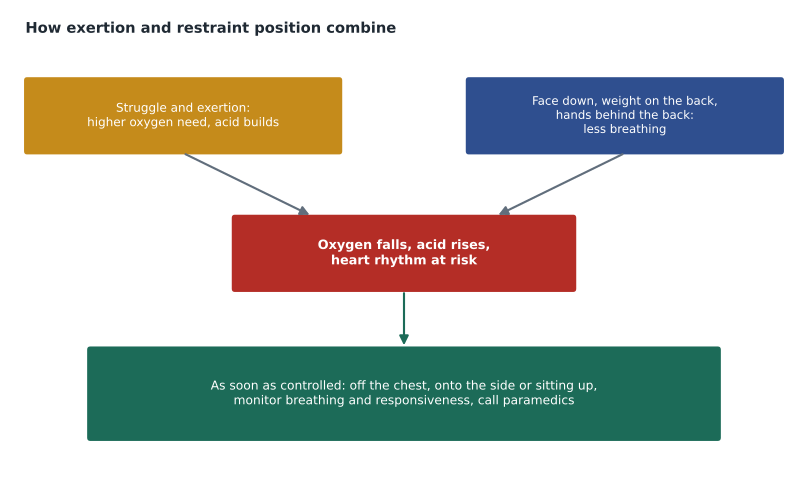
The process is often called positional or restraint asphyxia. When a person lies face down with weight on their back and their hands behind them, they cannot breathe as deeply as they need to. If they have just struggled hard, they need much more oxygen than usual, and their blood is becoming more acidic. As oxygen falls and acid builds, the heart can go into a dangerous rhythm and stop, sometimes with little warning. The research on exactly how much weight and position contribute is still debated, but the practical lesson from medical experts and from reviews of deaths is consistent: get the person off their chest and off their stomach as soon as possible after control, and watch them closely.
"If you can talk, you can breathe" is wrong
One of the most dangerous beliefs in policing is that a person who is saying 'I can't breathe' must be breathing, because they have enough air to speak. Medical experts reject this. A person can speak with very shallow breaths that do not move enough air to meet their body's needs, especially after a struggle. People who later died in restraint have often said they could not breathe minutes before they stopped breathing altogether. A person saying they cannot breathe should be treated as a medical warning, every time.
At Tidewater Park, Pelley said 'I can't breathe' twice in the forty seconds after the handcuffs went on. The second time, his voice was quieter. Ivey says that change is one of the signs she teaches officers to watch for. 'People think the danger is when someone is yelling,' she says. 'The danger is when they go quiet.'
| Sign | What officers should do |
|---|---|
| Says they cannot breathe | Move them off their chest immediately; check breathing |
| Gasping, grunting or very fast breathing | Sit them up or put them on their side; call paramedics |
| Sudden quiet or stillness after a struggle | Check responsiveness and breathing at once |
| Grey, blue or very pale lips or face | Treat as a medical emergency |
| Very hot skin, heavy sweating, confusion | Possible acute behavioural emergency; urgent paramedics |
| Loss of consciousness or no breathing | Remove handcuffs if needed for care, start CPR and use an AED |
What officers should do after control
Modern training and policy set out a clear sequence. As soon as a person is handcuffed, officers should move them off their chest, either onto their side in a recovery position or into a seated position, and keep weight off their back and neck. One officer should be assigned to watch the person's breathing, colour and responsiveness, and to keep talking to them. Paramedics should be called for anyone who has been through a significant struggle, who shows any warning sign, or who appears intoxicated or in crisis. If the person stops breathing, officers must start CPR, which may mean removing the handcuffs, and use an automated external defibrillator if one is available.
Many services now teach officers to announce key moments aloud, so that everyone involved knows the situation has changed: 'Cuffs on.' 'Rolling him.' 'He's breathing.' As lesson 6 noted, Port Ardent added the first of these to its training after Tidewater Park. The announcement serves the team as much as the person, because it breaks the task fixation described in lesson 8.
Acute behavioural emergencies and the term excited delirium
Officers sometimes meet people who are extremely agitated, confused, sweating heavily, very hot to the touch, unusually strong and apparently insensitive to pain, often after using stimulant drugs such as cocaine or methamphetamine or during a severe psychiatric crisis. These people are at high risk of sudden death, especially if they struggle hard and are restrained. For years, police training and some medical examiners described this pattern as excited delirium, and the term was used in many reports to explain deaths in custody.
The term has been heavily criticized, and major medical organizations have moved away from it. It does not appear in the main diagnostic manuals used by doctors. Critics argued that it was used to attribute deaths to the person's condition rather than to the restraint, that it was applied disproportionately to Black men, and that it encouraged officers to see agitated people as dangerous rather than as medical patients. The American Psychiatric Association said in 2020 that the term should not be used until a clear set of diagnostic criteria was validated. The American Medical Association opposed its use in 2021. In 2023, the American College of Emergency Physicians withdrew a 2009 paper that had supported the term, and the National Association of Medical Examiners said it should not be used as a cause of death. California banned the term from police reports and death certificates in 2023.
Canadian practice has moved in the same direction. Many Canadian services and medical bodies now describe such situations in terms of the underlying medical emergency, such as severe agitation, delirium or drug toxicity, and several coroner's inquests into deaths after restraint have recommended that police treat these situations as medical emergencies from the start. The firm lesson for officers does not depend on the name: a person showing these signs is in a medical emergency, needs paramedics urgently and is at serious risk from a prolonged struggle and prone restraint.
In practice, that means calling paramedics early, before going hands on if possible; using enough officers to keep any struggle short; avoiding prolonged prone restraint; and handing the person over to medical care as quickly as possible. Ivey adds that paramedics may give medication to calm a severely agitated person, and that decision belongs to paramedics and doctors, not to police.
Other injuries to check for
Breathing is the most urgent risk after a struggle, but not the only one. Falls during a struggle can cause head injuries, and a person who hit their head may seem fine at first and then become drowsy, confused or sick over the following hours, especially if they are also intoxicated. Handcuffs that are too tight or not double-locked can injure nerves in the wrist. Knees, elbows and shoulders can be strained or dislocated. People who were hit by an intermediate weapon need specific aftercare, which the less-lethal weapons course covers. Officers should ask every person after a use of force whether they are hurt, look for visible injuries, check handcuffs for fit, and make sure that injuries and complaints are passed on to paramedics, custody staff or hospital staff. Every injury, and every complaint of injury, belongs in the report.
Pelley had grass stains and abrasions on his cheek and both knees, and a red mark on his left wrist where the handcuff had been pulled tight during the struggle. Ivey noted all of them, and Malhotra photographed them at the hospital with Pelley's permission. Reyes had a bruised right hand from a kick. 'Check everyone,' Ivey says. 'Including yourselves. Adrenaline hides pain. I have treated officers who did not know they had broken a finger until the next morning.'
The legal duty of care
Officers who take a person into custody take on legal responsibility for their safety. Section 215 of the Criminal Code imposes a duty to provide the necessaries of life to a person under one's charge who is unable to withdraw from that charge, and failing in that duty can be a crime. In R. v. Nasogaluak, discussed in lesson 5, part of the Supreme Court's concern was that the officers did not tell anyone that the man had been injured, and he went without treatment for a punctured lung. Provincial policing standards and service policies require officers to obtain medical attention for anyone injured by force, and an injury or death in custody brings in oversight bodies such as Ontario's Special Investigations Unit.
Tidewater Park, second by second
Ivey and Haddad walk the class through the medical side of the call using the video. The handcuffs went on at 19:49:38. Pelley said 'I can't breathe' at about 19:49:50 and again, more quietly, at about 19:50:10. Reyes said 'Ken, off his back, roll him' at 19:50:16, and Brody's knee came off at 19:50:18. Pelley was on his side at 19:50:24 and sitting up against Reyes at 19:50:45. Malhotra requested paramedics at 19:50:30. Paramedics arrived at 19:54:10. At no point did Pelley lose consciousness.
Worked problem
How much of the medical risk window was avoidable?
Using the times above, how long after the handcuffs went on was Pelley moved onto his side, and how much of that time came after his first "I can't breathe"? If policy expects a person to be moved onto their side within about 10 seconds of handcuffing when it is safe, how many seconds over that was the actual time?
Show solution
- Handcuffs to side: 19:50:24 minus 19:49:38.
- \[24 + 22 = 46 \text{ seconds}\]
- First "I can't breathe" to side: 19:50:24 minus 19:49:50 is 34 seconds.
- Compared with the 10-second expectation:
- \[46 - 10 = 36 \text{ seconds}\]
Answer: Pelley was moved onto his side 46 seconds after handcuffing, 34 of them after he first said he could not breathe, which is about 36 seconds longer than the policy expectation. Those seconds are where the medical risk sat.
Ivey ends with what she wishes every officer knew. 'The person you have just handcuffed is now your patient as much as your prisoner,' she says. 'From that second, you are responsible for whether they keep breathing. Most of the time it takes almost nothing: roll them, sit them up, talk to them, call us. The officers who get into trouble, and the families who lose someone, are almost always on the calls where nobody did that.'
Common mistakes
MistakeIf a person can say "I can't breathe", they are breathing fine.
InsteadA person can speak without moving enough air; the statement is a medical warning every time.
MistakeA quiet, still person after a struggle has calmed down.
InsteadSudden quiet can be a sign of a medical emergency; check breathing and responsiveness.
MistakeExcited delirium is a recognized diagnosis that explains deaths in custody.
InsteadMajor medical bodies reject the term; the underlying state is a medical emergency that restraint can make worse.
MistakeMedical care is the paramedics' job, not the officers'.
InsteadOfficers have a legal duty of care from the moment a person is in custody.
Summary and key terms
- Restraint-related deaths often involve prone position, weight on the back, exertion, drugs, obesity and duration.
- After control, move the person off their chest, onto their side or sitting up, and monitor them.
- "I can't breathe" is always a medical warning; sudden quiet is a danger sign.
- Severe agitation with confusion, sweating and high temperature is a medical emergency; call paramedics early.
- Major medical organizations have rejected the term excited delirium.
- Section 215 of the Criminal Code and provincial standards create a duty of care for people in custody.
- Positional asphyxia
- Inadequate breathing caused by body position and restraint.
- Prone position
- Lying face down.
- Recovery position
- Lying on the side, with the airway open, so a person can breathe and fluids can drain.
- Acute behavioural emergency
- Severe agitation and confusion, often with high temperature, that puts a person at risk of sudden death.
- Duty of care
- The legal responsibility officers take on for the safety of a person in their custody.
Practice problems
Work each problem on paper first, then reveal the answer to check.
Name four risk factors in restraint-related deaths.
Show answer
Any four of: prone position, weight on back or neck, hands behind back, exhaustion, stimulant drugs, obesity, illness, duration.
Why is "if you can talk, you can breathe" wrong?
Show answer
A person can speak with shallow breaths that do not move enough air, especially after a struggle.
What should officers do as soon as a person is handcuffed in a prone position?
Show answer
Move them onto their side or sitting up, keep weight off them, monitor breathing and call paramedics if needed.
Why did medical bodies reject the term excited delirium?
Show answer
It is not a validated diagnosis, was used to attribute deaths to the person rather than the restraint and was applied disproportionately to Black men.
Lesson quiz · 5 questions
Score 60% or more to complete this lesson.
Create a free account to save your progress, take quizzes and earn a certificate.