
LES-204 · Lesson 3 of 12 · 20 min
De-escalation: time, distance, cover and teamwork
▶ Video coming soon A video version of this lesson is on the way.
Nine minutes after Malhotra started talking, Owen Pelley set the broken bottle down on the planter wall. Nobody had ordered him to. Malhotra had asked three times, each time with a reason, and each time Pelley had said no. The fourth time, Malhotra said, 'Owen, I'd really like to get you to your sister's place tonight. I can't do that while you're holding that. Can you put it on the wall and step back to the bench?' Pelley looked at the bottle for a long moment, put it down and sat on the bench. Reyes moved quietly to stand between him and the wall. 'That,' Haddad tells the class, 'is de-escalation working. Not magic. Not one perfect sentence. Nine minutes of patience, a reason that mattered to him, and nobody rushing.'
What de-escalation is
De-escalation means actions taken to stabilize a situation and reduce its intensity, so that officers have more time, more options and more resources, and so that force becomes less likely or less severe. It is not a single technique, and it is not the same as being soft. It combines communication, which lesson 2 covered, with tactics: how officers use time, distance, cover, position and teamwork to keep a situation from getting worse while they work on making it better.
De-escalation does not mean that officers must never use force, or that they must keep talking while someone is being hurt. When a person is attacking someone, the priority is to stop the attack. But most tense situations police meet are not like that. They involve a person who is upset, intoxicated, in crisis or holding something dangerous but not actively attacking anyone. In those situations, the officer often has more time than it feels like, and using that time well is the single biggest factor in avoiding force.
Time, distance and cover
Three resources sit at the centre of most de-escalation training. Time lets arousal fall, lets the officer gather information, lets more officers and specialists arrive and lets the person make a decision for themselves. Distance gives the officer time to react to a sudden movement and gives the person space so they do not feel cornered. Cover, meaning an object that would stop or slow an attack, such as a vehicle, a wall or a counter, lets the officer stay safe while staying in the conversation. The three work together. Distance creates time. Cover makes it safe to keep the distance. Time allows the conversation that lowers the risk.
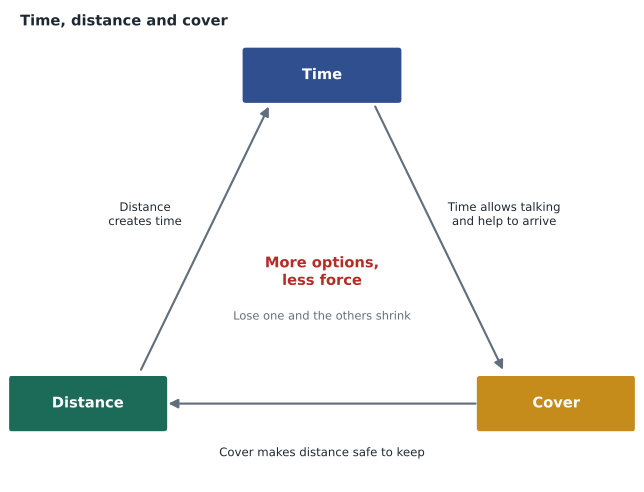
At Tidewater Park, the officers used all three. Malhotra stood about seven metres from Pelley with the planter wall between them, which was both distance and partial cover. Brody asked transit to hold buses at the near stop and moved waiting passengers back, which removed people Pelley might have lunged at and took away a reason to hurry. And Malhotra asked dispatch for the mobile crisis team in his first minute on scene, knowing it would take a while to arrive. 'Every one of those decisions bought time,' Haddad says. 'Time is what let Owen put the bottle down on his own.'
The opposite pattern is sometimes called officer-created jeopardy: an officer moves close to a person with a weapon, often to give commands or to try to grab the weapon, and in doing so loses distance, cover and time. If the person then moves toward them, the officer is left with no option but a high level of force, sometimes lethal force, in a situation that did not need to become dangerous. Reviews of police shootings of people in crisis, in both Canada and the United States, have repeatedly identified this pattern.
The tactical pause and repositioning
When a situation is not improving, de-escalation training encourages officers to take a tactical pause: stop, step back if safe to do so, and reassess. Repositioning, which means moving to a place with more distance or better cover, is treated as a legitimate tactic, not as retreat or failure. Many force models, including the Canadian National Use of Force Framework covered in lesson 6, list tactical repositioning as an option at every level. An officer who steps back to a better position and keeps talking has not given up control of the situation. They have kept it.
| Question | Why it matters |
|---|---|
| Is anyone in immediate danger right now? | If not, there is usually time to slow down |
| Do I have enough distance and cover? | If not, reposition before anything else |
| Who is talking, and is it working? | Consider switching the contact officer or changing approach |
| What resources are on the way or could be? | Crisis worker, supervisor, more officers, interpreter, family |
| What does the person want? | Their goal is often the key to cooperation |
| What is my plan if the person moves suddenly? | Every officer should know their role |
Teamwork
De-escalation is easier with more than one officer, but only if the officers work as a team. Lesson 2 introduced contact and cover roles. As more officers arrive, the team can add roles: someone to manage bystanders and traffic, someone to talk with dispatch and incoming units, and someone ready with a less-lethal option if one is needed later. Each officer should know their role and stay in it, and the team should agree on a plan for what to do if the person moves suddenly, attacks or tries to leave.
Teams also need to manage the urge to act. When several officers are standing around a person who is not complying, the pressure to 'do something' builds, especially as time passes and onlookers gather. Supervisors play a key role in relieving that pressure by confirming that slowing down is the right decision. At Tidewater Park, Haddad came on the radio at minute six. 'Dev, you're doing fine. Crisis is ten out. Take all the time you need.' Malhotra told the class later that hearing that made a real difference.
A decision model for de-escalation
The ICAT curriculum teaches a decision model called the Critical Decision-Making Model, adapted from a model used in the United Kingdom. It has five steps arranged in a circle around a core of ethics, values, proportionality and the sanctity of life: collect information; assess the situation, threats and risks; consider police powers and agency policy; identify options and choose the best course of action; and act, review and reassess. The circle shape is the point. Officers are expected to go around it again and again as the situation changes, not to make one decision at the start and stick to it.
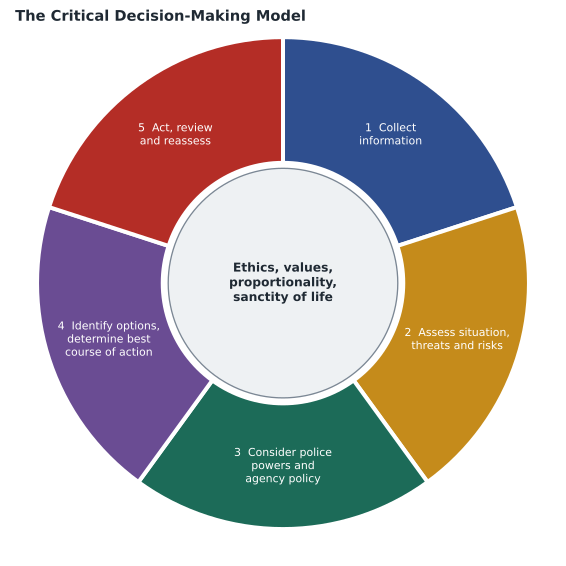
Applied to Tidewater Park, the first loop sounded like this. Information: a man in crisis, a broken bottle, passengers nearby, the crisis team known to him. Threats and risks: the bottle could injure someone at close range; the passengers and traffic are at risk; Pelley himself is at risk. Powers and policy: no offence yet that requires an immediate arrest; a possible mental health apprehension if he poses a danger to himself or others. Options: talk, contain, clear the area, call crisis, wait; or close in and take the bottle. Best course: talk and contain, because no one is being attacked. Act, then reassess every minute or two. By minute nine, the loop had changed because the bottle was down.
Does de-escalation training work?
For years, there was little research on whether de-escalation training actually reduces force. That has changed. The best-known study, by Robin Engel and colleagues at the University of Cincinnati, evaluated ICAT training in the Louisville Metro Police Department in Kentucky and published its results in 2022. After officers were trained, use-of-force incidents fell by about 28 in every 100, injuries to members of the public by about 26 in every 100 and injuries to officers by about 36 in every 100, compared with the period before training. Other studies have found smaller or mixed effects, and researchers stress that training works best when it is supported by policy, supervision and repeated practice. In Canada, several provinces and services have built de-escalation into their basic and annual training, and coroner's inquests into deaths of people in crisis have repeatedly recommended more of it.
Worked problem
What a reduction of 28 in every 100 means for one service
Port Ardent recorded 246 use-of-force incidents in 2024. If de-escalation training produced the same reduction as in Louisville, about 28 in every 100, how many incidents would the service expect the following year, assuming the same number of calls?
Show solution
- Expected reduction:
- \[246 \times 0.28 \approx 68.9\]
- Round to 69 fewer incidents.
- \[246 - 69 = 177\]
Answer: About 177 incidents, or about 69 fewer than before. If officer injuries fell by about 36 in every 100 as well, the savings in time off work alone would be large.
Haddad adds a caution. 'The study measured trained officers who were then supervised to use the training,' she says. 'A one-day course with no follow-up does not get you those numbers. Supervisors have to back it up on every call, the way I tried to on the radio at Tidewater Park.'
De-escalation in law and policy
Canadian law does not contain a separate rule that officers must de-escalate before using force. But the question under section 25 of the Criminal Code is whether the force was necessary and reasonable in all the circumstances, and courts, coroners and oversight bodies such as Ontario's Special Investigations Unit look at what the officers did before the force, including whether they gave up distance, rushed the person or ignored chances to slow down. Most Canadian services now require de-escalation in their use-of-force policies, and many inquests into deaths of people in crisis have recommended that services strengthen that requirement and train for it every year.
What these sources have in common is that an officer's earlier choices count. An officer who keeps distance, calls for help and keeps talking has a much stronger position when force later becomes necessary than one who closed in, shouted and left themselves no options.
What gets in the way
Officers know most of this, and it still does not always happen. Common barriers include pressure from a busy call queue, the belief that waiting looks weak, impatience after a long shift, a crowd filming and shouting, and a culture in which officers who use force quickly are admired. Supervisors and experienced officers can change that culture by praising slow, patient calls as loudly as they praise quick arrests. Haddad keeps a short list of calls her platoon resolved without force and reads one out at every briefing.
When de-escalation is not enough
De-escalation does not always work, and officers are not to blame simply because a person chose to keep resisting or attacked anyway. What the law and good practice ask is that officers make reasonable efforts to de-escalate where it is safe and feasible to do so, and that they continue to look for chances to de-escalate even after force begins. At Tidewater Park, the bottle came down, but when the crisis worker arrived and Pelley realized he might be taken to hospital, he became agitated again and started walking quickly toward the traffic on Harbour Street. Lessons 4 and 5 cover what the officers could lawfully do at that point and why.
Common mistakes
MistakeDe-escalation means officers must keep talking even while someone is being hurt.
InsteadWhen someone is being attacked, stopping the attack comes first; de-escalation applies where there is time.
MistakeStepping back from a person is retreating and losing control.
InsteadTactical repositioning is a legitimate option that preserves time, distance and control.
MistakeA decision made at the start of a call should be followed through.
InsteadOfficers should reassess continually as the situation changes.
MistakeA single de-escalation course is enough to reduce force.
InsteadTraining works best with policy, supervision and repeated practice.
Summary and key terms
- De-escalation stabilizes a situation to gain time, options and resources and to reduce the need for force.
- Time, distance and cover support each other and are the core resources of de-escalation.
- Officer-created jeopardy happens when officers give up distance and cover and leave themselves no options.
- A tactical pause and repositioning are legitimate tactics, not failures.
- The Critical Decision-Making Model is a loop: collect, assess, consider powers and policy, choose, act and reassess.
- Courts, oversight bodies and agency policies look at the officer's choices before force, not only the final seconds.
- Research on ICAT in Louisville found large reductions in force and injuries after training supported by supervision.
- De-escalation
- Actions to stabilize a situation and reduce its intensity so that force becomes less likely or less severe.
- Cover
- An object that would stop or slow an attack, such as a vehicle or wall.
- Officer-created jeopardy
- A situation in which an officer's own tactics remove their options and leave only a high level of force.
- Tactical repositioning
- Moving to a position with more distance or better cover.
- Critical Decision-Making Model
- A five-step decision loop taught in ICAT training, centred on ethics, proportionality and the sanctity of life.
Practice problems
Work each problem on paper first, then reveal the answer to check.
How did the officers at Tidewater Park create time?
Show answer
Distance and the planter wall, holding buses and moving passengers back, and calling the crisis team early.
What is officer-created jeopardy?
Show answer
When an officer gives up distance, cover and time, for example by moving close to an armed person, and is left with only high-level force.
Name the five steps of the Critical Decision-Making Model.
Show answer
Collect information; assess situation, threats and risks; consider powers and policy; identify options and choose; act, review and reassess.
A service with 300 force incidents achieves a reduction of 20 in every 100. How many incidents remain?
Show answer
300 times 0.20 is 60, so 240 incidents remain.
Why do an officer's choices before force matter legally?
Show answer
Courts, coroners and oversight bodies look at the whole situation, including whether the officer gave up distance or ignored chances to slow down.
Lesson quiz · 5 questions
Score 60% or more to complete this lesson.
Create a free account to save your progress, take quizzes and earn a certificate.