
LES-204 · Lesson 11 of 12 · 20 min
Reporting, review, oversight and officer wellness
▶ Video coming soon A video version of this lesson is on the way.
Malhotra wrote his use-of-force report at 01:40 the next morning, after taking Pelley to Port Ardent General and handing him over to the emergency department. It was two pages long. Reyes's was a page and a half. Brody's first version was four lines: 'Subject resisted apprehension. Subject taken to ground. I assisted with control by applying body weight to the subject's upper back. Subject handcuffed without further incident.' Haddad sent it back. 'Every sentence in it is true,' she tells the class. 'And it tells me nothing. It doesn't say what Owen was doing, why Ken chose that, how long it lasted, what Owen said, or what happened next. A reviewer reading it would have no idea that the most important forty seconds of the call were in that third sentence.'
Why reporting matters
Use-of-force reports serve several purposes at once. They are the officer's account of what they did and why, which protects the officer if the force was justified. They give supervisors the information they need to review the incident, catch problems and support the officers. They feed data systems that allow services to see patterns: which call types lead to force, which units or officers use force more often, which techniques cause injuries. And they are part of the public record that allows communities, oversight bodies and courts to hold the police accountable. A report that is vague, late or incomplete fails at all of these.
When a report is required
Provincial law and service policy set out when a report is required. In Ontario, regulations under the Community Safety and Policing Act require a use-of-force report when, for example, an officer uses physical force on a person that results in an injury requiring medical attention, uses a weapon other than a firearm on a person, draws a handgun in the presence of a member of the public, points a firearm at a person or discharges a firearm. Since 2020, Ontario's reports have also recorded the officer's perception of the race of the person involved, under the province's anti-racism data standards. Many services require reports for lower levels of force as well, such as any grounding or any pointing of a conducted energy weapon.
| Element | Question it answers | Brody's first version |
|---|---|---|
| Authority | What lawful power was being exercised? | Implied only |
| What the person did | Specific actions, words and threats, in order | "Resisted apprehension" |
| What the officer perceived | What the officer saw and heard, and what they believed | Missing |
| What the officer did | Each type of force, with its purpose | "Applying body weight to the upper back" |
| Why lesser options would not work | Options considered and why they were rejected | Missing |
| Duration and changes | How long each force lasted and when it stopped | Missing |
| Injuries and aid | Injuries to anyone, complaints, medical care | "Without further incident" |
| Others present | Officers, witnesses, cameras | Missing |
Haddad points out that 'without further incident' was not just vague but wrong: Pelley said twice that he could not breathe, Reyes intervened and paramedics found his oxygen low. Brody's second report, written after he watched the video and spoke with his association representative, described the knee, its duration, Pelley's words and Reyes's intervention, and said that he had not heard Pelley at the time. 'That report helped Ken,' Haddad says. 'It was honest, it explained what happened in his head, and it matched the video. The first one would have hurt him badly.'
Avoiding boilerplate
Officers often fall back on stock phrases, such as 'the subject became combative', 'the subject made a furtive movement' or 'minimal force was used to gain control'. These phrases summarize a conclusion instead of describing facts, and they appear so often that reviewers and courts give them little weight. Worse, when a stock phrase does not match the video, the officer's credibility suffers. Good reports describe behaviour in plain words: 'He pulled his right arm free and kicked at Constable Reyes's legs twice.' Lesson 8 explained why officers should mark estimates as estimates and separate what they perceived from what they assume.
Supervisor and service review
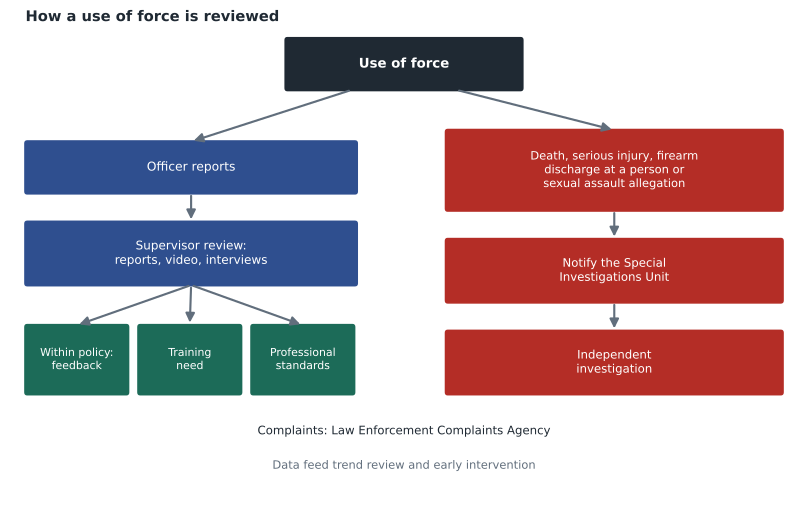
Every use-of-force report should be reviewed by a supervisor, usually within the same shift or the next. The supervisor reads the reports, watches the video, speaks with the officers and, where appropriate, with the person and witnesses, and decides whether the force was within law and policy. Most reviews find that it was, and the review ends with feedback and, sometimes, praise. Where there are concerns, the review may lead to additional training, a referral to professional standards for investigation, or both. Many services also have a use-of-force review committee that looks at trends and at serious or unusual incidents.
Data from reports feed early intervention systems, which flag officers who have an unusual number of force incidents, complaints or injuries compared with peers doing similar work. A flag is not a finding of misconduct. It is a signal for a supervisor to look more closely and, often, to offer support, training or a change of assignment before problems grow.
What Haddad's review found
Haddad's supervisor review of Tidewater Park ran to six pages. She watched all three body-worn camera videos, read the reports, spoke with each officer, with Kerr and with Ivey, and, a week later, with Pelley himself, who agreed to meet her at his sister's apartment. Her findings fell into three groups.
| Area | Finding | Action |
|---|---|---|
| De-escalation | Strong: distance, cover, one voice, early crisis request, patient conversation | Commendation for Malhotra; used in training |
| Handover | No plan agreed with the crisis worker before the hospital was raised | New guidance on handover planning |
| Closing distance | Necessary but unplanned; no roles agreed | Scenario added to requalification |
| Apprehension and grounding | Within law and policy | None |
| Weight after handcuffing | About 40 seconds of weight on the upper back after handcuffing, during two statements of "I can't breathe"; outside policy | Additional training for Brody; review committee referral |
| Intervention | Prompt, clear verbal intervention by Reyes | Formal recognition |
| Aftercare and explanation | Medical care good; little explanation to Pelley at the scene | Reminder to platoon on explaining after force |
| Reporting | One report incomplete on first submission | Returned and corrected |
Haddad's meeting with Pelley was not required by policy. She asked for it because, as she tells the class, nobody had explained to him what happened or why. 'He remembered the knee and he remembered not being able to breathe,' she says. 'He didn't remember the bottle or the curb. From where he was, the police had grabbed him for no reason and nearly smothered him. I explained the traffic, apologized for the forty seconds and told him what we had changed. I don't know if it fixed anything. But he took the complaint information, and his sister said afterward that the meeting was the first time anyone had treated them like people in all of this.'
Using data to check for fairness
Force data are also used to ask whether force falls unevenly on different groups. Services that record the perceived race, gender, age and mental health status of the people involved can compare their share of force incidents with their share of the population or of police contacts. Differences do not by themselves prove bias, because many factors affect who police meet and in what circumstances, but large and persistent differences call for explanation. Services that take the question seriously publish their data, invite independent analysis, and look at specific practices, such as which calls lead to firearms being pointed, to see where change could make a difference.
Independent oversight
The most serious incidents go outside the service. In Ontario, the Special Investigations Unit, a civilian agency created in 1990, investigates incidents involving officers that result in death or serious injury, the discharge of a firearm at a person or an allegation of sexual assault. The service must notify the SIU immediately, and the SIU decides whether its mandate applies. The SIU director decides whether there are reasonable grounds to believe an officer committed a criminal offence and, if so, lays charges. Other provinces have similar bodies, such as British Columbia's Independent Investigations Office and Alberta's Serious Incident Response Team. Complaints from the public about officer conduct in Ontario go to the Law Enforcement Complaints Agency, which replaced the Office of the Independent Police Review Director in 2024.
The Tidewater Park call did not fall within the SIU's mandate, because Pelley's injuries, abrasions and a sore wrist, were not serious injuries. It was reviewed internally by Haddad and then, because of the restraint issue, by the service's use-of-force review committee. Pelley's sister later filed a complaint with the Law Enforcement Complaints Agency, which was resolved after the service shared what it had changed.
Video and transparency
Body-worn cameras have changed reporting and review. Video lets supervisors see what happened, protects officers against false complaints and gives the public evidence it can trust. It also has limits: cameras miss things outside their field of view, do not record what the officer perceived, and can make events look different from how they felt. Services have policies on when cameras must be on, how long video is kept and when it is released to the public. Many now release video of serious incidents within a set time, unless an investigation requires otherwise.
Officer wellness after force
Officers involved in force incidents, especially serious ones, can experience strong reactions: replaying the event, trouble sleeping, irritability, guilt, anxiety about the investigation and, sometimes, symptoms of post-traumatic stress. Reactions often start hours or days later. Being under investigation, even when the force was justified, adds stress. Good services treat officer wellness as part of the response to force, not an afterthought.
Common supports include a check-in from a supervisor after any significant force incident, peer support teams of trained officers, confidential access to psychologists and employee assistance programs, and time off when needed. In Ontario, workplace insurance law has since 2016 presumed that post-traumatic stress disorder in first responders, including police officers, is work-related, which makes it easier for officers to get support. Brody asked to speak with the service's peer support team after the review. Reyes, who had never before intervened against a colleague, did too.
Wellness also has a practical side for the next call. An officer who has just been through a struggle, an intervention or a near miss may be shaken, injured or still running on adrenaline. Supervisors should ask whether the officer is fit to return to the street, give them time to write their report somewhere quiet, and make sure they get something to eat. Haddad kept Brody and Reyes off calls for the rest of the shift after Tidewater Park. 'Not as a punishment,' she says. 'Because neither of them was going to make good decisions for the next few hours, and they both knew it.'
Families are affected too. Officers often do not talk at home about serious incidents, either to protect their families or because they do not know how. Many peer support programs now include information sessions for partners and family members, so that they know what reactions to expect and where to find help.
Worked problem
Reading an early intervention flag
Port Ardent's early intervention system flags any patrol officer whose force reports in 12 months exceed twice the platoon average. B platoon's 14 patrol officers filed 63 force reports in the past year. One officer filed 11. Is that officer flagged?
Show solution
- Platoon average:
- \[63 \div 14 = 4.5\]
- Threshold: twice the average.
- \[2 \times 4.5 = 9\]
- The officer filed 11, which is above 9.
Answer: Yes. The officer is flagged for a supervisor to review. The flag is not a finding of misconduct; the officer may work a busier area, and the review should look at the calls behind the numbers.
Common mistakes
MistakeA short report protects an officer because it gives critics less to work with.
InsteadA detailed, honest report that matches the video protects officers; vague reports damage credibility.
MistakeStock phrases such as "became combative" are good enough.
InsteadReports should describe specific actions in plain words.
MistakeEvery use of force goes to the Special Investigations Unit.
InsteadThe SIU's mandate covers death, serious injury, firearm discharges at people and sexual assault allegations.
MistakeAn early intervention flag means the officer did something wrong.
InsteadIt is a signal for a closer look and often for support.
Summary and key terms
- Reports explain the officer's actions, support review, feed data systems and support public accountability.
- Ontario regulations require reports for injuries requiring medical attention, weapons, drawing or pointing firearms and discharges.
- Strong reports describe authority, behaviour, perception, actions, options, duration, injuries and witnesses.
- Supervisors review every report; data feed review committees and early intervention systems.
- The SIU investigates deaths, serious injuries, firearm discharges at people and sexual assault allegations.
- Officer wellness, including check-ins and peer support, is part of the response to force.
- Use-of-force report
- An officer's written account of force used, required by law or policy.
- Boilerplate
- Stock phrases that state conclusions instead of describing facts.
- Early intervention system
- A system that flags officers with unusual numbers of force incidents or complaints for review and support.
- Independent investigation
- An investigation by a body outside the service, such as Ontario's Special Investigations Unit.
- Peer support
- Trained officers who offer confidential support to colleagues after difficult incidents.
Practice problems
Work each problem on paper first, then reveal the answer to check.
What were the main problems with Brody's first report?
Show answer
It omitted what Pelley did and said, Brody's perception, duration, options considered, injuries and Reyes's intervention, and "without further incident" was wrong.
Rewrite "the subject became combative" as a factual description.
Show answer
For example: "He pulled his right arm free and kicked at Constable Reyes's legs twice."
Why did the Tidewater Park call not go to the SIU?
Show answer
Pelley's injuries were not serious injuries, and no firearm was discharged.
Why did Haddad meet with Pelley?
Show answer
Nobody had explained to him what happened or why; she explained, apologized for the forty seconds and told him what had changed.
A platoon of 12 files 54 reports. Is an officer with 10 over twice the average?
Show answer
The average is 4.5 and twice that is 9, so yes, 10 is over the threshold.
Lesson quiz · 5 questions
Score 60% or more to complete this lesson.
Create a free account to save your progress, take quizzes and earn a certificate.