
LES-204 · Lesson 2 of 12 · 20 min
Conflict and tactical communication
▶ Video coming soon A video version of this lesson is on the way.
Desjardins plays the first ninety seconds of Malhotra's body-worn camera footage from Tidewater Park with the sound turned up. Pelley is shouting, mostly about a bus driver who would not let him board and about people who were 'following' him. He waves the neck of a broken bottle as he talks. Malhotra stops about seven metres away, beside the low concrete wall of a planter, and the first thing he says is not a command. 'Hey, I'm Dev. I'm with the police. Looks like tonight has gone pretty badly for you. What's your name?' Pelley stops waving the bottle for a moment and looks at him. 'Owen,' he says. 'Okay, Owen,' Malhotra says. 'I'm going to stay right here. Tell me what happened with the bus.'
Desjardins pauses the video. 'He has not solved anything yet,' he says. 'Owen still has the bottle, and he is still angry. But in ten seconds Dev has done four things. He introduced himself, he named what he could see without judging it, he got Owen's name, and he told him what he, Dev, was going to do. Every one of those is a technique, and every one of them lowers the temperature. This lesson is about why.'
How conflict escalates
Most of the people police meet in tense situations are not planning to fight. They are frightened, angry, embarrassed, intoxicated, in pain or in crisis, and often several of these at once. When people are highly aroused, the parts of the brain that handle planning, language and judgment work less well, and the parts that handle threat and self-protection take over. A person in that state hears commands less clearly, takes in less information and reacts faster to anything that looks like a threat, including an officer moving closer, raising their voice or reaching for them.
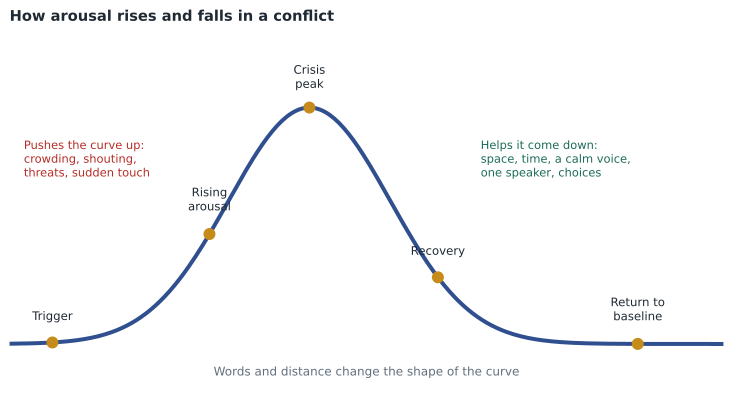
Conflict tends to escalate in a cycle. Something triggers the person, such as being refused service, being accused or being touched. Their arousal rises. If the people around them respond with threats, crowding or shouting, it rises further, until the person either backs down, flees or fights. Officers are part of this cycle whether they want to be or not. The officer's tone, distance, posture and choice of words either add to the person's arousal or help bring it down. Tactical communication is the set of skills officers use to bring it down on purpose.
What tactical communication is
Tactical communication means using words, tone and body language deliberately to gain voluntary cooperation, reduce the chance of violence and gather information. It is called tactical because it serves the officer's goals on the call, not just politeness. The best-known training programs include Verbal Judo, developed by George Thompson in the 1980s, and later programs such as the Integrating Communications, Assessment, and Tactics (ICAT) curriculum published by the Police Executive Research Forum in 2016. They share a small set of core ideas.
| Idea | What it means | Tidewater Park example |
|---|---|---|
| Introduce and explain | Say who you are and what you are doing | "I'm Dev. I'm with the police. I'm going to stay right here." |
| Listen first | Let the person talk before trying to solve anything | Malhotra let Pelley describe the bus for almost two minutes |
| Name the emotion | Say what you see, without judging it | "Looks like tonight has gone pretty badly for you." |
| One voice | Only one officer talks to the person at a time | Reyes stayed quiet and watched; Brody spoke only to dispatch |
| Explain the why | Give a reason when asking for something | "Can you put the bottle on the wall? Then nobody gets nervous and we can just talk." |
| Offer choices | Give real options within safe limits | "You can sit on the wall or stand, whatever is easier." |
| Keep promises | Never promise what you cannot deliver | Malhotra did not promise Pelley he could leave |
Listening as a tool
Most new officers want to talk too much. Listening feels passive, but it does three things that talking cannot. It lets the person vent, which on its own often lowers arousal. It tells the officer what the person cares about, which is the key to any later request. And it buys time, which is the most valuable resource on almost any tense call. Lesson 3 covers time in detail.
Active listening has a few simple techniques. Minimal encouragers, such as 'okay', 'mm-hm' and 'go on', show the person they are being heard. Paraphrasing repeats the content back in the officer's own words: 'So the driver wouldn't let you on, and you'd been waiting forty minutes.' Emotional labelling names the feeling: 'That sounds really frustrating.' Open questions, such as 'What happened next?', invite the person to keep talking, while closed questions, such as 'Have you been drinking?', get specific facts. Silence, used well, gives the person room to fill it. These techniques are the first steps of the Behavioral Change Stairway used by crisis negotiators, which students will meet again in the high-risk calls course.
At Tidewater Park, Pelley told Malhotra three things in his first two minutes of talking that shaped the rest of the call. He had not slept for two days. He believed people at the terminal were following him. And he wanted to get to his sister's apartment on Ferry Road. Malhotra did not argue with the belief that he was being followed. He said, 'That sounds scary. I don't see anyone following you right now, but I believe it feels that way.' The sister's apartment became the thing Malhotra could offer later.
Words that make things worse
Some of the most common phrases in policing tend to escalate conflict. 'Calm down' is the best-known example: it tells the person their feelings are wrong, and almost nobody calms down because they are told to. 'Because I said so', 'You need to...' and 'What's your problem?' sound like challenges. Swearing at a person, mocking them or threatening consequences that the officer has no intention of carrying out all damage credibility. Commands shouted by several officers at once are among the worst, because the person cannot follow conflicting instructions even if they want to.
| Instead of | Try |
|---|---|
| "Calm down!" | "I can see you're upset. Talk to me." |
| "Drop it now or else!" (shouted by several officers) | One officer: "Put the bottle on the wall for me, please, so we can talk." |
| "Because I said so." | "Here's why I'm asking..." |
| "You're not going anywhere." | "I can't let you walk into the road. Let's figure out how to get you to your sister's." |
| "What's wrong with you?" | "What's going on tonight?" |
None of this means officers should never give commands. When a person is about to hurt someone, a short, loud, clear command may be exactly right. The skill is in matching the communication to the situation: conversation when there is time, firm and simple directions when there is not, and a return to conversation as soon as the danger passes.
Body language, distance and position
Much of what a person in crisis takes in is not the officer's words but their body. An officer who stands square on, close, with hands on their belt and a hard stare looks like a threat, whatever they are saying. An officer who stands at an angle, at a distance that gives the person space, with open hands visible and a relaxed face looks less threatening, while still being in a position to react. Moving slowly and announcing movements ('I'm just going to take a step back here') prevents surprises.
Distance is both a communication tool and a safety tool. The officer needs enough space that the person does not feel crowded and the officer has time to react if the person moves suddenly, but not so much that conversation becomes shouting. At Tidewater Park, Malhotra stayed about seven metres from Pelley, with a planter wall between them, which gave him time to react to the bottle and let him talk at a normal volume. Lesson 3 covers distance, cover and time together as the core of de-escalation, and lesson 7 covers distance and position as defensive tactics principles.
Contact and cover
On calls with more than one officer, teams commonly split two roles. The contact officer does the talking and builds the relationship. The cover officer stays quiet, watches the person's hands and surroundings, manages bystanders and is ready to act if needed. Splitting the roles keeps one voice and frees one officer to think about safety while the other thinks about the conversation. Roles can be swapped if the person responds better to the other officer, but the switch should be made on purpose and announced: 'Owen, this is Sofia. She's going to talk with you for a bit.'
At Tidewater Park, Reyes took the cover role without being asked, standing about four metres to Malhotra's left, where she could see Pelley's hands and the bus shelter. When Brody arrived, Malhotra asked him over the radio to keep the gathering passengers back and to ask transit to hold buses on the near stop. 'The best thing Ken did in the first ten minutes,' Haddad says, 'was not talk to Owen. A third voice would have undone everything Dev was building.'
Worked problem
How long does talking take compared with waiting for help?
The mobile crisis team tells dispatch it is 14 minutes away. Malhotra has been talking with Pelley for 5 minutes. If the team arrives on time, how many more minutes must the officers keep the conversation going, and what share of the total time on scene before the team arrives will be conversation if the officers arrived 4 minutes after the 911 call and the team was requested 1 minute after they arrived?
Show solution
- The team was requested 1 minute after arrival and is 14 minutes away, so it arrives 15 minutes after the officers.
- Conversation has lasted 5 minutes, so it must continue for:
- \[15 - 5 = 10 \text{ minutes}\]
- If Malhotra started talking about 1 minute after arrival, the conversation fills 14 of the 15 minutes on scene before the team arrives.
- \[14 \div 15 \approx 0.93\]
Answer: About 10 more minutes of conversation, so roughly 93 in every 100 minutes on scene before the crisis team arrives are spent talking. Tactical communication is not a prelude to the call; it usually is the call.
Communicating with people who may not understand
Some people cannot respond to ordinary communication, however skilled. People who are deaf or hard of hearing may not hear commands. People who do not speak the local language well may not understand them. People with developmental disabilities, autism, dementia or brain injuries may need simpler words, more time or visual cues. People in psychosis may be responding to voices the officer cannot hear. Intoxicated people may not process complex instructions. Lesson 4 covers these situations, which are among the most common reasons people fail to comply with commands without any intention of resisting.
The practical rule is that a failure to comply is information, not proof of defiance. Before treating non-compliance as resistance, officers should ask whether the person heard, understood and was able to do what was asked. Shorter sentences, one instruction at a time, gestures, an interpreter, a family member or simply more time often solve the problem.
Communication does not stop when force starts
Communication remains important during and after any use of force. During a struggle, short, consistent directions tell the person exactly what will make the force stop: 'Stop pulling. Put your hands behind your back. Good, that's it.' Acknowledging compliance the moment it happens, and easing off as soon as it does, teaches the person that cooperation works. After force, officers should explain what happened and why, ask about injuries, and keep talking in a calm voice. People remember how they were spoken to after a struggle at least as clearly as the struggle itself, and so do the witnesses filming on their phones. At Tidewater Park, as lesson 12 shows, this was the part of the call the officers did least well.
Common mistakes
Mistake"Calm down" is a good first thing to say.
InsteadNaming the emotion and inviting the person to talk usually works better.
MistakeAll officers on scene should give commands so the person knows they are serious.
InsteadOne voice at a time; multiple speakers confuse people and raise arousal.
MistakeListening wastes time on a dangerous call.
InsteadListening lowers arousal, gives information and buys time, which is usually the officer's best resource.
MistakeA person who does not follow commands is resisting.
InsteadNon-compliance may come from not hearing, not understanding or not being able to comply.
Summary and key terms
- High arousal reduces a person's ability to process words and increases reactions to perceived threats.
- Tactical communication uses words, tone and body language to gain cooperation and reduce violence.
- Core ideas: introduce and explain, listen first, name emotions, use one voice, explain why, offer choices and keep promises.
- Active listening uses encouragers, paraphrasing, emotional labelling, open questions and silence.
- Distance and body position communicate as much as words and also give officers time to react.
- Contact and cover roles keep one voice and free one officer to watch for danger.
- Tactical communication
- Deliberate use of words, tone and body language to gain cooperation and reduce violence.
- Active listening
- Listening techniques that show understanding and encourage a person to keep talking.
- Emotional labelling
- Naming the emotion a person appears to feel, without judging it.
- Contact officer
- The officer who talks with the person.
- Cover officer
- The officer who watches for danger and manages the surroundings while the contact officer talks.
Practice problems
Work each problem on paper first, then reveal the answer to check.
What four things did Malhotra do in his first ten seconds with Pelley?
Show answer
He introduced himself, named what he saw, asked Pelley's name and said what he was going to do.
Give a better alternative to "Calm down!"
Show answer
For example: "I can see you're upset. Talk to me."
Why should only one officer speak to the person?
Show answer
Several voices give conflicting instructions, confuse the person and raise arousal.
What should an officer ask before treating non-compliance as resistance?
Show answer
Whether the person heard, understood and was able to do what was asked.
Lesson quiz · 5 questions
Score 60% or more to complete this lesson.
Create a free account to save your progress, take quizzes and earn a certificate.