
LES-204 · Lesson 8 of 12 · 21 min
Perception, stress and decisions under pressure
▶ Video coming soon A video version of this lesson is on the way.
In his interview for the review, Ken Brody said something that surprised the students when Haddad read it out. 'I didn't hear him say he couldn't breathe,' Brody said. 'I've watched the video. I can hear it on the video, twice. I believe it's there. But I didn't hear it at the time. What I heard was Sofia saying my name.' Brody had been about forty metres away at the bus shelter when the struggle started. He ran to it, saw his two colleagues on the ground with a man who was kicking, and went straight in. His heart rate, recorded by the fitness watch he wore, went from 88 to 171 beats a minute in under twenty seconds.
'Nobody in this room is immune to what happened to Ken,' Desjardins says. 'This lesson is about how stress changes what officers see, hear, remember and decide, and what training and teamwork can do about it. It does not excuse what happened. It explains it, so that you can prepare for it.'
The body under threat
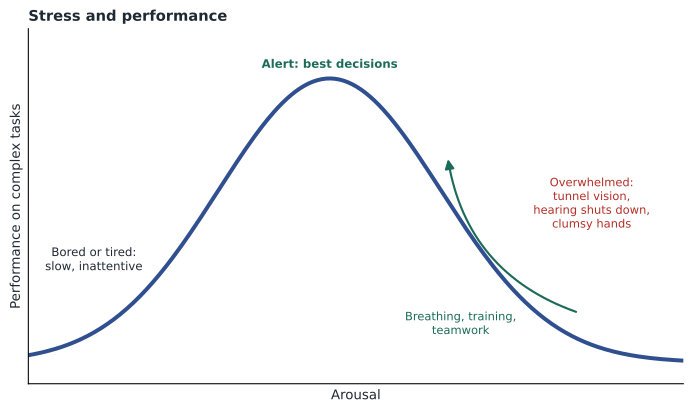
When a person perceives a serious threat, the body's stress response prepares them to fight or flee. Adrenaline and other hormones raise heart rate and blood pressure, send blood to the large muscles and away from the hands and digestive system, speed up breathing and sharpen attention on the threat. These changes help with running and struggling, but they come at a cost. Fine motor skills, such as working a radio, handcuffs or a weapon, become harder. Complex thinking, such as weighing options, becomes slower. And perception narrows.
| Effect | What happens | How it can affect a force call |
|---|---|---|
| Tunnel vision | Visual attention narrows to the threat | Officer may not see bystanders, other officers or a change in the person's condition |
| Auditory exclusion | Sounds are muted or not heard | Officer may not hear commands, a partner or the person saying they cannot breathe |
| Time distortion | Events seem to slow down or speed up | Officer's estimate of how long something lasted may be far off |
| Memory gaps and errors | Parts of the event are missing or out of order | Reports may leave things out or get sequences wrong, without any intent to deceive |
| Loss of fine motor control | Hands become clumsy | Handcuffing and radio use take longer |
| Automatic behaviour | Officer acts without conscious decision | Officer does what was trained most, which may not be what is needed |
Research on officers involved in shootings and other critical incidents, including surveys by the psychologist Alexis Artwohl published in 2002, found that a large majority reported at least one of these effects, and many reported several. Diminished sound and tunnel vision were among the most common. Similar effects have been found in laboratory studies that put officers through realistic, stressful scenarios and then tested what they remembered.
Arriving into a struggle
Brody's experience is typical of an officer who arrives at a struggle that is already under way. He did not see the nine minutes of conversation, the bottle going down or the walk toward the road from close up. He saw his colleagues on the ground with a kicking man. His arousal was at its peak at the moment he made physical contact, and his attention narrowed to the job of getting Pelley's hands under control. When the handcuffs went on, nobody told him, his body was still in fight mode, and he stayed where he was.
Training increasingly addresses this situation. Arriving officers are taught to take a second to look before going in: what is happening, who is in charge, what job is needed. Officers already engaged are taught to tell arriving officers what to do, in short, clear words: 'Take his legs.' 'Cuffs are on.' 'Get him on his side.' The review found that the single most useful thing that could have been said at Tidewater Park was 'Cuffs on, roll him', said loudly the moment the second handcuff clicked.
Perception and expectation
People see partly what is in front of them and partly what they expect. An officer who has been told that a person is armed and violent is more likely to see a dark object in the person's hand as a weapon. An officer who has been told the person is a frightened man in crisis may see the same movement as an attempt to get away. Expectations come from dispatch information, from past experience, from what other officers say on the radio and from beliefs about groups of people.
That last source matters for fairness. Research on implicit bias shows that people, including police officers, can hold automatic associations between groups and ideas such as danger or crime, even when they consciously reject those associations. Laboratory studies have found that such associations can affect how quickly people identify objects as weapons. Training on bias does not remove it, but research suggests that slowing decisions down, focusing on specific behaviour rather than appearance, and having clear policies can reduce its effect on decisions in the field.
Fatigue and other factors
Stress is not the only thing that affects officers' perception and judgment. Fatigue from long shifts, overtime, night work and court appearances on days off reduces attention and decision-making in ways similar to alcohol. Hunger, dehydration, personal stress and earlier calls in the same shift all add to the load. Brody was in the eleventh hour of a twelve-hour shift, and he had been to a serious collision two hours earlier. 'None of that is unusual,' Haddad says. 'That's what a Saturday night looks like. Which is why we can't rely on officers being at their best. The system has to work when they're tired.'
Decision traps
Beyond the physical effects of stress, several patterns of thinking regularly lead officers, and people in other high-pressure jobs, into poor decisions. Psychologists who study decision-making in aviation, medicine and firefighting have described many of them, and police trainers now teach them by name so that officers can recognize them.
| Trap | What it looks like | Counter |
|---|---|---|
| Action bias | Feeling that doing something is always better than waiting | Ask whether anyone is in immediate danger; if not, time is usually an asset |
| Plan continuation | Sticking with the first plan after facts have changed | Reassess at each change, as the decision model requires |
| Contagion | Officers copying each other's actions or level of force without their own assessment | Each officer makes and can explain their own decision |
| Confirmation bias | Noticing only information that fits the first impression | Ask what would show the first impression is wrong |
| Authority deference | Not speaking up because a senior officer is acting | Policy and training make it everyone's job to speak up |
| Task fixation | Focusing on one task, such as handcuffing, and losing sight of the person's condition | Assign someone to watch the person's breathing and the big picture |
Several of these traps appeared at Tidewater Park. Brody's knee is an example of task fixation: his task was getting control of Pelley's hands, and once that was done, nothing in his mind had moved him on to the next task. The unplanned rush at the curb was partly plan continuation: the officers had planned for a handover to the crisis worker and had not updated the plan when the risk of Pelley running became obvious. And Reyes's intervention was a deliberate break from authority deference, since Brody had several more years of service than she did.
Training for real conditions
Most police training used to happen in calm classrooms and on quiet ranges, which taught skills but not how to use them under stress. Modern programs add scenario-based training, in which officers face realistic situations with role players, noise, time pressure and uncertainty, and then debrief what they saw, decided and did. The aim, sometimes called stress inoculation, is to expose officers to stress in a controlled way so that real incidents feel less unfamiliar. Good scenarios do not always end in force. Many are designed so that the best outcome comes from slowing down, talking or stepping back, and some reward an officer for recognizing that a person cannot comply.
The debrief is where most of the learning happens. Trainers ask officers what they perceived, what they were thinking, what options they considered and why they chose what they did, and then compare that with video of the scenario. Officers often discover that they missed things, misjudged time or acted on assumptions, in a setting where the cost of the mistake is a lesson rather than an injury. Haddad says the platoon now runs a version of the Tidewater Park call as a scenario at every requalification, with a role player who says 'I can't breathe' after the handcuffs go on.
Managing stress in the moment
Officers cannot switch off the stress response, but they can influence it. Controlled breathing, sometimes called tactical or box breathing, in which a person breathes in, holds, breathes out and holds again for a slow count, can lower heart rate within seconds and is taught in many police academies. Self-talk, such as a short phrase that refocuses attention ('Step back. Look. Talk.'), helps. So does experience: officers who have been through realistic, stressful training scenarios many times tend to experience less extreme stress effects in real incidents, because the situation is more familiar.
Teamwork is the most important protection. Because stress narrows each officer's perception differently, a team in which officers talk to each other, divide roles and watch each other catches things that any one officer would miss. Reyes heard Pelley say he could not breathe and saw that Brody had not reacted. She did what the team needed: she said Brody's name, loudly, and told him what to do. Lesson 10 covers that intervention in detail.
Memory, video and reports
Stress effects on memory have practical consequences after the incident. An officer's honest account may differ from the video in timing, sequence and detail. That does not necessarily mean the officer is lying, but it can damage their credibility if the difference is not explained. Officers are taught to write what they perceived and remember, to note where they are unsure, and not to fill gaps with what they assume must have happened.
Services differ on whether officers should view body-worn camera video before writing their reports or giving statements. Those who favour viewing first say it produces more accurate reports. Those who oppose it say it contaminates the officer's own memory, which is what the law asks about, since force is judged on what the officer reasonably perceived at the time. Some services use a two-step approach: the officer gives an initial account first, then views the video and adds a supplementary account explaining any differences. In Ontario, officers who are subject officers in a Special Investigations Unit investigation are not required to give a statement or provide their notes to the SIU, while witness officers must.
Desjardins adds a practical rule for students' own reports. Write times you know from a source, such as the dispatch log or the video, as exact times, and write times you are estimating as estimates. 'About thirty seconds, I believe' is honest. 'Thirty seconds' is a claim. When a reviewer later finds that the real figure was ninety seconds, the first officer has made an understandable error and the second appears to have made something up. The same applies to distances, numbers of people and the order of events.
Worked problem
Estimating time under stress
In his first account, Brody estimated that his knee was on Pelley's back for "maybe ten seconds" after the handcuffs went on. The video shows 40 seconds. By what factor did he underestimate the time, and what does this suggest for report writing?
Show solution
- Ratio of actual to estimated time:
- \[40 \div 10 = 4\]
- Brody's estimate was one quarter of the actual time.
Answer: He underestimated the time by a factor of four. Officers should give time estimates as estimates, check them against video and other evidence where available, and explain differences rather than assume their memory is exact.
Common mistakes
MistakeA trained officer will hear and see everything important during a struggle.
InsteadTunnel vision and auditory exclusion affect most officers under high stress.
MistakeIf an officer's account differs from the video, the officer is lying.
InsteadStress affects memory; differences should be explained, and honest accounts may still contain errors.
MistakeArriving officers should go straight to the struggle.
InsteadThey should take a second to look and should be told what job to do.
MistakeStress cannot be managed in the moment.
InsteadControlled breathing, self-talk, realistic training and teamwork all help.
Summary and key terms
- The stress response helps physical action but impairs fine motor skills, complex thinking and perception.
- Common effects include tunnel vision, auditory exclusion, time distortion and memory gaps.
- Expectations, implicit bias and fatigue also shape what officers perceive and decide.
- Arriving officers are especially vulnerable; clear, short directions from engaged officers help.
- Controlled breathing, training and teamwork reduce the effects of stress.
- Stress affects memory, so reports should separate what was perceived from what was assumed.
- Tunnel vision
- Narrowing of visual attention under stress.
- Auditory exclusion
- Reduced or absent hearing of sounds under stress.
- Time distortion
- Events seeming faster or slower than they were.
- Implicit bias
- Automatic associations between groups and ideas that can affect perception and judgment.
- Tactical breathing
- A slow, controlled breathing pattern used to reduce stress effects.
Practice problems
Work each problem on paper first, then reveal the answer to check.
Why did Brody not hear Pelley say he could not breathe?
Show answer
Auditory exclusion and tunnel vision under very high arousal after arriving into a struggle.
What should an engaged officer say to an arriving officer?
Show answer
Short, specific directions, such as "Take his legs" or "Cuffs on, roll him".
Name two things that can reduce stress effects in the moment.
Show answer
Any two of: controlled breathing, self-talk, realistic training experience, teamwork.
What is task fixation, and how did it appear at Tidewater Park?
Show answer
Focusing on one task and losing sight of the bigger picture; Brody stayed focused on controlling Pelley's hands after the handcuffs were on.
An officer estimates 15 seconds; video shows 45. By what factor did they underestimate?
Show answer
A factor of three.
Lesson quiz · 5 questions
Score 60% or more to complete this lesson.
Create a free account to save your progress, take quizzes and earn a certificate.