
LES-204 · Lesson 4 of 12 · 21 min
Crisis, mental health and people who cannot comply
▶ Video coming soon A video version of this lesson is on the way.
The mobile crisis worker, Nadia Kerr, arrived at Tidewater Park seventeen minutes after Malhotra and Reyes. She had worked with Owen Pelley before and greeted him by name. For about seven minutes, the call seemed to be ending well. Pelley sat on the bench, Kerr crouched to talk with him, and Malhotra stood back. Then Kerr gently said that she thought he needed to go to the hospital tonight to get some sleep and see a doctor. Pelley stood up. 'No. No hospital. They'll lock me up.' He started walking fast, then almost jogging, toward Harbour Street, where cars were passing at about fifty kilometres an hour, looking over his shoulder at the officers as if they were chasing him.
Desjardins stops the footage there. 'Everything up to this point was de-escalation done well,' he says. 'Now the officers have about six seconds before Owen is in the road. This lesson is about people in crisis: why they are overrepresented in use-of-force incidents, why they often cannot follow commands, and how the law treats force used to protect a person from themselves.'
People in crisis and police force
People experiencing mental health crises make up a small share of police calls but a much larger share of serious use-of-force incidents and deaths. In Ontario, reviews of police encounters, including former Supreme Court Justice Frank Iacobucci's 2014 report for the Toronto Police Service, Police Encounters With People in Crisis, written after the death of Sammy Yatim in 2013, found that a large proportion of people killed by police had been in mental health crisis. Similar findings have come from coroner's inquests across the country. These reviews led to crisis teams, mandatory crisis training and policies that put de-escalation first when a person in crisis is involved.
The reasons are not mysterious. People in crisis are often frightened and confused. Some are hearing voices or believe they are being persecuted, as Pelley did. Some are intoxicated, sleep-deprived or in physical distress. Some are holding objects, such as knives or bottles, for reasons that make sense to them but look threatening to others. And many are less able than other people to understand and follow police commands quickly. A person who cannot comply, facing officers who expect compliance, is a set-up for force unless the officers recognize what is happening.
Cannot comply versus will not comply
The most important distinction in this lesson is between a person who will not comply and a person who cannot. A person who will not comply understands the instruction and chooses to resist it. A person who cannot comply may not hear the instruction, may not understand it, may be physically unable to do it, or may be so overwhelmed by fear or by symptoms that they cannot organize a response. The same outward behaviour, such as standing still while an officer shouts 'Get on the ground', can come from either.
| Condition or situation | What officers may see | What may help |
|---|---|---|
| Psychosis | Responding to voices, fear of persecution, unusual beliefs | Calm, simple speech; do not argue with beliefs; time; a crisis worker |
| Severe anxiety or panic | Rapid breathing, fleeing, freezing | Slower pace, reassurance, space |
| Intoxication | Slurred speech, poor balance, slow responses | Short instructions, one at a time, patience, medical check |
| Deafness or hearing loss | No response to spoken commands | Gestures, writing, eye contact, interpreter |
| Autism or developmental disability | Literal understanding, distress at noise and touch | Quiet, clear language, fewer people, a caregiver |
| Dementia or brain injury | Confusion, memory gaps, agitation | Simple questions, reassurance, family or caregiver |
| Medical emergency | Sweating, confusion, seizure, diabetic emergency | Call paramedics; treat as medical first |
Lesson 9 returns to the medical side, including the controversial term excited delirium. For now, the rule is the one introduced in lesson 2: treat non-compliance as information. Ask whether the person can hear, understand and do what is being asked, adjust the communication, and give more time wherever the situation allows.
People in crisis with weapons
Some of the most dangerous calls involve a person in crisis holding a knife, a bottle or another edged or improvised weapon. Training once taught that an officer within about seven metres (the so-called twenty-one-foot rule) of a person with a knife was in mortal danger. The original research, by Dennis Tueller in 1983, actually showed that a person could cover that distance in about a second and a half, and that officers needed distance and cover to have time to react. It was never meant as a rule that officers could shoot anyone with a knife inside that distance, and modern training stresses the opposite lesson: create more distance, use cover and keep talking, because distance and time are what keep everyone alive.
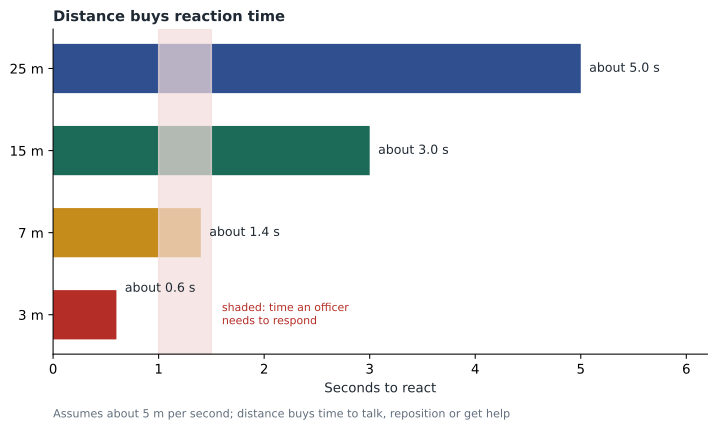
At Tidewater Park, the officers never closed the distance while Pelley held the bottle, even when he waved it. Reyes later said that she was frightened when he took two quick steps toward Malhotra at about minute four. 'But Dev just stepped back behind the planter and kept talking,' she said, 'and Owen stopped.' Malhotra explained that he had decided, before he even got out of the car, that he would keep at least seven metres and the planter between them for as long as Pelley held anything.
Legal authority to intervene with a person in crisis
Police often have authority to take a person in crisis into custody even when no crime has been committed. In Ontario, section 17 of the Mental Health Act allows an officer to take a person to a physician for examination if the officer has reasonable and probable grounds to believe the person is acting or has acted in a disorderly manner and has reasonable cause to believe that the person has threatened or attempted to cause bodily harm to themselves or others, has behaved violently toward another person, or has shown a lack of competence to care for themselves, and that the person has a mental disorder likely to result in serious harm to themselves or others, or serious physical impairment. Other provinces have similar laws. The mental health course (LES-114) covers these powers in detail. What matters here is that an apprehension under the Act is lawful authority, which means that section 25 of the Criminal Code can protect force reasonably necessary to carry it out.
At Tidewater Park, the officers had grounds before Pelley moved toward the road: he had threatened people with a broken bottle, he appeared to have a mental disorder, and he had told Kerr he had not slept or eaten properly in days. When he walked fast toward the traffic, the risk of serious physical harm to himself became immediate. Malhotra shouted, 'Owen, stop, the cars!' and when Pelley did not stop, Malhotra and Reyes took hold of his arms at the curb. Lesson 5 examines whether that was lawful and why.
Crisis teams and alternative responses
Many Canadian cities now have teams that pair officers with mental health workers or send mental health workers without police to some calls. Examples include Toronto's Mobile Crisis Intervention Teams and its Toronto Community Crisis Service, which sends trained crisis workers without police to many calls, and the Car 87 program in Vancouver, which has paired an officer with a psychiatric nurse since 1978. The national 9-8-8 suicide crisis helpline, launched in November 2023, gives people another way to get help. These programs do not remove police from every crisis call, but they change who arrives and what options are available.
The Tidewater Park call shows both the value and the limits of these programs. Kerr's arrival was the right step, and she knew Pelley. But a crisis worker cannot physically stop a person from walking into traffic, and Kerr later said she did not expect Pelley to bolt. 'The right people were there,' Haddad says. 'What we could have done better was plan with Nadia before she told him about the hospital: where the officers would stand, what we would do if he ran, which side the road was on.' That point returns in lesson 12.
Planning the handover
Haddad's point about planning with Kerr applies to every call where officers hand a person in crisis to someone else, whether a crisis worker, a paramedic or a family member. The moment of handover is often the moment of greatest risk, because it is when the person learns what is going to happen next. A short plan, agreed out of the person's hearing, makes it much less likely that the officers will be caught off guard.
| Question | Tidewater Park, as it happened | What the review recommended |
|---|---|---|
| Who tells the person about the hospital? | Kerr, without warning the officers first | Kerr, after a one-minute huddle with Malhotra |
| Where do officers stand when the news is given? | Malhotra about 5 metres back; Reyes to the side; nobody between Pelley and the road | One officer on the road side, at a distance that does not crowd him |
| What if the person tries to leave? | Not discussed | Agree who speaks and who moves, and what the legal authority is |
| What if the person becomes violent? | Not discussed | Agree that Kerr steps back behind the officers |
| How will the person travel to hospital? | Not discussed | Ambulance requested in advance, staged nearby |
Suicide risk on force calls
Some people in crisis want to die, and a few of them behave in ways that seem intended to make police use lethal force, for example by advancing on officers with a weapon or pretending to have a gun. Researchers and police trainers sometimes call this suicide by cop, although many mental health professionals prefer terms such as victim-precipitated or officer-involved suicide. Studies of police shootings have found that a meaningful share of them involve people who appear to have been suicidal. These situations are extremely difficult for officers, because the person may truly present a lethal threat even though their underlying goal is their own death.
The response is the same as on other crisis calls, only more so: maximize distance and cover, slow everything down, use one calm voice, ask directly about suicide where it is safe to do so, and bring in crisis negotiators and mental health professionals as early as possible. Officers who are involved in such incidents often carry lasting distress, even when their actions were lawful and unavoidable. Lesson 11 covers support for officers after serious force incidents.
Family members and caregivers
Family members, roommates and caregivers are often the people who call police and the people who know the person best. They can tell officers what has worked before, what frightens the person, whether they take medication and whether they have weapons at home. They can also help calm the person, or, in some cases, make things worse. Officers should ask them for information early, keep them safe and, where it helps, involve them in the conversation. Pelley's sister, reached by phone during the review, said he had been off his medication for two weeks and was terrified of being held in hospital after a bad experience two years earlier. That information, had it been available on the night, would have changed how the hospital was raised with him.
Worked problem
How much time does distance buy?
A person in crisis can move toward an officer at about 5 metres per second when running. An officer needs about 1.5 seconds to see a movement, decide and respond. What is the minimum distance that gives the officer at least that much time, and how much time does a distance of 20 metres give?
Show solution
- Time available equals distance divided by speed.
- \[t = \frac{d}{v}\]
- For 1.5 seconds at 5 metres per second:
- \[d = 1.5 \times 5 = 7.5 \text{ m}\]
- At 20 metres:
- \[t = 20 \div 5 = 4 \text{ s}\]
Answer: At least about 7.5 metres gives the officer the time they need just to react. At 20 metres the officer has about 4 seconds, enough to reposition, use cover or keep talking. More distance means more options.
Common mistakes
MistakeA person who does not follow commands is choosing to resist.
InsteadThey may be unable to hear, understand or carry out the command.
MistakeThe twenty-one-foot rule means officers may use lethal force on anyone with a knife inside that distance.
InsteadIt showed that officers need distance and cover to have time to react; the lesson is to create distance.
MistakeOfficers cannot use force on a person who has committed no crime.
InsteadMental health apprehension powers can provide lawful authority, and force must then be reasonable.
MistakeOnce a crisis worker arrives, officers can stand down.
InsteadOfficers and crisis workers should plan together, including what happens if the person tries to leave.
Summary and key terms
- People in crisis are overrepresented in serious use-of-force incidents and deaths.
- The key distinction is between a person who will not comply and one who cannot.
- Psychosis, panic, intoxication, hearing loss, autism, dementia and medical emergencies can all prevent compliance.
- With edged weapons, distance and cover buy the time that keeps everyone alive.
- Ontario's Mental Health Act, section 17, gives officers authority to apprehend a person in crisis in defined circumstances.
- Crisis teams improve options, but officers and crisis workers must plan together for what happens if the person tries to leave.
- Mental health crisis
- A situation in which a person's behaviour puts them at risk of harm or prevents them from caring for themselves.
- Cannot comply
- Being unable, rather than unwilling, to follow an instruction.
- Mental health apprehension
- Taking a person into custody under mental health law so they can be examined by a physician.
- Crisis team
- A team that includes or consists of mental health professionals responding to crisis calls.
Practice problems
Work each problem on paper first, then reveal the answer to check.
Why is the handover to a crisis worker a high-risk moment?
Show answer
It is often when the person learns what will happen next, such as going to hospital, and may try to leave or become agitated.
Give three reasons a person might not comply that are not defiance.
Show answer
Any three of: psychosis, panic, intoxication, hearing loss, autism or developmental disability, dementia, a medical emergency.
What did the original Tueller research actually show?
Show answer
That a person can cover about seven metres in about a second and a half, so officers need distance and cover to have time to react.
What legal authority did the officers have to stop Pelley at the curb?
Show answer
Section 17 of the Mental Health Act, because they had grounds that he posed a serious risk of harm.
At 4 metres per second, how much time does 12 metres give an officer?
Show answer
12 divided by 4 is 3 seconds.
Lesson quiz · 5 questions
Score 60% or more to complete this lesson.
Create a free account to save your progress, take quizzes and earn a certificate.