
LES-204 · Lesson 1 of 12 · 20 min
Force in policing: purpose, evidence and public trust
▶ Video coming soon A video version of this lesson is on the way.
Professor Ray Desjardins starts the course by showing a single still image from a body-worn camera. It is a quiet evening in Tidewater Park, near the Harbour Street transit terminal. A man in a grey hoodie stands beside a bus shelter, holding something that glints. Two officers stand well back, one with an open hand raised and the other a few steps to the side. Nobody is touching anybody. 'This is a use-of-force call,' Desjardins says. 'At this moment, no force has been used, and for the next nine minutes none will be. What happens in those nine minutes is most of what this course is about.'
The course follows one evening in the fictional city of Port Ardent. At 19:20 on Saturday, September 27, 2025, a transit supervisor called 911 about a man shouting at passengers in Tidewater Park and holding a broken bottle. Constable Dev Malhotra and Constable Sofia Reyes, then in her first year, arrived four minutes later, and Constable Ken Brody arrived soon after. The man, Owen Pelley, was 34 and known to the city's mobile crisis team. Over the next half hour, the officers talked him into putting the bottle down, tried to hand him over to a crisis worker, and then had to stop him from walking into traffic on Harbour Street. What followed was a short struggle, a handcuffing on the ground, a moment of real medical danger and a review that changed how the platoon trains.
Sergeant Lisa Haddad, who supervises B platoon on nights and reviewed the Tidewater Park call, joins the class as a guest throughout the course. Paramedic Joan Ivey, who treated Pelley at the scene, joins several classes on medical risk. Desjardins is clear about what the course is and is not. 'You will learn the law, the policy, the decision models, how to talk people down, what defensive tactics are for and what can go wrong medically,' he says. 'You will not learn how to strike, take down or restrain anyone in this classroom. That is taught only on the mat, by certified instructors, with supervision and repetition. What we do here is the thinking that has to sit on top of every one of those skills.'
What "use of force" means
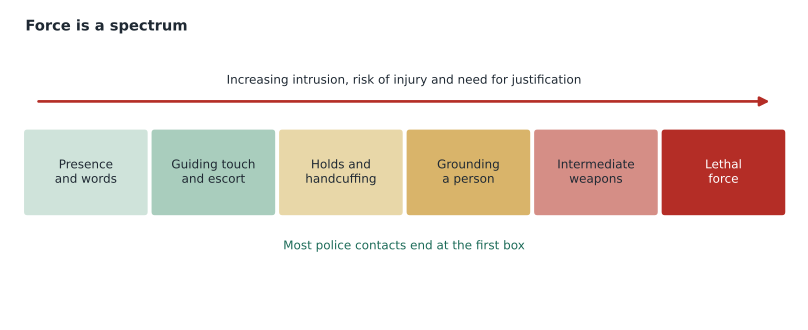
In policing, use of force means any physical effort, weapon or show of weapon that an officer uses to make a person do something or to stop them from doing something. It runs from the lightest touch, such as a hand on an elbow to guide someone, through holds, handcuffing, pushing a person to the ground and using an intermediate weapon such as a conducted energy weapon, to lethal force. Many services also count the display of a weapon, such as pointing a firearm or a conducted energy weapon at a person, as a reportable use of force, because it is a serious intrusion that has to be justified even when nothing is fired.
Officer presence and words are usually placed at the start of force models, but most services do not treat them as force in the legal sense. They are better thought of as the tools that, used well, make force unnecessary. That is why this course spends its first four lessons on communication, de-escalation and crisis before it reaches the law of force. By the time force is lawful, the officer has usually already had chances to prevent it.
Why police are allowed to use force at all
Police are one of very few groups in a democracy who may lawfully use force on other people as part of their job. That power exists because some laws can only be enforced, and some people can only be protected, if someone is able to physically stop a person who will not stop on their own. An arrest that the person refuses, a fight that is about to injure a bystander, or a person in crisis about to walk into traffic all fall into this category.
The power comes with three conditions that run through every lesson in this course. First, force must have a lawful purpose, such as making a lawful arrest, preventing an offence that would cause serious harm, or protecting a person, including the person the force is used on. Second, force must be necessary, which means that less intrusive options would not reasonably work in the time available. Third, force must be proportionate and reasonable, which means it matches the threat and the resistance, and stops when the need for it stops. Force that fails any of these tests can be a crime, a civil wrong and a disciplinary offence, even when it was used by an officer on duty.
In Canada, the main legal source is section 25 of the Criminal Code, which protects officers who use as much force as is necessary, on reasonable grounds, to carry out their lawful duties. Section 26 makes anyone who uses excessive force criminally responsible for the excess. The Supreme Court of Canada explained how these rules work in R. v. Nasogaluak in 2010. Lesson 5 covers all of this in detail.
How often force is used
Students often arrive expecting that force is a daily part of patrol. The research says otherwise. Studies of police services in Canada and the United States consistently find that force is used in a small fraction of encounters with the public, usually well under 1 in 100 calls for service, and that most of the force that is used is at the low end of the spectrum, such as grabbing, holding and handcuffing a person who resists. Firearm discharges at people are rare events, even in large services.
Rare does not mean unimportant. Because force is used so seldom, each use carries a lot of weight in how the public sees the police, and a single badly handled incident can undo years of trust. Because force is concentrated in a small number of call types, such as people in crisis, intoxicated people, domestic disputes and arrests of people who flee or fight, training can focus on exactly those situations. And because a small number of officers in any service often account for a large share of force incidents, supervisors who track force data can spot patterns early.
Worked problem
Reading a year of force data
In 2024, Port Ardent police attended 61,500 calls for service. Officers filed use-of-force reports for 246 incidents. Of those, 171 involved only physical control such as holds and handcuffing, 52 involved the display or use of an intermediate weapon, 21 involved pointing a firearm and 2 involved a firearm discharge. In how many calls in every 1,000 was a reportable use of force recorded, and what share of the incidents involved only physical control?
Show solution
- Rate of force: divide incidents by calls.
- \[246 \div 61500 = 0.004\]
- That is 4 calls in every 1,000, or 0.4 in every 100.
- Share involving only physical control:
- \[171 \div 246 \approx 0.695\]
- That is about 70 in every 100 incidents.
- Check: 171 + 52 + 21 + 2 = 246, so the categories account for every report.
Answer: A reportable use of force was recorded in about 4 calls in every 1,000, and about 70 in every 100 of those incidents involved only physical control.
Haddad points out what the numbers do not show. 'A report is filed when force is used,' she says. 'Nobody files a report for the 61,000 calls where somebody was angry, drunk or frightened and an officer talked them through it. Those are invisible in the data, and they are the reason the numbers are so small.'
Force and public trust
Police in Canada and the United States work under the principle of policing by consent. Sir Robert Peel's principles of 1829, still quoted in police training, say that police should use physical force only when persuasion, advice and warning are not enough, and then only the minimum necessary. The point is practical as well as moral. Police depend on the public to report crimes, give evidence, follow instructions and accept that police decisions are fair. When people believe that police use force unfairly, they cooperate less, and policing becomes harder and more dangerous for everyone.
Research on procedural justice supports this. People judge the police less by the outcome of an encounter than by how they were treated: whether they had a chance to speak, whether the officer was neutral and explained their decisions, and whether they were treated with dignity. A use of force that is lawful but carried out with contempt, insults or no explanation damages trust. A use of force that is explained, stopped as soon as it is no longer needed, and followed by care for the person's injuries can sometimes preserve it.
Trust is also uneven. In Canada, Black and Indigenous people have long reported, and data from several services have confirmed, that they are more likely than others to be subject to police force. The Ontario Human Rights Commission's inquiry into racial profiling and discrimination by the Toronto Police Service, and the service's own race-based data reports, first published in 2022, found that Black people were overrepresented in use-of-force incidents compared with their share of the population. Lesson 11 returns to what services do with such data.
Three outcomes that matter
Desjardins asks the students to judge every use-of-force call by three outcomes, in this order. The first is whether everyone went home safe, including the officers, the public and the person the force was used on. The second is whether the force was lawful and within policy. The third is whether the person, and anyone watching, would say they were treated fairly. A call can succeed on one and fail on another. An arrest can be lawful but leave someone injured who did not need to be. A call can end safely but with force that went beyond what the law allows.
| Outcome | Question to ask | Tidewater Park, first look |
|---|---|---|
| Safety | Did everyone, including the subject, end the call without avoidable injury? | Minor abrasions to Pelley and a bruised hand for Reyes, but one moment of serious medical risk |
| Lawfulness | Was each use of force authorized, necessary, proportionate and reasonable, and within policy? | The apprehension and grounding appear lawful; the time spent with weight on Pelley's back is questioned |
| Fairness | Would the subject and witnesses say he was treated with dignity and given explanations? | Long, patient conversation before force; explanation afterward was brief |
The rest of the course takes each part of the Tidewater Park call in turn. Lessons 2 to 4 cover communication, de-escalation and people in crisis, using the nine minutes of conversation that came before any force. Lessons 5 and 6 cover the law of force and the models and policies that put it into practice. Lessons 7 and 8 cover what defensive tactics are for and how officers make decisions under stress. Lesson 9 covers the medical risks, including the moment when Pelley said he could not breathe. Lesson 10 covers the duty to intervene. Lesson 11 covers reporting, review and oversight. Lesson 12 brings it all together in a full review of the call.
Several later courses in the program build on this one. The arrest and control course (LES-206) covers handcuffing, escorts and searching people after arrest. The firearms course (LES-207) covers the law of lethal force in more depth. In the winter term, the less-lethal weapons course (LES-217) covers conducted energy weapons, OC spray and batons, and the high-risk calls course (LES-216) covers felony stops, building searches and active threats.
The officer who uses force
Using force is hard on officers too. Officers are injured in a meaningful share of use-of-force incidents, usually by being struck, kicked or bitten or by falling during a struggle. Force incidents are also among the most stressful events in an officer's career, because they combine physical danger with the knowledge that every second will be reviewed later. Officers who are well trained, who trust their partners and who have practised communication and control skills until they are automatic tend to use less force, get hurt less and recover faster. Lesson 8 covers stress and decision-making, and lesson 11 covers officer wellness after a force incident.
Haddad ends the first class with what she calls the platoon's working rule. 'Talk first, wait if you can, get help if you can, use the least force that will work, stop the moment it is no longer needed, and look after the person afterward,' she says. 'If you do those six things, you will almost never be in serious trouble, and neither will the person in front of you.'
Common mistakes
MistakeUse of force means hitting someone or using a weapon.
InsteadUse of force includes any physical control, such as holds and handcuffing, and many services count pointing a weapon as reportable force.
MistakeForce is a routine part of most police calls.
InsteadForce is used in a small fraction of calls, usually well under 1 in 100, and most of it is low-level physical control.
MistakeIf force was lawful, the call was handled well.
InsteadA call should also be judged on whether everyone was kept safe and whether people were treated fairly.
MistakePublic trust is a public relations issue, separate from force.
InsteadHow force is used directly affects whether people cooperate with police, which affects safety for everyone.
Summary and key terms
- Use of force is any physical effort, weapon or show of weapon used to make a person do or stop doing something.
- Force must have a lawful purpose, be necessary, and be proportionate and reasonable, and it must stop when the need stops.
- In Canada, section 25 of the Criminal Code and R. v. Nasogaluak set the main legal rules.
- Force is rare and mostly low level, but each incident has a large effect on public trust.
- Calls should be judged on safety, lawfulness and fairness.
- Talk first, wait and get help where possible, use the least force that will work, stop when it is no longer needed and provide care afterward.
- Use of force
- Any physical effort, weapon or display of a weapon used to compel or stop a person.
- Necessity
- The requirement that less intrusive options would not reasonably work.
- Proportionality
- The requirement that force matches the threat and the resistance.
- Policing by consent
- The principle that police depend on public cooperation and should use force only as a last resort.
- Procedural justice
- Fair treatment in police encounters: voice, neutrality, respect and explanation.
Practice problems
Work each problem on paper first, then reveal the answer to check.
Name the three conditions that force must meet in this course.
Show answer
A lawful purpose, necessity and proportionality or reasonableness, with force ending when the need ends.
Why does use-of-force data understate how often officers prevent force?
Show answer
Reports are filed only when force is used; calls resolved by talking leave no force record.
A service records 90 force incidents in 30,000 calls. How many per 1,000 calls is that?
Show answer
90 divided by 30,000 is 0.003, or 3 per 1,000 calls.
What are the three outcomes Desjardins uses to judge a call?
Show answer
Safety, lawfulness and fairness.
Lesson quiz · 5 questions
Score 60% or more to complete this lesson.
Create a free account to save your progress, take quizzes and earn a certificate.