
LES-204 · Lesson 6 of 12 · 21 min
Use-of-force models and policy
▶ Video coming soon A video version of this lesson is on the way.
Priya Sandhu asks the question that comes up every year. 'If the law already says force has to be necessary and reasonable, why do we need a model and a forty-page policy?' Haddad answers with a story. 'At the curb, Ken had about two seconds to decide what to do, and then about a minute to decide what to keep doing. The law tells a judge, years later, how to decide whether he was right. The model and the policy are what are supposed to be in his head in those two seconds and that minute. They turn the law into something you can train.'
Why force models exist
A use-of-force model is a diagram or framework that helps officers think about how a situation, a person's behaviour and the officer's possible responses fit together. Models are teaching and decision tools. They help officers explain their decisions, help trainers build scenarios, and help reviewers ask the right questions afterward. They are not laws, and no model can tell an officer exactly what force to use in a particular situation. Courts judge force by the legal tests in lesson 5, not by whether the officer moved correctly around a diagram.
Early models, developed in the 1980s and 1990s, were usually drawn as a ladder or staircase, often called a force continuum. Each step matched a level of resistance with a level of force. Critics pointed out that staircases suggested officers had to climb one step at a time, or that a certain level of resistance automatically justified a certain level of force. Most modern models are drawn differently to avoid that impression.
Canada: the National Use of Force Framework
In Canada, the National Use of Force Framework was endorsed by the Canadian Association of Chiefs of Police in 2000 and is the basis for most provincial models, including the Ontario Use of Force Model adopted in 2004. It is drawn as a circle. At the centre is the situation, which the officer is constantly assessing. Around it is a ring for the officer's assessment process: assess, plan and act. The next ring describes the subject's behaviour, from cooperative through passive resistant, active resistant and assaultive to behaviour likely to cause grievous bodily harm or death. The outer ring shows the officer's response options: officer presence, communication, physical control, intermediate weapons and lethal force. Tactical repositioning appears as an option throughout, and communication is shown as running across every level.
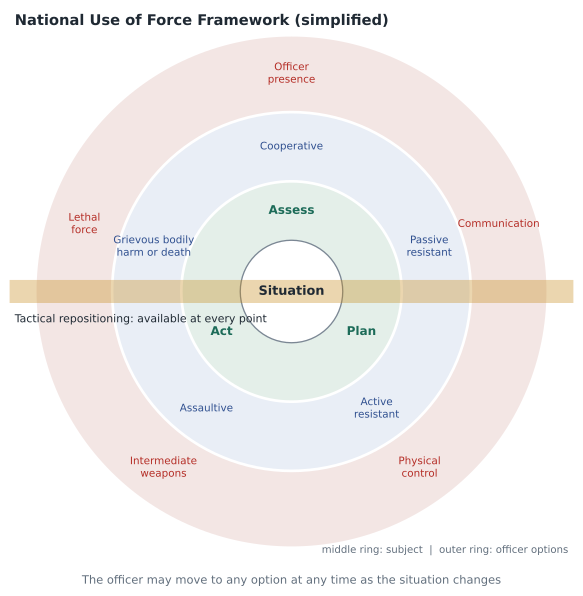
Two features of the circle matter most. First, the officer can move from any point to any other point as the situation changes, including straight down to communication or repositioning. Second, the officer's assessment of the situation, not just the subject's behaviour, drives the response. The same behaviour can call for different responses depending on factors such as the person's size and abilities, the number of officers present, whether a weapon is involved, and the environment.
| Category | Meaning | Tidewater Park |
|---|---|---|
| Cooperative | Responds to presence and communication | Pelley sitting on the bench, talking with Kerr |
| Passive resistant | Refuses to comply without physical resistance, such as going limp or not moving | Refusing three times to put the bottle down, without advancing |
| Active resistant | Uses non-assaultive physical action to resist, such as pulling away or running | Pulling his arms free at the curb |
| Assaultive | Attempts or threatens to apply force to someone | Kicking at Reyes; earlier, waving the bottle at passengers |
| Grievous bodily harm or death | Behaviour likely to cause serious injury or death | Not reached; would have applied if he had attacked someone with the bottle |
The table shows that Pelley moved around the circle several times: from assaultive (waving the bottle at passengers) to passive resistant (refusing but not advancing) to cooperative (on the bench), then to active resistant and assaultive at the curb, and finally, once handcuffed and saying he could not breathe, to a point where he was no longer resisting at all. The model is meant to make officers notice those changes and change their response to match, including when the behaviour comes down.
The United States: force options and national guidance
In the United States, there is no single national model. Some agencies still use a continuum, many have moved to circular or matrix models, and some have dropped models in favour of decision-making frameworks such as the Critical Decision-Making Model in lesson 3. Students in Canada meet the U.S. guidance here because Canadian services often draw on it. In 2016, the Police Executive Research Forum published 30 Guiding Principles on Use of Force, including that the sanctity of all human life should be at the heart of everything an agency does, that agencies should adopt policies stricter than the constitutional minimum, and that officers should have a duty to intervene. In 2017, eleven major law enforcement organizations, including the International Association of Chiefs of Police, published a National Consensus Policy on Use of Force, updated in 2020, which agencies can adapt.
What a good use-of-force policy contains
An agency's policy turns the law and the model into rules officers must follow. Policies are usually stricter than the law, and officers are disciplined against the policy, not just the law. Most modern policies share a common structure.
| Part | Typical content |
|---|---|
| Statement of values | Sanctity of life, dignity, proportionality, minimal force |
| De-escalation | Required when safe and feasible; time, distance, cover, communication |
| Legal standard | Restates the Criminal Code or constitutional test in plain language |
| Specific options | Rules for each weapon and technique, including bans and restrictions |
| Vulnerable people | Extra care with children, older people, pregnant people, people in crisis |
| Duty to intervene | Officers must intervene to stop excessive force and report it |
| Medical aid | Duty to provide or call for aid after force; monitoring of restrained people |
| Reporting | What counts as reportable force, who reports, deadlines |
| Review | Supervisor review of every report; escalation to professional standards |
| Training | Annual requalification; scenario training; records |
Rules for particular situations
Beyond the general standard, most policies include specific rules for situations that reviews have shown to be especially risky. Common examples include restrictions on firing at or from moving vehicles, a ban on warning shots, limits on using intermediate weapons on people who are handcuffed, pregnant, elderly, very young or in an elevated position from which they could fall, and rules on pointing firearms. Many policies also require a verbal warning before force where it is safe and feasible to give one, and require officers to identify themselves. The less-lethal weapons course covers the detailed rules for conducted energy weapons, OC spray and batons; the point here is that these rules exist because the general standard alone did not prevent particular kinds of harm.
| Rule | Risk it addresses |
|---|---|
| No firing at moving vehicles except to stop a deadly threat other than the vehicle itself | Shooting a driver rarely stops a car and endangers bystanders |
| No warning shots | Bullets fired in the air or ground still land somewhere |
| Restrictions on intermediate weapons against handcuffed people | A restrained person usually poses little threat, so the force is rarely necessary |
| Extra care with people in elevated positions | A fall can cause serious injury or death |
| Recovery position after prone handcuffing | Positional asphyxia (lesson 9) |
| A warning before force where feasible | Gives the person a last chance to comply and improves fairness |
How policy changes
Policies are not fixed. They change when the law changes, when research shows a better practice, when an incident reveals a gap and when the public demands it. In Canada, provincial governments set minimum standards, for example through regulations under Ontario's Community Safety and Policing Act, and coroner's inquests and oversight bodies make recommendations that services are expected to answer. Many services now consult community groups before major policy changes and publish their policies online. The Iacobucci report in Toronto, discussed in lesson 4, led to dozens of changes in policy and training on people in crisis.
Port Ardent's restraint rule, with its requirement to move a person off their chest 'as soon as practicable', was itself the product of an earlier review. Haddad tells the class that the Tidewater Park review recommended making the rule more specific, and that the service now trains officers to announce aloud when a person is handcuffed, as a cue for everyone to move the person onto their side.
Port Ardent's policy at Tidewater Park
Haddad walks the class through the parts of the Port Ardent policy that applied at Tidewater Park. The de-escalation section required officers to use time, distance and communication where safe, which the officers did for nearly half an hour. The section on people in crisis required officers to request a crisis team where available, which Malhotra did in his first minute. The section on restraint required that a person be placed in a recovery position or seated upright 'as soon as practicable' after being handcuffed in a prone position, and that officers monitor the person's breathing and responsiveness. The duty-to-intervene section required any officer who saw force that was clearly beyond what was needed to intervene and report it.
'The policy is where the knee becomes a problem,' Haddad says. 'You can argue for a long time about whether forty seconds of weight on Owen's back was a crime. You don't need to argue about whether it was within policy. It wasn't. He was cuffed, he said he couldn't breathe, and the policy said to get him off his chest as soon as practicable. Forty seconds was not as soon as practicable.' Lessons 9 and 10 cover the medical reasons behind that rule and how Reyes acted on the duty to intervene.
Thinking with a model under pressure
Officers rarely think explicitly about a model during a fast-moving incident. What training aims for is that the model's questions become automatic: what is the person doing now; has it changed; what are my options; is a lower option available; is this force still needed. Scenario training, in which officers work through realistic situations with role players and then debrief, builds that habit far better than memorizing diagrams. The debrief usually asks the officer to explain each decision in the language of the model and the law, which is the same language they will need in their report.
Worked problem
Matching response to behaviour over time
Malhotra's report lists Pelley's behaviour minute by minute from 19:24 to 19:50: assaultive for 3 minutes, passive resistant for 6 minutes, cooperative for 15 minutes, active resistant for 1 minute and assaultive for 1 minute. For how many of these minutes was Pelley cooperative or only passively resistant, and what share of the 26 minutes is that?
Show solution
- Cooperative or passive resistant:
- \[15 + 6 = 21 \text{ minutes}\]
- Check the total: 3 + 6 + 15 + 1 + 1 = 26 minutes.
- \[21 \div 26 \approx 0.81\]
Answer: For 21 of the 26 minutes, about 81 in every 100, Pelley was cooperative or only passively resistant. Physical force was used during only the last two minutes of the call, which is typical: most of a force call is not force.
Common mistakes
MistakeA use-of-force model tells officers exactly what force to use.
InsteadModels help officers think and explain; the legal tests decide whether force was lawful.
MistakeOfficers must move up a force model one step at a time.
InsteadModern models are circular; officers may move to any option, up or down, as the situation changes.
MistakeAgency policy simply repeats the law.
InsteadPolicies are usually stricter than the law, and officers are disciplined against them.
MistakeOnce a person has been assaultive, officers may treat them as assaultive for the rest of the call.
InsteadBehaviour changes, and the response must change with it, including coming down.
Summary and key terms
- Force models are teaching and decision tools, not legal tests.
- Staircase continuums have largely given way to circular models that allow movement in any direction.
- The National Use of Force Framework (2000) is the basis for most Canadian models, including Ontario's.
- Subject behaviour ranges from cooperative to behaviour likely to cause grievous bodily harm or death, and it changes during a call.
- Good policies include values, de-escalation, specific limits, vulnerable people, duty to intervene, medical aid, reporting, review and training.
- Policy is often stricter than the law; the knee at Tidewater Park was outside policy even if its legality could be argued.
- Force continuum
- An older staircase-style model linking levels of resistance to levels of force.
- National Use of Force Framework
- A circular Canadian model endorsed by the Canadian Association of Chiefs of Police in 2000.
- Passive resistant
- Refusing to comply without physical resistance.
- Active resistant
- Resisting physically without assaulting, such as pulling away or fleeing.
- Use-of-force policy
- An agency's rules on force, usually stricter than the law.
Practice problems
Work each problem on paper first, then reveal the answer to check.
Why did modern models move away from the staircase design?
Show answer
Staircases suggested officers had to climb step by step, or that a given resistance automatically justified a given force.
Name the five subject behaviour categories in the framework.
Show answer
Cooperative, passive resistant, active resistant, assaultive, and grievous bodily harm or death.
Which part of Port Ardent's policy did the knee on Pelley's back conflict with?
Show answer
The restraint section requiring a recovery position or seated position as soon as practicable after prone handcuffing, with monitoring.
Why do many policies ban warning shots and restrict firing at moving vehicles?
Show answer
Shots fired as a warning still land somewhere, and shooting a driver rarely stops a vehicle and endangers bystanders.
What change did the Tidewater Park review make to training on handcuffing a prone person?
Show answer
Officers now announce aloud when a person is handcuffed, as a cue to move the person onto their side.
Name four parts of a modern use-of-force policy.
Show answer
Any four of: values, de-escalation, legal standard, specific options, vulnerable people, duty to intervene, medical aid, reporting, review, training.
Lesson quiz · 5 questions
Score 60% or more to complete this lesson.
Create a free account to save your progress, take quizzes and earn a certificate.