
LES-203 · Lesson 7 of 12 · 23 min
Breath, blood and drug evaluation evidence
▶ Video coming soon A video version of this lesson is on the way.
At the Port Ardent station, Haddad placed a call to duty counsel at 23:36, and Lindqvist spoke privately with a lawyer for six minutes. At 23:44, Constable Femi Okoro, a qualified breath technician, began the fifteen-minute observation period he uses before every test, watching to make sure Lindqvist did not burp, vomit or put anything in his mouth. The approved instrument ran its own checks, and Lindqvist provided his first sample at 23:58 and his second at 00:21. The results were 118 and 112 mg of alcohol in 100 mL of blood. Okoro printed the certificate, signed it, and gave Lindqvist a copy.
This lesson covers the evidence that proves a driver's concentration of alcohol or drugs: evidential breath tests, blood samples and drug recognition evaluations. Kowalczyk calls it 'the part of the file where science meets the rules of evidence.' The science is reliable when the instrument is approved, maintained and operated correctly. The rules of evidence decide whether the result reaches the court at all.
How evidential breath instruments work
When a person drinks, alcohol is absorbed into the blood, mostly from the small intestine, and carried throughout the body. In the lungs, alcohol passes from the blood into the air in the tiny air sacs called alveoli, in a fairly constant ratio. Evidential breath instruments measure the alcohol in a sample of deep lung air and report the result as a blood concentration using a ratio set by the instrument's approval. Most modern instruments use infrared spectroscopy, which measures how much infrared light at certain wavelengths the alcohol absorbs, and some also use a fuel cell, which produces a small electric current in proportion to the alcohol present.
The observation period protects against mouth alcohol, which is alcohol in the mouth from recent drinking, a burp, regurgitation or mouthwash. Mouth alcohol can make a breath result much higher than the true blood concentration. Instruments also look for a slope in the alcohol concentration during the breath that suggests mouth alcohol, and they test room air and a known alcohol standard before or between subject samples. Two samples that agree closely give confidence that the result is reliable.
The legal rules for breath evidence
An evidential breath demand under section 320.28(1) requires reasonable grounds to believe that the person operated a conveyance while impaired or with a BAC of 80 or over within the previous three hours. The samples must be taken as soon as practicable. Under section 320.31(1), the results of the analyses are conclusive proof of the person's BAC at the time of the analyses if the instrument's system blank test and system calibration check were within the set limits, the samples were taken at least 15 minutes apart and the results agree within 20 mg, and the concentration is taken to be the lowest result. Under section 320.31(4), if the first sample was taken more than two hours after the person stopped operating, the BAC within two hours of operating is taken to be the result plus 5 mg for every 30 minutes beyond two hours. The 2018 reforms limited the defences available, so that evidence of drinking after driving and challenges to the instrument must meet strict conditions.
Worked problem
Checking the legal conditions
Lindqvist stopped operating at 23:10. His samples were taken at 23:58 and 00:21, with results of 118 and 112. Do the results meet the timing and agreement conditions, and is the two-hour presumption needed?
Show solution
- The samples were 23 minutes apart, which is at least 15 minutes.
- The results differ by 118 minus 112, which is 6 mg, within the 20 mg limit.
- The first sample was taken 48 minutes after operation, within two hours, so the presumption in s.320.31(4) is not needed.
Answer: Both conditions are met; the BAC is conclusively 112 mg in 100 mL, with no adjustment.
Worked problem
When the first test is late
Suppose a collision investigation delayed the first sample until 01:40, two hours and 30 minutes after operation, and the lower result was 104 mg. What BAC does section 320.31(4) presume for the two-hour mark?
Show solution
- The first sample was 30 minutes beyond two hours, which is one interval of 30 minutes. Add 5 mg for each interval.
- \[104 + 5 = 109 \text{ mg in 100 mL}\]
- The Crown may also use expert evidence instead of the presumption.
Answer: 109 mg in 100 mL.
Alcohol absorption and elimination
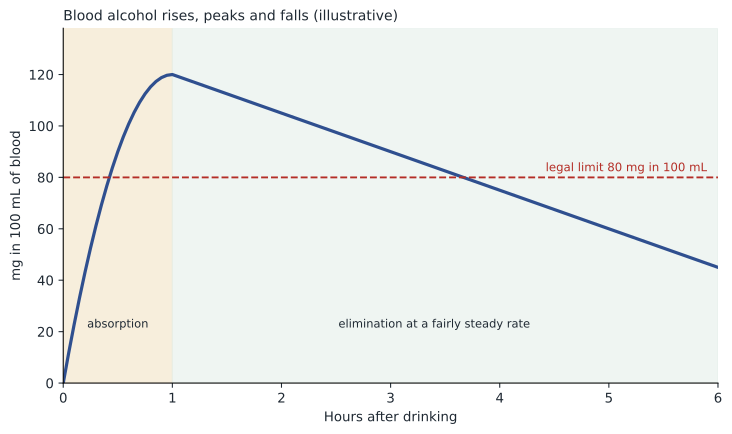
The amount of alcohol in the blood rises during the absorption phase after drinking, reaches a peak, and then falls during the elimination phase as the liver breaks alcohol down. In most people, elimination proceeds at a fairly steady rate, often taken as about 15 mg in 100 mL per hour, with a range of about 10 to 20. Food in the stomach slows absorption and lowers the peak. Officers are not experts in these calculations, but they should understand them, because toxicologists use them in court to estimate a driver's concentration at the time of driving, and defence lawyers raise them to argue that a driver was still absorbing alcohol and was under the limit when stopped.
Worked problem
A toxicologist's back-calculation
A toxicologist is asked to estimate a driver's BAC at 22:30, when a collision happened, from a blood sample taken at 01:00 that showed 95 mg in 100 mL. Assuming the driver had finished absorbing alcohol by 22:30 and eliminated it at 15 mg per hour, what was the BAC at the time of the collision? What range follows from elimination rates of 10 to 20 mg per hour?
Show solution
- The time between the collision and the sample is 2.5 hours.
- \[95 + 2.5 \times 15 = 132.5 \text{ mg in 100 mL}\]
- \[95 + 2.5 \times 10 = 120, \quad 95 + 2.5 \times 20 = 145\]
- Every value in the range is over the limit, which is why the estimate is useful even with uncertainty about the rate.
Answer: About 132 mg, with a range of 120 to 145 mg in 100 mL.
Blood samples
Blood is the most direct measure of alcohol and drug concentration and is the main sample for drugs other than alcohol. Under section 320.28(1)(a)(ii) and (2), an officer with reasonable grounds can demand blood samples taken by or under the direction of a qualified medical practitioner or a qualified technician, if the medical practitioner or technician is satisfied that taking the sample will not endanger the person's health. When a person cannot consent or provide breath because of their condition, for example after a serious collision, a justice can issue a warrant for blood samples under section 320.29, and hospitals' own medical samples can sometimes be obtained by a production order or search warrant.
| Sample | What it shows | Main limits |
|---|---|---|
| Breath | Alcohol concentration, quickly and without a needle | Only alcohol; mouth alcohol and timing rules |
| Blood | Alcohol and drug concentrations directly | Needs a qualified person, a demand or warrant, and health safety |
| Oral fluid | Presence of some drugs | Screening only at the roadside; presence, not impairment |
| Urine | Presence of drugs or metabolites over a longer period | Not used for Criminal Code concentration offences |
Drug recognition evaluations
Because no roadside device measures drug impairment, both countries use trained drug recognition experts, or DREs, to evaluate drivers suspected of drug impairment. The Drug Evaluation and Classification Program was developed by the Los Angeles Police Department in the 1970s and is now coordinated by the International Association of Chiefs of Police with NHTSA, and used in both countries. A DRE follows a standardized twelve-step evaluation and forms an opinion about whether the person is impaired and, if so, by which category of drug.
| Step | What the DRE does |
|---|---|
| 1. Breath alcohol test | Rules alcohol in or out as the explanation |
| 2. Interview of the arresting officer | Learns what was seen and said |
| 3. Preliminary examination and first pulse | Checks for injury or illness |
| 4. Eye examinations | HGN, vertical gaze nystagmus and lack of convergence |
| 5. Divided attention tests | Modified Romberg balance, walk-and-turn, one-leg stand, finger to nose |
| 6. Vital signs and second pulse | Blood pressure and temperature |
| 7. Dark room examinations | Pupil size in different lighting |
| 8. Muscle tone | Whether muscles are rigid or flaccid |
| 9. Check for injection sites and third pulse | Looks for signs of injected drugs |
| 10. Statements and other observations | Questions about drug use, after rights are given |
| 11. Opinion of the evaluator | Impaired or not, and which drug category or categories |
| 12. Toxicological examination | A bodily fluid sample to confirm the drug |
The DRE's opinion names one or more of seven drug categories: central nervous system depressants, central nervous system stimulants, hallucinogens, dissociative anaesthetics, narcotic analgesics, inhalants and cannabis. Each category produces a typical pattern of signs. For example, cannabis typically produces lack of convergence, a raised pulse and normal or slightly enlarged pupils, while narcotic analgesics such as opioids typically produce very small pupils and a lowered pulse.
Section 320.28(2)(b) allows an officer with reasonable grounds of drug impairment to demand that the person submit to an evaluation by an evaluating officer, and section 320.28(4) then allows a demand for a bodily fluid sample if the evaluating officer has reasonable grounds. In R. v. Bingley in 2017, the Supreme Court of Canada held that a qualified evaluating officer can give an opinion on drug impairment at trial without a separate hearing on their expertise, because Parliament had recognized their training in the Criminal Code.
Disclosure and the breath file
Every evidential test produces records that must be disclosed to the defence: the certificate or test record, the instrument's maintenance and calibration logs, the operator's qualifications, the observation notes and any video from the breath room. Section 320.34 of the Criminal Code, added in the 2018 reforms, lists specific records about the test and the instrument that the prosecution must provide on request. Okoro keeps a copy of every test record with his notes. 'Somebody will ask for it,' he says. 'Every single time.'
Hospital samples and medical records
After serious collisions, drivers are often taken to hospital before police can arrange an evidential test, and hospital staff may take blood for medical reasons. Those medical samples and records can be valuable evidence, but they belong to the patient's medical care and are protected by privacy law. Police generally need a search warrant or production order to obtain hospital blood samples or medical records, and courts have excluded evidence when police obtained them informally from hospital staff, as in R. v. Dyment in 1988. Hospital tests also often measure alcohol in serum or plasma rather than whole blood, which gives a higher number; a toxicologist must convert the result before it can be compared with the legal limit.
The breath room as evidence
Most stations now record the breath room on video. The recording shows the observation period, the demand, the instructions and the samples, and it often settles disputes about what was said and whether the person had a chance to contact counsel. Okoro tells new officers to assume that a judge will watch every minute of the video. 'If you are on your phone during the observation period, the judge will see it. If you explain the instructions clearly and patiently, the judge will see that too.'
Blood demands and warrants for blood are usually arranged at the hospital, and the officer must record who took the sample, when, using what kit, and how it was sealed, labelled and sent to the Centre of Forensic Sciences for analysis. Continuity is as important for a blood sample as for any other exhibit, and a gap in the record can make the result impossible to use.
Common mistakes
MistakeMouth alcohol does not affect breath results.
InsteadIt can greatly raise a result, which is why officers observe the person before the test.
MistakeBreath samples can be taken at any time after the arrest.
InsteadThey must be taken as soon as practicable, and the presumption in s.320.31(4) applies after two hours.
MistakeBlood can be taken by any officer on demand.
InsteadBlood must be taken by a qualified medical practitioner or technician, and only if it will not endanger health.
MistakeA DRE identifies the exact drug.
InsteadThe DRE identifies drug categories; toxicology confirms the drug.
Summary and key terms
- Breath instruments measure deep lung air and report a concentration; observation guards against mouth alcohol.
- Results are conclusive if the samples were 15 minutes apart, agree within 20 mg and the instrument checks passed; the lowest result counts.
- Blood alcohol rises, peaks and falls at a fairly steady elimination rate, which toxicologists use to estimate earlier concentrations.
- Blood demands require a qualified person; warrants are available when the person cannot consent.
- Drug recognition experts follow a twelve-step evaluation and identify drug categories.
- Every test produces records that must be kept and disclosed.
- Mouth alcohol
- Alcohol in the mouth that can falsely raise a breath result.
- Elimination rate
- The rate at which the body removes alcohol from the blood.
- Drug recognition expert
- An officer trained to evaluate whether a person is impaired by drugs and by which category.
- Approved instrument
- A breath instrument approved by the federal Attorney General for evidential tests.
Practice problems
Work each problem on paper first, then reveal the answer to check.
Why is there an observation period before a breath test?
Show answer
To make sure mouth alcohol from burping, vomiting or anything in the mouth does not affect the result.
What happens if the first sample is taken more than two hours after operation?
Show answer
The BAC is presumed to be the result plus 5 mg for every 30 minutes beyond two hours.
What does a DRE's opinion identify?
Show answer
Whether the person is impaired and by which drug category or categories.
What range of elimination rates do toxicologists commonly use?
Show answer
About 10 to 20 mg in 100 mL per hour.
Lesson quiz · 5 questions
Score 60% or more to complete this lesson.
Create a free account to save your progress, take quizzes and earn a certificate.