
LES-203 · Lesson 8 of 12 · 20 min
Responding to a collision: priorities and scene management
▶ Video coming soon A video version of this lesson is on the way.
The first 911 call about the Kingsway collision came at 01:40:20 from a taxi driver, Omar Siddiqui, who had been stopped at the red light on Mill Street, facing the intersection. 'A truck just smashed a little car,' he told the call-taker. 'The car's on the corner, there's a woman inside, she's not moving. The truck guy is out, he's walking around.' Reyes and Malhotra, in car 14 on Harbour Road, were dispatched at 01:40:55 and arrived at 01:43:10. Kowalczyk, who had been finishing paperwork at the traffic office, arrived at 01:44:30. Fire and paramedics arrived at 01:46.
This lesson covers what officers do in the first minutes and hours at a collision. Desjardins tells the class that the first officers at a collision have to be five people at once: a first-aider, a traffic controller, a scene manager, an investigator and a witness. 'You cannot do all five well at the same moment. You have to know the order. Life first. Then the scene. Then the evidence. Then everything else.'
Priorities on arrival
Most police services teach a short list of priorities for collision scenes, in this order: the safety of responders and the public, the preservation of life, the protection of the scene and evidence, the identification of the people involved and witnesses, and the restoration of traffic. The order matters because each priority depends on the one before. An officer who is struck by a passing car cannot help anyone. A victim who dies because the officer was photographing tire marks is a failure no evidence can make up for. But an officer who rushes to the victim without protecting the scene from passing traffic may create a second collision.
| Priority | What it means at the scene | What car 14 did on Kingsway |
|---|---|---|
| Safety | Protect responders and the public from traffic and hazards | Parked the cruiser across the westbound lanes with emergency lights on, upstream of the debris |
| Life | Check and help the injured; call for medical help | Malhotra went to the hatchback; Reyes confirmed paramedics and fire were coming |
| Scene | Stop the scene from changing; keep evidence in place | Reyes asked dispatch for another car to close Kingsway at Harbour Road |
| People | Identify drivers, passengers and witnesses; keep them available | Reyes spoke with Halloran and kept him away from the vehicles; noted the taxi |
| Traffic | Reopen roads once the scene is documented | Kingsway stayed closed until 05:20 |
Safety: protecting the scene from traffic
Responders at collisions are exposed to passing traffic, and secondary collisions at crash scenes kill and injure police officers, firefighters, paramedics and tow operators every year. Officers use their vehicles to protect the scene, placing them upstream of the work area with emergency lights on so that approaching drivers see a barrier before they reach people on foot. They set out flares or cones to give approaching drivers advance warning and a gradual taper into the open lanes. In Ontario, the Ontario Traffic Manual, Book 7, sets out standards for temporary traffic control, including at emergency scenes.
Collision scenes also have their own hazards. Leaking fuel can ignite. Damaged electric and hybrid vehicles can hold high-voltage batteries that may short and catch fire hours later. Airbags that did not deploy can deploy unexpectedly. Downed power lines, broken glass, sharp metal and spilled loads add to the risks. Officers are taught to look before approaching, to report hazards to fire crews, and to stay out of the space that a fire crew or paramedic is working in. On Kingsway, the hatchback was a small gasoline car and the pickup was undamaged except for its front end, but Malhotra still checked under both vehicles for leaks before leaning into the hatchback.
Life: first aid and medical response
Malhotra found Rosa Pereira conscious but confused, pinned in the passenger seat by the door, which had been pushed in almost to the centre console. Ana Pereira was out of the car on the sidewalk, holding her arm and calling her mother's name. Malhotra did not try to move Rosa, because of the risk of spinal injury and because the door was jammed. He talked to her, kept her still, checked her breathing and looked for bleeding, and reported to dispatch that a passenger was trapped with possible serious injuries so that fire would bring extrication tools. Fire crews cut away the door and the roof pillar and removed her on a spinal board at 02:05. She was taken to Port Ardent General at 02:12.
Kowalczyk makes a point that surprises some students. 'Paramedics and firefighters will move things. They will cut the car, move the seat, step on glass and drive their trucks over the debris. That is right. Their job is to save her. Your job is to remember what the scene looked like before they did, and to photograph it as soon as you safely can, even with your phone.' Reyes took fourteen photographs of the vehicles and the intersection between 01:44 and 01:47, before fire arrived. Several of them later showed the positions of debris that was scattered by the fire trucks.
Protecting the scene and evidence
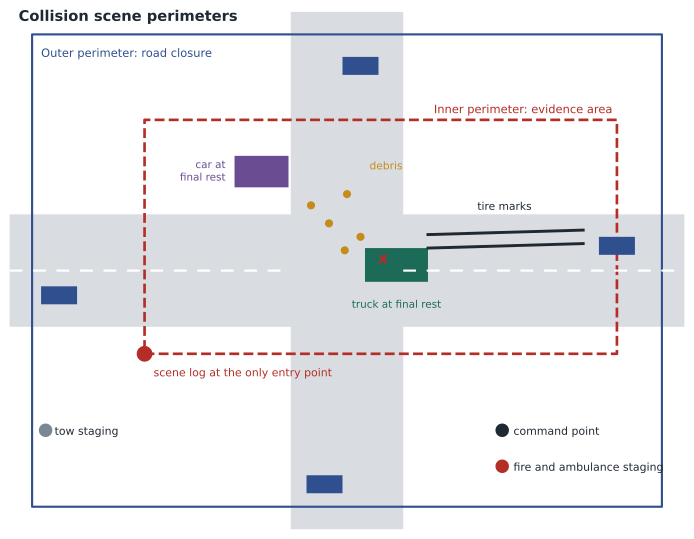
Once the injured are being cared for, the next priority is to stop the scene from changing. Collision evidence is fragile: tire marks can be driven over and smudged, debris can be kicked and swept, fluids evaporate, and vehicles may be moved by well-meaning bystanders or by tow operators. Officers set up a perimeter as soon as they can, wide enough to include all the evidence. The inner perimeter encloses the area where evidence lies, from the first marks to the vehicles' final rest positions; only people with a job to do enter it, and a scene log records who comes and goes. The outer perimeter is the traffic closure, which keeps vehicles and spectators away.
Worked problem
How big should the inner perimeter be?
Reyes sees tire marks starting about 25 metres east of the point where the vehicles met, and debris and the hatchback's final rest position about 18 metres beyond it to the west. Her service's guideline is to add at least 15 metres beyond the furthest evidence at each end. How long should the inner perimeter be along Kingsway?
Show solution
- The evidence spans 25 plus 18, which is 43 metres.
- Add 15 metres at each end.
- \[43 + 2 \times 15 = 73 \text{ m}\]
- The perimeter can be made larger once the reconstructionist arrives, but it is very hard to make it larger once evidence outside it has been disturbed.
Answer: At least 73 metres.
Kowalczyk's rule is that a perimeter should start too big. 'You can always shrink it. You can never grow it back over evidence that a tow truck has already driven across.' On Kingsway, the first officers taped from the first tire mark to the corner of the bank lot, and Kowalczyk later extended it east by another 20 metres after he found a faint mark the first officers had not seen.
People: drivers, passengers and witnesses
Drivers and witnesses are as fragile a source of evidence as tire marks. Witnesses leave, especially at night, and memories change quickly when people talk to each other or read about a collision. Officers identify everyone at the scene, separate the drivers, and ask witnesses to wait or at least give their names and contact details before they leave. Reyes asked Siddiqui to park his taxi off the road and wait; he also mentioned that his taxi had a dashboard camera, which turned out to be one of the most important pieces of evidence in the case. Section 199 of the Highway Traffic Act requires drivers involved in collisions above the reporting threshold to report them to police, and section 200 requires drivers to remain at the scene, give assistance and provide their names, addresses and insurance details. Failing to stop after an accident is also a Criminal Code offence under section 320.16.
Halloran was standing beside his truck when Reyes arrived. He said, without being asked, 'She just turned straight in front of me. I had the green.' Reyes wrote down his words and the time. She asked him whether he was hurt, asked for his licence, registration and insurance, and asked him to sit in the back of the cruiser with the door open, which he did. Because this was a collision causing bodily harm that might lead to a criminal charge, Reyes gave him his rights to counsel and a caution once she decided he was detained for the investigation, at 01:51. She also made a mandatory alcohol screening demand at 01:53; the approved screening device showed a pass. Ana Pereira's screening test, taken at the hospital later with her consent, also showed no alcohol.
Desjardins points out that a driver's first words at a collision are often the most honest and the most self-serving at the same time. 'Halloran said he had the green. That was true; the lights were green for him. He also said she turned in front of him, which was also true. What he did not say was how fast he was going. Your job is to write down exactly what was said, not to decide yet what it means.'
Calling out the collision investigators
Most services have a policy that sets out when specialist collision investigators or reconstructionists must be called. Typical criteria include a death or a likely death, a life-threatening injury, a collision involving a police vehicle, a school bus or a commercial vehicle carrying dangerous goods, and any collision where a serious criminal charge is likely. Port Ardent's policy also lists collisions where the first officers believe excessive speed may have caused serious injury. Kowalczyk was already at the scene when Rosa Pereira's injuries were confirmed as serious, and he took over the investigation at 02:15, with Reyes and Malhotra assigned to him for the rest of the night.
| Typical call-out criterion | Why it needs specialists |
|---|---|
| A death or likely death | Possible criminal charges, a coroner's investigation and lasting public interest |
| A life-threatening or serious injury | Possible criminal or serious provincial charges; the injury may become a death |
| A police, transit or school vehicle involved | Public confidence requires an independent, thorough investigation |
| Dangerous goods or commercial vehicles | Complex regulations and specialized evidence such as logbooks and inspections |
| Suspected excessive speed or impairment with injury | Speed and impairment need scientific evidence to prove |
Coordinating with other agencies
A serious collision brings many agencies together: police, fire, paramedics, tow operators, the city's road and signal crews, and sometimes utility companies, public transit, environmental authorities and the coroner or medical examiner. The first officer on scene is the initial incident commander until a more senior or more qualified person takes over, and the same incident command principles covered in earlier courses apply. On Kingsway, Haddad arrived at 01:58 and took overall command, with Kowalczyk in charge of the investigation, the fire captain in charge of rescue and the traffic officers in charge of closures. They agreed on a single command point at the corner of Kingsway and Harbour Road, outside the inner perimeter.
Haddad also asked dispatch to contact the city's signal technician, who arrived at 03:10 and downloaded the signal controller's timing log for the intersection. The log confirmed that Kingsway had a green light in both directions at the time of the collision, that the night-time plan had no protected left-turn arrow, and that the yellow phase for Kingsway was set at 4.0 seconds. Without that log, the investigators would have had to rely on what the drivers and Siddiqui remembered.
Reopening the road
Closing a major road has costs. It delays emergency vehicles, diverts traffic onto residential streets and can cause secondary crashes at the edge of the closure. Officers keep a road closed only as long as the investigation needs. On Kingsway, the documentation took until 05:00, the vehicles were towed by 05:15 to the service's secure garage, and the road reopened at 05:20, before the morning traffic began. Kowalczyk insisted that both vehicles be towed to the secure garage rather than to a commercial lot, so that their data could be downloaded under warrant and their mechanical condition examined.
Common mistakes
MistakeThe first job at a collision is to photograph the evidence.
InsteadSafety and life come first; evidence comes once the injured are cared for, though early photographs are very valuable.
MistakeA small perimeter is easier to manage, so start small.
InsteadStart large; a perimeter can be reduced but evidence outside it cannot be recovered.
MistakeA driver who says "I had the green" has explained the collision.
InsteadRecord the words exactly and keep an open mind; the statement may be true but incomplete.
MistakeThe road should stay closed until every question is answered.
InsteadClose it only as long as the documentation needs; long closures have their own risks.
Summary and key terms
- Priorities at a collision are safety, life, the scene, the people and then traffic.
- Responders protect themselves from secondary collisions with vehicles, warning devices and traffic control standards.
- Officers help the injured first but photograph the scene early, because rescue changes it.
- An inner perimeter protects evidence, an outer perimeter closes the road, and a scene log records entry.
- Drivers and witnesses must be identified, separated and kept available; first statements are recorded exactly.
- Specialist investigators are called for deaths, serious injuries and other listed collisions.
- Secondary collision
- A crash that happens at or near the scene of an earlier one.
- Inner perimeter
- The protected area containing collision evidence, entered only by people with a role.
- Final rest position
- Where a vehicle or object came to a stop after a collision.
- Signal timing log
- A record from a traffic signal controller showing which signals were displayed when.
Practice problems
Work each problem on paper first, then reveal the answer to check.
What are the five collision scene priorities, in order?
Show answer
Safety, life, the scene and evidence, the people involved and witnesses, and restoring traffic.
Why did Reyes photograph the scene before fire arrived?
Show answer
Because the rescue would move debris and change the scene.
What does the inner perimeter include?
Show answer
All the evidence from the first marks to the final rest positions, plus a margin.
What did the signal timing log show?
Show answer
That Kingsway had a green light in both directions, with no left-turn arrow and a 4.0-second yellow.
Lesson quiz · 5 questions
Score 60% or more to complete this lesson.
Create a free account to save your progress, take quizzes and earn a certificate.