
LES-203 · Lesson 6 of 12 · 20 min
Detecting impairment and roadside screening
▶ Video coming soon A video version of this lesson is on the way.
Ruiz had been watching each car approach the RIDE check for several seconds before it reached him. Lindqvist's sedan came to a stop about a car length too far forward, and Lindqvist took a moment to find the button for his window. Neither of those things proved anything. But when the window came down, Ruiz smelled alcohol, saw that Lindqvist's eyes were watery and red, and heard him say that he had had 'two glasses of wine with dinner, hours ago.' Ruiz asked him to pull into the lane marked by cones on the right, where Haddad was waiting with the screening equipment.
This lesson covers what officers look for when deciding whether a driver might be impaired, and the roadside tools the law gives them to confirm or dispel that suspicion. Kowalczyk describes roadside screening as a sorting process. 'Most drivers who have had a drink are under the limit and go home. A few are over and get arrested. The screening tools let us tell them apart quickly and fairly, in a few minutes at the side of the road, without taking everyone to the station.'
The three phases of detection
Training in both countries teaches impaired driving detection in three phases, a model developed by NHTSA and widely used in Canada as well. Phase one is the vehicle in motion: the officer watches how the vehicle is driven before and during the stop. Phase two is personal contact: the officer talks with the driver and observes their face, eyes, speech, breath, hands and responses. Phase three is pre-arrest screening: tests and instruments at the roadside that help the officer decide whether there are grounds for arrest or for an evidential demand.
| Phase | What the officer looks for | Examples |
|---|---|---|
| Vehicle in motion | Driving that suggests impairment | Weaving, drifting, wide turns, stopping too far forward, very slow speed, no headlights at night |
| Personal contact | Signs in the driver's appearance and behaviour | Odour of alcohol or cannabis, red or watery eyes, slurred speech, fumbling with documents, admissions of drinking |
| Pre-arrest screening | Results of roadside tests | Approved screening device, standardized field sobriety tests, approved drug screening equipment |
Each observation is only a clue. Watery eyes may come from allergies or tiredness, and fumbling may come from nerves. Officers are trained to describe what they saw in specific terms, such as 'the driver took four attempts to remove his licence from his wallet', rather than writing a conclusion such as 'the driver was drunk.' The court decides what the observations mean; the officer's job is to record them accurately.
Mandatory alcohol screening and screening demands
Since December 2018, section 320.27(2) of the Criminal Code has allowed an officer who has an approved screening device in their possession, and who is acting in the course of the lawful exercise of their powers, to demand that the driver of a motor vehicle immediately provide a breath sample into the device, without any suspicion that the driver has alcohol in their body. This is called mandatory alcohol screening. Parliament adopted it because studies in other countries, such as Ireland and Australia, found that suspicion-based screening missed many drivers who were over the limit. Section 320.27(1) allows a demand for a screening breath sample, physical coordination tests or a drug screening sample when the officer reasonably suspects that a driver has alcohol or a drug in their body and has operated a conveyance within the previous three hours.
Haddad made a mandatory alcohol screening demand to Lindqvist at 23:14, reading it from her card: 'I demand that you provide immediately a sample of your breath, suitable for analysis, into an approved screening device.' She explained how to blow, and Lindqvist provided a sample at 23:16. The device showed an F, meaning fail. In Port Ardent, as in most services, the devices are calibrated so that a fail means a concentration of at least 100 mg in 100 mL, a warn means 50 to 99 and a pass means under 50. The fail, together with her other observations, gave Haddad reasonable grounds to believe that Lindqvist had committed the 80-or-over offence, and she arrested him at 23:17.
Standardized field sobriety tests
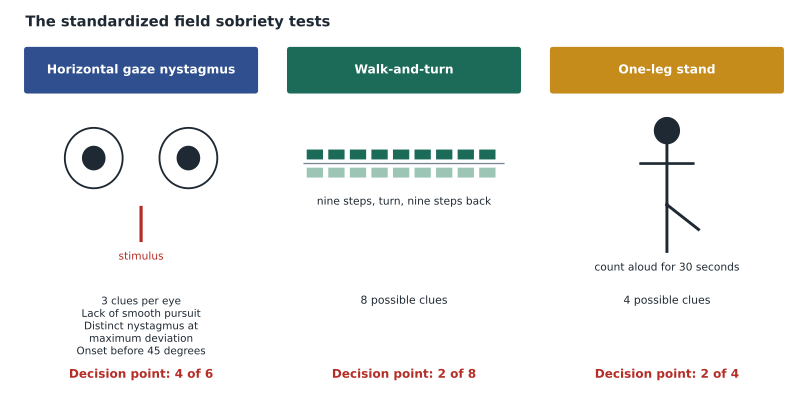
The standardized field sobriety tests, or SFSTs, are three tests developed and validated in research funded by NHTSA in the 1970s and 1980s, and they are used throughout the United States and in Canada. They are standardized because they must be given and scored the same way every time. If an officer departs from the standard instructions, the results can lose their reliability and their weight in court. The three tests are horizontal gaze nystagmus, walk-and-turn and one-leg stand.
Horizontal gaze nystagmus, or HGN, is an involuntary jerking of the eyes that occurs as the eyes move to the side. Everyone has some nystagmus at extreme angles, but alcohol and some drugs make it appear sooner and more distinctly. The officer asks the driver to follow a stimulus, such as a pen tip, with their eyes only, and checks each eye for three clues: lack of smooth pursuit, distinct and sustained nystagmus at maximum deviation, and onset of nystagmus before 45 degrees. That gives six possible clues, and four or more is the decision point that suggests impairment. The officer also checks first for signs of medical conditions, such as unequal pupils or unequal tracking, that could affect the test.
The walk-and-turn test is a divided attention test. The driver stands heel to toe while listening to instructions, then takes nine heel-to-toe steps along a line, turns in a prescribed way and takes nine steps back, counting aloud and watching their feet. There are eight possible clues, such as starting too soon, stepping off the line, missing heel to toe or using the arms for balance, and two or more is the decision point. The one-leg stand test asks the driver to raise one foot about 15 centimetres off the ground and count aloud for thirty seconds. There are four clues, such as swaying, using the arms, hopping or putting the foot down, and two or more is the decision point.
| Test | Possible clues | Decision point | Lindqvist's result |
|---|---|---|---|
| Horizontal gaze nystagmus | 6 (3 per eye) | 4 or more | 6 of 6 |
| Walk-and-turn | 8 | 2 or more | 3: stopped walking, missed heel to toe, raised arms |
| One-leg stand | 4 | 2 or more | 2: swayed, put foot down at count 17 |
In Canada, Haddad did not need the SFSTs for Lindqvist, because the approved screening device fail gave her grounds. Officers use the SFSTs mainly in drug cases, under the authority in section 320.27(1)(a), and in alcohol cases where an approved screening device is not available. The table shows the results that Port Ardent's trainers use in a classroom exercise based on Lindqvist's case, to show how the SFSTs would have looked if an approved screening device had not been at hand.
Drug-impaired driving at the roadside
Drug-impaired driving is harder to detect than alcohol impairment, because there is no single roadside test that measures impairment by drugs, and many drugs produce different signs. Since 2018, police have been able to use approved drug screening equipment, which tests a sample of oral fluid for the presence of THC and, with some devices, cocaine and methamphetamine. The federal Attorney General approved the Dräger DrugTest 5000 and later the Abbott SoToxa as approved drug screening equipment. A positive result does not prove impairment, but it can contribute to reasonable grounds for a blood demand or a drug evaluation demand.
Signs that may suggest drug impairment include pupils that are unusually large or small for the lighting, an odour of cannabis, body tremors, very slow or very rapid speech, and a lack of convergence when the driver is asked to cross their eyes toward their nose. Officers are trained not to guess which drug is involved at the roadside. Their task is to document what they see and decide whether they have grounds for the next step.
Rights at the roadside
As lesson 4 explained, the right to counsel under section 10(b) of the Charter is suspended during roadside screening, because screening must happen immediately (Orbanski and Elias, 2005). But it applies once the driver is arrested or a demand for an evidential sample is made. Haddad gave Lindqvist his rights to counsel at 23:18, just after the arrest, and read him the demand for evidential breath samples at 23:19. She also gave him the standard caution about statements. Lindqvist said he wanted to speak to duty counsel, and Haddad noted that she would arrange it at the station before the breath tests.
Timelines and notes
Every impaired driving investigation depends on a precise timeline, because several legal rules depend on how much time passed between steps. Officers write the time of each step to the minute, and many services use a checklist. Kowalczyk shows the students the timeline from Lindqvist's case, which the officers built from their notes and the checkpoint log.
| Time | Event |
|---|---|
| 23:10 | Vehicle stopped at RIDE check |
| 23:11 | Odour of alcohol, red watery eyes, admission of two glasses of wine |
| 23:14 | Mandatory alcohol screening demand |
| 23:16 | Sample into approved screening device: F (fail) |
| 23:17 | Arrest for 80 or over |
| 23:18 | Rights to counsel and caution given |
| 23:19 | Evidential breath demand under s.320.28(1) |
| 23:31 | Arrival at station |
Worked problem
How long after driving?
The last time Lindqvist was operating his car was 23:10. The arrest was at 23:17. How long after operation was the arrest, and how much of the two-hour window in section 320.14(1)(b) remains?
Show solution
- From 23:10 to 23:17 is 7 minutes.
- The two-hour window ends at 01:10.
- \[120 - 7 = 113 \text{ minutes remaining}\]
Answer: 7 minutes after operation; 113 minutes of the window remain.
Conditions that can look like impairment
Several medical conditions produce signs that look like impairment, and officers must keep them in mind. A person with diabetes whose blood sugar has dropped too low may be confused, sweaty, slurring and unsteady, and may smell of acetone, which can be mistaken for alcohol. A head injury, a stroke or a seizure can cause confusion, unequal pupils, weakness on one side and poor balance. Inner-ear disorders affect balance, and some eye conditions affect the nystagmus tests. Fatigue produces many of the same signs as low-level impairment. Officers who see signs that do not fit, such as unequal pupils, a strong smell of acetone without alcohol, or weakness on one side of the body, call paramedics first and investigate impairment only once the person's medical condition is known. A missed medical emergency is far more serious than a missed impaired driving charge.
Running a check stop fairly
In Ontario, RIDE programs stop drivers at fixed locations chosen to catch impaired drivers on routes and at times when they are most likely to be on the road, such as near bars and event venues late at night. Every vehicle is stopped, or vehicles are stopped in a set pattern, so that officers are not choosing whom to check. Since mandatory alcohol screening began, many services ask every driver at a RIDE check to provide a screening sample, while others use it more selectively. Either way, the location, the times, the pattern and the screening policy are written down in advance, and the supervisor records how many vehicles were stopped and the results, so that the program can be evaluated and explained. Haddad's check on Harbour Road stopped 214 vehicles in two hours, screened every driver, and found two over the limit and three in the warn range.
Desjardins asks the students whether a check stop that finds two impaired drivers among two hundred is worth the cost. Most of the class says yes, and Haddad adds a point many miss. 'The two we caught are not the main benefit. The main benefit is the hundreds of people who will think twice about driving home from a party next weekend because they saw us there. Visible enforcement works by changing what people expect.'
Officers at a check stop also watch for drivers who try to avoid it, for example by turning sharply away just before the stop or pulling into a side street. Avoiding a check stop is not an offence in itself, but the way a vehicle is driven can give an officer reason to stop it, and many services post an officer beyond the check point to watch for such driving.
Common mistakes
MistakeWatery eyes or fumbling prove impairment.
InsteadThey are clues that must be recorded in specific terms; the court decides what they mean.
MistakeA mandatory screening demand requires reasonable suspicion.
InsteadUnder s.320.27(2), no suspicion is needed if the officer has an approved screening device and is lawfully stopping the driver.
MistakeField sobriety tests can be given any way the officer likes.
InsteadThey are standardized and must be given and scored the same way every time.
MistakeA positive drug screening result proves impairment.
InsteadIt shows presence, not impairment, and contributes to grounds for the next step.
Summary and key terms
- Detection has three phases: vehicle in motion, personal contact and pre-arrest screening.
- Mandatory alcohol screening under s.320.27(2) needs no suspicion; s.320.27(1) screening needs reasonable suspicion.
- The three SFSTs are HGN, walk-and-turn and one-leg stand, with decision points of 4, 2 and 2 clues.
- Drug screening shows the presence of a drug, not impairment.
- The right to counsel is suspended during roadside screening but applies after arrest or demand.
- A precise timeline is essential because several rules depend on elapsed time.
- Nystagmus
- An involuntary jerking of the eyes.
- Decision point
- The number of clues on a standardized test that suggests impairment.
- Divided attention test
- A test that requires the person to do mental and physical tasks at once.
- Approved screening device
- A roadside breath device that gives a pass, warn or fail result.
Practice problems
Work each problem on paper first, then reveal the answer to check.
What are the three phases of impaired driving detection?
Show answer
Vehicle in motion, personal contact and pre-arrest screening.
What are the decision points for the three SFSTs?
Show answer
Four of six clues on HGN, two of eight on walk-and-turn and two of four on one-leg stand.
What does a fail on an approved screening device usually mean?
Show answer
A concentration of at least 100 mg in 100 mL.
Why should officers describe observations in specific terms?
Show answer
Because specific facts are evidence, while conclusions are for the court.
Lesson quiz · 5 questions
Score 60% or more to complete this lesson.
Create a free account to save your progress, take quizzes and earn a certificate.