
LES-203 · Lesson 3 of 12 · 25 min
Speed enforcement: radar, lidar and pacing
▶ Video coming soon A video version of this lesson is on the way.
From 23:30 to 01:30 on the Friday night, Constable Nadine Coutu ran speed enforcement on Kingsway from a marked cruiser parked in the lot of a closed tire shop, facing the traffic heading west from Harbour Road. She used a hand-held lidar device, sometimes called a laser speed gun. Before starting, she tested the device using the checks the manufacturer and her service require, wrote the results in her notebook, and recorded the posted limit, the weather and the road conditions. In two hours she stopped six drivers. One of them, at 00:47, was a black pickup truck whose speed she measured at 81 km/h in the 50 km/h zone. It was the same truck that struck the Pereiras' hatchback less than an hour later.
That earlier stop would become important evidence. Kowalczyk says it is one of the reasons he tells new officers that every speed stop should be documented as if it might end up in a much bigger case. 'Coutu's notes put that truck at that speed on that road, with that driver, fifty-three minutes before the crash. The defence was always going to say he was a careful driver who happened to be in the wrong place. Her notes made that hard to argue.'
How officers measure speed
Police use four main methods to measure the speed of a vehicle: radar, lidar, pacing and timing over a known distance, which includes aircraft enforcement and automated cameras. Each relies on simple physics, and each has known sources of error that officers must understand and be ready to explain in court. Canadian courts generally accept that properly tested radar and lidar devices measure speed accurately, but the officer must show that the device was approved, tested as required and used by a trained operator.
Radar
Radar, short for radio detection and ranging, sends out a radio signal and measures the change in frequency of the signal reflected from a moving vehicle. This change is called the Doppler shift. When a vehicle is moving toward the radar, the reflected waves are compressed and the frequency rises; when it is moving away, they are stretched and the frequency falls. The size of the shift is proportional to the vehicle's speed relative to the radar unit, so the unit can convert it directly to a speed.
Police radar comes in two main forms. Stationary radar is used from a parked cruiser. Moving radar works while the cruiser is moving; it measures the patrol vehicle's own speed from the road surface and subtracts or adds it to find the target's speed. Radar beams spread out as they travel, so at long range the beam can cover several lanes and several vehicles. The officer must therefore identify the target visually and estimate its speed before relying on the reading, a practice called tracking history or visual estimate confirmation.
Lidar
Lidar, short for light detection and ranging, sends out short pulses of infrared laser light and measures how long each pulse takes to travel to the vehicle and back. Because light travels at a known speed, about 300,000 kilometres per second, the time of flight gives the distance to the vehicle. The device fires many pulses in a fraction of a second and calculates speed from how quickly the distance changes. A lidar beam is very narrow, so at 300 metres it is only about a metre wide, which lets the officer pick out a single vehicle in traffic.
Worked problem
Distance from time of flight
A lidar pulse returns from a vehicle 1.20 microseconds after it was sent. How far away is the vehicle? Use 300 metres per microsecond for the speed of light.
Show solution
- The pulse travels to the vehicle and back, so the distance to the vehicle is half the total path.
- \[d = \frac{300 \times 1.20}{2} = 180 \text{ m}\]
- The device repeats this many times per second and tracks how quickly the distance shrinks.
Answer: About 180 metres.
Worked problem
Speed from two distances
Two lidar measurements taken 0.30 seconds apart give distances of 182.40 m and 177.65 m. What is the vehicle's speed in km/h?
Show solution
- The vehicle closed 182.40 minus 177.65, which is 4.75 m, in 0.30 s.
- \[v = \frac{4.75}{0.30} = 15.83 \text{ m/s}\]
- To convert metres per second to kilometres per hour, multiply by 3.6.
- \[15.83 \times 3.6 \approx 57.0 \text{ km/h}\]
Answer: About 57 km/h.
The cosine effect
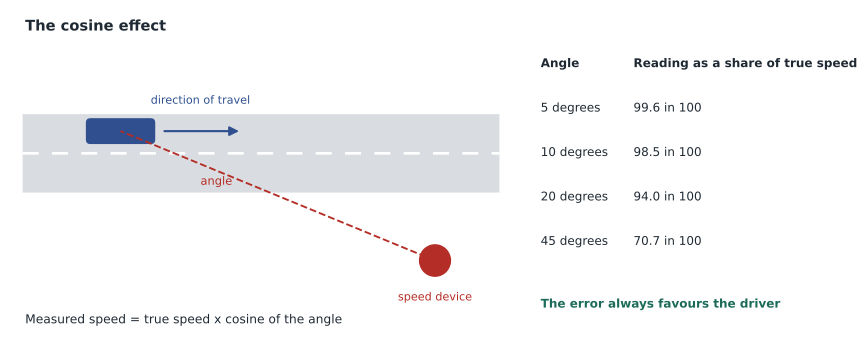
Both radar and lidar measure the speed at which the distance between the device and the vehicle changes. If the officer is standing directly in the vehicle's path, that is the vehicle's true speed. If the officer is off to the side, the device measures only the part of the vehicle's motion that is directly toward it. This is called the cosine effect, because the measured speed equals the true speed multiplied by the cosine of the angle between the beam and the vehicle's path.
The cosine effect always makes the measured speed lower than the true speed, never higher, so it works in the driver's favour. At small angles the effect is tiny: at 10 degrees, the cosine is about 0.985, so a vehicle travelling 70 km/h reads about 68.9 km/h. At large angles, such as when the officer is very close to the road and the vehicle is nearly level with them, the reading falls sharply. Officers are trained to set up where the angle will be small at the distance where they take their readings.
Testing, approval and training
A speed measurement is only as good as the device and the operator. In Canada, police services use devices that meet national standards and are tested according to the manufacturer's instructions and service policy. Courts have generally required evidence that the officer was trained on the device, tested it before and after the shift in the way the manufacturer recommends, and used it properly.
| Check | Radar | Lidar |
|---|---|---|
| Self-test | Internal circuit test at start up | Internal display and circuit test |
| Accuracy check | Tuning forks that produce known speeds | Known-distance check against measured marks |
| Alignment | Not required for radar | Scope alignment check so the aiming dot matches the beam |
| When | Start and end of each shift, as policy requires | Start and end of each shift, as policy requires |
| Recorded | In the officer's notes and device log | In the officer's notes and device log |
Coutu's notes for the night show that she tested the lidar at 23:22 and again at 01:34, that each test passed, that she checked the scope alignment against a utility pole and confirmed the distance check against two marks painted on the lot 50.0 metres apart. She also noted her own training certificate number. Kowalczyk shows the students the page. 'This is what a speed case looks like when it is done properly. Six lines. Three minutes of work. It will survive any cross-examination.'
Pacing
Pacing means following a vehicle at a constant distance for a long enough stretch and reading the patrol car's own speedometer. If the gap does not change, the two vehicles are travelling at the same speed. Pacing needs no special device, but it depends on an accurate, recently calibrated speedometer and on the officer keeping the distance truly constant. Officers record the distance over which they paced, the gap, the speedometer reading and the date of the last speedometer calibration.
Worked problem
Correcting a paced speed
Malhotra paces a car for 600 metres at a steady gap. His speedometer reads 96 km/h. The patrol car's last calibration showed that at an indicated 100 km/h the true speed was 97 km/h. What speed should he record?
Show solution
- The calibration shows the speedometer reads about 3 in 100 high near this speed.
- \[96 \times \frac{97}{100} \approx 93 \text{ km/h}\]
- The officer records the corrected speed, along with the calibration certificate, because the correction favours the driver.
Answer: About 93 km/h.
Timing over a distance
Speed is distance divided by time, so a vehicle's average speed can be found by timing it between two marks a known distance apart. This is the principle behind aircraft enforcement, where an officer in a plane times vehicles between painted marks on a highway, and behind average-speed cameras used in some countries. It is also the principle investigators use to check witness claims: a witness who says a car went 'from the corner to the light in a couple of seconds' has given a distance and a time that can be turned into a speed.
Worked problem
Average speed between marks
An aircraft observer times a car between two marks 500 metres apart. It takes 15.0 seconds. What was its average speed?
Show solution
- Average speed is distance divided by time.
- \[\frac{500}{15.0} = 33.3 \text{ m/s} = 33.3 \times 3.6 \approx 120 \text{ km/h}\]
Answer: About 120 km/h.
Automated enforcement
Ontario municipalities can use automated speed enforcement cameras in school zones and community safety zones, and red-light cameras at intersections. Charges from these cameras are laid against the vehicle's registered owner, carry a fine but no demerit points, and are processed through an administrative penalty system or the courts, depending on the municipality. Automated enforcement has been controversial in some cities, but evaluations have generally found reductions in speeding where cameras operate.
Visual estimates and testimony
Courts accept an experienced officer's visual estimate of speed as evidence, especially when it is supported by a device reading. Speed enforcement training includes practice estimating speeds and then checking against a device, until estimates are consistently close. In court, the officer testifies to the visual estimate first, then to the device reading, the testing and the identification of the vehicle. Coutu's notes say she estimated the pickup's speed at well over 70 km/h before she triggered the lidar, which then read 81 km/h at 212 metres.
Coutu stopped the pickup in the lot of a closed bank, identified the driver as Brent Halloran from his licence, and issued a speeding ticket. Her notes record that he was calm and polite, that she detected no odour of alcohol, that his speech was normal and that he said he was 'just heading to a friend's place.' She also noted that he was holding a phone when she approached. She gave him the ticket, told him to slow down, and watched him pull away. He said later that he spent the next half hour at a friend's apartment near Harbour Road. At 01:40 he was back on Kingsway, heading west toward Mill Street, about 2.1 kilometres past the place where Coutu had stopped him.
Common challenges to speed evidence
Defence lawyers who challenge speed evidence usually focus on a small number of known problems. With radar, the classic issues are target identification, when the beam covers several vehicles and the strongest or fastest reflection may come from a different vehicle than the one stopped; interference from nearby transmitters or the patrol car's own fan and electrical system; and, with moving radar, shadowing, when the unit mistakes a large vehicle ahead for the road surface and calculates the patrol car's speed incorrectly. With lidar, the main issue is sweep or slip error, when the beam slides along the side of a vehicle during a measurement so that the distance changes for reasons other than the vehicle's motion. Modern lidar devices detect most such errors and refuse to display a reading.
The answer to each challenge is the same: training, testing and notes. An officer who can explain how the device works, show that it was tested before and after use, describe the setup and the angle, and state that the vehicle was identified visually before the reading was taken leaves little room for doubt. Officers should also be ready to admit what they do not know. A witness who says 'I am not an engineer, but I was trained to use this device and I used it as I was trained' is far more credible than one who claims to know everything about the electronics.
Common mistakes
MistakeRadar and lidar readings cannot be challenged.
InsteadThey are accurate when the device is tested and used properly by a trained operator, and the officer must be able to show that.
MistakeThe cosine effect can make a reading too high.
InsteadIt always makes the reading lower than the true speed.
MistakeA pace is valid at any distance.
InsteadThe officer must keep a constant gap over a reasonable distance and use a calibrated speedometer.
MistakeTesting records are optional if the device seems to work.
InsteadTesting at the start and end of the shift, recorded in notes, is what makes the reading reliable in court.
Summary and key terms
- Radar measures speed from the Doppler shift of a reflected radio signal.
- Lidar measures distance from the time of flight of laser pulses and calculates speed from the change in distance.
- The cosine effect always lowers the measured speed, so it favours the driver.
- Pacing and timing over a known distance rely on simple distance and time calculations.
- Testing, alignment checks, training and notes make speed evidence reliable in court.
- A visual estimate confirmed by a device reading is the standard way officers testify to speed.
- Doppler shift
- The change in frequency of a wave reflected from a moving object.
- Time of flight
- The time a pulse takes to travel to a target and back.
- Cosine effect
- The reduction in measured speed when the device is at an angle to the vehicle's path.
- Pacing
- Measuring a vehicle's speed by following it at a constant gap and reading a calibrated speedometer.
Practice problems
Work each problem on paper first, then reveal the answer to check.
Why is a lidar beam better than radar for picking out one vehicle in traffic?
Show answer
Because the lidar beam is very narrow, while a radar beam spreads to cover several lanes.
Why does the cosine effect favour the driver?
Show answer
Because the measured speed is always less than or equal to the true speed.
What did Coutu record before using the lidar?
Show answer
Her tests, the scope alignment, the distance check, the limit, the weather and road conditions, and her training.
How do you convert metres per second to kilometres per hour?
Show answer
Multiply by 3.6.
Lesson quiz · 5 questions
Score 60% or more to complete this lesson.
Create a free account to save your progress, take quizzes and earn a certificate.