
LES-203 · Lesson 5 of 12 · 20 min
Impaired driving law
▶ Video coming soon A video version of this lesson is on the way.
At 23:10 on the Friday night, a RIDE check on Harbour Road just south of the marina stopped every vehicle heading north. Sergeant Lisa Haddad supervised four officers. Most drivers were waved on within a minute. The eleventh driver, Craig Lindqvist, 46, was driving a silver sedan home from a retirement party for a colleague. Constable Tomas Ruiz noticed a strong odour of an alcoholic beverage when Lindqvist lowered his window, and Lindqvist said he had had 'two glasses of wine with dinner.' Less than an hour later, Lindqvist had been arrested and had provided two breath samples on an approved instrument at the station. Lessons 5 to 7 follow his case from the roadside to the evidence that would be used at trial.
Impaired driving is one of the areas of policing where the law is most detailed and most often litigated. Kowalczyk tells the class that a single impaired driving file can raise more legal issues than a robbery. 'Every demand has a legal test. Every sample has a time limit. Every step is recorded and every step will be challenged. If you understand the structure of the law, the steps make sense. If you just memorize the steps, you will miss the one that matters.'
Why impaired driving law is so detailed
Alcohol and drugs affect the skills driving depends on: attention, judgment, reaction time, vision and coordination. Even low levels of alcohol reduce the ability to divide attention between tasks. At a blood alcohol concentration of 80 milligrams of alcohol in 100 millilitres of blood, the risk of a crash is several times higher than for a sober driver, and the risk rises steeply at higher concentrations. In Canada, alcohol and drugs are each found in a large share of drivers killed in crashes, and Transport Canada and road safety researchers have reported that drugs, especially cannabis, are now found in fatally injured drivers about as often as alcohol.
Because the danger is serious and the evidence fades within hours, legislatures in both countries have written detailed laws that let police screen drivers quickly, require drivers to provide samples, and allow the results to be used at trial with presumptions about the timing. Those powers are significant intrusions on privacy and liberty, so the courts have insisted that every step follow the law exactly.
The offences
Impaired driving offences are found in Part VIII.1 of the Criminal Code, which Parliament rewrote in 2018. Section 320.14(1) creates four main offences of operating a conveyance: (a) while one's ability to operate it is impaired to any degree by alcohol or a drug or a combination of them; (b) having a blood alcohol concentration equal to or over 80 mg of alcohol in 100 mL of blood within two hours after ceasing to operate it; (c) having a blood drug concentration equal to or over the limit set by regulation for a drug within two hours; and (d) having a combined alcohol and drug concentration over the combined limit within two hours. A conveyance includes a motor vehicle, a vessel, an aircraft and railway equipment. Section 320.15 makes it an offence to refuse or fail to comply with a lawful demand. Causing bodily harm or death while committing any of these offences carries higher penalties.
| Offence | What the prosecution must prove |
|---|---|
| Impaired operation, s.320.14(1)(a) | Operation, and impairment to any degree by alcohol, a drug or both |
| 80 or over, s.320.14(1)(b) | Operation, and BAC of 80 mg in 100 mL or more within two hours |
| Drug concentration, s.320.14(1)(c) | Operation, and blood drug concentration over the regulated limit within two hours |
| Refusal, s.320.15 | A lawful demand, and a refusal or failure to comply without reasonable excuse |
| Causing bodily harm or death, s.320.14(2) and (3) | One of the above, and that the operation caused the harm or death |
Impairment to any degree
The impaired operation offence does not require that a driver be falling-down drunk. In R. v. Stellato, the Ontario Court of Appeal held in 1993, and the Supreme Court affirmed in 1994, that any degree of impairment, from slight to great, is enough if it is proven beyond a reasonable doubt. Parliament wrote this standard into section 320.14(1)(a) in 2018 with the words 'to any degree'. Impairment can be proven from the driving, the driver's appearance and behaviour, the results of physical tests and expert opinion, as well as from a concentration of alcohol or a drug.
Haddad tells the students to think of the impaired offence and the concentration offence as two routes to the same place. 'If the breath test is thrown out because of a time problem or a demand problem, the impaired charge can still stand on what you saw and heard. If the driver was steady on his feet and polite, the concentration charge can still stand on the instrument result. That is why you write everything down, even when you think the breath result will be enough.'
The legal limits
The legal limit for alcohol is a blood alcohol concentration of 80 mg of alcohol in 100 mL of blood, often written as 80 mg per cent or 0.08. Breath instruments measure alcohol in breath and report the equivalent blood concentration. The Blood Drug Concentration Regulations set limits for several drugs. For THC, the main psychoactive part of cannabis, it is a summary offence to have 2 nanograms or more but less than 5 nanograms per millilitre of blood, and a more serious hybrid offence to have 5 nanograms or more. A combined limit applies to 50 mg of alcohol in 100 mL of blood together with 2.5 nanograms of THC. For several other drugs, including cocaine, LSD and methamphetamine, any detectable amount is over the limit. Provinces add their own administrative sanctions, and Ontario has a zero-alcohol and zero-drug rule for novice and young drivers.
Worked problem
Reading the limits
Lindqvist's two breath results are later reported as 118 and 112 mg of alcohol in 100 mL of blood. By how much does the lower result exceed the legal limit, and what share of the limit is that?
Show solution
- The legal limit is 80 mg in 100 mL. Use the lower result, because Canadian law takes the lowest of the valid results.
- \[112 - 80 = 32 \text{ mg in 100 mL}\]
- 32 divided by 80 is 0.40, so the result is 40 in 100 above the limit.
Answer: 32 mg over the limit, or 40 in 100 above it.
Operation and care or control
The 2018 reforms use the word operate, defined to include driving and having care or control of a motor vehicle. Care or control covers people who are not driving but could set the vehicle in motion, for example a person found asleep in the driver's seat with the engine running. In R. v. Boudreault in 2012, the Supreme Court held that care or control requires a realistic risk of danger to persons or property, which can be shown by evidence that the person might set the vehicle in motion or that the vehicle might be set in motion accidentally. Section 320.35 creates a presumption that a person in the driver's seat is in care or control unless they establish that they did not occupy it to set the vehicle in motion.
Penalties and administrative sanctions
The Criminal Code sets mandatory minimum penalties for impaired driving. For a first offence, the minimum is a fine of 1,000 dollars; for a BAC of 120 to 159 mg, it is 1,500 dollars; for 160 mg or more, it is 2,000 dollars; and for refusal, it is 2,000 dollars. A second offence carries a minimum of 30 days in jail, and a third offence a minimum of 120 days. Every conviction also brings a driving prohibition, with a minimum of one year for a first offence, which can be reduced by joining an ignition interlock program. Separately, Ontario imposes an immediate 90-day administrative driver's licence suspension and a seven-day vehicle impoundment when a driver blows over the limit, refuses or is found impaired, and shorter suspensions for drivers in the 50 to 79 mg warn range.
Lindqvist had no record. Under the law of his province, he faced the minimum fine of 1,000 dollars, because his lower result was under 120 mg, a minimum one-year driving prohibition, and Ontario's 90-day roadside suspension and seven-day impoundment, which began that night. Kowalczyk reminds the students that these consequences are for the court and the registrar to impose, not the officer. 'Your job is to collect the evidence lawfully and write it down accurately. Whether he deserves to lose his licence is for the law and the judge.'
Reasonable grounds and the structure of the investigation
The impaired driving investigation moves through stages, and each stage has its own legal threshold. An officer who skips a stage or lacks the threshold for a demand risks losing the evidence that follows it. In Canada, the main thresholds are: no suspicion needed for a mandatory alcohol screening demand at a lawful stop, if the officer has an approved screening device at hand; reasonable suspicion of alcohol or a drug in the body for other screening demands; and reasonable grounds to believe an offence has been committed for an evidential breath, blood or drug evaluation demand.
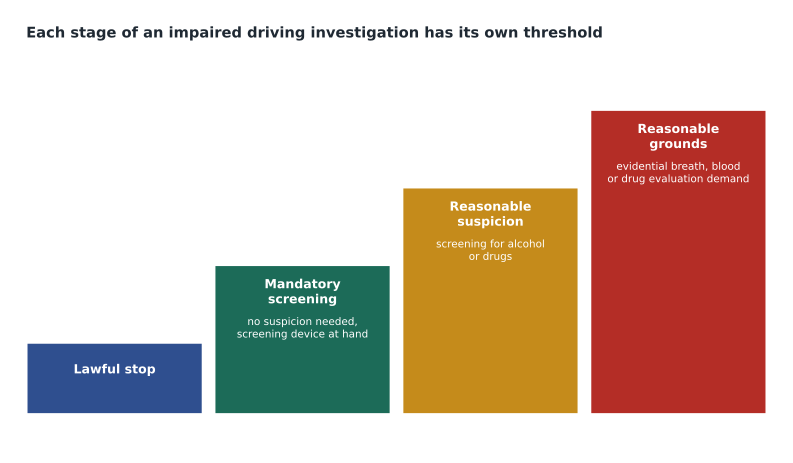
Lesson 6 follows Lindqvist through the first stages at the roadside. Lesson 7 follows him to the station and covers the evidential tests and drug evaluations. The same structure applies whether the investigation begins at a RIDE check, a traffic stop or a collision.
Refusal
Refusing or failing, without reasonable excuse, to comply with a lawful demand is an offence under section 320.15 of the Criminal Code, with the same maximum penalties as impaired operation and a mandatory minimum fine of 2,000 dollars for a first offence, higher than for most blood alcohol results. The penalties are set high on purpose, so that drivers cannot avoid a conviction by refusing to provide a sample. The officer must prove that the demand was lawful, that it was clearly made, that the driver understood it and the consequences of refusing, and that the driver refused or failed to comply. A reasonable excuse is narrow; a medical condition that prevents a driver from blowing can qualify, but a wish to speak to a lawyer first generally does not at the roadside.
Common challenges in impaired driving cases
Impaired driving trials often turn on a small set of issues. Was the stop lawful? Did the officer have the grounds needed for each demand? Were the samples taken as soon as practicable, and were any delays explained? Was the right to counsel implemented properly, including a real chance to reach a lawyer of choice and a private place to talk? Since the 2018 reforms, defences based on drinking after driving or on challenging the instrument's reliability are much narrower. Section 320.14(5) protects a driver who drank only after stopping driving and had no reason to expect to be required to give a sample, but the exception is tightly worded. Officers protect their cases by recording the reason for every step and the time it happened.
Kowalczyk tells the students that most impaired driving cases are won or lost long before trial. 'The trial is just where we find out whether you did the boring parts properly. The time you wrote down. The words you read. The observation period you actually watched. Do the boring parts properly and the trial takes care of itself.'
Ignition interlock
An ignition interlock is a small breath tester wired into a vehicle's ignition, so that the vehicle will not start unless the driver provides a breath sample below a set level. Under the Criminal Code, a court can allow an offender to drive during the prohibition period if they join a provincial interlock program, and for a first offence this can begin with no waiting period. Ontario's program requires the interlock for at least a year after a conviction, with longer periods for repeat offenders, and the device records every test and any attempt to tamper with it. Research has found that interlocks reduce repeat impaired driving while they are installed, although the effect fades once they are removed.
The administrative side of the case
The roadside suspension and impoundment are imposed under provincial law and run separately from the criminal case. Drivers can ask the registrar to review a suspension on narrow grounds, such as mistaken identity, but the review does not decide the criminal charge, and a later acquittal does not erase the roadside suspension. Officers complete the suspension and impoundment forms carefully, because errors on them can lead to the suspension being cancelled.
Common mistakes
MistakeA driver must be very drunk to be guilty of impaired operation.
InsteadImpairment to any degree, proven beyond a reasonable doubt, is enough (Stellato).
MistakeIf the breath result is excluded, the case is over.
InsteadAn impaired charge can still be proven from observations, driving and physical tests.
MistakeA person asleep in a parked car cannot be charged.
InsteadCare or control can apply if there is a realistic risk of danger (Boudreault).
MistakeThe officer decides the penalty.
InsteadCourts and licensing authorities impose penalties; the officer gathers lawful evidence.
Summary and key terms
- Section 320.14 creates impaired, 80-or-over, drug-concentration and combined offences; s.320.15 covers refusal.
- Impairment to any degree is enough (Stellato).
- The alcohol limit is 80 mg in 100 mL of blood; THC limits are 2 and 5 ng/mL.
- Operation includes care or control, which requires a realistic risk of danger.
- Criminal penalties and administrative suspensions both apply, but neither is imposed by the officer.
- Each stage of the investigation has its own legal threshold.
- Blood alcohol concentration
- The amount of alcohol in a given volume of blood.
- Per se offence
- An offence proven by a concentration at or above a set limit, without proof of impairment.
- Care or control
- Being in a position to set a vehicle in motion, creating a realistic risk of danger.
- Administrative suspension
- A licence suspension imposed by law at the roadside or by the licensing authority, separate from any criminal penalty.
Practice problems
Work each problem on paper first, then reveal the answer to check.
What four main offences does s.320.14(1) create?
Show answer
Impaired operation, 80 or over, drug concentration and combined alcohol and drug concentration.
Why should officers record observations even when they expect a breath result?
Show answer
Because the impaired charge can still be proven from observations if the breath result is excluded.
What is the minimum fine for a first offence with a BAC of 120 to 159 mg?
Show answer
1,500 dollars.
Who imposes penalties for impaired driving?
Show answer
Courts and licensing authorities, not the officer.
Lesson quiz · 5 questions
Score 60% or more to complete this lesson.
Create a free account to save your progress, take quizzes and earn a certificate.