
LES-203 · Lesson 5 of 12 · 19 min
Impaired driving law
▶ Video coming soon A video version of this lesson is on the way.
At 23:10 on the Friday night, a sobriety checkpoint on Harbor Road just south of the marina stopped every vehicle heading north. Sergeant Lisa Haddad supervised four officers. Most drivers were waved on within a minute. The eleventh driver, Craig Lindqvist, 46, was driving a silver sedan home from a retirement party for a colleague. Officer Tomas Ruiz noticed a strong odor of an alcoholic beverage when Lindqvist lowered his window, and Lindqvist said he had had 'two glasses of wine with dinner.' Less than an hour later, Lindqvist had been arrested and had provided a breath sample on the station's evidential instrument. Lessons 5 to 7 follow his case from the roadside to the evidence that would be used at trial.
Impaired driving is one of the areas of policing where the law is most detailed and most often litigated. Kowalczyk tells the class that a single impaired driving file can raise more legal issues than a robbery. 'Every demand has a legal test. Every sample has a time limit. Every step is recorded and every step will be challenged. If you understand the structure of the law, the steps make sense. If you just memorize the steps, you will miss the one that matters.'
Why impaired driving law is so detailed
Alcohol and drugs affect the skills driving depends on: attention, judgment, reaction time, vision and coordination. Even low levels of alcohol reduce the ability to divide attention between tasks. At a blood alcohol concentration of 0.08 grams per 100 milliliters, the legal limit in Ohio and most states, the risk of a crash is several times higher than for a sober driver, and the risk rises steeply at higher concentrations. In the United States, NHTSA reports that roughly 30 in 100 traffic deaths each year involve a driver with a blood alcohol concentration of 0.08 or higher, more than 12,000 deaths in recent years.
Because the danger is serious and the evidence fades within hours, legislatures in both countries have written detailed laws that let police screen drivers quickly, require drivers to provide samples, and allow the results to be used at trial with presumptions about the timing. Those powers are significant intrusions on privacy and liberty, so the courts have insisted that every step follow the law exactly.
The offenses
Ohio's impaired driving law is called OVI, for operating a vehicle under the influence, and is found in section 4511.19 of the Revised Code. Division (A)(1)(a) makes it an offense to operate a vehicle while under the influence of alcohol, a drug of abuse or a combination. Divisions (A)(1)(b) to (e) make it an offense to operate with a prohibited concentration of alcohol in blood, blood serum, breath or urine, including 0.08 grams or more of alcohol per 210 liters of breath. Higher concentrations, such as 0.17 grams per 210 liters of breath, carry higher mandatory penalties. Division (A)(1)(j) sets prohibited concentrations of specific drugs, including marijuana. Division (A)(2) applies to drivers with a recent OVI who refuse a test. Vehicular assault and aggravated vehicular homicide in Chapter 2903 apply when an OVI driver causes serious harm or death.
| Offense | What the prosecution must prove |
|---|---|
| Under the influence, 4511.19(A)(1)(a) | Operation, and that alcohol or drugs adversely affected the driver's ability |
| Per se alcohol, 4511.19(A)(1)(b) to (e) | Operation, and a test result at or above the prohibited concentration |
| High test, 4511.19(A)(1)(f) to (i) | Operation, and a result of 0.17 breath or the equivalent, or more |
| Per se drugs, 4511.19(A)(1)(j) | Operation, and a drug or metabolite at or above the listed concentration |
| Vehicular assault or homicide, Chapter 2903 | Serious physical harm or death caused while committing OVI or driving recklessly |
Impairment to any degree
Ohio's under-the-influence offense does not require that a driver be falling-down drunk. Ohio courts describe the standard as whether the alcohol or drug adversely affected the driver's actions, reactions or mental processes, or appreciably impaired the ability to drive. Impairment can be proven from the driving, the driver's appearance and behavior, field sobriety tests and expert testimony, as well as from a test result.
Haddad tells the students to think of the impaired offense and the concentration offense as two routes to the same place. 'If the breath test is thrown out because of a time problem or a demand problem, the impaired charge can still stand on what you saw and heard. If the driver was steady on his feet and polite, the concentration charge can still stand on the instrument result. That is why you write everything down, even when you think the breath result will be enough.'
The legal limits
Ohio's per se limits for alcohol are 0.08 grams per 100 milliliters of whole blood, 0.08 grams per 210 liters of breath, 0.096 grams per 100 milliliters of blood serum or plasma, and 0.11 grams per 100 milliliters of urine. Higher limits, starting at 0.17 grams per 210 liters of breath, trigger enhanced penalties. Division (A)(1)(j) lists per se levels for drugs, including 2 nanograms of marijuana per milliliter of whole blood or serum and 10 nanograms per milliliter of urine, and separate levels for marijuana metabolite. Drivers under 21 commit a separate offense at a breath concentration of 0.02 grams per 210 liters or more.
Worked problem
Reading the limits
Lindqvist's evidential breath result is later reported as 0.112 grams per 210 liters of breath. By how much does it exceed the per se limit, and is it in the high-test range?
Show solution
- The per se limit is 0.080 grams per 210 liters, and the high-test threshold is 0.170.
- \[0.112 - 0.080 = 0.032\]
- 0.112 is below 0.170, so it is not a high test, but it is 0.032 over the limit, which is 40 in 100 above it.
Answer: 0.032 over the per se limit; not a high test.
Operation and care or control
Ohio law defines operate to mean causing or having caused movement of a vehicle, and creates a separate offense of being in physical control of a vehicle while under the influence, in section 4511.194. Physical control means being in the driver's position with the ability to use the controls, so a person asleep behind the wheel with the key can be charged with physical control even if the vehicle never moved. The OVI offense in section 4511.19 requires proof that the person operated the vehicle.
Penalties and administrative sanctions
For a first OVI offense, Ohio law requires either three consecutive days in jail or attendance at a three-day certified drivers' intervention program, a fine of 565 to 1,075 dollars and a license suspension of one to three years, with limited driving privileges or ignition interlock possible. Penalties rise for high tests, refusals and repeat offenses within ten years. Separately, a driver who fails or refuses a chemical test receives an immediate administrative license suspension from the officer under section 4511.191: 90 days for a first test failure and one year for a first refusal.
Lindqvist had no record. Under the law of his state, he faced the mandatory three days in jail or a driver intervention program, a fine of at least 565 dollars, a court suspension of at least one year, and the 90-day administrative license suspension that began that night. Kowalczyk reminds the students that these consequences are for the court and the Bureau of Motor Vehicles to impose, not the officer. 'Your job is to collect the evidence lawfully and write it down accurately. Whether he deserves to lose his license is for the law and the judge.'
Reasonable grounds and the structure of the investigation
The impaired driving investigation moves through stages, and each stage has its own legal threshold. An officer who skips a stage or lacks the threshold for a demand risks losing the evidence that follows it. In Ohio, the main thresholds are: reasonable suspicion of a violation to make the stop; reasonable suspicion of impairment to extend the stop for field sobriety tests; probable cause to arrest for OVI; and an arrest, followed by the implied consent advice, before requesting a chemical test under section 4511.191.
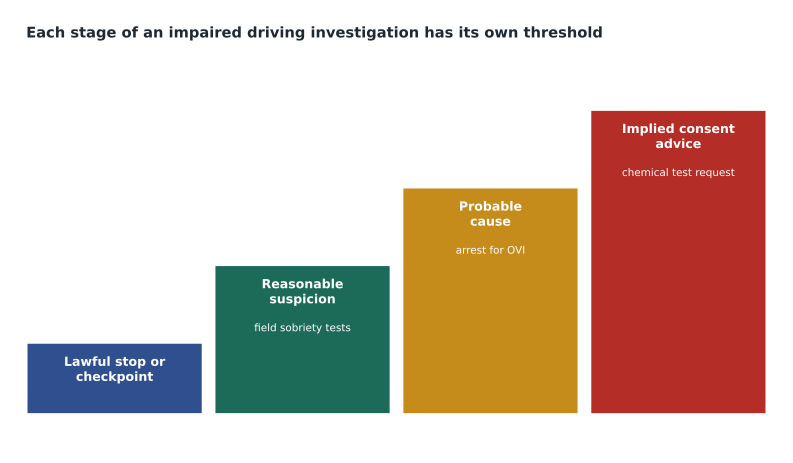
Lesson 6 follows Lindqvist through the first stages at the roadside. Lesson 7 follows him to the station and covers the evidential tests and drug evaluations. The same structure applies whether the investigation begins at a checkpoint, a traffic stop or a collision.
Refusal
Refusing a chemical test after an OVI arrest triggers an immediate administrative license suspension of one year for a first refusal, longer for repeat refusals, and the refusal can be used as evidence at trial. In South Dakota v. Neville in 1983, the U.S. Supreme Court held that admitting evidence of a driver's refusal to take a blood alcohol test does not violate the privilege against self-incrimination. Ohio law also makes refusal a separate offense for drivers who have had an OVI conviction within the previous twenty years, under division (A)(2) of section 4511.19,. Because the consequences are serious, officers must read the implied consent advice exactly as written on the BMV 2255 form and record the driver's response word for word.
Common challenges in impaired driving cases
OVI trials and suppression hearings often turn on a small set of issues. Was the stop lawful? Did the officer have reasonable suspicion to extend the stop for field sobriety tests, and probable cause to arrest? Were the field sobriety tests given in substantial compliance with the NHTSA standards, as section 4511.19(D)(4)(b) requires before the results can be admitted? Was the implied consent advice read correctly? Was the breath test done within three hours, by a permitted operator, on an instrument that had passed its required calibration checks, after a proper observation period? Each of these steps is covered by Ohio statutes or Department of Health rules, and an error in any one of them can lead to the suppression of the test result. Officers protect their cases by recording the reason for every step and the time it happened, and by keeping their certifications current.
Kowalczyk tells the students that most impaired driving cases are won or lost long before trial. 'The trial is just where we find out whether you did the boring parts properly. The time you wrote down. The words you read. The observation period you actually watched. Do the boring parts properly and the trial takes care of itself.'
Ignition interlock
An ignition interlock is a small breath tester wired into a vehicle's ignition, so that the vehicle will not start unless the driver provides a breath sample below a set level. Ohio courts can grant unlimited driving privileges with an interlock during a suspension, and interlocks are required for some repeat offenders and high-test cases. The device records every test, including failed starts and any attempt to tamper with it, and those records are reported to the court or the Bureau of Motor Vehicles. Research has found that interlocks reduce repeat impaired driving while they are installed, although the effect fades once they are removed, which is why some states now require longer interlock periods and treatment as well.
The administrative side of the case
The administrative license suspension is imposed by the officer on behalf of the Bureau of Motor Vehicles, using the BMV 2255 form, and it takes effect immediately. The driver can appeal the suspension at the initial appearance in court, but the appeal is limited to a few questions: whether the officer had reasonable grounds to believe the driver was operating under the influence, whether the driver was arrested, whether the implied consent advice was given, and whether the driver refused or failed the test. Because the appeal turns on exactly those points, the officer's notes and the completed form must record each of them clearly. The court can also grant limited driving privileges during the suspension, for work, school or medical appointments, and the administrative suspension is credited against any court suspension imposed later if the driver is convicted.
Common mistakes
MistakeA driver must be very drunk to be guilty of impaired operation.
InsteadThe driver's ability must be adversely affected; it need not be extreme.
MistakeIf the breath result is excluded, the case is over.
InsteadAn impaired charge can still be proven from observations, driving and physical tests.
MistakeA person asleep in a parked car cannot be charged.
InsteadPhysical control under section 4511.194 can apply to a person in the driver's seat with the ability to use the controls.
MistakeThe officer decides the penalty.
InsteadCourts and licensing authorities impose penalties; the officer gathers lawful evidence.
Summary and key terms
- Section 4511.19 creates the under-the-influence offense and per se offenses for alcohol and drugs.
- Impairment means the ability to drive was adversely affected.
- The breath limit is 0.08 grams per 210 liters; the high-test level is 0.17; the THC blood limit is 2 ng/mL.
- Operation means causing movement; physical control is a separate offense.
- Criminal penalties and administrative suspensions both apply, but neither is imposed by the officer.
- Each stage of the investigation has its own legal threshold.
- Blood alcohol concentration
- The amount of alcohol in a given volume of blood.
- Per se offense
- An offense proven by a concentration at or above a set limit, without proof of impairment.
- Physical control
- Being in the driver's position with the ability to use the controls.
- Administrative suspension
- A license suspension imposed by law at the roadside or by the licensing authority, separate from any criminal penalty.
Practice problems
Work each problem on paper first, then reveal the answer to check.
What does division (A)(1)(a) of section 4511.19 prohibit?
Show answer
Operating a vehicle while under the influence of alcohol, a drug of abuse or both.
Why should officers record observations even when they expect a breath result?
Show answer
Because the impaired charge can still be proven from observations if the breath result is excluded.
What is the fine range for a first OVI?
Show answer
565 to 1,075 dollars.
Who imposes penalties for impaired driving?
Show answer
Courts and licensing authorities, not the officer.
Lesson quiz · 5 questions
Score 60% or more to complete this lesson.
Create a free account to save your progress, take quizzes and earn a certificate.