
LES-116 · Lesson 8 of 12 · 20 min
Routine traffic stops and roadside safety
▶ Video coming soon A video version of this lesson is on the way.
The first stop of the night came at 20:12. Driving east on Lakeshore Road, Reyes saw a dark blue pickup ahead with no light over its rear plate. Ontario's Highway Traffic Act requires that a rear licence plate be lit at night, and section 216 of the Act gives police power to stop drivers. Reyes told Malhotra she wanted to stop it. He said, 'Your stop. Where are you going to do it?' Ahead, the road curved to the left past a row of houses, with no shoulder. Reyes began to activate her lights, then stopped herself. 'Not on the curve,' she said. Three hundred metres past the curve was a closed gas station with a wide, well-lit lot. She called the stop in to dispatch, waited until the pickup was near the lot, and activated her lights. The driver pulled in and stopped.
Traffic stops are among the most common contacts between police and the public, and among the most varied. Most are routine and end with a warning or a ticket. A small number involve impaired drivers, wanted people, weapons or other serious matters. Many involve risk from the road itself: officers and drivers stand beside moving traffic, sometimes at night, in rain or snow. This lesson covers the legal authority for traffic stops, the safety principles officers use to plan and conduct them, and the particular dangers of roadside work, including collision scenes.
The legal authority to stop
In Ontario, section 216(1) of the Highway Traffic Act provides that a police officer, in the lawful execution of their duties, may require the driver of a motor vehicle to stop. In R. v. Ladouceur (1990), the Supreme Court of Canada upheld random roadside stops for traffic safety purposes as a reasonable limit on the right not to be arbitrarily detained, because of the importance of road safety. But the purpose matters. In R. v. Mellenthin (1992), the Court held that a check stop for traffic safety cannot be turned into a means of conducting an unfounded search: questions and searches beyond the traffic safety purpose need their own grounds. In R. v. Nolet (2010), the Court accepted that a stop may have more than one purpose, so long as the traffic purpose is genuine, and that police powers can evolve as new information emerges. Drivers must produce their licence, ownership or permit and proof of insurance on request. Passengers are in a different position: an Ontario Court of Appeal decision in 2007 held that police could not require a passenger to identify himself simply to run a records check when there was no reason to suspect him of anything.
Desjardins draws the common thread. In both countries, the reason for the stop defines its scope. A stop for a burned-out plate light allows the officer to deal with the plate light and the driver's documents. It does not, on its own, allow a search of the vehicle or an extended interrogation about unrelated matters. If something else emerges, such as the smell of alcohol, a warrant, or contraband in plain view, the officer's powers may expand, but each expansion needs its own lawful basis. Officers should be able to explain at each step why they were doing what they were doing.
Before the stop
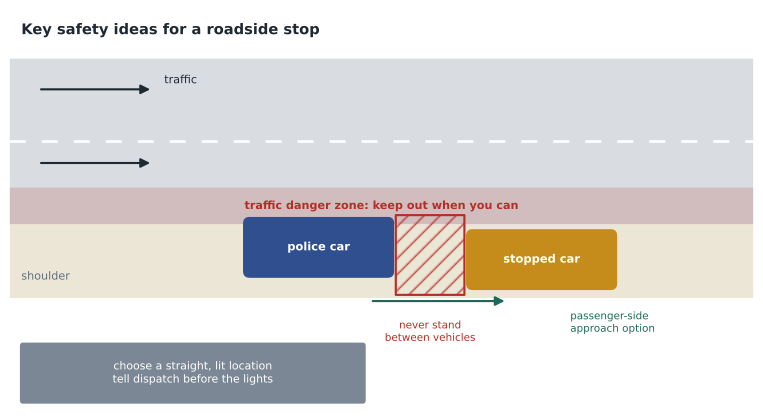
Planning starts before the lights come on. Reyes's decision to wait for the gas station lot illustrates the most important pre-stop choice: location. A good location gets both vehicles completely off the travelled road or onto a wide shoulder, has good lighting, avoids curves and hills where approaching drivers cannot see the stop, avoids blocking driveways and intersections, and gives the officer space to stand away from traffic. If no good location is available immediately, officers can usually wait a short distance for a better one, unless there is an urgent reason to stop now.
Before activating lights, officers tell dispatch about the stop: their location, the plate and description of the vehicle, and the number of occupants if known. This means that if something goes wrong, other officers know where to go and which vehicle to look for. Many officers also run the plate before the stop, which can reveal whether the vehicle is stolen, whether the registered owner has a suspended licence or a warrant, and whether there are officer-safety flags. Reyes ran the pickup's plate: registered to a Port Ardent resident with no flags.
The approach and the conversation
Approach methods vary by agency and situation, and officers learn the specific techniques their agency uses in practical training. The principles are consistent. Officers watch the vehicle and its occupants as they stop, looking at the number of people, their movements and anything unusual. They take a moment before getting out to finish their radio call and think. They stay out of the traffic lane as much as possible, and avoid standing between the police car and the stopped car, where a collision from behind would crush them. Many officers approach on the passenger side, especially on busy roads, because it keeps them away from traffic and often gives a less expected view into the car. At night, officers use lighting to see into the vehicle while avoiding standing in their own headlights.
At the pickup, Reyes walked up the passenger side and Malhotra stood back near the rear of the pickup on the driver's side, where he could see into the cab. The driver, Helen Fraser, sixty-four, lowered the passenger window. Reyes began the way she had been taught: 'Good evening, ma'am. I'm Constable Reyes with Port Ardent police. The reason I stopped you is that the light over your rear licence plate is out. Is there a reason it might not be working?' Mrs. Fraser said she had no idea, apologized and offered her licence. Reyes asked for the ownership and insurance as well, returned to the cruiser, checked the licence, and came back with a warning and a printed note about repairing the light within a week. The stop took eight minutes.
The structure of Reyes's opening, greeting, identification, reason and a question, is the same structure taught in the communication lesson. Haddad says that explaining the reason for the stop early is the single most effective way to reduce tension. Drivers who do not know why they have been stopped tend to assume the worst, become defensive or argue. Drivers who know the reason can relax, and many will simply say, 'Oh, I didn't know.' Research on procedural justice in traffic stops supports this: drivers who receive a clear explanation and respectful treatment rate the encounter more positively, even when they receive a ticket.
| Stage | Safety focus | Legal focus |
|---|---|---|
| Before the stop | Location, dispatch notification, plate check | Grounds for the stop |
| Stopping | Watch the occupants, finish radio call, plan approach | Lawful exercise of the stop power |
| Approach | Stay out of traffic, avoid standing between vehicles, light the car | Scope of the stop |
| Conversation | Greet, identify, give reason, ask; watch hands | Documents, questions linked to purpose |
| Checks and decision | Contact handles paperwork, cover keeps watching | Any expansion needs its own grounds |
| Ending | Return documents, explain outcome, help the driver merge safely | Stop ends when its purpose is done |
Roadside danger and the move-over law
Traffic is one of the largest sources of risk for officers on the road. Officers are struck by passing vehicles while standing beside stopped cars, directing traffic, investigating collisions and setting up flares. Drivers who are distracted, impaired, tired or driving too fast for conditions may drift toward the flashing lights, a phenomenon sometimes linked to drivers steering toward what they are looking at. Bad weather and darkness increase the risk. Ontario's Highway Traffic Act, section 159, requires drivers approaching a stopped emergency vehicle or tow truck with its lights flashing to slow down and proceed with caution and, on multi-lane highways, to move into another lane if it can be done safely; failing to do so carries a fine and demerit points. Haddad tells the students that the law helps, but they cannot assume that every driver knows or obeys it.
At 01:40, the highway gave Reyes a lesson she would never forget. A small car had slid off Highway 12 in blowing snow and come to rest in the ditch on the eastbound side. The driver was shaken but unhurt. Reyes and Malhotra parked behind it on the shoulder with all their lights on, set out flares, and Reyes went down the bank to speak to the driver while Malhotra stood on the shoulder near the cruiser's front bumper on the passenger side, away from traffic. Two minutes later, a sedan approaching in the right lane did not move over or slow down. It passed so close to the cruiser that its mirror clipped the cruiser's driver-side mirror and snapped it off. The sedan kept going. Had anyone been standing at the cruiser's driver door, they would have been hit.
Malhotra radioed the sedan's description to other units, who stopped it twelve kilometres east. The driver had been looking at his phone. In the debrief, Haddad praised the officers for positioning away from traffic and for parking so the cruiser shielded the scene, and for setting flares early. She also pointed out that in blowing snow, approaching drivers would have seen the lights late. On a night like that, she said, officers should consider asking for a second car to park further back, using the highway's closure procedures, or moving the driver up the bank and into the cruiser rather than standing on the shoulder at all.
# How far does a car travel before it stops? (simple physics; real values vary)
def stopping_distance(kmh, reaction_s=1.5, friction=0.7, g=9.81):
    v = kmh / 3.6                       # convert km/h to m/s
    reaction = v * reaction_s           # distance before braking starts
    braking = v ** 2 / (2 * friction * g)
    return reaction, braking

for label, mu in [("dry road", 0.7), ("snow", 0.25)]:
    r, b = stopping_distance(100, friction=mu)
print(f"{label:9} 100 km/h: reaction {r:5.1f} m + braking {b:5.1f} m = {r + b:5.1f} m")dry road 100 km/h: reaction 41.7 m + braking 56.2 m = 97.8 m snow 100 km/h: reaction 41.7 m + braking 157.3 m = 199.0 m
The example shows why roadside work in winter is so dangerous. At 100 kilometres per hour, a car travels about 42 metres before its driver even begins to brake, and on snow the braking distance is several times longer than on a dry road. A driver who sees the flashing lights late cannot stop or swerve safely. The numbers are simplified, but they explain why officers set flares well back, park to shield the scene, keep out of the traffic lane and move people off the shoulder whenever possible.
Ending the stop
A stop ends when its purpose is complete. The officer returns documents, explains the outcome, such as a warning, a ticket or further steps, and answers questions. Officers should tell the driver how to respond to a ticket and make sure they understand. Before walking back to the cruiser, officers stay alert; the end of a stop is not the end of the risk. Many officers also help the driver merge back into traffic safely by waiting to turn off their emergency lights until the driver has pulled away, and by watching traffic as the driver leaves. Afterwards, the officer updates dispatch that the stop is clear and records the stop in notes or the records system.
Desjardins reminds the class that most drivers stopped by police are ordinary people having an ordinary day, and that the encounter may be their only contact with police that year. 'A professional, respectful stop does more for public trust than any community event,' he says. 'And a rude or careless one undoes a lot of good work.'
Worked problem
Choosing a location
An officer on a two-lane rural highway at night sees a car with a broken tail light. Ahead are a sharp hill, then a long straight stretch with a wide gravel shoulder, then a village with a lit church parking lot two kilometres away. Where should she stop the car, and why?
Show solution
- Not before the hill: drivers coming over the hill would not see the stopped cars in time.
- The straight stretch with a wide shoulder is acceptable, especially if visibility is good, because approaching drivers can see the lights from a distance.
- The lit church parking lot is better still: both vehicles can be completely off the road, the area is lit and there is no traffic beside the officer.
- Because the violation is minor and there is no urgency, waiting two kilometres for the lot is reasonable.
- She should tell dispatch the location and plate before activating her lights near the lot.
Answer: Choosing a straight, lit location off the road, even if it means waiting, reduces the traffic risk to everyone.
Common mistakes
MistakeA traffic stop allows a search of the vehicle.
InsteadThe stop's purpose defines its scope; a search needs its own lawful basis.
MistakeThe driver side is the only correct approach.
InsteadApproach methods vary; many officers use the passenger side to stay away from traffic.
MistakeDrivers will always move over for flashing lights.
InsteadMany drivers do not; officers must position as if some will not.
MistakeOfficers should stop a vehicle immediately after seeing a violation.
InsteadFor minor violations, waiting for a safe location is usually better.
Summary and key terms
- Ontario's Highway Traffic Act gives the power to stop; Ladouceur, Mellenthin and Nolet define how the purpose limits the stop.
- The reason for the stop defines its scope, and any expansion needs its own grounds.
- Before the stop, choose a safe location, notify dispatch and check the plate.
- During the approach, stay out of traffic, avoid standing between vehicles and give the reason early.
- Move-over laws help, but officers must position as if some drivers will not comply.
- End the stop clearly, help the driver merge safely and record the stop.
- Highway Traffic Act, section 216
- The Ontario power for police to require a driver to stop.
- R. v. Mellenthin
- The 1992 case holding that a traffic check stop cannot be used for an unfounded search.
- Scope of a stop
- The actions the stop's purpose allows; anything more needs its own basis.
- Move-over law
- A law requiring drivers to slow down or change lanes near stopped emergency vehicles.
- Stopping distance
- Reaction distance plus braking distance.
Practice problems
Work each problem on paper first, then reveal the answer to check.
Why did Reyes not stop the pickup on the curve?
Show answer
Approaching drivers could not see a stop on the curve, and there was no shoulder.
What happened at the highway collision at 01:40?
Show answer
A passing sedan failed to move over and clipped the cruiser's driver-side mirror.
In the code example, roughly how far does a car at 100 km/h travel during a 1.5-second reaction?
Show answer
About 42 metres.
What does Haddad suggest officers consider on a night with blowing snow?
Show answer
A second car further back, closure procedures, or moving the driver off the shoulder into the cruiser.
Lesson quiz · 5 questions
Score 60% or more to complete this lesson.
Create a free account to save your progress, take quizzes and earn a certificate.