
LES-116 · Lesson 2 of 12 · 20 min
Situational awareness and the safety mindset
▶ Video coming soon A video version of this lesson is on the way.
At 23:05 on January 22, dispatch sent Reyes and Malhotra to Lakeview Motors on Harbour Road. A passing driver had called to say that someone with a flashlight was walking between the cars on the closed dealership lot, trying door handles. The temperature was minus fourteen, the lot was lit by tall lamps with dark gaps between them, and snow had drifted against the fence. Reyes drove. As they turned in, she fixed her eyes on the figure moving between a row of pickup trucks and said, 'There he is.' Malhotra said, 'Good. Now tell me about the grey hatchback idling by the side gate.' Reyes had not seen it.
The man on the lot turned out to be Corey Nash, twenty-four, who had started work three days earlier as the dealership's night lot attendant and was checking that every vehicle was locked. The hatchback belonged to his girlfriend, who had driven him to work and was waiting to pass him a coffee. Nothing about the call was dangerous. But Malhotra used it as the first coaching point of the night, because it showed the most common failure of situational awareness: locking onto the obvious thing and missing everything else.
What situational awareness is
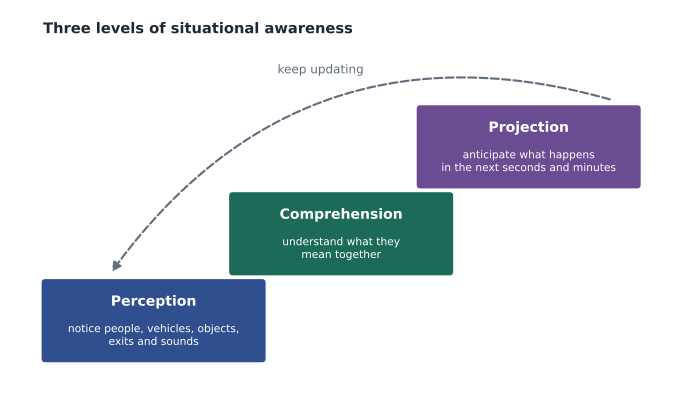
Situational awareness is an accurate, continuously updated understanding of what is happening around you and what is likely to happen next. Researchers who study awareness in aviation, medicine and policing often describe three levels. The first is perception: noticing the relevant elements in the environment, such as people, vehicles, exits, objects and sounds. The second is comprehension: understanding what those elements mean together, such as recognizing that a running car near a gate could be a getaway car or simply a ride. The third is projection: anticipating what will happen in the next few seconds or minutes, such as what the person will do when the cruiser's lights hit him. Good awareness requires all three. An officer can see everything and understand nothing, or understand the scene well but fail to anticipate a change.
Awareness is not the same as suspicion. Desjardins is careful about this distinction. Suspicion is a conclusion that someone may be involved in wrongdoing, and in law it must be based on specific facts. Awareness is simply paying attention. An aware officer notices that a man has his right hand in his jacket pocket, but does not conclude that he has a weapon. The officer keeps watching, positions sensibly, and asks a friendly question. Awareness also includes noticing things that reduce concern, such as a dealership uniform jacket, a set of keys on a lanyard and the fact that the man walked toward the cruiser and waved.
How attention fails
Human attention is limited. People can only process a small part of what their senses take in, and the brain fills in gaps with expectations. Several well-studied effects matter for patrol officers.
- Tunnel vision, or attentional narrowing: under stress or excitement, attention focuses on the most obvious or threatening element and peripheral information drops away. Reyes's focus on the figure in the lot is a mild example.
- Inattentional blindness: people can fail to see something in plain view when their attention is busy elsewhere. In a well-known experiment, many viewers counting basketball passes failed to notice a person in a gorilla suit walking through the scene.
- Expectation bias: people tend to see what they expect. An officer who expects a theft may read ordinary behaviour as suspicious; an officer who expects a routine call may miss a real danger sign.
- Auditory exclusion: under high stress, some people report not hearing sounds such as radio traffic or a partner's voice.
- Task saturation: when too many demands arrive at once, such as driving, listening to the radio, reading the computer screen and watching a scene, performance on all of them drops.
Haddad tells the students that none of these effects are character flaws. 'Everybody's brain does this,' she says. 'The difference between an experienced officer and a new one is not that the experienced officer's brain works differently. It is that they have built habits that force them to look again.' She describes one of those habits: after you have spotted the obvious thing, deliberately scan the rest of the scene and ask, 'What else is here?' Another is to divide the work with a partner, so one officer watches the person and the other watches everything else.
Stress and performance
Stress affects the body and the brain in predictable ways. When a person perceives a threat, the body releases stress hormones that increase heart rate, breathing and muscle tension and prepare the body to act. Moderate arousal can improve focus and reaction. Very high arousal tends to degrade fine motor skills, such as manipulating small equipment, and complex thinking, such as weighing several options at once. Vision can narrow, time can seem to slow down or speed up, and memory of the event can be incomplete or distorted. Officers who have been through critical incidents often find that their memories of the sequence of events do not match the video.
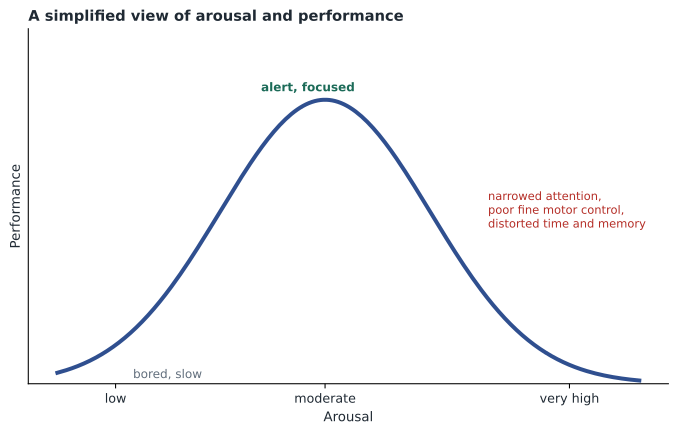
Desjardins notes that this picture is a simplification. The exact relationship between stress and performance depends on the person, the task and their training. Tasks that have been practised until they are automatic hold up better under stress than tasks that require careful thought. That is one reason training emphasizes repetition of basic skills such as radio procedure, communication scripts and safe positioning. It is also why breathing techniques matter. Slow, controlled breathing, sometimes taught as box breathing, can reduce physical arousal in the moment and help an officer think more clearly. Several services teach it in academy and requalification training.
# How far does a person travel while an officer reacts? (simple illustration)
# distance = speed x time; walking about 1.4 m/s, running about 5 m/s
reaction_times = [0.75, 1.0, 1.5]   # seconds to notice and begin responding
for speed, label in [(1.4, "walking"), (5.0, "running")]:
    for t in reaction_times:
print(f"{label:8} reaction {t:4} s -> {speed * t:4.1f} m covered")walking reaction 0.75 s -> 1.0 m covered walking reaction 1.0 s -> 1.4 m covered walking reaction 1.5 s -> 2.1 m covered running reaction 0.75 s -> 3.8 m covered running reaction 1.0 s -> 5.0 m covered running reaction 1.5 s -> 7.5 m covered
The example illustrates why distance matters. Reaction is never instant: an officer must perceive a change, understand it and begin to respond, and even a fast reaction takes most of a second. A person who is walking covers more than a metre in that time, and a person who is running covers several metres. The numbers are illustrations, not rules, but they explain why trainers encourage officers to keep enough space to give themselves time to think and act, and why closing distance quickly is rarely the best first move.
The decision cycle
Many officer-safety programs describe decision-making as a loop. One widely used version, developed by a military strategist, is the OODA loop: observe, orient, decide, act. The officer observes the situation, orients by interpreting it against training and experience, decides on a course of action, and acts, and then the loop begins again as the situation responds. The idea is that decisions are never final. Each action changes the situation, and the officer must observe the result and adjust. A person who is stuck in one part of the loop, for example someone who keeps observing without deciding, or someone who acts on an old decision after the situation has changed, falls behind events.
Desjardins links the loop to the levels of awareness. Observing is perception. Orienting includes comprehension and projection. Deciding and acting are where awareness becomes behaviour. He tells the class that the loop also explains why calm communication works: when an officer slows an encounter down, everyone in it, officer and subject alike, has more time to move through the loop and make better decisions.
Baselines and changes
One of the most practical awareness habits is to establish a baseline and watch for changes. A baseline is what is normal for a particular place, time and person. On a weekday afternoon at a busy mall, crowds and noise are normal; at three in the morning on a residential street, a running car with its lights off is not. A person who is anxious at a traffic stop is normal; most people are nervous when stopped by police. What matters is change from the baseline, such as a person who was talking calmly and suddenly goes quiet and looks around, or a person who keeps turning one side of the body away from the officer.
Haddad warns the students not to treat lists of so-called danger signs as a checklist. Nervousness, avoiding eye contact and fidgeting are common in innocent people, especially people who have had bad experiences with police, people who are neurodivergent, people from cultures where direct eye contact with authority is rude, and people who simply do not like being stopped. 'If you treat ordinary nervousness as a threat,' she says, 'you will escalate encounters for no reason and you will train yourself to see danger everywhere. Look for clusters of behaviour, for changes, and for behaviour that fits a specific concern, and then respond by getting more information and better positioning, not by grabbing someone.'
Awareness habits for patrol
The class builds a list of everyday habits that support awareness.
| Habit | What it looks like | Why it helps |
|---|---|---|
| Scan, then scan again | After spotting the obvious, look deliberately at the rest of the scene | Counters tunnel vision |
| Watch hands | Look at what a person is holding and where their hands are | Hands are what can hurt you or reveal intent |
| Know your location | Keep track of street names, addresses and direction of travel | Lets you call for help accurately |
| Use the approach | Look at the scene as you drive up, before you stop | Gives information before you commit |
| Split the work | Agree who watches the person and who watches the area | Reduces task saturation |
| Listen to the radio | Stay aware of calls nearby and of updates | Brings in information you cannot see |
| Check your own state | Be alert to fatigue, anger or distraction | Your condition affects every decision |
Back at Lakeview Motors, Malhotra did several of these things in the first ten seconds. He looked at the whole lot as they drove in, noticed the hatchback and its exhaust, noted that the side gate was the only other exit, and told Reyes that he would keep an eye on the car while she spoke to the man. Reyes stopped the cruiser where its headlights lit the area between them and the figure, and she called out a greeting from beside her open door before she walked forward. Nash called back, 'I work here! I'm the lot guy!' and held up a ring of keys. Ninety seconds later the call was cleared.
Afterwards, Reyes asked Malhotra why he had not just pointed out the car when they pulled in. He said he wanted her to find it herself, and that the next time she would. She did: about five hours later, at the stop that produced the wanted passenger, she was the one who noticed that the passenger was watching the side mirror instead of looking at her.
Worked problem
Applying the three levels
At 2 a.m., an officer arrives at a convenience store for an alarm. Through the window, she sees the clerk behind the counter, a man in a parka near the drinks cooler, and a car running at the side of the building with nobody visible inside. Describe what she might perceive, comprehend and project.
Show solution
- Perception: the clerk, the man near the cooler, the running car, the store's two doors, the lighting and the absence of other people.
- Comprehension: the alarm may be accidental, or the clerk may have triggered it because something is wrong; the man may be a customer or may be involved; the car may belong to him or to someone else.
- Projection: if something is wrong, the man may leave quickly through the side door toward the car; if nothing is wrong, the clerk will probably look surprised and wave.
- Response: she reports her arrival and what she sees, positions where she can see both doors and the car, and waits a moment for her backup or for more information before going in.
Answer: Awareness at all three levels turns an unclear scene into a plan.
Common mistakes
MistakeSituational awareness means being suspicious of everyone.
InsteadAwareness means paying attention; suspicion is a conclusion that needs specific facts.
MistakeNervousness is a reliable sign of danger.
InsteadNervousness is common and normal; look for clusters, changes and behaviour linked to a specific concern.
MistakeExperienced officers do not get tunnel vision.
InsteadEveryone's attention narrows under stress; experienced officers have habits that make them look again.
MistakeA decision, once made, should be carried through.
InsteadDecisions must be revisited as the situation changes; the decision cycle keeps turning.
Summary and key terms
- Situational awareness has three levels: perception, comprehension and projection.
- Attention fails in predictable ways: tunnel vision, inattentional blindness, expectation bias, auditory exclusion and task saturation.
- High stress degrades fine motor skills and complex thinking; practised skills and controlled breathing hold up better.
- Reaction takes time, which is why distance gives officers room to think and act.
- The OODA loop describes decisions as a continuous cycle of observing, orienting, deciding and acting.
- Establish a baseline and watch for changes and clusters rather than single so-called danger signs.
- Situational awareness
- An accurate, continuously updated understanding of what is happening and what is likely to happen next.
- Tunnel vision
- Narrowing of attention onto one element under stress, so other information is missed.
- Inattentional blindness
- Failing to see something in plain view because attention is elsewhere.
- Task saturation
- Overload when too many demands arrive at once, reducing performance on all of them.
- OODA loop
- A decision cycle of observe, orient, decide and act, repeated as the situation changes.
- Baseline
- What is normal for a particular place, time and person, used to notice changes.
Practice problems
Work each problem on paper first, then reveal the answer to check.
What did Reyes miss when she arrived at Lakeview Motors?
Show answer
The grey hatchback idling by the side gate.
In the code example, how far does a running person travel during a 1.5-second reaction?
Show answer
7.5 metres.
What are the three levels of situational awareness?
Show answer
Perception, comprehension and projection.
Why should officers be cautious about treating nervousness as a danger sign?
Show answer
Nervousness is common among innocent people, so treating it as a threat escalates encounters for no reason.
Lesson quiz · 5 questions
Score 60% or more to complete this lesson.
Create a free account to save your progress, take quizzes and earn a certificate.