
LES-116 · Lesson 11 of 12 · 20 min
Officer wellness: fatigue, stress and the survival mindset
▶ Video coming soon A video version of this lesson is on the way.
The shift ended at 07:00, but Reyes did not leave the station until almost 08:00. Vollmer's arrest meant extra reports, the highway mirror strike meant a collision report, and Mr. Brandt's daughter had called the station to say thank you, which Reyes was glad to hear but which took ten minutes. By the time she got into her own car, she had been awake for almost twenty-four hours. On the drive home, at a red light on Mill Street, she realized she could not remember the last two kilometres. When the light turned green, the driver behind her had to honk. She drove the rest of the way with the window down and the radio loud, and when she got home she sat in the driveway for a while before going in.
She told Malhotra about it the next night, half expecting him to laugh. He did not. He told her that in his second year he had fallen asleep for a second on the highway on the way home from a night shift and woken up with two wheels on the rumble strip. 'That scared me more than anything that's happened on a call,' he said. 'The job will tell you that you're tough. Your body doesn't care how tough you are.' This lesson is about the part of officer safety that is easiest to ignore: the effects of the work on the officer's own body and mind.
Shift work and fatigue
Police work runs around the clock, and many officers work rotating shifts, including nights. The human body has a circadian rhythm, an internal clock of roughly twenty-four hours that makes people most alert during the day and sleepiest in the early morning hours, typically between about two and six. Night shift work pushes against that clock. Officers on nights often sleep less and less well during the day, because of light, noise and family schedules, and the effects accumulate over a run of shifts. Overtime, court appearances on days off and long reports after busy shifts make it worse.
Fatigue affects many of the skills that officer safety depends on. Tired people react more slowly, notice less, make poorer decisions, have more trouble controlling emotions and are more likely to take risks. Studies of sleep deprivation have compared its effects to those of alcohol. Research published in the late 1990s and 2000 found that after about seventeen to nineteen hours without sleep, performance on some tasks was comparable to performance at a blood alcohol concentration of about 0.05, and that after about twenty-four hours awake, it was comparable to about 0.10, which is above the legal limit for driving in both countries. The comparison is approximate, and people vary, but it makes the point clearly: an officer who has been awake for twenty-four hours may be as impaired as a driver they would arrest.
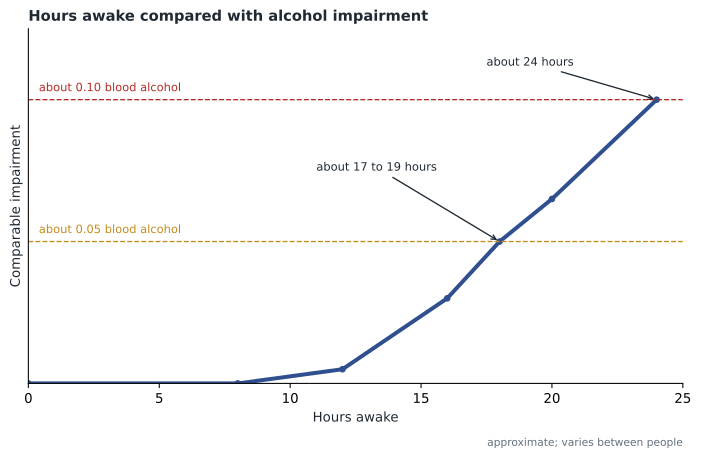
Fatigue is also a driving risk, and driving is one of the largest sources of officer injury and death. Officers drive for hours during a shift and then drive home tired. Some services have policies limiting consecutive hours worked, requiring rest periods between shifts, or allowing officers who are too tired to drive to rest at the station or get a ride. Haddad tells the class that she would much rather pay for a taxi than attend another officer's funeral.
Managing fatigue
Fatigue cannot be eliminated in police work, but it can be managed. Sleep researchers and occupational health specialists recommend several strategies for shift workers.
- Protect sleep: use blackout curtains, earplugs or white noise; keep the bedroom cool; tell family members and friends when you are sleeping.
- Plan naps: a short nap before a night shift can improve alertness; some services allow brief rest breaks during long shifts.
- Use caffeine wisely: caffeine helps alertness but should be avoided in the last few hours before sleep.
- Eat and drink well: regular, balanced meals and water help more than sugary snacks and energy drinks.
- Watch the drive home: if you are drowsy, do not drive; rest first, or get a ride.
- Speak up: tell a supervisor when fatigue is affecting your work, and support colleagues who do.
Reyes asked Malhotra what he does now. He told her that before a run of nights he sleeps in the afternoon, eats a real meal before the shift, brings food and water, avoids coffee after about three in the morning, and keeps a pillow in his locker for days when reports run long. He also checks on newer officers at the end of busy shifts. 'If you look like you're going to fall asleep in the parking lot, I'm going to ask you,' he told her. 'And you're going to answer honestly.'
# Counting sleep debt over a run of night shifts (hours; target 7.5 per day)
target = 7.5
slept = [7.0, 5.5, 5.0, 6.0]   # sleep before each of four night shifts
debt = 0.0
for day, hours in enumerate(slept, start=1):
    debt += target - hours
print(f"night {day}: slept {hours} h, running sleep debt {debt:.1f} h")night 1: slept 7.0 h, running sleep debt 0.5 h night 2: slept 5.5 h, running sleep debt 2.5 h night 3: slept 5.0 h, running sleep debt 5.0 h night 4: slept 6.0 h, running sleep debt 6.5 h
The example shows how sleep debt grows over a run of night shifts even when each day's shortfall seems modest. By the fourth night, the officer in the example is six hours short of the sleep they need, which is close to a full night's sleep. Researchers have found that people are poor judges of their own fatigue; they tend to feel more alert than their performance shows. That is one reason objective limits on hours worked, and honest conversations between colleagues, are so important.
Stress and the body
Police work involves both acute stress, from critical incidents such as violent calls, fatal collisions and the deaths of children, and chronic stress, from shift work, workload, organizational pressures, public criticism and the steady accumulation of difficult calls. Stress affects the body. Over time, high stress is associated with sleep problems, high blood pressure, heart disease, digestive problems and weight gain. Police officers in several studies have shown higher rates of some of these conditions than the general population. Physical fitness, good nutrition and regular medical checkups are therefore part of a long, healthy career.
Stress also affects the mind. A large 2018 survey of Canadian public safety personnel, including police, found that about 44 in 100 respondents screened positive for symptoms consistent with at least one mental disorder, such as post-traumatic stress disorder, depression or anxiety. In 2016, Ontario created a presumption under its workers' compensation law that post-traumatic stress disorder diagnosed in first responders, including police officers, is work-related, which makes it easier for them to receive benefits and treatment. Desjardins tells the class that these numbers are not a reason to fear the job. They are a reason to take mental health as seriously as physical safety.
Recognizing stress and getting help
Officers often find it hard to admit that they are struggling. The culture of policing has long valued toughness and self-reliance, and some officers worry that seeking help will hurt their careers or lead to their firearm being taken away. Many services are working to change this culture, and supervisors like Haddad play a large part. Signs that an officer may be struggling include changes in sleep, irritability, withdrawal from family and friends, increased drinking, loss of interest in things they used to enjoy, cynicism, intrusive memories of calls, and difficulty concentrating. These signs can appear in oneself or in a colleague.
Help is available in several forms. Most services have an employee and family assistance program offering confidential counselling. Many have peer support teams, made up of trained officers who can listen and connect colleagues to professional help. Some offer critical incident debriefing or check-ins after traumatic calls, though research on the best form and timing of such sessions is mixed, and many programs now focus on voluntary support and follow-up rather than mandatory group debriefs. Chaplains, family doctors, psychologists and community mental health services are also options. In Canada, anyone in crisis can call or text 9-8-8, the Suicide Crisis Helpline. Haddad tells the students that she has used her service's assistance program twice in her career, and that it made her a better sergeant.
| Resource | What it offers |
|---|---|
| Employee and family assistance program | Confidential short-term counselling for officers and families |
| Peer support team | Trained colleagues who listen and connect officers to help |
| Critical incident support | Check-ins and voluntary support after traumatic calls |
| Family doctor or psychologist | Assessment and treatment of physical and mental health conditions |
| 9-8-8 Suicide Crisis Helpline | Immediate support for anyone in crisis, by call or text |
| Supervisor | Practical help with schedules, workload and access to resources |
The survival mindset
Many officer-safety programs talk about a survival mindset: the determination to keep going, to stay focused and to protect oneself and others under extreme stress. Desjardins thinks the idea is useful, but he wants the students to understand it properly. A healthy survival mindset is not paranoia, aggression or a belief that every person is an enemy. It is a combination of preparation, confidence in one's training, awareness, and the will to keep problem-solving when things go wrong. It includes the ability to recover after a stressful event and to keep doing the work for a whole career.
He contrasts this with a mindset that some officers develop over time: hypervigilance that never switches off, cynicism about the public, and an us-versus-them view of the community. That mindset may feel protective, but it erodes relationships with the public, makes encounters more confrontational and damages officers' own health and families. Researchers have described how chronic hypervigilance can contribute to exhaustion and to difficulty relaxing at home. 'A good officer can switch on at work and switch off at home,' Desjardins says. 'If you can't switch off, that's not toughness. That's a sign you need some support.'
Resilience is the ability to adapt to and recover from stress. It is not a fixed trait; it can be built. Strategies that support resilience include regular exercise, good sleep, strong relationships with family and friends outside policing, interests outside the job, realistic optimism, a sense of purpose, and the willingness to talk about difficult experiences. Some services teach specific techniques, such as controlled breathing, which was covered in an earlier lesson, and mental rehearsal of difficult situations.
Families and life outside the job
Shift work and stress also affect officers' families. Partners and children may see little of the officer during runs of nights, may worry about their safety, and may notice changes in mood that the officer does not. Some services offer family orientation sessions for new officers, explaining the realities of shift work and the support available. Malhotra told Reyes that one of the most protective things in his life was a weekly dinner with friends who had nothing to do with policing. 'They don't care about my calls,' he said. 'They care about whether I've seen the new movie. That reminds me there's a world out there that isn't the job.' Desjardins adds that officers who keep up hobbies, friendships and family routines outside policing tend to cope better with stress and have longer, healthier careers.
Worked problem
Noticing a colleague
Over two months, an officer notices that his partner, usually cheerful, has stopped joining the platoon for breakfast after shifts, snaps at members of the public over small things, and mentions that he has not been sleeping well since a fatal collision they attended. What should he do?
Show solution
- Recognize that these changes may be signs of stress or trauma after a difficult call.
- Find a private moment and say what he has noticed, without judging: 'You haven't seemed yourself since that collision. How are you doing?'
- Listen, and avoid trying to fix everything or telling his partner to toughen up.
- Mention the resources available, such as the peer support team or the assistance program, and offer to help him connect.
- If he is worried about his partner's immediate safety, he should not leave him alone, should involve a supervisor or crisis resources, and should call 9-8-8 if needed.
Answer: Noticing changes, asking directly and connecting a colleague to support are part of looking after each other.
Common mistakes
MistakeTough officers do not need sleep.
InsteadFatigue impairs everyone; after about 24 hours awake, performance can be comparable to alcohol impairment.
MistakeAsking for mental health help ends careers.
InsteadServices increasingly support officers who seek help, and early help often prevents bigger problems.
MistakeA survival mindset means treating everyone as an enemy.
InsteadA healthy survival mindset combines preparation, awareness and resilience, and switches off at home.
MistakePeople can tell how tired they are.
InsteadPeople tend to underestimate their own fatigue, so objective limits and honest colleagues matter.
Summary and key terms
- Night shifts fight the circadian rhythm, and sleep debt builds over a run of shifts.
- Fatigue slows reactions and impairs judgement; long hours awake can be comparable to alcohol impairment.
- Managing fatigue includes protecting sleep, planned naps, sensible caffeine, good food and not driving drowsy.
- Acute and chronic stress affect physical and mental health; rates of mental health conditions are high among police.
- Support includes assistance programs, peer support, critical incident support, professionals and crisis lines.
- A healthy survival mindset includes preparation, awareness and resilience, and the ability to switch off.
- Presumptive legislation
- Ontario's 2016 law presuming that post-traumatic stress disorder in first responders is work-related.
- Circadian rhythm
- The body's internal clock of roughly 24 hours that controls alertness and sleep.
- Sleep debt
- The total shortfall between the sleep a person needs and the sleep they get.
- Resilience
- The ability to adapt to and recover from stress.
- Peer support
- Trained colleagues who listen and connect officers to help.
- Hypervigilance
- A constant state of heightened alertness that does not switch off.
Practice problems
Work each problem on paper first, then reveal the answer to check.
What happened to Reyes on the drive home?
Show answer
She could not remember the last two kilometres and did not notice the light turn green.
In the code example, what was the sleep debt after four nights?
Show answer
6.0 hours.
About how many hours awake has been compared to a blood alcohol concentration of about 0.05?
Show answer
About 17 to 19 hours.
Name three sources of support for officers.
Show answer
An assistance program, a peer support team and a family doctor or psychologist; also crisis lines and supervisors.
Lesson quiz · 5 questions
Score 60% or more to complete this lesson.
Create a free account to save your progress, take quizzes and earn a certificate.