
LES-116 · Lesson 5 of 12 · 20 min
Communication and de-escalation on patrol
▶ Video coming soon A video version of this lesson is on the way.
At 02:50, dispatch sent car 14 and car 9 to 41 Ridley Crescent for a family dispute. The caller was Lynn Pruitt, fifty-two, who said that her nineteen-year-old son Ethan was shouting at her and her husband Gary in the kitchen and would not leave. She said nobody had been hit. Dispatch added that the address had two calls earlier that day for arguments, with no charges. Reyes remembered the item from the briefing. Malhotra asked dispatch whether there were weapons in the house or any history of violence; the call-taker asked Lynn, who said no. Constable Nadine Coutu in car 9 said she was two minutes away. Malhotra suggested they meet at the corner and walk up together.
When the three officers reached the door, they could hear a young man's voice shouting inside. Lynn opened the door, looking tired and embarrassed. In the kitchen, Ethan stood by the counter, red-faced, holding his phone. Gary sat at the table with his arms crossed. Within the first ten seconds, Reyes said, 'Hi, I'm Constable Reyes. Nobody's in trouble right now. We just want to make sure everyone's okay and figure out what's going on. Ethan, can you and I step into the living room for a minute so I can hear your side?' Ethan said, 'Fine, whatever,' and walked with her. Coutu stayed with Lynn in the hallway; Malhotra stayed with Gary in the kitchen.
Over the next twenty-five minutes, each officer listened to one person. The argument was about money and the car: Ethan had used his father's car without asking and had been told he could no longer live at home if it happened again. Nobody had been assaulted or threatened, and there were no signs of injury or damage. With Ethan's agreement, the officers arranged for him to stay the night at a friend's apartment and gave the family information about a local family counselling service. The call ended with Lynn thanking the officers and Ethan shaking Reyes's hand. In the car, Malhotra told Reyes that her first ten seconds had done most of the work.
Why communication is a safety skill
Communication is the tool officers use most often and the one that resolves most situations. Police deal with people who are angry, frightened, intoxicated, grieving, confused or in crisis. How officers speak to them, and how well they listen, strongly affects whether an encounter stays calm or escalates. Research on police encounters has found that people are more likely to comply and less likely to resist when they feel they have been treated fairly and respectfully, which connects directly to the procedural justice principles covered in earlier courses. Good communication reduces the need for force, protects officers and the public, and builds trust.
Communication is also a skill that can be taught and practised. Many Canadian services now include de-escalation and crisis communication training in recruit and in-service programs, and some provinces have strengthened requirements for such training. Courts and oversight bodies regularly consider whether officers tried communication before using force. Desjardins tells the class that the best communicators he has worked with were not naturally charming. They had practised, they paid attention, and they learned from calls that went badly.
The first ten seconds
The opening moments of an encounter set its tone. People form impressions quickly, and an officer who begins with a greeting, a name and a reason is far more likely to get cooperation than one who begins with an order. Haddad teaches a simple opening: greet, identify yourself, explain why you are there, and ask a question or make a request. 'Good evening, I'm Constable Reyes with Port Ardent police. We got a call about an argument and we want to make sure everyone's okay. Can you tell me what's happening?' The opening gives the person information, signals respect and invites them to speak.
Reyes's opening at Ridley Crescent did two other important things. First, she said nobody was in trouble right now, which lowered Ethan's defensiveness without making a promise she might not be able to keep. Second, she separated him from his parents with a request rather than an order, giving him a choice and a reason. Separating people in a dispute is a standard practice: it lets each person speak without being interrupted or provoked, it reduces the audience for angry displays, and it lets officers compare accounts. Done respectfully, it rarely causes resistance.
Listening
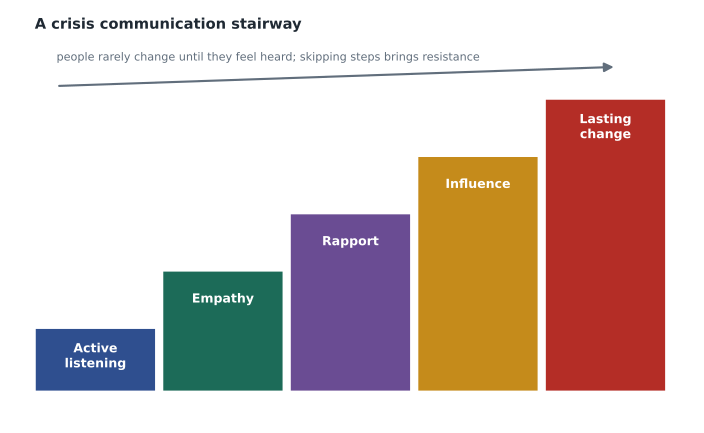
Active listening is listening with the goal of understanding, and showing the other person that you understand. It is the foundation of most crisis communication models, including the Behavioural Change Stairway Model developed for crisis negotiators by the FBI, which describes a progression from active listening to empathy, rapport, influence and finally behavioural change. The model's key insight is that people rarely change what they are doing until they feel heard. Officers who try to jump straight to influence, by giving orders or advice before the person feels understood, often meet resistance.
- Minimal encouragers: small signals such as 'okay', 'go on' or a nod that show you are listening.
- Paraphrasing: repeating back what the person said in your own words, such as 'So you used the car because you needed to get to work.'
- Emotional labelling: naming the feeling you hear, such as 'It sounds like you feel like nobody listens to you.'
- Open questions: questions that invite more than a yes or no, such as 'What happened tonight?'
- Summarizing: bringing together the main points, such as 'Let me make sure I've got this right.'
- Effective pauses: allowing silence so the person keeps talking or calms down.
Reyes used several of these techniques with Ethan. When he said his parents treated him like a child, she said, 'It sounds like you feel like they don't trust you,' and he said, 'Exactly,' and his voice dropped. Haddad points out that emotional labelling works partly because it gives people a sense of being understood, and partly because naming an emotion can help reduce its intensity. It does not mean agreeing. Reyes did not say Ethan was right. She said she understood how he felt.
De-escalation
De-escalation is the use of communication, time, distance and positioning to reduce the intensity of a situation and the likelihood that force will be needed. It is not a single technique but a set of choices. Slowing down is often the most important: officers who arrive calmly, speak slowly and do not rush to act give everyone time to think. Creating distance and using barriers, such as standing on the other side of a table, gives officers time to react and reduces the sense of threat for the person. Reducing the audience, by moving a conversation away from onlookers or family members, removes pressure to save face. Offering choices, even small ones, gives the person a sense of control.
De-escalation also requires officers to manage their own emotions. People who are shouting or insulting officers are often trying to provoke a reaction, or are simply overwhelmed. An officer who takes the insults personally and responds with anger will escalate the situation. Haddad tells the students that their own voice is one of their most powerful tools: if they lower their volume and slow their speech, people often follow. She also warns them that de-escalation does not always work. When a person is actively violent, officers may need to act to protect themselves and others, and the law allows reasonable force. But even then, communication continues, and officers should look for chances to de-escalate again.
| Escalating behaviour | De-escalating alternative |
|---|---|
| Giving orders immediately | Greeting, identifying yourself and explaining why you are there |
| Raising your voice to match theirs | Lowering your voice and slowing your speech |
| Crowding the person | Keeping distance and using barriers |
| Arguing about facts | Acknowledging feelings and summarizing what you heard |
| Threatening consequences early | Explaining options and choices |
| Talking in front of an audience | Moving to a quieter space |
| Rushing to finish | Using time to let emotions settle |
Communication barriers
Some people cannot easily understand or respond to officers' words. People who are deaf or hard of hearing may not hear commands. People who speak another language may not understand them. People with autism, intellectual disabilities, brain injuries or dementia may process language differently, may not make eye contact, and may react strongly to noise, touch or bright lights. People in mental health crisis or under the influence of drugs or alcohol may be confused or frightened. Earlier courses covered mental health and crisis response in detail. In patrol work, the important habit is to consider whether a person's failure to respond might be a communication barrier rather than defiance.
Practical steps include speaking clearly and simply, giving one instruction at a time, allowing extra time for a response, using gestures, writing notes, using interpreter services, turning off sirens and flashing lights where safe, and asking family members or caregivers how best to communicate. Officers should be cautious about using family members, especially children, as interpreters in situations involving conflict or allegations. Desjardins tells the class about a call early in his career when a man ignored his commands at a collision scene. He began to raise his voice, then noticed a hearing aid. The man had lost it in the crash and could not hear a word. 'I nearly put hands on a man for being deaf,' he says. 'Always ask yourself why someone isn't responding.'
# Counting talk time from body-worn camera notes: who spoke more?
segments = [  # (speaker, seconds)
    ("Reyes", 12), ("Ethan", 45), ("Reyes", 8), ("Ethan", 60),
    ("Reyes", 15), ("Ethan", 38), ("Reyes", 20), ("Ethan", 25),
]
talk = {}
for who, secs in segments:
    talk[who] = talk.get(who, 0) + secs
total = sum(talk.values())
for who, secs in talk.items():
print(f"{who:6} {secs:4} s ({round(secs / total * 100)} in 100)")Reyes 55 s (25 in 100) Ethan 168 s (75 in 100)
Haddad uses the body-worn camera from the Ridley Crescent call when coaching. In the first few minutes, Reyes spoke for only about a quarter of the time and Ethan for about three quarters. Haddad tells the students that this ratio is a sign of good listening. Officers who talk more than the person they are trying to understand are usually telling, not listening.
When words are not working
Sometimes a conversation is not working. The person keeps shouting, refuses every option and seems to be getting angrier. Haddad tells the students that this is the moment to slow down further, not speed up. Officers can try changing the person they are speaking to, because sometimes a different officer or voice helps. They can change the setting, such as moving away from an audience or a source of stress. They can take a short pause, telling the person they will give them a minute to think. They can ask what the person wants to happen, which often reveals a need that can be met. And they can explain clearly and calmly what will happen next and why, so that the person is not surprised.
If a situation is not urgent and nobody is in danger, time is usually on the officers' side. Desjardins describes a man who refused to leave a bus shelter for nearly an hour, shouting at everyone who approached. The officers kept their distance, talked to him every few minutes and waited. Eventually he said he was cold and hungry and had nowhere to go. A shelter worker came and took him for a meal. 'If we had tried to drag him out in the first five minutes,' Desjardins says, 'someone would have been hurt and he would have been charged with assaulting police. Instead he had breakfast.'
When a person becomes violent, officers may have to act. Even then, communication continues: officers tell the person what they want them to do, repeat it clearly, and look for any sign that the person is ready to stop. As soon as the danger is over, officers return to calm communication and to caring for anyone who has been hurt.
Worked problem
Choosing words
An officer arrives at a parking lot where a man is shouting at a security guard about a parking ticket. The officer's first instinct is to say, 'Calm down or you're going to be arrested.' Rewrite the opening using the principles in this lesson.
Show solution
- Start with a greeting and identification: 'Hi, I'm Officer Lee with the police.'
- Explain why you are there without blame: 'I was asked to come and help sort out what's going on with the parking.'
- Separate if useful: 'Can you step over here with me so I can hear your side?'
- Listen and label: 'It sounds like you think the ticket wasn't fair.'
- Offer options once the person feels heard: 'Here's how you can dispute it.'
Answer: A greeting, an explanation, a request and listening are more effective than an early threat.
Common mistakes
MistakeDe-escalation means never using force.
InsteadDe-escalation reduces the need for force; when a person is actively violent, reasonable force may still be necessary.
MistakeEmotional labelling means agreeing with the person.
InsteadIt shows you understand the feeling without agreeing with the facts or behaviour.
MistakeA person who ignores commands is defying you.
InsteadConsider communication barriers such as hearing loss, language, disability, crisis or intoxication.
MistakeOfficers should speak more than the person to stay in control.
InsteadListening more than talking usually builds the cooperation that gives real control.
Summary and key terms
- Communication resolves most situations and reduces the need for force.
- A strong opening greets, identifies, explains and asks.
- Separating people in a dispute, done respectfully, helps everyone speak and calm down.
- Active listening includes encouragers, paraphrasing, emotional labelling, open questions, summarizing and pauses.
- De-escalation uses time, distance, barriers, reduced audience, choices and calm voice.
- Officers should consider communication barriers before treating non-response as defiance.
- Active listening
- Listening to understand and showing the person you understand.
- Emotional labelling
- Naming the emotion a person seems to be feeling.
- De-escalation
- Using communication, time, distance and positioning to reduce intensity and the need for force.
- Paraphrasing
- Repeating back what someone said in your own words.
- Behavioural Change Stairway Model
- A crisis-communication model running from listening through empathy and rapport to influence and change.
- Communication barrier
- Anything that prevents a person from understanding or responding, such as hearing loss or language.
Practice problems
Work each problem on paper first, then reveal the answer to check.
What did Reyes say in her first ten seconds at Ridley Crescent?
Show answer
She greeted Ethan, identified herself, said nobody was in trouble right now, and asked him to step aside so she could hear his side.
What is the first step of the Behavioural Change Stairway Model?
Show answer
Active listening.
In the code example, roughly how much of the talk time did Reyes use?
Show answer
About 55 of 223 seconds, or about a quarter.
Name three possible reasons a person might not respond to commands.
Show answer
Hearing loss, language differences, disability, mental health crisis or intoxication.
Lesson quiz · 5 questions
Score 60% or more to complete this lesson.
Create a free account to save your progress, take quizzes and earn a certificate.