
LES-116 · Lesson 6 of 12 · 20 min
Positioning, contact and cover
▶ Video coming soon A video version of this lesson is on the way.
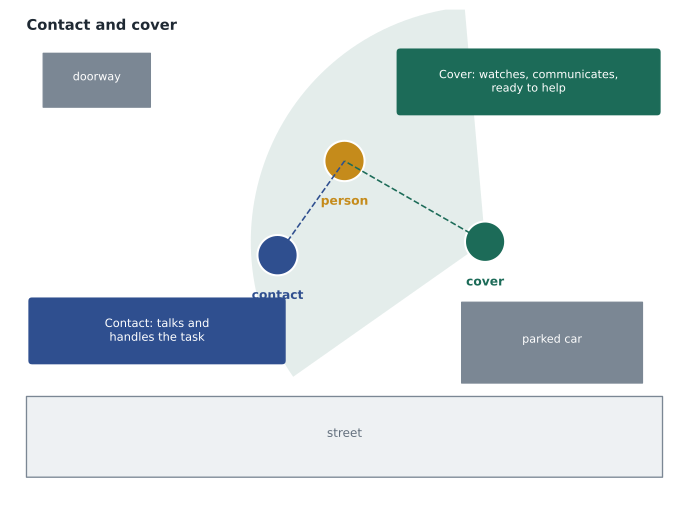
When Haddad reviewed the body-worn camera footage from Lakeview Motors the next week, she paused it at the moment Reyes walked toward Corey Nash. 'Look where Malhotra is,' she told the students. Malhotra stood a few steps to Reyes's side and slightly behind her, beside the cruiser's front wheel, with a clear view of Nash, the hatchback and the side gate. He was not talking. He was watching. 'That's cover,' Haddad said. 'Reyes is the contact officer. She does the talking and the dealing. He makes sure nothing surprises her. Neither job is more important than the other, and the system only works if both people know which job they have.'
Contact and cover is one of the oldest and most widely taught concepts in patrol safety. It was formalized in American police training in the 1980s, partly in response to analyses of officer deaths, and it is now taught in some form across Canada and the United States. Its core idea is simple: when two or more officers deal with a person, one takes the lead in communicating and handling the task, and the other takes responsibility for watching the person, the surroundings and any threat, and for being ready to help. The roles can switch, but they must be clear.
The contact officer
The contact officer is the one who interacts directly with the person. They introduce themselves, explain the reason for the contact, ask questions, gather identification, run checks, write tickets, give instructions and, if necessary, make an arrest. Because their attention is on the conversation and the task, the contact officer's awareness of the surroundings is reduced. Writing a ticket, reading a driver's licence or typing on a computer all take the eyes away from the person and the scene. That is exactly why the contact officer needs a partner.
Haddad tells the students that the contact officer should also be the main voice. When two officers both give instructions, the person may be confused about whom to listen to, and conflicting instructions can lead to dangerous misunderstandings. 'One voice,' she says. 'If the cover officer needs to say something urgent, like I see a knife, they say it clearly to their partner. Otherwise, the contact officer talks and the cover officer watches.'
The cover officer
The cover officer is responsible for the safety of the contact officer and for awareness of everything the contact officer cannot watch. That includes the person's hands and behaviour, other people nearby, vehicles approaching, and the wider environment. The cover officer usually positions where they can see the person and the contact officer without being in the contact officer's way, and where they would not be in a line of danger if something went wrong. They avoid becoming involved in the paperwork or the conversation, because that defeats the purpose. If the cover officer sees a threat or a change, they communicate it to the contact officer and act if needed.
Desjardins mentions a common problem in practice: the cover officer drifts into a second task. At a busy scene, it is tempting for the cover officer to start talking to a passenger, look at a phone or help with a search. Sometimes that is necessary, but when it happens, both officers should know that cover has been lost. Haddad says that some officers use a simple phrase such as 'I'm off cover' or 'I need cover' to make the change explicit.
Positioning principles
Positioning is where officers stand or park relative to the people, vehicles and objects around them. Good positioning gives officers time and options; poor positioning takes them away. Several principles apply in most situations, though officers must always adapt them to the setting.
- Distance: keep enough space to see the person's whole body, especially the hands, and to react if something changes. Distance should be comfortable for conversation without crowding the person.
- Angles: standing slightly to the side rather than directly in front of a person is less confrontational and gives more options to move.
- Avoid crossfire: two officers should not stand on opposite sides of a person in a way that would put one in the other's line of danger.
- Lighting: put the light behind you and on the person, rather than standing in the light while the person is in the dark.
- Barriers and cover: use objects such as a vehicle or a counter as a barrier when appropriate, and know where real cover is.
- Exits: know where you, your partner and the person could go, and avoid blocking the person's only way out unless you intend to detain them.
- Footing and traffic: watch for ice, uneven ground, stairs and moving vehicles.
Desjardins stresses that positioning should look natural. Officers who stand in an obviously tactical way during a friendly conversation can make people nervous, which defeats the purpose. Most of the time, good positioning simply looks like a relaxed officer standing a little to one side, at a polite distance, with their partner nearby. Many people never notice it. 'The best positioning is invisible to the person and obvious to your partner,' he says.
Reyes's opening at Lakeview Motors showed several of these principles. She stopped the cruiser so its headlights lit the space between her and Nash, which put the light on him and kept her in the shadow behind it. She called out from beside her open door, which was a barrier and gave her time to see his reaction before she walked forward. When she approached, she walked at an angle rather than straight at him. Haddad pointed out one thing she would change: Reyes walked into the gap between two pickup trucks, which limited her ability to move sideways and blocked Malhotra's view for a moment. 'Small thing,' Haddad said. 'But small things add up at four in the morning.'
Distance and time
The reason distance matters so much is that reaction takes time. An earlier lesson showed that a person can cover several metres during the time it takes an officer to notice a change and begin to respond. Trainers sometimes call the space needed to react a reactionary gap. There is no single correct distance, because it depends on the person, the setting, the officer's training and the situation. What matters is the principle: the closer an officer is, the less time they have, so officers should close distance only when they have a reason and are ready, for example when they need to hand over a document or make an arrest with their partner in position.
# Time available to react before a person covers the distance (illustration only, m/s)
speeds = {"walking": 1.4, "jogging": 3.0, "running": 5.0}
for distance in [2, 4, 6]:
    times = ", ".join(f"{label} {distance / v:.1f} s" for label, v in speeds.items())
print(f"{distance} m -> {times}")2 m -> walking 1.4 s, jogging 0.7 s, running 0.4 s 4 m -> walking 2.9 s, jogging 1.3 s, running 0.8 s 6 m -> walking 4.3 s, jogging 2.0 s, running 1.2 s
The numbers in the example are illustrations, not rules, but they show the shape of the relationship. Doubling the distance doubles the time. At two metres, a person who starts running toward an officer covers the gap in less than half a second, which is less than most people's reaction time. At six metres, the officer has a little over a second. That extra second is often the difference between having options and having none. It is also time in which communication can work, which is why distance is a de-escalation tool as much as a safety tool.
Positioning indoors
Indoor calls, such as the family dispute on Ridley Crescent, present particular challenges. Rooms are smaller, there are doors and corners, kitchens contain knives and other objects, and people may move between rooms. Officers entering a home should think about where people are, where the exits are, and where they will stand. At Ridley Crescent, each officer took one person to a different space, which kept everyone apart and reduced the audience. Malhotra stayed with Gary in the kitchen but moved the conversation to the table, away from the knife block on the counter, by asking Gary if they could sit down. Coutu kept Lynn in the hallway near the front door, which gave both of them an easy exit.
Officers should be cautious about standing in doorways for long periods, because a doorway limits movement and can leave an officer silhouetted against the light. They should keep partners in sight or in earshot when possible, and should tell each other when they move to a different room. Haddad asks officers who separate people inside a home to check on each other every few minutes, either by looking or by a quick word on the radio, so that nobody is out of touch for long.
| Situation | Contact officer | Cover officer |
|---|---|---|
| Pedestrian conversation | Greets, explains, asks questions | Watches hands, surroundings and other people |
| Traffic stop | Speaks to the driver, collects documents, writes ticket | Watches the occupants and traffic, often from the other side |
| Family dispute | Each officer may act as contact for one person | Partners check on each other and keep in touch |
| Arrest | Explains the arrest and gives instructions | Watches for resistance and helps when ready |
| Records check | Runs queries and handles results | Keeps eyes on the person while the contact officer reads |
Working with a partner
Contact and cover depends on communication between officers. Partners should agree on roles before they arrive whenever possible, in a sentence or two: 'I'll take the driver, you've got cover.' They should use clear, simple language during the encounter and agree on signals for common situations, such as needing to switch roles or seeing something concerning. Experienced partners often develop their own shorthand, but officers who are working with a new partner, or with an officer from another service, should keep things explicit. Haddad says misunderstandings between officers are one of the most common factors in incidents that go wrong.
When there are more than two officers, roles still matter. At a larger scene, one officer may coordinate, others may each take a person or an area, and someone should be watching the overall scene. Reyes asked Malhotra after the Ridley Crescent call who had been in charge. He said that he was, as the senior officer, but that he had let her take the lead with Ethan because she had built rapport in the first ten seconds. 'Being in charge doesn't mean doing all the talking,' he said. 'It means making sure everyone has a job and nothing falls through the cracks.'
Positioning with one officer
Many officers work alone, especially in smaller services and on day shifts. Without a cover officer, an officer must do both jobs at once, which is harder. One-officer cars should be especially careful to use distance, barriers and lighting, to give dispatch their location before getting out, and to ask for backup when there is more than one person or when anything about the situation seems uncertain. They can also slow the encounter down, for example by asking a person to wait while they write something in the car, which gives time to watch and think.
Worked problem
Setting up contact and cover
Two officers stop to speak to a woman standing beside a parked car outside a closed shopping plaza at midnight. A man is sitting in the passenger seat. Describe how they might set up roles and positions.
Show solution
- Before getting out, agree on roles: Officer A will speak to the woman; Officer B will cover and keep an eye on the man in the car.
- Park so the cruiser's lights illuminate the area and the officers are behind the light.
- Officer A approaches at an angle, stops at a comfortable distance and greets the woman, explaining why they stopped.
- Officer B positions to the side where they can see the woman, the passenger and the surroundings, without standing in Officer A's line.
- If Officer A needs to look at identification or run a check, Officer B keeps watching both people; if B sees something concerning, B tells A clearly.
Answer: Clear roles agreed before the approach let one officer focus on the task while the other watches.
Common mistakes
MistakeThe cover officer should help with the paperwork to save time.
InsteadThe cover officer's job is to watch; if they take on another task, both officers should know cover is lost.
MistakeBoth officers should give instructions so the person takes them seriously.
InsteadOne voice avoids confusion; the cover officer speaks to the partner if there is something urgent.
MistakeGood positioning should look tactical.
InsteadGood positioning usually looks relaxed and natural to the person.
MistakeThere is a correct safe distance for every situation.
InsteadDistance depends on the situation; the principle is that more distance gives more time.
Summary and key terms
- In contact and cover, one officer communicates and handles the task while the other watches and protects.
- Roles should be agreed in advance, made explicit and switched clearly.
- Positioning principles include distance, angles, avoiding crossfire, lighting, barriers, exits and footing.
- Reaction takes time, so distance gives options and time for communication to work.
- Indoors, officers think about rooms, exits, objects and keeping in touch with partners.
- Being in charge means making sure everyone has a job, not doing all the talking.
- Contact officer
- The officer who communicates with the person and handles the task.
- Cover officer
- The officer who watches the person and surroundings and is ready to help.
- Reactionary gap
- The space an officer needs to have time to notice and respond to a change.
- Crossfire
- A position where one officer would be in the other's line of danger.
- Barrier
- An object between an officer and a person that slows contact and gives time.
- Positioning
- Where officers stand or park relative to people, vehicles and objects.
Practice problems
Work each problem on paper first, then reveal the answer to check.
At Lakeview Motors, who was the contact officer and who was cover?
Show answer
Reyes was contact; Malhotra was cover.
What small positioning issue did Haddad point out at Lakeview Motors?
Show answer
Reyes walked into the gap between two pickup trucks, limiting her movement and briefly blocking Malhotra's view.
In the code example, how long does a running person take to cover 4 metres?
Show answer
0.8 seconds.
Why did Malhotra move the kitchen conversation to the table?
Show answer
To move away from the knife block on the counter.
Lesson quiz · 5 questions
Score 60% or more to complete this lesson.
Create a free account to save your progress, take quizzes and earn a certificate.