
LES-116 · Lesson 4 of 12 · 20 min
Patrol planning, briefings and readiness
▶ Video coming soon A video version of this lesson is on the way.
B platoon's night shift on January 22 began at 18:45 in the parade room at Port Ardent's central station, fifteen minutes before the official start. Sergeant Haddad stood at the front with a laptop connected to the screen. Twelve officers sat at the tables with coffee, notebooks and the day's printed bulletin. Reyes sat beside Malhotra, who had told her on her first week that the briefing was the most important fifteen minutes of the shift. 'Everything you hear in that room is information you would otherwise have to discover on the street,' he had said. 'Discovering it on the street is slower and more dangerous.'
Haddad covered six items in eleven minutes: staffing and zone assignments; a wanted person, Trent Vollmer, thirty-one, with a warrant for failing to appear on a fraud charge and a history of running from police but no history of weapons; a pattern of thefts from unlocked vehicles in the Harbourside neighbourhood between midnight and four in the morning; a road closure on Mill Street for water main repairs; a weather warning for blowing snow on the highway after midnight; and a reminder that two officers were off on long-term injury and the platoon would be short if anything big happened. She finished by asking whether anyone had anything to share. An officer from the day shift who had stayed late mentioned that a family on Ridley Crescent had called twice that afternoon about an argument but nobody had been charged. Reyes wrote it down. Five hours later, it mattered.
Why preparation matters
Patrol work looks reactive: calls come in and officers respond. But much of what makes a response safe happens before the call. An officer who knows the zone, knows who is wanted, knows the condition of the roads and has checked their equipment and vehicle starts every call with an advantage. An officer who skipped the briefing, has a dead radio battery and does not know the street layout starts every call behind. Desjardins compares it to a pilot's preflight check. Pilots do not skip the checklist because they have flown many times before; experience is exactly what teaches them that the checklist catches problems that confidence misses.
Preparation also supports lawful decision-making. When an officer stops a person, the information they had beforehand may be part of the grounds for their actions. A clear briefing about a wanted person, including a description and a recent photograph, can support a stop. Vague or outdated information cannot. Haddad reminds the class that information in a briefing must be accurate and current, and that officers must still confirm it, for example by checking that a warrant is still valid before arresting someone on it.
The briefing
A good briefing is short, organized and focused on what officers need to do their work safely. It usually includes several kinds of information.
- Assignments: who is working, which zones or cars, and who is the supervisor and backup.
- Wanted and missing persons: descriptions, photographs, warrants and any safety cautions.
- Crime patterns: recent incidents, hot spots and times, often provided by crime analysts.
- Officer-safety information: addresses or people with recent violence or threats, flagged in the service's records system.
- Operational issues: road closures, special events, weather, equipment problems or staffing shortages.
- Follow-up from previous shifts: ongoing situations that may generate calls, such as the Ridley Crescent family.
Haddad uses a simple test for each item: what will officers do differently because they heard it? If the answer is nothing, the item probably does not belong in the briefing. She also tries to end every briefing with a question to the group, because the most useful information often comes from officers rather than from the sergeant. Desjardins adds that briefings also matter for officer wellness. They are one of the few times a platoon is in one room, and a supervisor who notices that an officer looks exhausted or upset can check in privately afterwards.
Personal readiness
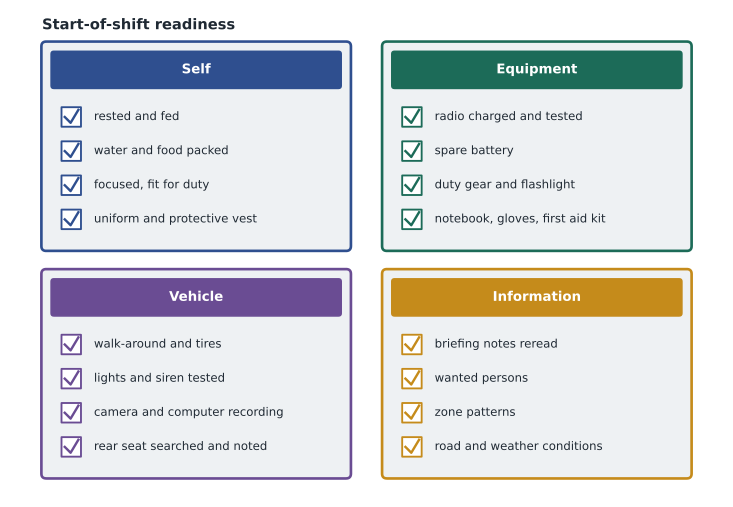
Readiness starts with the officer. Before a twelve-hour night shift, Malhotra eats a proper meal, sleeps in the afternoon, and brings water and food so that he is not relying on whatever is open at three in the morning. He tells Reyes that fatigue and hunger make people irritable and slow, and irritable, slow officers make poor decisions and have more confrontations. A later lesson covers fatigue in depth. For now, the point is that officers have a professional responsibility to arrive fit for duty, and to tell a supervisor if they are not.
Personal readiness also includes protective equipment. Most services issue soft body armour and require or strongly encourage officers to wear it on patrol. Armour must fit properly and be within its service life. Officers also carry gloves for handling people, property and bodily fluids, and many carry a personal first aid kit with a tourniquet and wound dressings. Desjardins notes that first aid training is a safety skill for everyone on scene: officers are often first to arrive at collisions, assaults and medical emergencies, and the ability to stop serious bleeding or start CPR saves lives.
Equipment and vehicle checks
At 18:58, Reyes and Malhotra walked out to car 14 in the lot. Malhotra watched as Reyes did the vehicle check. She walked around the car looking at tires and body damage, tested the emergency lights and siren, checked that the in-car camera and computer started and recorded, checked the fuel, and confirmed that the first aid kit, fire extinguisher, flares, traffic vest and spare flashlight batteries were in the trunk. Then she opened the rear doors, lifted the rear seat cushion and looked underneath with a flashlight.
The rear seat search is a standard practice. Anything found under the seat after a prisoner has been transported could be evidence, contraband or a weapon, and the officer needs to know whether it was there before the prisoner got in. Searching at the start of every shift, and after every transport, means that the officer can say with confidence when something was put there. Reyes found a single cough drop wrapper. Malhotra told her to note it anyway. 'If you find a knife under there at four in the morning,' he said, 'you want to be able to say exactly what was there at seven.'
The radio check came next. Reyes keyed her portable radio, identified herself and car 14 to dispatch and asked for a radio check. Dispatch confirmed that she was clear. She checked that her spare battery was charged. Radios are an officer's lifeline, and a radio that is not working, not charged or set to the wrong channel can leave an officer unable to call for help. Lesson 10 covers radio discipline in detail.
# Shift start checklist: flag anything not done before leaving the lot
checklist = {
    "radio tested with dispatch": True,
    "spare radio battery charged": True,
    "protective vest on": True,
    "duty gear checked": True,
    "vehicle walk-around": True,
    "lights and siren tested": True,
    "camera and computer recording": True,
    "rear seat searched and noted": True,
    "first aid kit and tourniquet present": True,
    "briefing notes reviewed": False,
}
missing = [item for item, done in checklist.items() if not done]
print("items checked:", sum(checklist.values()), "of", len(checklist))
print("not done:", missing if missing else "none")items checked: 9 of 10 not done: ['briefing notes reviewed']
In the example, Reyes had not yet reread her briefing notes. Malhotra asked her to read them aloud in the car before they left the lot: Vollmer's description, the Harbourside thefts, the Mill Street closure, the highway warning and the Ridley Crescent family. It took forty seconds. Haddad tells the class that this habit of rereading key information is one of the simplest ways to fight the forgetting that happens over a long shift.
Knowing the zone
A patrol officer's zone is the area they are responsible for. Knowing it well is a safety skill. An officer who knows that a street is a dead end will not chase a car into it without thinking. An officer who knows which apartment buildings have rear exits, which parking lots are poorly lit, which bars close at two, and where the nearest hospital and fire station are can make faster and better decisions. Officers learn their zones by driving and walking them, reading call histories, talking to residents and business owners, and listening to more experienced officers.
Knowing the zone also means knowing the people in it. Community policing, covered in an earlier course, builds relationships with residents, business owners and community agencies. Those relationships are a source of information and goodwill that makes calls safer. A shop owner who knows an officer by name is more likely to call early about a problem. A resident who trusts the local officers is more likely to tell them that a neighbour has been acting strangely. Malhotra tells Reyes that some of his best safety information has come from people he met at coffee shops, not from the computer.
| Question | Why it matters for safety |
|---|---|
| Where are the hospitals, fire halls and other police stations? | Fast help for injuries and backup |
| Which roads are dead ends, one-way or often closed? | Avoid trapping yourself or delaying a response |
| Which buildings have unusual layouts or several exits? | Plan approaches and containment |
| Where are the high-call locations and when? | Anticipate demand and patterns |
| Where is radio coverage weak? | Plan alternatives such as a phone or relaying |
| Who are the community contacts? | Information and goodwill |
Planning for the shift
Some services encourage officers to think about how they will spend the time between calls. Directed patrol, such as driving through the Harbourside area between midnight and four to deter vehicle thefts, puts officers where crime is likely. Officers can also plan when and where they will eat, when they will write reports, and how they will manage fatigue in the early morning hours. Haddad asks each car to tell her their plan for proactive time, partly so she knows where people are and partly because a plan makes the shift more purposeful.
Planning also means thinking about likely calls. On January 22, Reyes and Malhotra talked in the car about what they would do if they saw someone matching Vollmer's description: they would not try to grab him alone if he ran, they would report his direction, and they would coordinate with other cars to contain the area. They also talked about the Ridley Crescent family. If a call came from that address, they would ask dispatch for the history, travel together, and plan to separate the parties. These short conversations, held while driving, are a habit Malhotra calls talking through the what-ifs.
Information systems and flags
Officers also prepare by knowing how to use their service's information systems. Before and during a shift, they check messages from other units, read new bulletins and learn which addresses or people carry safety flags. A flag is not a conclusion that a person is dangerous. It is a note that something relevant has happened, such as a recent threat to officers or a weapon found at an address, and it is only as good as the information behind it. Officers should read the details, not just the flag, and should remember that flags can be outdated or incomplete. Haddad tells the students that she has seen officers arrive at a call so alarmed by an old flag that they treated a frightened elderly man as a threat, and others who ignored a recent, serious flag because they had seen the same address many times. The right response is to treat flags as information to weigh, alongside everything else the officer sees and hears.
Worked problem
Building a mental plan
During briefing, an officer learns that a man with a warrant for breaching a release order is believed to be staying with his sister on Pine Street, that he has run from police twice before, and that he has no history of weapons. What should the officer think about before the shift begins?
Show solution
- Confirm the warrant is still valid and note the description and photograph.
- Learn the layout around Pine Street: back lanes, fences and the routes a person on foot might take.
- Agree with a partner that if they see him, one officer will make contact and the other will watch for flight and call it in.
- Plan not to chase alone over fences or into unknown yards, and to rely on containment and other units instead.
- Remember that the sister and any children in the house are not suspects and should be treated respectfully.
Answer: A brief plan made before the shift makes a possible contact calmer and safer for everyone.
Common mistakes
MistakeBriefings are routine and can be skipped by experienced officers.
InsteadBriefings provide current information that officers would otherwise discover on the street, at greater risk.
MistakeVehicle checks are only about mechanical safety.
InsteadThey also include equipment, camera, computer and a rear seat search that protects evidence.
MistakeInformation from a briefing is enough to arrest someone.
InsteadOfficers must confirm key information, such as whether a warrant is still valid.
MistakeKnowing the zone is only about streets.
InsteadIt also means knowing people, patterns, resources and radio coverage.
Summary and key terms
- Preparation before calls gives officers information and time that make responses safer.
- A good briefing covers assignments, wanted persons, patterns, safety flags, operational issues and follow-up.
- Personal readiness includes rest, food, fitness for duty and properly fitted protective equipment.
- Vehicle and equipment checks include lights, siren, camera, radio, first aid equipment and a rear seat search.
- Knowing the zone covers roads, buildings, resources, patterns, radio coverage and community contacts.
- Talking through likely scenarios with a partner builds a shared plan.
- Briefing
- A short meeting at the start of a shift to share information officers need.
- Officer-safety flag
- A note in a records system about recent violence or threats linked to a person or address.
- Rear seat search
- A check of the prisoner compartment at the start of a shift and after every transport.
- Directed patrol
- Patrol time focused on a place and time where problems are likely.
- Zone
- The area a patrol officer is responsible for.
- Fit for duty
- Physically and mentally able to do the job safely.
Practice problems
Work each problem on paper first, then reveal the answer to check.
What item did a day-shift officer mention at the end of the briefing?
Show answer
A family on Ridley Crescent that had called twice about an argument.
Why search the rear seat at the start of every shift?
Show answer
So the officer can say exactly what was there before any prisoner was transported.
What test does Haddad use for each briefing item?
Show answer
What will officers do differently because they heard it?
In the code example, which item had not been done?
Show answer
Reviewing the briefing notes.
Lesson quiz · 5 questions
Score 60% or more to complete this lesson.
Create a free account to save your progress, take quizzes and earn a certificate.