
LES-116 · Lesson 12 of 12 · 20 min
Capstone: documenting and reviewing a patrol shift
▶ Video coming soon A video version of this lesson is on the way.
A week after the January 22 shift, Sergeant Haddad sat down with Reyes and Malhotra in a small meeting room with a laptop, Reyes's notebook, the shift's call records and the body-worn and in-car camera footage. The review was not a disciplinary meeting. It was part of Reyes's field training: a structured look at a whole shift, call by call, to find what went well and what could be better. Haddad invited Desjardins's class to watch a recording of the review, with everyone's permission, because she believes that reviewing ordinary shifts is the best way to prevent extraordinary failures.
This lesson brings the course together. It covers the documentation that records what officers did and why, the after-action review process that turns experience into learning, and a full review of the January 22 shift using the principles from every lesson.
Why documentation matters
Documentation is the written record of police work: notebook entries, occurrence reports, use-of-force reports, collision reports, supplementary reports and the data entered into records systems. It serves several purposes. It records evidence for court. It explains officers' decisions to supervisors, review bodies and the public. It provides information to other officers who deal with the same people and places later. It supports officer safety, because safety flags and history come from earlier reports. And it protects officers who acted properly, because a clear, contemporaneous record is the best answer to a later complaint.
Notes should be made as soon as practicable after events, while memory is fresh. They should be accurate, complete, legible and in chronological order, with times recorded. They should record what the officer saw, heard and did, and the reasons for decisions, especially decisions that affect people's rights, such as detentions, searches and arrests. They should not include opinions presented as facts, and they should never be altered after the fact; corrections are made in a way that leaves the original visible, and later additions are clearly dated. Officers must give their notes to the prosecutor when a case goes to court, and defence lawyers will compare them with video and other evidence.
Haddad uses a simple rule: write it as if the court, a review board and the person you dealt with will all read it, because they might. She also reminds the students that the best notes explain the grounds for each decision in the officer's own words. Stock phrases, such as 'the subject became aggressive', tell a reader nothing. Specific facts, such as 'he stepped toward me, clenched both fists and said I'm going to knock you out', let a reader understand what the officer saw.
| Weak note | Better note |
|---|---|
| Male acting suspicious. | 00:40, Dock Lane: male shone a phone light into four parked cars in one block during the theft pattern window. |
| Subject was aggressive. | Ethan raised his voice, said nobody listens to him, and slammed his phone on the counter; no threats, no approach toward anyone. |
| Entered for safety. | 21:36, outside 4B: heard a faint voice say help; announced police and entered to find the caller. |
| Wanted male arrested. | 04:41, passenger confirmed he is Trent Vollmer; dispatch confirmed warrant for failing to appear; arrested on warrant. |
Video and notes
Many services now use body-worn cameras and in-car cameras, and the footage has become one of the most important records of police work. Video shows things that notes cannot, such as tone of voice and body language. But video has limits. It shows only what the camera saw, which may differ from what the officer saw. It may miss events outside the frame, at night or in poor conditions. It does not show what the officer knew from dispatch or from earlier experience. Notes and video are therefore complementary. In Canada, services that use cameras have policies on when to record, how footage is stored and disclosed, and whether officers may review it before writing notes, and these policies vary. Haddad tells the class that the worst thing an officer can do is write notes that contradict the video without explaining why.
The after-action review
An after-action review is a structured discussion of an event that asks four questions: what was supposed to happen, what actually happened, why there was a difference, and what should be done differently next time. The method was developed by the military and is now used in many fields, including policing, emergency services and health care. Its value depends on honesty. A review that looks for someone to blame makes people defensive and hides problems. A review that looks for lessons makes people open and finds them. Haddad starts every review by saying that the goal is to learn, not to punish, and by pointing out what went well before discussing what could be better.
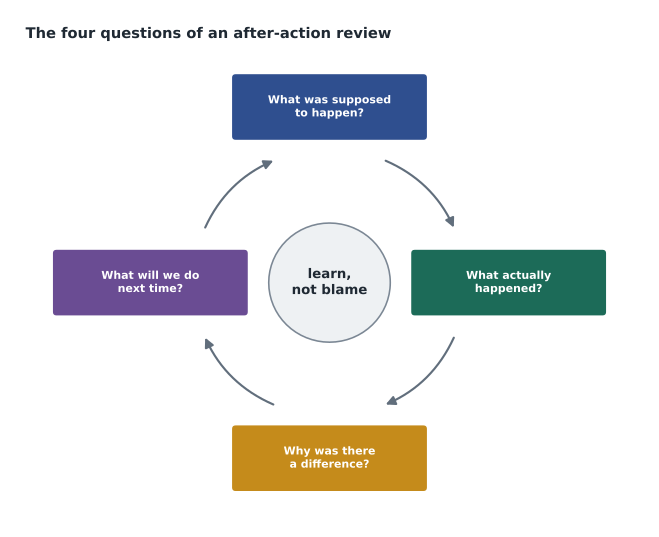
After-action reviews in policing can be formal or informal. A quick conversation between partners after a call is an informal review. A supervisor's review of a whole shift, like Haddad's, is more structured. Serious incidents, such as uses of force causing injury, vehicle pursuits and officer injuries, usually require formal reviews under service policy, and some are also investigated by external bodies. In Ontario, the Special Investigations Unit investigates incidents involving police in which a person dies, is seriously injured, is shot at or alleges sexual assault, and the Law Enforcement Complaints Agency handles public complaints. Whatever the level, the same four questions apply.
Reviewing the shift
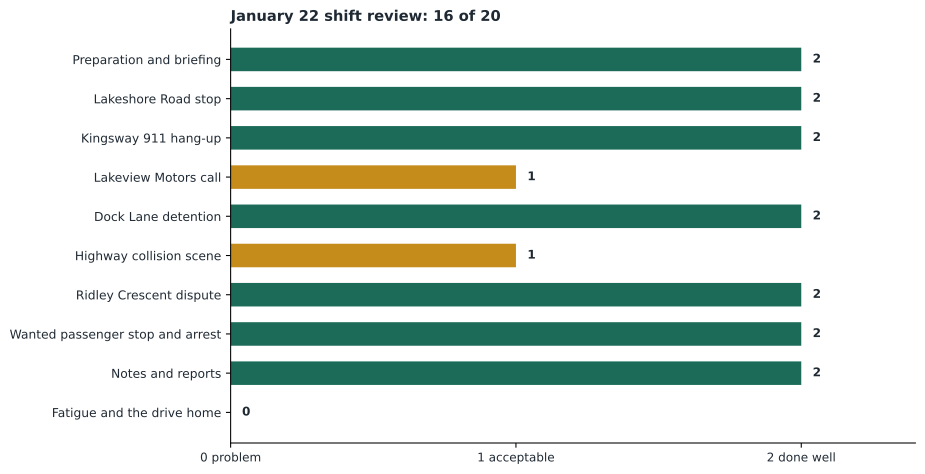
Haddad uses a simple scoring sheet with ten areas, each scored from zero to two: two means done well, one means acceptable with room to improve, and zero means a significant problem. She is careful to explain that the score is a coaching tool, not a grade, and that the comments matter more than the numbers.
# The January 22 shift review (0 = significant problem, 1 = acceptable, 2 = done well)
review = [
    ("Preparation and briefing", 2),
    ("Lakeshore Road stop", 2),
    ("Kingsway 911 hang-up", 2),
    ("Lakeview Motors call", 1),
    ("Dock Lane detention", 2),
    ("Highway collision scene", 1),
    ("Ridley Crescent dispute", 2),
    ("Wanted passenger stop and arrest", 2),
    ("Notes and reports", 2),
    ("Fatigue and the drive home", 0),
]
total = sum(score for _, score in review)
print("total:", total, "out of", 2 * len(review))
for area, score in review:
    print(f"{score}  {area}")
print("areas to work on:", [a for a, s in review if s < 2])total: 16 out of 20 2 Preparation and briefing 2 Lakeshore Road stop 2 Kingsway 911 hang-up 1 Lakeview Motors call 2 Dock Lane detention 1 Highway collision scene 2 Ridley Crescent dispute 2 Wanted passenger stop and arrest 2 Notes and reports 0 Fatigue and the drive home areas to work on: ['Lakeview Motors call', 'Highway collision scene', 'Fatigue and the drive home']
The shift scored sixteen out of twenty. Haddad went through each area. Preparation scored two: Reyes did a complete vehicle check, searched the rear seat, reread her briefing notes in the car, and remembered the Ridley Crescent item when the call came. The Lakeshore Road stop scored two: Reyes chose a safe location off the road, called the stop in first, approached on the passenger side, explained the reason in her first sentence and ended the stop politely. The Kingsway call scored two: the officers planned on the way, parked short, listened at the door, entered only when they heard a voice calling for help, limited their check of the apartment to what safety required, and treated Mr. Brandt with kindness.
Lakeview Motors scored one. The officers positioned well and Malhotra provided good cover, but Reyes did not notice the hatchback when they arrived, and she walked into the gap between two pickup trucks. Haddad called both points normal for a new officer and noted that Reyes had already improved: she was the one who spotted the passenger watching the mirror later in the shift. The Dock Lane detention scored two: Reyes documented her grounds before getting out, began with a conversation, explained the detention and the person's rights, kept it brief, did not search without a safety reason, and released Mr. Ostrowski with thanks.
The highway collision scored one. The officers parked to shield the scene, set flares and positioned away from traffic, which is why nobody was hurt when the sedan clipped the mirror. But in blowing snow at night, Haddad said, they should have asked for a second car further back, considered the highway's closure procedures, and moved the driver up into the cruiser rather than having Reyes go down the bank while Malhotra stood on the shoulder. Malhotra agreed and said he had made that call out of habit and should have thought more about the weather. Haddad thanked him for saying so in front of a probationary officer.
Ridley Crescent scored two: the officers met before approaching, separated the family members respectfully, listened, found no offence and connected the family to services. The Harbour Road stop and arrest scored two: Reyes noticed the passenger's behaviour, told her partner quietly, requested backup without alarm, waited, confirmed the warrant and made a calm arrest. Notes and reports scored two, with Haddad's only suggestion being that Reyes add exact times to two entries. Then Haddad turned to the last area.
Fatigue and the drive home scored zero. Haddad did not soften it. Reyes had driven home after almost twenty-four hours awake and had a near miss at a red light. Haddad said that she was partly to blame herself, because she knew the shift had run long and had not checked on Reyes before she left. The platoon agreed on two changes: any officer who stays more than an hour past the end of a night shift will check out with the supervisor, who will ask how they are getting home; and the station's rest room will be made available for officers to sleep before driving. Reyes said that she had been embarrassed to mention it. Haddad told her that the embarrassment was the real safety problem, and that the platoon would fix it together.
Turning lessons into practice
An after-action review is only useful if its lessons lead to change. Some changes are individual: Reyes will scan for a second vehicle on every arrival and will avoid narrow gaps between parked vehicles. Some are for partners: Malhotra will think about weather before choosing roadside positions. Some are for the platoon: the fatigue check-out and the use of the rest room. And some are for the whole service: Haddad sent a short note to the training unit suggesting that the winter refresher include roadside positioning in poor visibility. Each change is specific, assigned to someone, and checked later.
Desjardins closes the course by returning to the line he started with: everyone goes home. He asks the students to look back at the shift and notice how many people that phrase covered. Mrs. Fraser drove home with a warning and a fair impression of the police. Mr. Brandt went to hospital and called his daughter. Corey Nash kept his new job and his dignity. Kevin Ostrowski found his wallet and walked his dog. Ethan Pruitt spent the night at a friend's place and shook an officer's hand. Trent Vollmer went to court without anyone getting hurt. The driver who clipped the cruiser was stopped before he hit someone else. And Reyes got home, though not as safely as she should have, and her platoon changed its practice so that the next officer would. 'That,' Desjardins says, 'is what officer safety looks like.'
Worked problem
Writing your own review
A student completes a ride-along on a quiet day shift with three calls: a minor collision in a parking lot, a shoplifter held by store security and released with a court date, and a welfare check on an elderly woman who turned out to be fine. Using the four after-action questions, outline a short review.
Show solution
- What was supposed to happen: each call handled safely and lawfully, with clear communication and proper notes.
- What happened: at the collision, the officer parked behind the cars with lights on and exchanged information calmly; at the store, the officer confirmed security's grounds, explained the process and released the person; at the welfare check, the officer knocked, identified herself and spoke to the woman through the door before she opened it.
- Why there were differences: at the store, the officer briefly turned her back on the person while talking to security, because she was focused on the paperwork.
- What to do next time: agree with store security who will watch the person while the officer reads the report.
- Specific change: next time, ask security to stand where they can see the person, and position so the person stays in view.
Answer: Even quiet shifts provide lessons when reviewed honestly with the four questions.
Common mistakes
MistakeA review is a search for who made mistakes.
InsteadA review looks for lessons; blame makes people defensive and hides problems.
MistakeVideo replaces the need for good notes.
InsteadVideo and notes complement each other; notes record what the officer knew and why they acted.
MistakeStock phrases in notes are fine because everyone knows what they mean.
InsteadSpecific facts are needed; stock phrases tell a reader nothing.
MistakeA high score means there is nothing to improve.
InsteadThe comments and specific changes matter more than the numbers.
Summary and key terms
- Documentation records evidence, explains decisions, informs other officers and protects officers who acted properly.
- Notes should be timely, accurate, complete, chronological and specific, and never altered after the fact.
- Video and notes complement each other; each shows things the other cannot.
- After-action reviews ask what was supposed to happen, what happened, why, and what to do next time.
- The January 22 shift scored 16 out of 20, with lessons about awareness, roadside positioning and fatigue.
- Lessons must become specific, assigned changes that are checked later.
- Special Investigations Unit
- Ontario's civilian agency that investigates police incidents involving death, serious injury, firearm discharges at people or sexual assault allegations.
- Contemporaneous notes
- Notes made at or near the time of events, while memory is fresh.
- After-action review
- A structured discussion of what was planned, what happened, why, and what to do next time.
- Stock phrase
- A vague, standard expression in a report that does not describe specific facts.
Practice problems
Work each problem on paper first, then reveal the answer to check.
What were the four questions Haddad used in the review?
Show answer
What was supposed to happen, what actually happened, why there was a difference, and what to do next time.
What did the shift score in total?
Show answer
16 out of 20.
Which area scored zero, and what changes did the platoon make?
Show answer
Fatigue and the drive home; a supervisor check-out for officers staying long past shift end, and use of the rest room before driving.
Why did the highway collision score only one?
Show answer
In blowing snow, officers should have used a second car, closure procedures or moved the driver into the cruiser instead of standing on the shoulder.
Lesson quiz · 5 questions
Score 60% or more to complete this lesson.
Create a free account to save your progress, take quizzes and earn a certificate.