
LES-116 · Lesson 10 of 12 · 20 min
Radio discipline, backup and teamwork
▶ Video coming soon A video version of this lesson is on the way.
At 04:30, on Harbour Road, Reyes stopped a silver sedan doing 82 km/h in a 50 zone. She called the stop in, chose a lit bus loop off the road, and approached on the passenger side with Malhotra on cover. The driver, Tanya Lisowski, twenty-nine, apologized and handed over her documents. The passenger, a man in his early thirties in a grey toque, said nothing and watched the side mirror. Reyes noticed that he kept glancing back at the cruiser and then at the road ahead. She also noticed that he looked a lot like the photograph of Trent Vollmer from the briefing.
Reyes did not say anything to the passenger. She told Mrs. Lisowski she would be back in a moment, walked back to the cruiser and sat in the driver's seat. Malhotra came back to the passenger side of the cruiser, keeping his eyes on the sedan. 'Passenger looks like Vollmer,' Reyes said quietly. 'He's watching the mirror.' Malhotra looked at the photo on the computer and agreed. Reyes keyed her radio.
'Car 14 to dispatch, can you start a second unit to my stop on Harbour Road at the Lakeview bus loop. Non-urgent, possible wanted party in the passenger seat.' Dispatch acknowledged and sent car 9 and the sergeant. While they waited, Reyes ran Mrs. Lisowski's licence, which was valid, and wrote the speeding ticket. Malhotra watched the passenger, who stayed in the car. Four minutes later, Coutu pulled in behind the cruiser and Haddad parked across the bus loop's exit, behind the sedan. Haddad and Coutu took positions near the sedan's rear, out of traffic.
With three officers in position, Reyes walked back to the sedan. She gave Mrs. Lisowski the ticket and explained it. Then she said to the passenger, 'Sir, you look a lot like someone we're looking for. Are you Trent Vollmer?' He sighed and said yes. Reyes asked dispatch to confirm the warrant; dispatch confirmed that a warrant for failing to appear was in force. Reyes told Vollmer he was under arrest on the warrant and asked him to step out of the car. He did, without resistance. Reyes informed him of the reason for the arrest and his right to counsel. He was searched, handcuffed and placed in the back of car 9. Later, in the car, Malhotra asked Reyes what she thought would have happened if she had tried to deal with Vollmer alone. 'He would have run,' she said. 'Over the bus loop fence and into Harbourside.' Malhotra agreed. 'And then we'd have been chasing a man with a minor warrant through the dark. Waiting four minutes made it a non-event.'
The radio as a lifeline
The radio is an officer's link to dispatch, other officers and help. Information about calls, wanted persons, hazards and changes comes over the radio, and when something goes wrong, the radio is how officers call for help. Radio skills are therefore safety skills. An officer who uses the radio clearly and calmly gets help faster, keeps the channel open for others, and gives everyone accurate information. An officer who rambles, uses unclear terms or ties up the channel during an emergency can put others at risk.
Radio discipline means using the radio in a disciplined, consistent way. Several principles are common across services.
- Think before you key: know what you are going to say before pressing the button.
- Identify the station and yourself: say whom you are calling and who you are, such as 'Car 14 to dispatch'.
- Keep it short: say what is needed and release the button; long transmissions block others.
- Use plain language or approved codes: follow your service's policy, and avoid slang.
- Give locations accurately: use addresses, cross streets and landmarks, and update as you move.
- Listen: pay attention to other calls, especially those nearby or involving officers you may need to back up.
- Stay calm: a calm voice gets clearer responses and helps others stay calm.
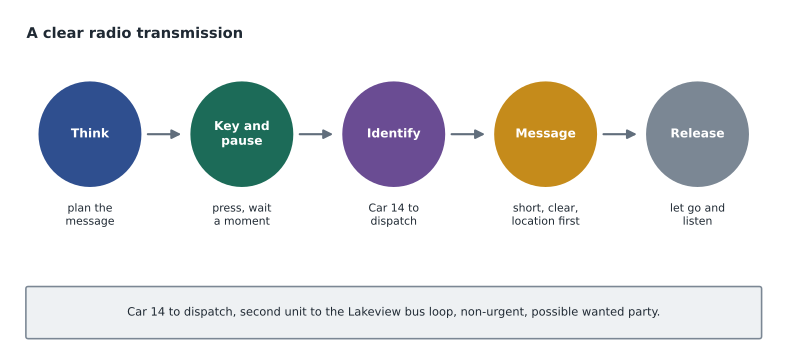
Plain language and codes
For many years, North American police used ten-codes, such as 10-4 for acknowledged, to shorten radio traffic. The codes varied from one agency to another, which caused confusion when agencies worked together, especially at large emergencies. Many Canadian services have moved to plain language for most radio traffic, while keeping a small number of codes or terms for officer safety, such as a code that tells dispatch an officer needs urgent help or that a person being checked has a safety flag. Reyes's request for backup used plain language with one key qualifier, non-urgent, which told dispatch and other officers how fast to come.
Haddad explains why that qualifier mattered. Officers responding to an urgent call for help drive fast, which carries risk. A non-urgent request tells them to come promptly but safely. Saying the passenger was a possible wanted party gave responding officers enough information to plan, while not broadcasting anything the passenger could understand if he could hear the radio. Some services use discreet ways to request backup or to ask for a records check without alerting the person, such as a computer message or a specific phrase. Reyes later said she had kept her portable radio's volume low and turned away from the sedan when she transmitted.
Emergency transmissions
Every radio system has a way for officers to signal an emergency. Most portable and vehicle radios have an emergency button that alerts dispatch and gives the channel priority, and many systems can then show the officer's location. Officers must know how to activate it without looking, under stress, and should practise doing so. Dispatchers are trained to respond immediately to emergency signals and to clear the channel. When an officer calls for urgent help, the most important information is the location. 'Car 14, urgent, Harbour Road at the bus loop' gives other officers what they need to start moving; details can follow.
Haddad tells the students that the hardest part of an emergency transmission is staying calm enough to be understood. Under high stress, people speak faster and higher, and may forget to give their location. Practising emergency calls in training, and getting used to saying the location first, helps. She also reminds them that radio coverage is not perfect. Officers should know where coverage is weak in their zone and have alternatives, such as a phone, a computer message or relaying through another officer.
# Checking the length of transmissions from a recorded shift (seconds each)
transmissions = {"Reyes": [4, 6, 3, 9, 5], "Car 22": [18, 25, 21], "Dispatch": [5, 7, 4, 6]}
for unit, lengths in transmissions.items():
    avg = sum(lengths) / len(lengths)
    long_ones = [t for t in lengths if t > 15]
print(f"{unit:8} average {avg:4.1f} s, longer than 15 s: {len(long_ones)}")Reyes average 5.4 s, longer than 15 s: 0 Car 22 average 21.3 s, longer than 15 s: 3 Dispatch average 5.5 s, longer than 15 s: 0
Haddad uses recordings like these in coaching. In the made-up example, car 22's transmissions average more than twenty seconds, while Reyes's average under six. Long transmissions are not always wrong, but they tie up the channel and usually mean the officer is thinking while talking. Haddad suggests that officers with long messages break them up, or use the computer for details such as descriptions and plate numbers.
When to call for backup
Deciding when to ask for backup is one of the most important safety decisions a patrol officer makes. Backup is another officer or unit who comes to help. Some services require two officers for certain calls, such as domestic disputes, reports of weapons or calls involving people with officer-safety flags. Beyond policy, officers use judgement. Factors that suggest backup is wise include more people than officers on scene, information about weapons or violence, signs that a person may flee or resist, an arrest that is likely to be difficult, poor lighting or a confined space, and simply a feeling that something is not right. Haddad says new officers often hesitate to ask because they worry about looking weak. 'Nobody on this platoon will ever criticize you for calling for backup,' she says. 'I will criticize you for not calling.'
Asking for backup also means planning what to do while it arrives. Reyes used the four minutes to write the ticket and run checks, which kept the stop looking routine. She stayed in the cruiser, which gave her a barrier, and Malhotra kept watching the sedan. If the passenger had got out and walked away before backup arrived, the plan was not to chase him alone but to report his direction and let the arriving units help contain the area. When backup arrives, officers should briefly share what they know and agree on roles before acting, as Reyes did with Coutu and Haddad.
| Situation | Why backup helps |
|---|---|
| More people than officers | One officer cannot watch several people |
| Information about weapons or violence | More officers give more options and safer containment |
| Possible flight | Officers can contain the area instead of chasing |
| Likely arrest of a resisting person | More officers reduce the force needed and the risk of injury |
| Confined or dark location | More eyes and positions reduce surprise |
| Something feels wrong | Your instincts may be noticing details you have not named |
Teamwork
Policing is teamwork. Officers who work well together share information, agree on roles, watch out for each other and speak up when something seems wrong. Some services have adapted ideas from crew resource management, a set of practices developed in aviation after investigations found that many crashes involved crews that did not communicate well or where junior crew members did not challenge a captain's mistakes. The core ideas are that every team member is responsible for safety, that concerns should be raised clearly and respectfully, and that the senior person should actively invite input. On patrol, this means a probationary officer like Reyes should feel able to say, 'I don't think we should go in yet,' and a senior officer like Malhotra should listen.
Malhotra and Reyes showed teamwork throughout the shift. They had planning conversations on the way to calls. They agreed on roles before getting out of the car. Reyes told Malhotra about the passenger quietly and early, rather than acting alone. Malhotra coached rather than took over. Haddad says that when she reviews incidents that went badly, the problem is often not that one officer lacked skill but that two officers were not working as a team: both talking at once, both watching the same person, or one not telling the other about something they had seen.
Working with dispatch
Dispatchers and call-takers are part of the safety team. They receive calls, gather information, assign units, track where officers are and send help when it is needed. A good working relationship between officers and dispatch makes everyone safer. Officers can help dispatch by keeping their status up to date, acknowledging messages, giving accurate locations, telling dispatch when they arrive and when they clear, and answering status checks promptly. Many services have dispatchers check on officers at regular intervals during stops and calls; an officer who does not answer a status check will have backup sent to them. Haddad tells the students that the most important thing they can do for their dispatchers is to be predictable. 'If you always tell them where you are, they'll know something's wrong the moment you don't.'
Dispatchers also work under stress, often handling several calls at once while listening to the radio. Officers who are short or rude on the radio make their job harder. Reyes later said that she had learned to thank dispatch at the end of a busy call. Malhotra told her that the dispatchers had noticed.
Worked problem
Making the call
An officer alone at night stops a car with three young men inside for a burned-out headlight. As she approaches, she smells cannabis and sees the rear passenger push something under the seat. Should she call for backup, and how?
Show solution
- Three occupants and one officer is a mismatch: she cannot watch everyone.
- The movement under the seat is a change that might mean nothing or might mean a hidden item; she does not know.
- She should step back to her car, give dispatch her location and the plate, and request a second unit, using her service's terms for urgency.
- While waiting, she can deal with the original reason for the stop, such as checking the driver's licence, from a position of safety.
- When backup arrives, they should agree on roles before re-approaching, and any further investigation must have its own lawful basis.
Answer: A short wait for backup turns a risky one-officer situation into a manageable two-officer one.
Common mistakes
MistakeCalling for backup shows a lack of confidence.
InsteadCalling for backup is good judgement and is expected by supervisors.
MistakeA long, detailed radio message is more professional.
InsteadShort, clear messages keep the channel open; details can go by computer.
MistakeIn an emergency, start with what happened.
InsteadStart with your location; details can follow.
MistakeJunior officers should not question senior officers.
InsteadEvery team member is responsible for safety; concerns should be raised clearly and respectfully.
Summary and key terms
- The radio is an officer's lifeline; radio discipline is a safety skill.
- Think before keying, identify, keep it short, give accurate locations, listen and stay calm.
- Many services now use plain language, keeping a few codes for officer safety.
- Emergency transmissions should give the location first; officers should practise using the emergency button.
- Request backup when people outnumber officers, when there are signs of violence or flight, or when something feels wrong.
- Teamwork, including speaking up and inviting input, prevents many incidents.
- Radio discipline
- Using the radio clearly, briefly and consistently according to policy.
- Plain language
- Ordinary words used on the radio instead of numeric codes.
- Ten-codes
- Numeric radio codes such as 10-4, which vary between agencies.
- Emergency button
- A radio control that signals an emergency and gives the channel priority.
- Backup
- Another officer or unit who comes to help.
- Crew resource management
- Teamwork practices from aviation that encourage communication and speaking up about safety.
Practice problems
Work each problem on paper first, then reveal the answer to check.
What did Reyes notice about the passenger?
Show answer
He kept watching the side mirror and resembled Trent Vollmer's photograph.
Why did Reyes say non-urgent when she requested backup?
Show answer
So responding officers would come promptly but without dangerous fast driving.
In the code example, how many of car 22's transmissions were longer than 15 seconds?
Show answer
All three.
What was the plan if the passenger walked away before backup arrived?
Show answer
Not to chase alone, but to report his direction and let arriving units help contain the area.
Lesson quiz · 5 questions
Score 60% or more to complete this lesson.
Create a free account to save your progress, take quizzes and earn a certificate.