
IRW-340 · Lesson 10 of 12 · 58 min
Calculation practice
▶ Video coming soon A video version of this lesson is on the way.
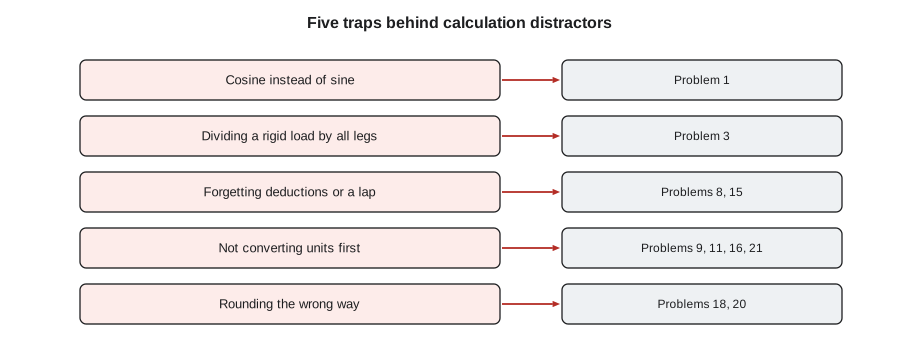
Andy saved the last hour of November 8 for numbers. He handed out a sheet of twenty-one problems, every one taken from a calculation the group had met in an earlier course, and gave them forty minutes. Then they went through them one by one. For each problem Andy asked two questions: what is the answer, and what is the wrong answer someone in a hurry would get? "The exam writers know the wrong answers better than you do," he said. "Every distractor on a calculation question is somebody's mistake. Learn the mistakes and the distractors stop working on you."
This lesson is that sheet. Each problem is worked out in full and ends with the trap: the error that produces a tempting wrong answer. Work each one on paper before reading the solution, then compare. The problems use the same values and the same methods as the earlier courses, so a result that differs from the one here is worth tracking down.
A few habits make calculation questions safer. Write the formula before putting numbers in. Keep units with every number and convert before calculating, not after. Estimate the answer roughly first: a sling leg load is always more than the share of the weight and never more than about twice it at sensible angles; a plumbness tolerance on a column is a couple of centimetres, not a couple of metres. If the exact answer is far from the estimate, the mistake is usually a unit or a missed step.
Rigging
Worked problem
1. Two legs at 45 degrees
A 2,400 kg (5,300 lb) beam is lifted with a two-leg bridle at 45 degrees from horizontal. Find the load per leg.
Show solution
- Share per leg: 2,400 ÷ 2 = 1,200 kg.
- Divide by sin 45° = 0.707: 1,200 ÷ 0.707 = 1,697 kg.
Answer: About 1,700 kg (3,750 lb). Trap: dividing by cos 45° gives the same number here by coincidence, so the error goes unnoticed until the angle changes; at 60 degrees the cosine gives a leg load twice the share, which is wrong.
Worked problem
2. Two legs at 30 degrees
The same beam is lifted with the legs at 30 degrees. Find the load per leg.
Show solution
- Share per leg: 1,200 kg.
- Divide by sin 30° = 0.5: 1,200 ÷ 0.5 = 2,400 kg.
Answer: 2,400 kg (5,300 lb) per leg: each leg carries the whole beam. Trap: assuming a flatter sling is easier on the slings. The flatter the legs, the higher the load in each.
Worked problem
3. Four legs on a rigid load
A rigid precast panel weighing 4,000 kg (8,800 lb) is lifted with a four-leg bridle at 60 degrees. Find the load to check each leg against.
Show solution
- Assume two legs carry it: 4,000 ÷ 2 = 2,000 kg.
- Divide by sin 60° = 0.866: 2,000 ÷ 0.866 = 2,309 kg.
Answer: About 2,310 kg (5,080 lb) per leg. Trap: dividing by four legs gives 1,155 kg (2,540 lb), half the real load, because a rigid load rocks onto two legs.
Worked problem
4. Choker capacity
A wire rope sling is rated 3,550 kg (7,800 lb) in a vertical hitch. What is its capacity as a choker?
Show solution
- Choker factor about 0.75.
- 3,550 × 0.75 = 2,662.5 kg.
Answer: About 2,660 kg (5,850 lb), and less if the choke angle is sharp. Trap: using the basket factor of 2.0, which gives 7,100 kg (15,600 lb).
Worked problem
5. Basket with angled legs
The same sling is used in a basket hitch with both legs at 60 degrees. What is its capacity?
Show solution
- Basket with vertical legs: 2 × 3,550 = 7,100 kg.
- Times the sling angle factor sin 60° = 0.866: 7,100 × 0.866 = 6,149 kg.
Answer: About 6,150 kg (13,510 lb). Trap: doubling the rating without the angle factor.
Weights and cranes
Worked problem
6. A beam's weight
What does a W310x39 beam 9.1 m long weigh?
Show solution
- The 39 is the mass in kilograms per metre.
- 39 × 9.1 = 354.9 kg.
Answer: 354.9 kg. Trap: multiplying the depth, 310, by the length.
Worked problem
7. A rebar bundle
What does a bundle of 40 bars of 15M at 12 m weigh?
Show solution
- 40 × 12 = 480 m; 480 × 1.570 = 753.6 kg.
Answer: 753.6 kg (1,668.8 lb). Trap: using the 10M mass of 0.785 kg/m, which gives 376.8 kg (1,068.8 lb).
Worked problem
8. Net capacity and critical lifts
A SAMPLE chart gives 9,600 kg at the working radius. The hook block is 680 kg and the rigging 150 kg. The load is 7,000 kg. What share of the net capacity is it?
Show solution
- Net: 9,600 − 680 − 150 = 8,770 kg.
- Share: 7,000 ÷ 8,770 = 0.798.
Answer: About 80 in 100, a critical lift under Crossbeam's 75 in 100 rule. Trap: comparing with the gross 9,600 kg gives 73 in 100.
Worked problem
9. Ground bearing under a mat
An outrigger puts 40 t on a 1.5 m by 1.5 m mat. What is the bearing pressure?
Show solution
- Force: 40,000 kg × 9.81 = 392,400 N.
- Area: 1.5 × 1.5 = 2.25 m².
- Pressure: 392,400 ÷ 2.25 = 174,400 Pa, about 174 kPa.
Answer: About 174 kPa. Trap: dividing by the side length, 1.5 m, instead of the area, or forgetting to turn kilograms into newtons.
Safety and structural steel
Worked problem
10. Fall clearance
A worker uses a 1.8 m (6 ft) energy-absorbing lanyard anchored at D-ring height. Deployment is up to 1.2 m (4 ft), harness stretch 0.3 m (1 ft), and the margin 0.9 m (3 ft). What clearance is needed below the working level?
Show solution
- 1.8 + 1.2 + 0.3 + 0.9 = 4.2 m.
Answer: 4.2 m (14 ft). Trap: leaving out the margin or the stretch, giving 3.3 m (11 ft) or 3.9 m (13 ft).
Worked problem
11. Plumbness
A column is 8.7 m (28 ft) between splices. What is its tolerance at 1 in 500?
Show solution
- 8,700 mm ÷ 500 = 17.4 mm.
Answer: 17.4 mm (0.672 in). Trap: dividing 8.7 m (28 ft) by 500 without converting, giving 0.0174, a number that looks like nothing.
Worked problem
12. Turn-of-nut rotation
A 3/4 in (19 mm) bolt is 89 mm (3 1/2 in) long. What rotation does the turn-of-nut method call for?
Show solution
- Length in diameters: 89 ÷ 19 = 4.7.
- Over 4 and up to 8 diameters: one-half turn.
Answer: One-half turn. Trap: choosing one-third turn because the bolt seems short.
Worked problem
13. Pre-installation verification
The minimum pretension of a 3/4 in A325 bolt is 125 kN (28 kips). What tension must the calibration device show?
Show solution
- At least 1.05 times the minimum: 1.05 × 125 = 131 kN.
Answer: 131 kN (29.4 kips). Trap: using the minimum pretension itself, which leaves no margin.
Worked problem
14. Concrete strength before erection
Footings are specified at 25 MPa (4,000 psi). What strength must be confirmed before steel is erected on them, at 75 in 100?
Show solution
- 0.75 × 25 = 18.75 MPa.
Answer: 18.75 MPa (3,000 psi). Trap: using half the strength.
Reinforcing and post-tensioning
Worked problem
15. Laps in a run
A 30 m (100 ft) run uses 12 m (40 ft) stock bars with 650 mm (26 in) laps. How long is the third bar?
Show solution
- Covered by two bars: 12 + (12 − 0.65) = 23.35 m.
- Remaining plus a lap: 30 − 23.35 + 0.65 = 7.30 m.
Answer: 7.30 m (24 ft 4 in). Trap: forgetting the last lap, giving 6.65 m (22 ft 2 in).
Worked problem
16. Tendon elongation
A tendon is jacked to 133 kN over 30.5 m, with a strand area of 98.7 mm² and a typical modulus of 195,000 MPa. Find the expected elongation.
Show solution
- \[\Delta = \frac{133\,000 \times 30\,500}{98.7 \times 195\,000} = 210.8\ \text{mm}\]
Answer: About 211 mm, acceptable from 196 to 225 mm at ±7 in 100. Trap: entering the length in metres with the modulus in megapascals, giving 0.21, a thousand times too small.
Decking, ornamental and welding
Worked problem
17. A deck bundle
A bundle has 30 sheets of 5.484 m² at 8.0 kg/m². Is it within Crossbeam's 1,800 kg limit for landing on joists?
Show solution
- 30 × 5.484 × 8.0 = 1,316 kg.
Answer: 1,316 kg, within the limit. Trap: using the area of one sheet only.
Worked problem
18. Stair risers
A floor-to-floor height is 4,300 mm and the maximum rise is 180 mm. How many risers, and how high?
Show solution
- 4,300 ÷ 180 = 23.9, rounded up to 24.
- 4,300 ÷ 24 = 179.2 mm.
Answer: 24 risers of 179.2 mm. Trap: rounding down to 23, giving 187 mm, over the limit.
Worked problem
19. Guard openings
A guard panel is 2,350 mm between posts with 21 pickets of 16 mm bar. What is the clear gap?
Show solution
- (2,350 − 21 × 16) ÷ 22 = 2,014 ÷ 22 = 91.5 mm.
Answer: 91.5 mm, under the 100 mm sphere. Trap: dividing by 21 instead of 22 spaces, or ignoring the bar width.
Worked problem
20. Acetylene cylinders
A heating tip uses 2.50 m³/h of acetylene and each cylinder holds 8.5 m³. How many cylinders on the manifold?
Show solution
- One cylinder: 8.5 ÷ 7 = 1.21 m³/h.
- 2.50 ÷ 1.21 = 2.06, rounded up to 3.
Answer: Three cylinders. Trap: rounding down to two.
Worked problem
21. Thermal movement
A steel building frame is 48 m long. How much does it change in length over a temperature change of 40 °C, with a coefficient of 12 × 10⁻⁶ per °C?
Show solution
- ΔL = 12 × 10⁻⁶ × 48,000 mm × 40 = 23.0 mm.
Answer: About 23 mm. Trap: using the length in metres and reading 0.023 as millimetres.
Scoring the sheet
Benno got 17 of the 21 right in forty minutes. He missed numbers 3 (he divided by four legs), 11 (he forgot to convert to millimetres), 15 (he left out the last lap) and 21 (he did not finish). Each mistake went into his error log with the trap written beside it. Jules missed 12 and 18; Shay, a first-year, got 11 right and said the turn-of-nut problem finally made sense. Andy's rule for the group was that a calculation is not finished until the answer has been compared with an estimate, and that rule alone would have caught two of Benno's four errors.
| Problem type | Number of problems | Benno right |
|---|---|---|
| Rigging | 5 | 4 |
| Weights and cranes | 4 | 4 |
| Safety and steel | 5 | 4 |
| Reinforcing and post-tensioning | 2 | 1 |
| Decking, ornamental and welding | 5 | 4 |
| Total | 21 | 17 |
Five more for practice
These five problems are left for the reader. They use the same methods as the worked problems above. Answers are at the end of the list; cover them while working.
- A. A 1,800 kg (4,000 lb) bundle is lifted on a two-leg bridle at 60 degrees. What is the load per leg?
- B. A W250x73 column is 8.7 m long. What does it weigh, before plates?
- C. A bolt is 76 mm (3 in) long and 19 mm (3/4 in) in diameter. What turn-of-nut rotation applies?
- D. A slab mat uses 60 bars of 10M at 9 m. What does it weigh?
- E. A guard is 1,800 mm between posts with 16 pickets of 16 mm bar. Does it pass the 100 mm sphere rule?
Answers: A. 900 ÷ 0.866 = 1,039 kg. B. 73 × 8.7 = 635.1 kg. C. 76 ÷ 19 = 4.0 diameters, so one-third turn. D. 60 × 9 × 0.785 = 423.9 kg. E. (1,800 − 16 × 16) ÷ 17 = 90.8 mm, so it passes.
How calculation questions are scored
On the exam, a calculation question scores the same as any other question: one mark for the right option, nothing for the work. That means the work on scrap paper is for the candidate, not the examiner. It is still worth writing, because it is the only way to check an answer quickly in the second pass. Andy's sheets always had the formula, the numbers with units, the answer and the estimate, in that order, so a glance at the end of the exam could find a slip.
Calculators are allowed on most trade exams, but the type is controlled; candidates should check the candidate guide and bring the kind it allows. A candidate who has practised only on a phone calculator may be slow on a basic one, so Benno did his November and December practice on the same simple calculator he would take into the exam.
A last habit from the sheet: when a problem gives more information than it needs, such as a beam's depth when only its mass per length matters, the extra number is often there to tempt a wrong method. Noticing what a problem does not need is part of solving it.
Common mistakes
MistakeCalculating before writing the formula.
InsteadWrite the formula with its units, then substitute.
MistakeConverting units at the end.
InsteadConvert before calculating; a tolerance in millimetres needs a height in millimetres.
MistakeRounding counts down.
InsteadRisers, cylinders, bars and bundles are rounded up to stay within limits.
MistakeSkipping the estimate.
InsteadCompare every answer with a rough estimate; a big difference means a mistake.
MistakeTrusting the first answer that matches an option.
InsteadDistractors are built from common mistakes; check the method, not just the match.
Summary and key terms
- Sling leg load is the share of the weight divided by the sine of the angle from horizontal; rigid loads are checked on two legs.
- Weights come from mass or weight per unit length times length; net crane capacity subtracts all deductions.
- Clearance adds free fall, deceleration, stretch and margin; plumbness is height divided by 500 in the same units.
- Turn-of-nut rotation depends on length in diameters; verification is 1.05 times the minimum pretension.
- Laps add one lap length per joint; elongation is PL ÷ AE in consistent units.
- Round risers and cylinders up; check guard gaps as clear openings.
- Estimate
- A rough answer worked out first to check the exact one.
- Trap
- A common mistake that leads to one of the wrong options.
- Consistent units
- Units chosen so that the formula gives the answer in the unit wanted without hidden conversion factors.
Practice problems
Work each problem on paper first, then reveal the answer to check.
A 3,000 kg (6,600 lb) load hangs from two legs at 45 degrees. What is the load per leg?
Show answer
1,500 ÷ 0.707 = 2,121 kg.
A column is 12 m (40 ft) between splices. What is the 1 in 500 tolerance?
Show answer
24 mm (0.96 in).
A bolt is 2 1/2 in long and 3/4 in in diameter. What rotation?
Show answer
2.5 ÷ 0.75 = 3.3 diameters: one-third turn.
A floor-to-floor height of 3,000 mm with a 180 mm maximum needs how many risers?
Show answer
3,000 ÷ 180 = 16.7, so 17 risers of 176.5 mm.
Footings are specified at 30 MPa (5,000 psi). What strength is needed before erection at 75 in 100?
Show answer
22.5 MPa (3,750 psi).
Lesson quiz · 5 questions
Score 60% or more to complete this lesson.
Create a free account to save your progress, take quizzes and earn a certificate.