
IRW-340 · Lesson 4 of 12 · 23 min
Review: rigging and cranes
▶ Video coming soon A video version of this lesson is on the way.
Carla Duquette took the first half of the second Sunday, October 25. She had run Thursday-evening rigging nights at the yard all fall, so she knew what the apprentices remembered and what they did not. She drew a beam on the whiteboard with two slings to a hook and wrote three numbers under it: the beam's weight, the leg angle and the sling's rated load. "If you can do this one in your head and then check it on paper," she said, "you've got a third of the rigging questions. The rest is knowing what's in a sling, what's on a crane's chart and what to say on the radio."
Rigging, hoisting, positioning and cranes are the second-largest part of the exam, about 31 questions in 100. This lesson reviews IRW-120 and the rigging parts of IRW-130 to IRW-330, with the calculations that come up most often.
Who does what
Every lift has a rigger who selects and attaches the rigging, a signaller who directs the operator, and an operator who runs the crane and is responsible for its capacity and set-up. On a planned lift, a lift supervisor or lift director coordinates all three. The Ontario regulation requires a competent signaller wherever the operator cannot see the load or its path, wearing the required high-visibility garment, and only the signaller gives signals except for an emergency stop, which anyone may give. Mobile crane operators in Ontario must hold a Certificate of Qualification in the compulsory trade of Hoisting Engineer.
Slings and their ratings
A sling's working load limit, or rated load, is the most it may lift in a stated hitch. For wire rope slings, the rated load is the minimum breaking strength divided by a design factor of 5, adjusted for the end fittings. The rating applies to a vertical hitch; other hitches and angles change it. The tag on every sling shows the rated loads, and a sling without a legible tag is taken out of service.
| Hitch | Capacity compared with the vertical rating | Notes |
|---|---|---|
| Vertical | 1.0 | One leg straight to the hook |
| Choker | About 0.75, less at sharp choke angles | Choke angle under about 120 degrees reduces it further |
| Basket, legs vertical | 2.0 | Both legs vertical; the load must be stable |
| Basket, legs at an angle | 2.0 times the sling angle factor | Same factor as for bridles |
| Bridle of two legs | 2 times the leg rating times the sling angle factor | Assume only two legs carry a rigid load even with three or four |
Wire rope slings must also respect the bend over a hook, shackle or edge. A sling bent sharply over a small pin or an unprotected edge loses strength; IRW-120 gave a table of efficiency against the ratio of the bend diameter to the rope diameter (D/d), and the rule to remember is that sharp edges always need softeners or corner protectors. Synthetic slings are light and easy on finished steel but cut easily and are damaged by heat and some chemicals.
Inspection criteria come up often. For a single-part wire rope sling, IRW-120 used the ASME B30.9 removal criteria: ten randomly distributed broken wires in one rope lay, or five broken wires in one strand in one rope lay, as well as kinking, crushing, birdcaging, heat damage, corrosion and damaged fittings. On October 5, Shay removed a 16 mm (5/8 in) sling from service with six broken wires in one lay, five of them in one strand.
Sling angles
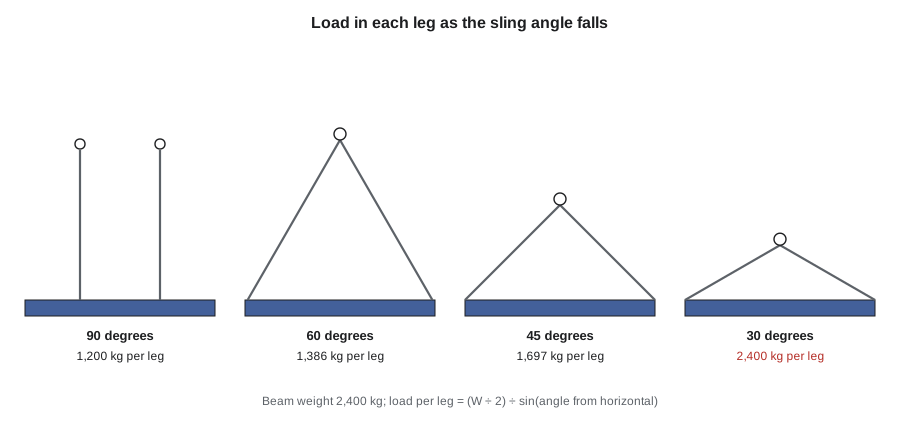
When sling legs are not vertical, each leg carries more than its share of the weight. The load on each leg of a two-leg bridle is the weight divided by two, then divided by the sine of the angle between the leg and the horizontal. The sine is 1.0 at 90 degrees, 0.866 at 60, 0.707 at 45 and 0.5 at 30. At 30 degrees each leg carries the full weight of the load. That is why Crossbeam's riggers try to keep legs at 60 degrees or steeper and never rig below 30.
Worked problem
A two-leg lift at 45 degrees
A beam weighs 2,400 kg (5,300 lb) and is lifted with a two-leg bridle, each leg at 45 degrees from horizontal. What is the load on each leg?
Show solution
- Share per leg: 2,400 ÷ 2 = 1,200 kg.
- Divide by sin 45° = 0.707: 1,200 ÷ 0.707 = 1,697 kg.
Answer: About 1,700 kg (3,750 lb) per leg, so each leg needs a rated load at least that high. A common mistake is to use the cosine, or to forget to halve the weight first.
With three or four legs on a rigid load, such as a precast panel or a stiff frame, the legs almost never share the load equally. The rule in this program, and in most rigging standards, is to assume that only two legs carry the load. A four-leg bridle on a 4,000 kg (8,800 lb) panel at 60 degrees is checked as two legs: each carries about 2,000 ÷ 0.866 = 2,309 kg.
Weights and centre of gravity
Knowing the weight is the start of every lift. For steel, the weight comes from the shape's designation, which gives the mass per unit length, multiplied by the length. For rebar, it is the bar's mass per unit length times the total length. The shipping ticket is a check, not the only source: at Larkmont in 2025, a transfer girder's ticket left out its bearing plates and cap plate, and the real weight turned a planned 86 in 100 lift into a 96 in 100 lift. Since then, Crossbeam confirms the shop weight for every critical pick.
| Item | Weight | From |
|---|---|---|
| W310x39 beam, 9.1 m | 39 × 9.1 = 354.9 kg | IRW-210 |
| 40 bars of 15M at 12 m | 40 × 12 × 1.570 = 753.6 kg | IRW-130 |
| Roof deck bundle, 30 sheets | 30 × 5.484 m² × 8.0 kg/m² = 1,316 kg | IRW-230 |
| Rafter half with spreader and rigging | 2,300 + 150 + 45 = 2,495 kg (two halves) | IRW-330 |
The centre of gravity must be directly under the hook, or the load will tilt as it lifts. For a symmetrical beam it is at the middle. For a column with a cap plate, a base plate and connection plates, it is found by taking moments: each part's weight times its distance from one end, added together and divided by the total weight. IRW-120's column example found the centre of gravity 3.99 m (12.76 ft) from the base of an 8.7 m (28 ft) column, not at the middle, because of the heavy base plate.
Hardware
Shackles, hooks, eyebolts, spreader bars and lifting beams are rated like slings, and their ratings are marked on them. A shackle loaded at an angle to its pin loses capacity; IRW-120 used typical reductions of about 70 in 100 at 45 degrees and 50 in 100 at 90 degrees of side load, with the manufacturer's chart governing. Hooks need a working safety latch unless the regulation or the hook's design allows otherwise, and a hook whose throat has opened noticeably is removed from service. Eyebolts are loaded in line with the shank unless they are shouldered and rated for angular loads, and even then the capacity drops sharply.
Load charts and lift planning
A crane's capacity depends on its configuration, its radius, the boom length, the counterweight, the outrigger set-up and the area of operation. The load chart gives the gross capacity for each combination. Everything below the boom tip counts against it: the hook block, the slings, shackles and spreader, and on some cranes the stowed jib. The net capacity is the chart value less those deductions, and the load must not exceed it.
Worked problem
Reading a chart with deductions
On the SAMPLE chart from IRW-120, a 30 m boom at 20 m radius has a gross capacity of 9,600 kg. The hook block weighs 680 kg and the rigging 150 kg. The steel weighs 7,000 kg. What share of the net capacity is the lift, and is it a critical lift under Crossbeam's rule of more than 75 in 100?
Show solution
- Net capacity: 9,600 − 680 − 150 = 8,770 kg.
- Share: 7,000 ÷ 8,770 = 0.798, about 80 in 100.
Answer: About 80 in 100 of the net capacity. It is a critical lift under Crossbeam's rule and needs a written lift plan. Forgetting the deductions gives 73 in 100, which looks like an ordinary lift.
The ground matters as much as the chart. Outrigger loads go into the ground through mats, and the bearing pressure is the load divided by the mat area. IRW-120 worked out an outrigger load of 40 t (88,000 lb) on a 1.5 m by 1.5 m (5 ft by 5 ft) mat: 40,000 × 9.81 ÷ 2.25 = 174 kPa, which the site's soil had to carry with a margin. Mats are bigger when the ground is soft or the reaction is high.
Crossbeam's critical lift rule, from IRW-120, calls for a written lift plan signed by the lift director and the operator for any lift over 75 in 100 of the net chart capacity, any lift with more than one crane, any lift over occupied areas or near power lines, and any unusual load. Ontario's regulation does not define a critical lift, so the definition is the company's; the regulation does require the crane to be used within its capacity and set up on adequate ground.
Multiple lifts and tandem lifts
Hoisting several beams on one hook, sometimes called Christmas-treeing, is restricted. Ontario's regulation has no section written specifically for it, so Crossbeam follows the same limits on its Canadian jobs as on its American ones: no more than five members, beams only, rigged by a trained rigger with rigging designed for it, a minimum vertical spacing of about 2.1 m (7 ft) between members, and the members set from the bottom up.
Tandem lifts, with two cranes on one load, need the most planning of all. Each crane's share depends on where the centre of gravity is between the pick points, and a change of angle shifts load from one crane to the other. In the 2023 rail footbridge lift that IRW-120 and IRW-310 described, the centre of gravity was about 1.0 m (3 ft) off centre, so the two cranes carried 9,847 kg and 8,753 kg, and the plan kept each crane under 75 in 100 of its chart.
Signals and communication
Hand signals are standard so that any operator understands any signaller. A candidate should know at least hoist, lower, swing, boom up and down, extend and retract, use main or auxiliary hoist, stop, emergency stop and dog everything. Radio signals use a dedicated channel, the signaller identifies the crane and keeps talking during the motion, and the operator stops if the voice stops. The signaller stands where both the operator and the load can be seen, and for a blind lift, a second signaller or radio is used.
Tag lines keep a load from spinning and let workers control it from a distance. They are not for holding a load against the wind or for pulling it into place against the crane. Nobody stands under a suspended load or puts hands between a landing load and the steel. At Brannock in July, a gust turned a rafter on its tag lines faster than Tobin Rask expected and burned through his glove; the crew added a second tag line on each end for the rest of the job.
Practice questions
Question 1. A sling tag is missing on a wire rope sling that looks good. What should the rigger do? Options: (a) use it at half its usual rating; (b) remove it from service until it is identified and rated; (c) use it for chokers only; (d) write a new rating on tape.
Answer and reasoning: (b). Without a legible tag, nobody knows its rated load; it is taken out of service.
Question 2. A column's base plate makes one end heavier than the other. Where is the centre of gravity? Options: (a) at the middle; (b) closer to the base, found by taking moments; (c) at the top; (d) it cannot be found.
Answer and reasoning: (b). Each part's weight times its distance from one end, added and divided by the total weight, puts the centre of gravity toward the heavy end, as in IRW-120's column example.
Question 3. On a radio-signalled lift the signaller's voice stops in the middle of a swing. What should the operator do? Options: (a) finish the swing; (b) stop the motion; (c) lower the load quickly; (d) call the office.
Answer and reasoning: (b). With radio signals, the operator stops if communication is lost.
Common mistakes
MistakeUsing the cosine of the sling angle.
InsteadLoad per leg is (W ÷ n) ÷ sin θ, with θ measured from horizontal.
MistakeDividing a rigid load among all four legs of a bridle.
InsteadAssume only two legs carry it.
MistakeComparing the load with the gross chart capacity.
InsteadSubtract the hook block, rigging and other deductions first.
MistakeTrusting a shipping ticket for a critical pick.
InsteadConfirm the shop weight, including all plates and attachments.
MistakeHolding a load against the wind with a tag line.
InsteadStop the lift; tag lines guide, they do not resist the crane or the wind.
Summary and key terms
- The rigger, signaller and operator each have defined duties; only the signaller signals, except for an emergency stop.
- Sling capacity depends on the hitch and the sling angle; check the tag and inspect before every use.
- Load per leg equals the weight divided by the number of legs and by the sine of the angle; at 30 degrees each leg carries the whole weight.
- Find weights from the shape or bar mass, and the centre of gravity by moments.
- Net capacity is the chart value less all deductions; Crossbeam treats over 75 in 100 as critical.
- Multiple lifts and tandem lifts need special rigging, limits and plans.
- Working load limit
- The greatest load a sling or fitting may lift in a stated configuration.
- Design factor
- The ratio of breaking strength to rated load; 5 for wire rope slings.
- Sling angle factor
- The reduction in capacity, or increase in leg load, caused by a leg angle less than vertical.
- Net capacity
- The crane chart capacity less the weight of the hook block, rigging and other deductions.
- Critical lift
- A lift that needs a written plan because of its size, method or location.
- Multiple lift
- The hoisting of several members on one hook, rigged one above another.
Practice problems
Work each problem on paper first, then reveal the answer to check.
What is the sine of 60 degrees?
Show answer
0.866.
A 3,000 kg (6,600 lb) load is lifted with two legs at 60 degrees. What is the load per leg?
Show answer
1,500 ÷ 0.866 = 1,732 kg.
What is the capacity of a choker hitch compared with the vertical rating?
Show answer
About 0.75, less at sharp choke angles.
Which weights are deducted from a crane's chart capacity?
Show answer
Hook block, slings, shackles, spreader and anything else below the boom tip, as the chart says.
Who may give an emergency stop signal?
Show answer
Anyone.
Lesson quiz · 5 questions
Score 60% or more to complete this lesson.
Create a free account to save your progress, take quizzes and earn a certificate.