
IRW-340 · Lesson 12 of 12 · 19 min
Your career as a journeyperson
▶ Video coming soon A video version of this lesson is on the way.
After the practice exam had been marked and the plan revised, Andy put the kettle on one more time and asked Benno what he wanted to be doing in ten years. Benno said he did not know: maybe a foreperson like Lionel, maybe a welding inspector, maybe running his own small misc shop. Andy said that was the right answer for now. "The certificate doesn't decide that," he said. "It opens the doors. What you do after you walk through them is up to you." Then he talked for half an hour about his own twenty-five years, and Shay, who had said almost nothing all afternoon, wrote most of it down.
This last lesson looks past the exam: what the certificate means, the paths an ironworker can take after it, the credentials that open each path, the habits that keep a long career safe and healthy, and the duty every journeyperson has to the apprentices who come next.
What the certificate means
A Certificate of Qualification with the Red Seal endorsement says that the holder has met the national standard for the trade. In Ontario, ironworking is non-compulsory, so the certificate is not needed to do the work, but it is what most union employers, many open-shop employers and many owners ask for, and it is the basis for higher pay rates, foreperson positions and mobility. The Red Seal means an Ontario ironworker can work in any province or territory without writing another exam, and Canadian agreements on labour mobility recognize it across the country.
The certificate is also a beginning. The trade keeps changing: new bolting methods, new fall protection equipment, new materials such as fibre-reinforced bars and high-strength steels, new crane technology, new rules. A journeyperson who stops learning at the exam falls behind within a few years.
Paths in the trade
Ironworking has more paths than most trades, because the trade itself is broad. The table lists the ones Crossbeam's people have followed, with what each one needs beyond the certificate.
| Path | What the work is | What it usually needs |
|---|---|---|
| Journeyperson specialist | Connecting, welding, rigging, rebar, ornamental or decking at a high level | Years in the specialty; welding or rigging certifications |
| Foreperson or pusher | Running a crew on site: planning, safety, quality, the crew's people | Experience, leadership, supervisor training, often a safety course for supervisors |
| General foreperson or superintendent | Running a whole job or several crews | Years as foreperson, scheduling and cost skills |
| Rigging specialist or lift director | Planning and directing critical and complex lifts | Rigging and signalling certifications, lift planning experience |
| Welding inspector | Inspecting welds and procedures for owners or testing agencies | CWB inspector certification to CSA W178.2 |
| Safety coordinator | Running a contractor's safety program | Safety training and certification; field experience |
| Instructor | Teaching apprentices at a training centre or college | Experience, teaching training, often the instructor's own certificate |
| Estimator or project manager | Pricing and managing jobs from the office | Field experience plus estimating and management courses |
| Business owner | Running an erection, rebar or misc company | All of the above, plus business, insurance and bonding |
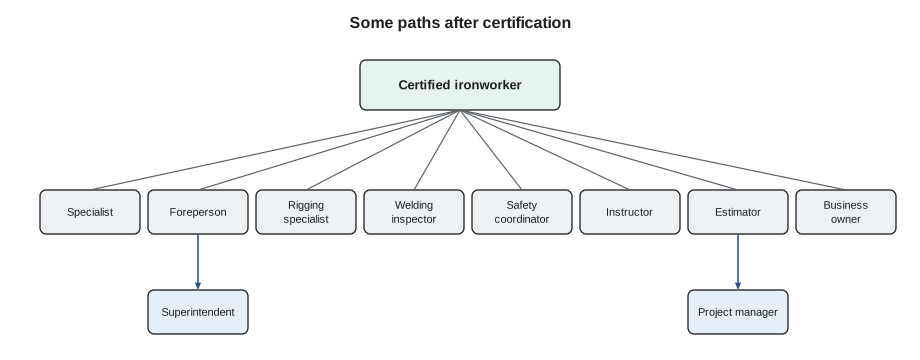
Andy's own path went through most of the field side: connector for fifteen years, foreperson for six, then back to connecting when his knees told him to stop climbing ladders all day as a foreperson walking several floors. Carla Duquette moved from connector to raising gang foreperson. Lionel Hartigan has run the misc crew for twenty years. Grace Ndlovu came into safety from paramedic work. Ruben Ostergaard is a welding foreman who teaches every new welder at Crossbeam. Each of them said, in one way or another, that the certificate was the first door.
Credentials worth adding
Some credentials are worth adding early, because they make a journeyperson more useful on any job and open later paths. A candidate who has just written the Red Seal exam is used to studying, and that habit is worth keeping.
- Welding tickets with the Canadian Welding Bureau in the processes and positions the work needs, kept current by retesting at the required intervals.
- Rigging and signalling courses beyond the minimum, and lift planning training for anyone heading toward critical lifts.
- Supervisor health and safety training, which Ontario requires for supervisors, and joint health and safety committee certification for anyone who will sit on a committee.
- Adhesive anchor installer certification for anyone doing post-installed anchors overhead or in sustained tension.
- Post-tensioning certifications for anyone in the rod gang who will place or stress tendons.
- First aid, aerial work platform and fall rescue training, renewed on schedule.
Staying safe and healthy for a long career
Ironwork is hard on the body. The injuries that end careers are not only the dramatic ones; they are knees, shoulders, backs, hearing and hands, worn down over years. A journeyperson who wants a long career looks after the body the way a good crew looks after its equipment: inspected, maintained and not overloaded.
- Lift with equipment, not backs: carts, hoists, cranes and a second person. The heaviest rebar and bolt buckets cause more back injuries than any single lift.
- Hearing protection every time it is needed, from the first day. Hearing loss from impact wrenches, grinders and gouging is permanent and gradual.
- Eye protection that is actually worn, and the right shade for every arc and torch.
- Respiratory protection for welding fumes, silica dust from drilling concrete, and lead on old steel.
- Heat and cold plans: water, shade and rest in summer, layers and warm-up breaks in winter.
- Sleep, food and fitness. A tired connector is a dangerous connector.
Mental health matters as much. Construction has high rates of suicide and substance use, and long hours, travel and the pressure of the work all contribute. Crossbeam's toolbox talks now include mental health, and the company's employee assistance program is confidential. A journeyperson who notices a crew member struggling can ask how they are doing and listen, and point them to help. Asking is not interfering; it is the same instinct as calling out a hazard.
Leaving the trade safer than you found it
Every journeyperson was once an apprentice, and every apprentice learned most of the trade from journeypersons on the job, not in a classroom. The duty to teach is part of the trade. It means explaining why, not just what; letting an apprentice do the work while watching closely; correcting mistakes without humiliation; and never asking an apprentice to do something the journeyperson would not do. It also means refusing to pass on the shortcuts that hurt people: the unclipped walk across a beam, the lift without a plan, the bolt left out because the crane was waiting.
Andy finished the afternoon by giving Shay the job of making the coffee for the December practice exam, and by telling Benno that when he passed, his first job as a journeyperson would be to help Shay get ready for his own exam in two years. Benno said he would. Jules said he wanted in on that too.
Looking back over the program
This course closes a program that began with Shay's first week on the Ashcroft Medical Building in September 2026. Along the way the courses have followed the raising gang, the rod gang, the deck crew, the misc crew, the metal building crew and the people who lead them, on jobs from a farm shed to a twelve-storey tower. The same ideas came back in every course.
- Plan the work before it starts: the erection plan, the lift plan, the anchor rod survey, the bar list check.
- Keep the structure stable and the people tied off at every stage.
- Know the weight and the capacity, with the deductions, every time.
- Build from the latest approved drawings, and stop and ask when something does not fit.
- Inspect your own work before anyone else does.
- Look after the crew, and teach the next one.
Those ideas will be on the Red Seal exam in many different questions. They will also be on every job for the rest of a career.
Working conditions after the certificate
A newly certified journeyperson usually moves from the apprentice wage, a share of the journeyperson rate that rises with each level, to the full rate in the collective agreement or the employer's pay scale. On union work, the local's hiring hall and the collective agreement also govern benefits, pension contributions, travel allowances and dispatch. On open-shop work, the employer sets them. Either way, the first years after certification are when a journeyperson builds a reputation, and reputation is what gets a worker called back, chosen for the hard jobs and trusted to run a crew.
Ironwork often means travel. Big projects such as plants, bridges and towers draw ironworkers from far away, and many journeypersons spend some years following the work. Travel pays well but costs time at home, sleep and sometimes health, and the safety habits learned at home have to travel too. A journeyperson who arrives on a new job with different rules and a different crew reads the site's safety plan first and asks before assuming.
What forepersons look for
Lionel, Carla and Corwin were asked what they look for when they pick a journeyperson for a crew. Their answers were nearly the same, and none of them mentioned exam marks.
- Shows up on time, ready to work, with inspected gear.
- Ties off without being told, every time.
- Reads the drawings before asking, and asks before guessing.
- Keeps the work area clean and the material in order.
- Tells the foreperson about a problem early, with the facts.
- Helps the apprentices and does not make them do the dirty work alone.
- Knows when to stop: wind, a load that does not look right, a connection that does not fit.
Carla added one more: the journeyperson she trusts most is the one who says "I don't know, let me check" instead of pretending. That habit, she said, is also what passes exams.
Practice questions
Question 1. A journeyperson arrives at a new site where the rules differ from his home contractor's. What should he do first? Options: (a) work the way he always has; (b) read the site's safety plan and orientation material and ask about anything unclear; (c) wait for an accident report; (d) ask the apprentice.
Answer and reasoning: (b). Each site has its own plan, hazards and rules.
Question 2. Which habit do forepersons in this lesson value most? Options: (a) speed at any cost; (b) tying off without being told and reporting problems early; (c) never asking questions; (d) working alone.
Answer and reasoning: (b). Safety and honest communication come first in every foreperson's list.
Question 3. A journeyperson notices that the apprentice on his crew has been given every dirty job for a week and has stopped asking questions. What is the best response? Options: (a) say nothing; (b) share the work fairly, talk with the apprentice, and if it continues, raise it with the foreperson; (c) tell the apprentice to toughen up; (d) report the apprentice.
Answer and reasoning: (b). Apprentices learn by doing the skilled work alongside a journeyperson; an apprentice who stops asking has stopped learning, and often stopped speaking up about hazards too.
Question 4. Which of these keeps a welding certification valid? Options: (a) holding the original card forever; (b) retesting or keeping continuity records as the certifying body requires; (c) a letter from the foreperson; (d) nothing, once passed.
Answer and reasoning: (b). Welder qualifications lapse without the required continuity or retesting.
A last word from Andy
Andy's last word to the group, before he locked the shop, was about the day he got his own certificate in 2001. He had expected to feel finished. Instead he felt, for the first time, responsible: for the crew beside him, for the apprentice behind him, and for the building that would stand for fifty years after he left it. "The certificate says you know enough to be trusted," he said. "Spend the rest of your career earning it." Benno wrote that on the inside cover of his binder, under the dates of the December and January practice exams.
Shay asked Andy one last question at the door: what he wished someone had told him in his first year. Andy thought about it and said, "That the people who get hurt are usually the ones in a hurry. Take the extra minute. Nobody ever lost a job for tying off."
Common mistakes
MistakeTreating the certificate as the end of learning.
InsteadKeep up with new methods, equipment and rules; add credentials.
MistakeIgnoring small injuries and hearing loss because they do not stop work today.
InsteadProtect knees, backs, hearing and lungs from the start; the damage adds up.
MistakePassing on shortcuts to apprentices.
InsteadTeach the right way and the reason for it.
MistakeKeeping quiet when a crew member is struggling.
InsteadAsk, listen and point to help.
MistakeWaiting until the last minute to renew welding and safety credentials.
InsteadTrack renewal dates and book early.
Summary and key terms
- The Certificate of Qualification with the Red Seal is recognized across Canada and is the basis for pay, positions and mobility.
- Paths after the certificate include specialist, foreperson, superintendent, lift director, welding inspector, safety, instructor, estimator and owner.
- Credentials worth adding include welding, rigging and signalling, supervisor safety, anchor and post-tensioning certifications.
- A long career depends on protecting the body, hearing, eyes and lungs, and on mental health.
- Teaching apprentices well, without shortcuts, is part of the trade.
- The program's themes are planning, stability, knowing the weight, the latest drawings, self-inspection and looking after the crew.
- Certificate of Qualification
- The provincial certificate issued to a tradesperson who passes the certification exam.
- Labour mobility
- The ability of a certified tradesperson to work in another province or state without re-certifying.
- Lift director
- The person who plans and directs a complex or critical lift.
- Welding inspector
- A certified person who inspects welds, welders and procedures.
- Employee assistance program
- A confidential counselling and support service provided by an employer.
- Mentoring
- Teaching and guiding a less experienced worker on the job.
Practice problems
Work each problem on paper first, then reveal the answer to check.
What does the Red Seal endorsement allow an Ontario ironworker to do?
Show answer
Work in any province or territory without writing another exam.
Name two credentials worth adding after the certificate.
Show answer
Any two of: CWB welding tickets, rigging and signalling training, supervisor safety training, adhesive anchor certification, post-tensioning certification.
Which welding inspector certification is used in Canada?
Show answer
CWB certification to CSA W178.2.
Name three parts of the body this lesson says to protect over a long career.
Show answer
Any three of: back, knees, shoulders, hearing, eyes, lungs, hands.
What is a journeyperson's duty to apprentices?
Show answer
To teach the right way and the reasons, without shortcuts.
Lesson quiz · 5 questions
Score 60% or more to complete this lesson.
Create a free account to save your progress, take quizzes and earn a certificate.