
IRW-230 · Lesson 9 of 12 · 23 min
Rigging and setting precast
▶ Video coming soon A video version of this lesson is on the way.
At Tidewell, every plank went up the same way. The truck driver stood clear on the ground, Andy Pruszynski hooked a pair of plank clamps onto the end of the top plank on the trailer, set the safety chains under it, and signalled. Dwayne lifted it a few centimetres, held it while Andy checked the clamps had bitten evenly, then swung it to the floor, where Carla and Marco Bellini guided it onto the beams with tag lines and set it tight against the plank before it. On Tuesday, August 18, Carla stopped a lift with the plank a hand's width off the trailer because one safety chain was hanging loose instead of wrapped under the plank. "The clamps hold it," she said, "but the chain is what holds it if the clamps let go. We don't lift without both."
Precast pieces are heavy, they can only be lifted from the points they were designed for, and they cannot be dropped, bumped or set down hard without cracking. This lesson covers lifting devices and inserts and their strength, how lifts of planks, tees, beams, columns and wall panels are rigged, load sharing and sling angles, setting pieces on their bearings, temporary bracing, and the safety rules for working around precast being lifted.
Lift points and inserts
Every precast piece is designed to be lifted at specific points, shown on its shop drawing. The lifting devices are cast into the piece in the plant: steel inserts with threads or a slot for a lifting clutch, loops of strand projecting from the top, or anchors with a head that takes a special lifting eye. The supplier designs the inserts for the piece's weight and the angles and dynamic effects of lifting, turning and setting it, and the erection drawing shows which inserts to use for each step. Pieces are never lifted by anything else: not by projecting bars, not by connection plates, not by a choker around a stem.
Lifting inserts and hardware in Canada are designed and supplied to the precast supplier's engineering and CSA A23.4, and Ontario's construction regulation requires that rigging and lifting devices be used within their rated capacities and inspected. Crossbeam uses only the hardware the supplier specifies, inspects it before each shift, and never mixes clutches or eyes from different insert systems.
Plank clamps
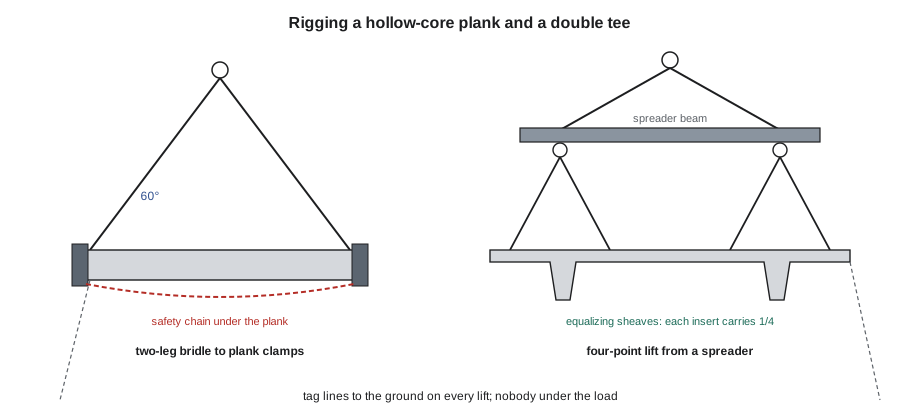
Hollow-core planks usually have no cast-in inserts. They are lifted with plank clamps, scissor-type or lever clamps that grip the plank's ends, top and bottom, as the lift pulls on them, or with forks that slide into the voids, depending on the supplier's system. Clamps are made for a specific plank depth and must be adjusted for it. Most clamp systems include a safety chain or strap that passes under the plank so that if the clamp slips the plank is caught. The supplier's instructions say whether the safety device is required; Crossbeam requires it on every plank lift.
Load sharing and sling angles
A piece lifted at two points with a two-leg bridle shares its weight between the legs, and as IRW-120 covered, the tension in each leg increases as the sling angle flattens. A piece lifted at four points does not automatically share its weight four ways: on a stiff piece, two diagonal slings can end up carrying most of it unless the rigging equalizes the load, with a spreader beam and sheaves, or a pair of spreaders. Precast suppliers usually show the rigging for each piece type, including spreaders and the minimum sling angle.
Worked problem
Leg tension on a plank lift
A Tidewell plank weighs 3,134 kg and is lifted with a two-leg bridle to clamps at its ends, the legs at 60 degrees from horizontal. What is the tension in each leg?
Show solution
- Each leg carries half the weight vertically: 3,134 ÷ 2 = 1,567 kg.
- Leg tension = 1,567 ÷ sin 60° = 1,567 ÷ 0.866 ≈ 1,809 kg.
Answer: About 1,809 kg in each leg, plus the weight of the clamps. The bridle and the clamps were rated well above that, and Carla's gang never flattened the legs below the 60 degrees the supplier's rigging sheet showed.
Worked problem
Load on each insert of a double tee
A double tee of 18.2 t (18,165 kg) is lifted at four inserts from an equalizing spreader. The supplier's rigging sheet tells the erector to allow 1.2 times the static load per insert for the dynamic effects of lifting. What design load does each insert see, and how does it compare with the insert's rated working load of 7,500 kg on the supplier's sheet?
Show solution
- Static load per insert = 18,165 ÷ 4 ≈ 4,541 kg.
- With the dynamic allowance = 4,541 × 1.2 ≈ 5,450 kg.
- 5,450 kg is less than the 7,500 kg rated working load.
Answer: About 5,450 kg per insert, within its rating, but only because the spreader equalizes the load. Without equalizing, two inserts could carry most of the weight and be overloaded.
The 1.2 factor in that example is typical of the allowances suppliers give for an ordinary lift from a trailer; pieces lifted out of forms, where suction holds them, or turned in the air, are given larger allowances on their rigging sheets.
Turning pieces
Some precast pieces are cast flat and must be turned upright before they are set: wall panels, columns and spandrels. Turning is done with two crane lines or a two-hook rig, one at the top and one at the bottom of the piece, with the bottom line paying out as the top line lifts, so that the piece rotates in the air without dragging its edge on the ground. The supplier designs separate inserts for turning and for setting, and the rigging is changed between the two steps as the drawings show. A piece turned with the wrong inserts, or dragged on its edge, can crack.
Setting on bearings
A precast piece is landed on its bearings as gently as the crane can manage, with the crew guiding it by tag lines and hand as it comes within reach, never with hands or feet between the piece and its support. It must land on its bearing pads or shims in the right position, with the bearing length the drawing requires at each end, square to its supports and tight to the piece beside it.
- Bearing pads are laid in the positions the drawings show before the piece is lifted, and checked for size and type.
- The piece is lowered until it sits on its bearings but the crane still holds some of its weight, so it can be adjusted; bars and wedges are used to nudge it into place, never hammers on its edges.
- Bearing length is checked at both ends before the crane releases the piece. A plank that lands short of its minimum bearing is lifted and reset.
- Planks are set tight to their neighbours; the keyway between them is the space the grout fills, and a plank set with a gap leaves a weak joint.
Temporary bracing
Columns, wall panels and some beams are unstable until their connections are made, and they must be braced before the crane lets go. The supplier's erection drawings show the bracing: pipe braces from the piece to the slab or to deadmen, guy cables, or temporary connections.
Ontario's construction regulation requires structural members to be braced or secured so that they cannot collapse or fall before they are released. The supplier's bracing design is followed exactly, braces are not removed until the permanent connections are complete and the supplier's engineer allows it, and braces are inspected daily and after high winds.
Nobody under the load
Under Crossbeam's rules and Ontario's general rules on hoisting, nobody stands or works under a precast piece being lifted, turned or set except the workers needed to guide and set it, and they work from the side, never from directly below. The landing area below is barricaded during lifts.
Weather and wind
Large flat precast pieces, wall panels and double tees, catch wind like deck does. The crane's chart, the supplier's instructions and Crossbeam's rules all set wind limits, and lifts stop when gusts reach the lowest of them. Precast is also slippery when wet and icy, and rain or frost on bearing surfaces is cleared before pieces are set.
The Tidewell lift rate
At Tidewell, the gang settled into a rhythm: about 15 minutes a plank from hooking on at the trailer to unhooking on the floor, which with trailer changes, moving the crane twice and the end of each floor gave about 28 planks a day. Carla said the rhythm was the easy part. The hard part, she said, was keeping it from making anyone careless with the clamps, the chains and their hands, and she changed who hooked on at the trailer every two hours so that nobody did it on autopilot.
Lifting from the trailer
Most precast pieces on a job like Tidewell are lifted straight from the trailer. The first lift of the day off each trailer is the most awkward: the piece may be tight against the next one, held by dunnage and straps, and the trailer's deck may be wet or icy. The straps or chains securing the load are released only for the piece being lifted, with the others still secured, so that a loose piece cannot slide off. The crane lifts the first few centimetres slowly so the riggers can see the piece is free and the rigging is holding evenly before it lifts clear.
Tag lines and hands
Tag lines are used on every precast lift to control the piece from a safe distance. Riggers guide the piece by the tag lines until it is close enough to touch, then by hand on its top surface or sides, never with hands under it or between it and the support, the next piece or the column. When planks are pushed tight against their neighbours, the push is made with a bar against the end of the plank, never by a worker's hands or feet between the two planks.
Setting planks on steel
Planks set on steel beams sit on the beam's top flange, often with a bearing strip or directly on the steel as the supplier shows. Because the flange is narrow, the plank's bearing length is limited, and planks from both sides of the beam meet over it. The gang checks the beam's position and level before setting begins, because a beam out of line shortens the bearing on one side. Where planks bear on steel, the beams must also be stable enough to take the load from one side only while the other side is empty, which the erection plan and the supplier's sequence address: planks are often set alternately on both sides, or the beam is braced, so that it does not twist.
Wall panels and columns
Precast wall panels and columns are set upright on shims or base plates, plumbed with the crane still holding them, and braced before the crane lets go. The braces are attached to inserts in the piece and to anchors in the slab or to deadmen, as the supplier shows, and are adjusted to plumb the piece. Only then is the crane released. Bracing is never attached to anchors the supplier has not designed for it, never removed to make room for other work, and checked after any high wind. On columns with grouted sleeves, the bracing stays until the grout has reached strength (lesson 10).
Radio and signals
Precast lifts are often blind for the crane operator, because the piece is lowered into a floor or a frame the operator cannot see. As IRW-120 described, a qualified signal person directs every blind lift, usually by radio, with a clear protocol for each movement and the stop signal from anyone. At Tidewell, Carla was the signal person on the floor for most lifts, and Andy signalled from the trailer for the first few centimetres of each lift.
When a lift goes wrong
If a piece shifts in its rigging, a clamp slips or a piece starts to swing toward people, the rule is the same as for steel: anyone can call stop, the piece is lowered as soon as it is safe to a place where it can rest on dunnage, and nobody goes under or near it until the rigging has been checked and the cause found. A piece that has struck something or been dropped, even a short distance, is inspected by the supplier before it is set, because prestressed concrete can crack inside without showing much on its surface.
Common mistakes
MistakeLifting a precast piece by a projecting bar or connection plate.
InsteadLift only by the designed inserts or the supplier's clamps.
MistakeLifting a plank without the safety chain under it.
InsteadUse the safety device on every plank lift, as Crossbeam requires.
MistakeRigging a four-point lift without equalizing.
InsteadUse the supplier's rigging with spreaders and sheaves so the inserts share the load.
MistakeReleasing the crane before bearing length is checked.
InsteadCheck bearing at both ends while the crane still holds the piece.
MistakeRemoving braces once the piece looks stable.
InsteadKeep bracing until permanent connections are made and the supplier allows removal.
Summary and key terms
- Precast is lifted only by its designed inserts or the supplier's clamps, with the hardware the supplier specifies.
- Inserts and hardware are designed by the supplier's engineer and used within their ratings.
- Four-point lifts need equalizing rigging; sling angles increase leg tension as they flatten.
- Pieces are landed gently on their pads with the required bearing, checked before release.
- Columns and walls are braced as designed until their permanent connections are complete.
- Only the workers needed are under a lift, working from the side.
- Lifting insert
- A device cast into a precast piece for attaching lifting hardware.
- Plank clamp
- A clamp that grips the end of a hollow-core plank for lifting.
- Safety chain
- A chain or strap under a plank that catches it if a clamp slips.
- Equalizing spreader
- A spreader with sheaves that shares a load evenly among lift points.
- Dynamic allowance
- An extra factor on lifting loads for the effects of starting, stopping and swinging.
- Bearing length
- How far a piece sits on its support.
- Turning
- Rotating a piece from flat to upright in the air.
Practice problems
Work each problem on paper first, then reveal the answer to check.
A 4,200 kg plank is lifted with two legs at 60 degrees. What is each leg's tension?
Show answer
2,100 ÷ 0.866 ≈ 2,425 kg.
A 24,000 kg tee on four equalized inserts with a 1.2 allowance. What is the load per insert?
Show answer
6,000 × 1.2 = 7,200 kg.
Why is a spreader with sheaves used on a four-point lift?
Show answer
So the four inserts share the load instead of two carrying most of it.
When may braces come off a precast column?
Show answer
When the permanent connections are complete and the supplier's engineer allows it.
Who may be under a piece being lifted?
Show answer
Only the workers needed to guide and set it, working from the side.
Lesson quiz · 5 questions
Score 60% or more to complete this lesson.
Create a free account to save your progress, take quizzes and earn a certificate.