
IRW-230 · Lesson 12 of 12 · 20 min
Case study: decking a warehouse roof
▶ Video coming soon A video version of this lesson is on the way.
Every lesson in this course has borrowed something from one job: the roof of Airpark Building B, a distribution warehouse near Hamilton's airport at Mount Hope, which Crossbeam framed and decked in July and August 2026. It was the second of the two tilt-up warehouses on which Tobias Reyes's rod gang had placed the panel steel (IRW-220), and once the panels were tilted up and braced by the general contractor, Halberd Construction, Crossbeam came back to set the joist girders, the joists and the roof deck. Carla Duquette's raising gang set the steel; Ilona Benedek's deck crew, with Femi Ogunleye among its welders, landed, spread and fastened the deck. This lesson follows the job from the pre-job meeting to the final inspection, using Ilona's job file and the story she told at the last deck night.
The building
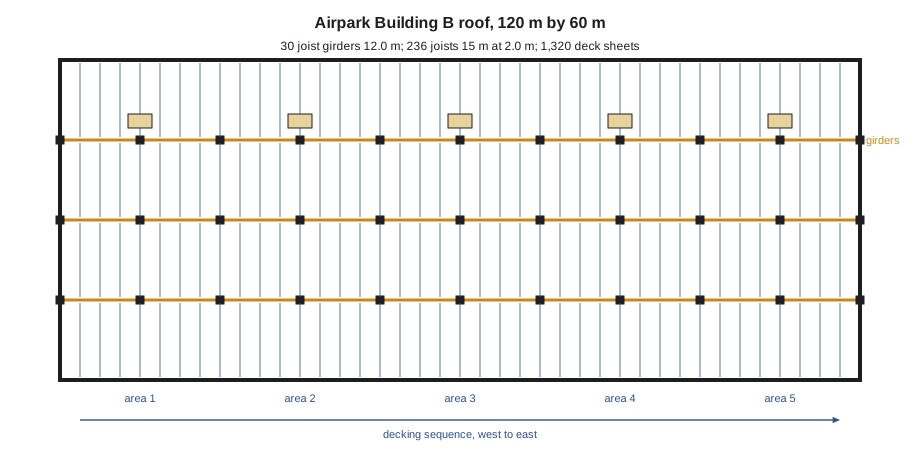
Building B is 120 m long and 60 m wide, a single storey about 10 m high, with tilt-up concrete walls on all four sides and a grid of steel columns inside. The roof is framed with joist girders spanning 12.0 m between columns along three interior column lines, and with joists spanning 15 m between the girders and the walls, spaced at 2.0 m. That gives 30 joist girders and 4 rows of 59 joists, 236 joists in all. The roof deck is 38 mm wide-rib roof deck, 0.76 mm thick (22 gauge), primed, in sheets 6.0 m long, about 7,200 m² of it, fastened with arc spot welds to the joists and screwed at the side laps.
Planning
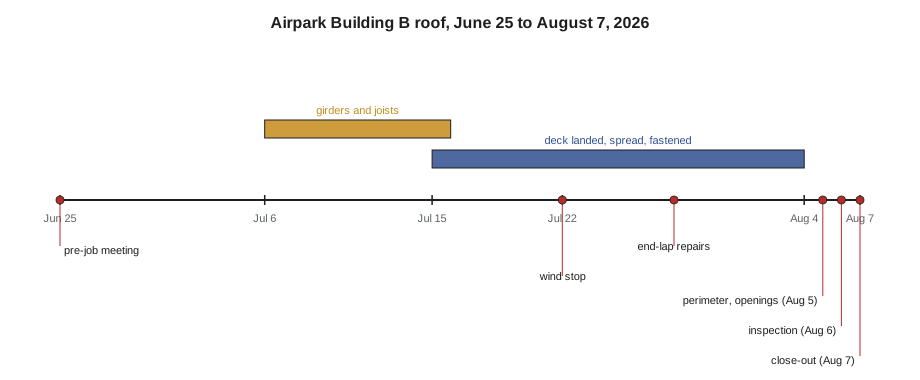
The pre-job meeting was on Thursday, June 25, at Halberd's site trailer. Carla, Ilona, Nate Okonkwo and Halberd's superintendent went through the joist erection drawings, the deck layout, the wall embed locations for the bridging anchors and the joist seats, the crane plan and the schedule. Three decisions came out of it.
- Bundle size. The deck supplier planned bundles of 30 sheets. At 6.0 m and 914 mm cover, each sheet weighs about 43.9 kg, so a 30-sheet bundle is about 1,316 kg, under Crossbeam's 1,800 kg limit for bundles on joists. The bundles stayed at 30, and the supplier marked weights on every tag.
- Bundle placement. Bundles would be landed only across joists attached at both ends, with the first row of bridging installed and anchored, near the girder bearings, on dunnage, as lesson 4 described.
- Fastening. Welds would follow the field pattern of 36/4 at every joist, 36/7 at the two joists nearest each wall, and perimeter welds at 300 mm (12 in) to the wall angles, with one side-lap screw in each span.
Worked problem
The scale of the deck job
With 6.0 m sheets, the deck runs 120 ÷ 6.0 = 20 sheet lengths along the building and 60 ÷ 0.914 ≈ 65.6, so 66 sheets across. How many sheets and bundles is that, and how many field welds and side-lap screws at 16 welds and 3 screws per sheet?
Show solution
- Sheets = 20 × 66 = 1,320.
- Bundles = 1,320 ÷ 30 = 44.
- Field welds = 1,320 × 16 = 21,120.
- Side-lap screws = 1,320 × 3 = 3,960.
Answer: 1,320 sheets in 44 bundles, about 58 t of deck, with about 21,100 field welds and 4,000 screws before the edge and perimeter fasteners. Ilona planned four welders and two screw-gun crews.
Joist girders and joists
The joist girders and the first joists were delivered on Monday, July 6. Carla's gang set the girders first, bolting them at the columns and restraining their bottom chords at the column stabilizer plates, then set the joists bay by bay from the west end, starting with the joists on the column lines, which were field-bolted. Dwayne Mercer ran Summitline's crane. The joists came in bundles in the order they would be set, as lesson 1 described, and the gang spread each bundle across the girders and set the joists one at a time on their seats, attaching both sides of one end of each before the next went in, and both ends before anyone walked on them.
The bridging went in as the joists did. Each joist bay had two rows of horizontal bridging at the third points, running from the tilt-up wall angles at one end to the first interior girder line, and on the joists nearest the east wall, where the wall angles were still being welded by Halberd's crew, the gang installed X-bridging between the first two joists of each row as a temporary anchor (lesson 2). Nate's checklist, adapted for joist bays, released each bay for deck only when its bridging rows were complete and anchored and its seats were checked.
By Thursday, July 16, all 30 girders and all the joists were set, attached and bridged, and the raising gang moved on. The bridging anchors at the east wall were finished the same day, and the temporary X-bridging stayed in place as the drawings allowed.
Landing and spreading the deck
Ilona's crew started on Wednesday, July 15, in the west bays that had already been released. Bundles were landed by Dwayne's crane on dunnage across the joists near the girders, within the distance of the bearing the rules allowed, and spread toward the east. The first sheet of each area was laid to a chalk line snapped from the deck layout's starting edge, and every sheet after it followed in module.
On Friday, July 17, a bundle in bay 7 was landed about 600 mm (2 ft) farther from the girder than its marks, because a gust swung it as it came down. Ilona had it lifted and re-landed on its marks before anyone touched the banding. On Wednesday, July 22, gusts rose past 40 km/h (25 mph) at about 1:30 in the afternoon. The crew stopped spreading, fastened every sheet already laid with its full field pattern, strapped the two open bundles back down to the joists and spent the rest of the afternoon welding the perimeter at the west wall.
Fastening
The welders followed the spreading crew by about one bay. Femi did the pre-shift checks on the welding machines and the weld test coupons each morning. Ilona or her lead hand walked each finished bay with the layout, counting fasteners at a sample of sheets, looking at weld size and fusion, and checking the edge and perimeter patterns. Two problems came up.
- In bay 12, on July 28, a new welder's welds at the end laps were small, because he was moving too fast where two sheets overlapped. Ilona had him slow down and add welds at the end laps he had done that morning, and she checked his work at every sheet for the rest of the day.
- At the north wall, the perimeter welds in one stretch were at about 450 mm (18 in) instead of 300 mm (12 in), because the welder had been working from the wrong detail. The extra welds were added the same afternoon.
Openings
The roof had 28 openings: 24 for rooftop exhaust fans and 4 for roof hatches. Following the rule from lesson 7, the crew decked straight over every one. The fan openings were cut by the roofer's crew in August, each the day its curb was set, and the hatch openings were cut and their curbs set by Ilona's crew on August 5, with covers on the openings at the end of that day until the hatches were installed the next morning.
Inspection and handover
Ilona's crew finished the field fastening on Tuesday, August 4, and the perimeter and edges on Wednesday, August 5. Before the owner's inspector arrived, the crew did its own full inspection with the checklist from lesson 11 and fixed what it found: two sheets with a crushed rib from a dragged bundle, replaced; three missing side-lap screws; and one sheet that stopped about 25 mm (1 in) short of its support at an end lap, which was replaced.
The owner's testing agency inspected the deck on Thursday, August 6. Its inspector measured 140 welds in a sample of the roof, found two undersized, below the 3 in 100 that would have widened the check, and had them repaired the same day. Her report closed on Friday, August 7, and the roofer started the next week.
The numbers
| Item | Planned | Actual |
|---|---|---|
| Joist girders and joists set | 8 working days | 9 working days (July 6–16) |
| Deck landed, spread and field-fastened | 13 working days | 15 working days (July 15–August 4) |
| Perimeter, edges and openings | 1 day | 1 day (August 5) |
| Bundles | 44 of 30 sheets | 44, plus 1 extra bundle of damaged-sheet replacements |
| Wind days lost | None planned | Half a day (July 22) |
| Recordable injuries | 0 | 0; one first-aid cut from deck banding |
The deck took two days longer than planned: half a day for wind, a day for the extra welding at the end laps and perimeter, and half a day for the re-landed bundle and the replaced sheets. The first-aid cut was from a band that sprang when it was cut by a worker standing in front of it instead of to the side; Grace Ndlovu used it in her toolbox talk the following Tuesday.
What the crew took from it
At the last deck night, Ilona asked the apprentices what they would remember from the job. Shay said the bundle in bay 7, because it showed that the marks on the steel only matter if someone checks the bundle lands on them. Jules said the perimeter welds, because nobody would ever have seen them under the roofing, and the roof would have looked fine until the first big storm. Ilona added two of her own.
- Plan the deck before the steel. The bundle sizes, the landing spots, the fastening crews and the opening plan were all settled at the pre-job meeting, three weeks before the first girder arrived.
- The edges are the job. Most of the defects on Building B, and most of the ones she had seen on other roofs, were at end laps, perimeters and openings, where the pattern changes and crews working fast miss it.
Crossbeam's next joist roof, a school gymnasium, is planned for the spring of 2027. Ilona has already asked for the deck layout.
Coordination with Halberd and the roofer
Two other parties shaped the Airpark schedule. Halberd's own crew was finishing the welded angles on the east tilt-up wall that the bridging anchored to, and its tilt-up bracing was still in place inside the building. The joists and deck could not be landed in a bay until Halberd confirmed the wall braces there could stay or be moved, because the roof deck, once fastened, would brace the walls and allow the temporary braces to be removed. The braces in each bay came out only after Halberd's engineer released them, which happened bay by bay a few days behind the deck. The roofer, meanwhile, wanted the deck as early as possible, and its crew started on the west end on August 10, three days after close-out.
The crane and the bundles
Summitline's crane worked from the slab inside the building for the girders and joists, set on mats as the crane plan required, and moved outside along the north wall for the deck bundles, landing them over the wall. Each bundle lift was called on the radio by its bundle number and weight from its tag. Most deck bundles were landed in the first half of each morning, so that the crane could leave by noon and the deck crew could spread and fasten without bundles swinging overhead.
Crew and hours
Ilona's crew on Airpark was eight: herself, two spreading pairs, three welders including Femi, and a screw-gun crew that shifted between side laps and helping the spreaders. With the half day of wind and the extra welding, the deck took 15 working days. Ilona kept a running count of sheets laid and welds made on a whiteboard in Halberd's trailer, and by the second week the general contractor's superintendent was reading it every morning before the coordination meeting.
What it cost to do it again
The job's two-day overrun cost the deck crew about 16 crew-days of extra time, most of it at the end laps and perimeter. Ilona's post-job review proposed three changes for the next joist roof: a pre-start meeting with each welder to walk the layout's edge and end-lap details on the deck itself; a separate colour of paint on the deck at every girder line and perimeter to flag the pattern change; and a short check by the foreperson of every welder's first two sheets each morning. Crossbeam adopted all three as standard practice for deck crews.
Common mistakes
MistakeLeaving the bundle size to the supplier without checking it against the landing rules.
InsteadCheck bundle weights against the limits for bundles on joists at the pre-job meeting.
MistakeLanding deck on bays not yet released.
InsteadLand bundles only on bays whose joists are attached and bridged and released by the foreperson.
MistakeSpreading deck in rising wind.
InsteadStop at the wind limit, fasten what is laid and secure open bundles.
MistakeLeaving inspection to the owner's inspector.
InsteadDo a full self-inspection with the checklist before handover.
MistakeCutting all the openings at once to save time.
InsteadCut each opening only when its curb or hatch is ready, and cover it at once if not.
Summary and key terms
- Airpark Building B was a single-storey tilt-up warehouse with joist girders, joists and wide-rib roof deck.
- Bundles of 30 sheets weighed about 1,316 kg, under Crossbeam's 1,800 kg limit for bundles on joists.
- Joists were attached and bridged bay by bay, with temporary X-bridging where the wall anchors were not ready.
- Deck was laid to a line, fastened behind the spreading crew and secured when wind stopped work.
- Self-inspection found and fixed crushed ribs, missing screws and a short sheet before the owner's inspector came.
- The job finished two days late and without a recordable injury.
- Tilt-up wall
- A concrete wall panel cast flat on site and tilted up into place.
- Pre-job meeting
- A planning meeting before work starts on a job.
- Release for deck
- The foreperson's confirmation that a bay is ready for deck.
- Handover
- Turning finished work over to the next trade.
- Close-out
- Finishing the paperwork and deficiency list on a job.
Practice problems
Work each problem on paper first, then reveal the answer to check.
A roof needs 1,100 sheets in bundles of 25. How many bundles?
Show answer
1,100 ÷ 25 = 44 bundles.
Sheets of 6.0 m at 914 mm cover and 8.0 kg/m² in bundles of 35. Is that under 1,800 kg?
Show answer
35 × 43.9 ≈ 1,536 kg, yes.
A roof has 900 sheets with 16 welds each. How many field welds?
Show answer
14,400.
An inspector finds 5 undersized welds in a sample of 140. Is that over 3 in 100?
Show answer
5 ÷ 140 ≈ 3.6 in 100, so yes; the check is widened.
Why were the openings decked over at Airpark?
Show answer
So nobody could fall through them before their curbs or hatches were set.
Lesson quiz · 5 questions
Score 60% or more to complete this lesson.
Create a free account to save your progress, take quizzes and earn a certificate.