
IRW-130 · Lesson 2 of 12 · 26 min
Bar sizes, grades and markings
▶ Video coming soon A video version of this lesson is on the way.
At the second rod school night, on Monday, October 5, Tobias had a rack of bar ends waiting on the shop bench, each cut about a hand's length long and each a different size. He asked Shay and the two other new apprentices to sort them from smallest to largest and name each one. They had the order right in a minute. Naming them took longer. Two bars that looked almost identical turned out to be one size apart, and a bar Shay was sure was the largest on the bench was a size smaller than the one beside it. "You will never measure a bar with a tape on the job," Tobias said. "You will read the tag, read the marks on the bar and know the size by eye and by weight. Get it wrong, and the wall has the wrong steel in it, and nobody will find out until it cracks."
This lesson covers how reinforcing bars are sized and named, the steel grades in common use, how bars are marked at the mill, how bundles are tagged and how to work out the weight of bars and bundles. It is the vocabulary that every placing drawing and bar list in the rest of the course is written in.
How bars are named
In Canada, reinforcing bars are made to the CSA G30.18 standard and are named in metric sizes: 10M, 15M, 20M, 25M, 30M, 35M, 45M and 55M. The number is roughly the bar's cross-sectional area in square millimetres divided by ten, rounded; a 15M bar has an area of about 200 mm², and a 25M bar about 500 mm². The M stands for metric. The size number is close to the bar's nominal diameter in millimetres but not equal to it; a 15M bar is 16.0 mm and a 25M bar is 25.2 mm.
A bar's nominal diameter is the diameter of a plain round bar with the same weight per length. Because of the deformations, the outside of a bar measured over the ribs is larger than its nominal diameter, which is one reason measuring a bar with calipers or a tape is unreliable.
| Bar size | Nominal diameter (mm) | Area (mm²) | Mass (kg/m) |
|---|---|---|---|
| 10M | 11.3 | 100 | 0.785 |
| 15M | 16.0 | 200 | 1.570 |
| 20M | 19.5 | 300 | 2.355 |
| 25M | 25.2 | 500 | 3.925 |
| 30M | 29.9 | 700 | 5.495 |
| 35M | 35.7 | 1,000 | 7.850 |
| 45M | 43.7 | 1,500 | 11.775 |
| 55M | 56.4 | 2,500 | 19.625 |
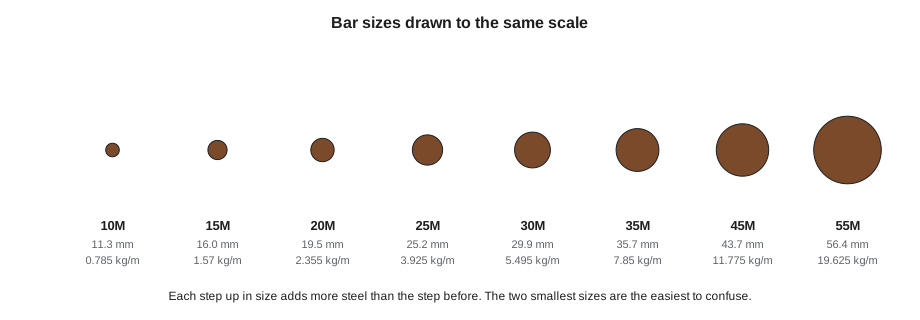
The masses in the table are worth knowing by heart for the sizes used most: 10M at about 0.8 kg/m, 15M at about 1.6, 20M at about 2.4, 25M at about 3.9 and 30M at about 5.5. A useful check: a 15M bar weighs twice as much per metre as a 10M, and a 25M weighs two and a half times as much as a 15M.
Steel grades
CSA G30.18 sets grades by minimum yield strength in megapascals and by whether the bar is made for welding. Grade 400R and 500R are regular bars; Grade 400W and 500W are weldable bars, made with a controlled chemistry, measured as the carbon equivalent, so that they can be welded under a proper procedure without becoming brittle. Grade 400W is the most common bar on Canadian building projects. Grade 500W is used where the designer wants less steel or less congestion. Older Grade 300 bars are rarely seen in new work. A bar with no W must not be welded at all, even for a tack, unless the engineer approves a procedure.
Grade matters to the placer for one simple reason: bars of the same size and different grades look almost the same, and a lower grade bar placed where a higher grade is specified can leave a member weaker than designed. Fabricators keep grades separate in their yards and on their tags, and the placer checks the grade on the tag and the bar against the drawings.
Mill markings
Every bar is rolled with a set of raised marks repeated along its length. The marks identify the mill that made it, the bar size and the grade, and on weldable bars they show the W designation. CSA G30.18 sets out what must be shown; many mills mark grade with continuous lines rolled between the ribs, commonly one line for 400W and two for 500W, but marking patterns vary from mill to mill, and the mill's marking guide and the mill certificate are the final word. The mill certificate, sometimes called a mill test report, lists the heat number, chemistry and test results for the steel, and the fabricator keeps it on file for every shipment.
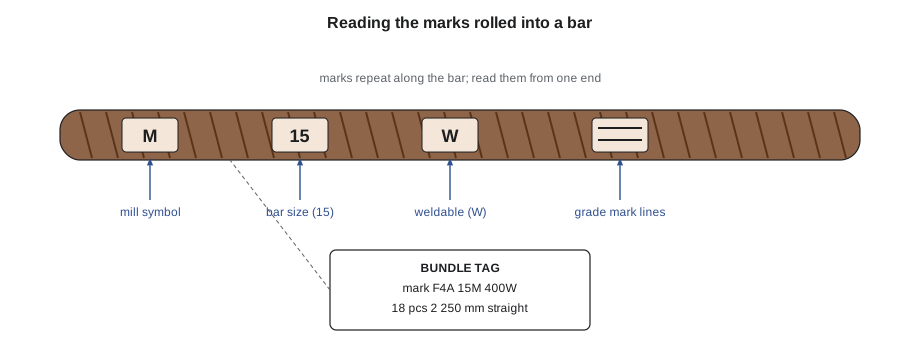
Markings are rolled into the bar before it is cut, so a short piece may not show all of them. On the job, the bundle tag is the first source of information, and the marks on the bar confirm it.
Coated and special bars
Most rebar is plain, uncoated carbon steel, often called black bar. Where corrosion is a concern, for example in parking structures, bridge decks and marine work, designers may specify coated or corrosion-resistant bars. Epoxy-coated bars are coated with a hard green, purple or grey film; galvanized bars are zinc-coated and look dull grey; stainless steel bars look bright and do not rust; and glass fibre reinforced polymer bars, made of fibres in resin, are light and non-metallic. Each needs its own handling: padded slings, coated chairs and coated tie wire for epoxy bars, care not to mix stainless and black steel, and the maker's rules for any bending. These bars and their handling are covered in IRW-220.
Bundle tags
Fabricated bars arrive on the job in bundles, each wired with a metal or plastic tag. A tag normally shows the job, the bar mark from the bar list, the bar size and grade, the number of pieces, the length, the shape if the bars are bent, and often the area of the building where they go. Tobias's rule is that tags stay on the bundle until the last bar is placed. A bundle with no tag is a bundle someone has to identify by measuring, counting and checking against the list, which wastes time and invites mistakes.
Bundles are sorted on site by area and by sequence so that the bars needed first are on top and nearest the work. Bars should be stored off the ground on dunnage, kept out of mud and away from oil and form release, and kept apart by size and grade. Light surface rust is normal and does no harm; loose, flaky scale or pitting should be shown to the foreperson.
Weights and bundles
The weight of a bundle matters for crane picks, for hand carrying and for checking a delivery against the bill. It is found by multiplying the number of bars by the length of each bar and by the mass or weight per unit length from the table.
Worked problem
The weight of a bundle
A bundle tag reads: 40 pieces, 15M, 12.0 m straight. What does the bundle weigh?
Show solution
- Total length = 40 × 12.0 = 480 m.
- Mass = 480 m × 1.570 kg/m = 753.6 kg.
Answer: About 754 kg. Two people cannot carry a bundle like that; it comes off the truck with the crane or a forklift, and individual bars come off the bundle by hand.
Worked problem
A heavy bundle for a crane pick
A bundle of 40 pieces of 25M, each 12.0 m long, is to be lifted into a wall form with the crane. What does it weigh, and how should it be rigged?
Show solution
- Total length = 40 × 12.0 = 480 m.
- Mass = 480 × 3.925 = 1,884 kg.
- Add the rigging, for example two chokers and a spreader, to the load on the hook.
Answer: About 1,884 kg before rigging. As IRW-120 explained, long bundles are picked from two points, with chokers about a quarter of the length in from each end and the bundle wire left on, never from a single choker in the middle; a bundle choked at one point can sag, and bars can slide out of the choke and fall.
Carrying single bars is a large part of a rodbuster's day, and a long day of it is hard on the back and shoulders. Bars over 6 m long, or heavy sizes at any length, are carried by two people, on the same shoulder, walking in step, with the lead person calling the turns and the set-down. Crossbeam limits single-person carries to a weight the worker can manage comfortably and asks crews to use the crane, a forklift or a bar cart for anything more.
Bar substitutions
Sometimes the size called for is not on site, and someone suggests using a different size "that has the same steel". Substitutions change bar spacing, cover, bond and laps, and only the engineer can approve them. The placer's job is to place what is shown, and to raise any shortage with the foreperson so that the engineer can decide.
Worked problem
Why substitutions need the engineer
A wall calls for 20M bars at 300 mm. Someone suggests using two 15M bars instead of each 20M. Is that the same steel?
Show solution
- One 20M = 300 mm² of steel.
- Two 15M = 2 × 200 = 400 mm² of steel.
- The area is larger, but there are now twice as many bars, with different clear spacing, laps and bond.
Answer: No. It has more steel area, but it changes the spacing between bars, the space for concrete to flow between them and the lap lengths. Only the engineer can say whether it works, and the change must be recorded.
Telling sizes apart in the field
The two size pairs that cause most mix-ups are 10M and 15M, which look alike from a distance, and 20M and 25M, which look alike close up. Tobias teaches three checks. First, the tag. Second, the mill marks, which show the size number. Third, the feel: pick up a 3 m piece of each and the difference in weight is obvious, about 2.4 kg against 4.7 kg for 10M and 15M. A bar whose size cannot be confirmed by the tag and the marks is set aside, not placed on a guess.
Remnants and offcuts are the most common source of mistakes. A short piece left over from one area, with no tag and its marks cut off, ends up as a dowel or a trim bar in the next area because it is handy. Crossbeam's rule is that untagged offcuts go back to the scrap bin unless the foreperson identifies them.
Bars by the tonne and the truckload
Fabricators sell, ship and invoice reinforcing by weight, and general contractors schedule it by weight too. A rod gang foreperson thinks in tonnes: how many tonnes are in an area, how many tonnes the gang placed today, how many tonnes are on the next truck. Truckloads are commonly up to about 20 t, limited by the truck and the road, but downtown sites and tight laydown areas often take smaller loads more often. Knowing the weight of what arrives lets the foreperson plan crane time, laydown space and the size of the crew.
Worked problem
Checking a delivery
A delivery ticket lists three marks: 60 pieces of 15M at 6.0 m, 24 pieces of 20M at 4.5 m and 80 pieces of 10M at 2.0 m. What is the total mass on the truck?
Show solution
- 15M: 60 × 6.0 × 1.570 = 565.2 kg.
- 20M: 24 × 4.5 × 2.355 = 254.3 kg.
- 10M: 80 × 2.0 × 0.785 = 125.6 kg.
- Total ≈ 945 kg.
Answer: About 945 kg. If the ticket total is very different, or the bundle count does not match, the foreperson checks the bundles before signing.
Storing bars by mark, with tags facing out, in the order they will be placed is a habit that pays off every day. A laydown area that looks like a scrapyard turns every search for a bar into a ten-minute job, and in a busy week those ten minutes add up to a day.
Common mistakes
MistakeIdentifying bars by measuring the diameter over the ribs.
InsteadRead the tag and the mill marks; the size over the ribs is larger than the nominal diameter.
MistakeWelding or tacking bars that have no W designation.
InsteadWeld only bars made for welding, under an approved procedure, and only where the engineer allows it.
MistakeRemoving bundle tags as soon as a bundle is opened.
InsteadKeep tags on until the last bar of the bundle is placed.
MistakeChoking a long bundle at one point in the middle.
InsteadPick from two points about a quarter of the length in from each end.
MistakeSubstituting a different bar size because it has the same area.
InsteadPlace what is shown; only the engineer can approve a substitution.
Summary and key terms
- Canadian bars are 10M to 55M under CSA G30.18; the size number is close to the diameter in millimetres.
- Grade 400W is the common Canadian bar; the W means weldable, and bars without it must not be welded.
- Mill marks show the mill, the size and the grade; the tag and mill certificate confirm them.
- Bundle weight = number of bars × length × mass or weight per unit length.
- Coated and corrosion-resistant bars need their own handling, covered in IRW-220.
- Only the engineer can approve a bar substitution.
- Nominal diameter
- The diameter of a plain round bar of the same weight per length as the deformed bar.
- Grade
- The minimum yield strength class of a bar.
- Mill marks
- The raised letters, numbers and lines rolled into a bar to identify its mill, size and grade.
- Mill certificate
- The mill's record of the heat, chemistry and test results for a shipment of steel.
- Black bar
- Plain, uncoated carbon steel reinforcing bar.
- Bundle tag
- The label wired to a bundle showing its job, bar mark, size, grade, count and length.
- Weldable bar
- A bar with controlled chemistry made so that it can be welded under a proper procedure.
Practice problems
Work each problem on paper first, then reveal the answer to check.
What is the mass of 25 pieces of 20M, each 6.0 m long?
Show answer
25 × 6.0 × 2.355 = 353.25 kg.
Roughly what area does a 25M bar have?
Show answer
About 500 mm².
What does the W in 400W mean?
Show answer
The bar is weldable.
Which bar weighs more per metre, 15M or 10M, and by how much?
Show answer
15M, about twice as much (1.570 against 0.785 kg/m).
Who can approve a bar substitution?
Show answer
The engineer.
Lesson quiz · 5 questions
Score 60% or more to complete this lesson.
Create a free account to save your progress, take quizzes and earn a certificate.