
INS-430 · Lesson 10 of 12 · 60 min
Calculation practice
▶ Video coming soon A video version of this lesson is on the way.
Calculation questions are a small share of the exam but a large share of the marks people lose, because a single slip gives a wrong answer that is, by design, one of the options. Bernie gave calculations their own session in the second half of the afternoon on Sunday, November 8, with Priya, who had been checking Raj's takeoffs all fall, at the whiteboard beside her. "Every one of these has a trap," Bernie said. "The trap is the reason the question exists."
This lesson is a set of worked problems that cover the calculations taught in the program. Each problem gives the method and the answer, and names the trap: the mistake that one of the wrong options would be built from. Work each one yourself before reading the steps. The numbers are the ones used earlier in the program wherever possible, so that the answers can be checked against those lessons.
A method for every calculation
Priya wrote Bernie's five steps on the board, and they work for every problem below.
- Read for the unknown. Underline what is asked, and note whether it wants a diameter or a radius, a length or an area, a total or a per-metre figure.
- Write the formula first, in symbols, before any numbers go in. Most slips happen when numbers are written straight into a half-remembered formula.
- Put every quantity in consistent units. Millimetres with metres, inches with feet, °C differences with a °C coefficient. Convert before calculating, not after.
- Estimate before you calculate. A rough answer in your head catches a misplaced decimal: a steam pipe will not lose 15 W/m, and a duct will not need 29 m of wrap per piece.
- Check against the options. If your answer is on the list, ask which mistake the nearby options represent, and make sure you did not make it.
Pipe, jacket and layout
Worked problem
1. Girth and jacket cut width
NPS 4 pipe (114.3 mm) with 51 mm of insulation. Find the calculated girth and the cut width with a 50 mm lap.
Show solution
- D = 114.3 + 2 × 51 = 216.3 mm.
- Girth = π × 216.3 = 679.5 mm.
- Cut width = 679.5 + 50 = 729.5 mm, about 730 mm (measure the real girth on the job, as in lesson 6).
Answer: About 730 mm. Trap: adding the thickness once gives π × 165.3 = 519 mm.
Worked problem
2. Sections for a run
A straight run is 24 m (80 ft). How many 914 mm (3 ft) sections are needed?
Show solution
- 24 ÷ 0.914 = 26.26.
- Round up: 27 sections.
Answer: 27. Trap: rounding to 26 leaves part of the pipe bare.
Worked problem
3. Bands on a straight run
Bands at 230 mm (9 in) on a 24 m (80 ft) run. How many bands?
Show solution
- 24,000 ÷ 230 = 104.3, so 105 spaces.
- Bands = spaces + 1 = 106.
Answer: 106. Trap: forgetting the band at the start gives 105.
Worked problem
4. Mitred elbow segment
Five-piece mitred elbow on NPS 8 long-radius, R = 304.8 mm, insulation outside diameter 371.1 mm. Find the heel length of a full segment.
Show solution
- Joint angle = 90 ÷ 4 = 22.5°; tan 11.25° = 0.1989.
- Heel radius = 304.8 + 371.1 ÷ 2 = 490.4 mm.
- Heel = 2 × 490.4 × 0.1989 = 195.1 mm.
Answer: 195.1 mm. Trap: using the pipe's outside diameter (219.1 mm) gives a heel radius of 414.4 mm and 164.8 mm.
Worked problem
5. Duct wrap stretch-out
Duct 900 × 450 mm; the maker's allowance is 200 mm. Stretch-out?
Show solution
- Perimeter = 2 × (900 + 450) = 2,700 mm.
- Stretch-out = 2,700 + 200 = 2,900 mm.
Answer: 2,900 mm. Trap: the bare perimeter, 2,700 mm, crushes the wrap at the corners.
Worked problem
6. Tank shell area
A tank 1.5 m in diameter and 3.0 m high has 50 mm of insulation. Outer shell area?
Show solution
- D = 1.5 + 2 × 0.05 = 1.6 m.
- Area = π × 1.6 × 3.0 = 15.08 m².
Answer: 15.1 m². Trap: using the tank diameter gives 14.1 m², short on jacket.
Worked problem
7. Pins on a wall
A wall 2.0 m (80 in) wide takes pins at no more than 450 mm (18 in). How many spaces and pins across?
Show solution
- 2,000 ÷ 450 = 4.44, so 5 spaces.
- 5 spaces need 6 pins across, including one near each edge.
Answer: 5 spaces, 6 pins. Trap: rounding to 4 spaces stretches the spacing past the maximum.
Heat flow
Worked problem
8. Heat flow through a flat surface
A wall is insulated with 50 mm of board, k = 0.040 W/(m·K), with 150 K across it. Heat flow per square metre?
Show solution
- q = k ΔT ÷ t = 0.040 × 150 ÷ 0.050.
- = 120 W/m².
Answer: 120 W/m². Trap: putting the thickness in millimetres gives 0.12 W/m².
Worked problem
9. Thermal resistance
What is the RSI of 50 mm of insulation with k = 0.040 W/(m·K), and the equivalent R?
Show solution
- RSI = t ÷ k = 0.050 ÷ 0.040 = 1.25.
- R = 1.25 × 5.68 = 7.1.
Answer: RSI 1.25, about R-7. Trap: k ÷ t gives 0.80.
Worked problem
10. Heat loss from an insulated pipe
NPS 4 pipe, r₁ = 57.15 mm, with 51 mm of insulation, k = 0.045 W/(m·K) at the mean, 150 K across the insulation. Heat loss per metre, ignoring the surface film?
Show solution
- r₂ = 57.15 + 51 = 108.15 mm; ln(r₂ ÷ r₁) = ln(1.892) = 0.6378.
- q′ = 2π × 0.045 × 150 ÷ 0.6378 = 66.5 W/m.
Answer: About 66.5 W/m. Trap: using log base 10 (0.277) gives 153 W/m.
Worked problem
11. Mean temperature
Pipe at 186 °C (366 °F), jacket at 30 °C (86 °F). At what mean should k be read?
Show solution
- (186 + 30) ÷ 2 = 108 °C.
Answer: 108 °C. Trap: reading k at the pipe temperature overstates it; at room temperature understates it.
Worked problem
12. A year's heat loss
The kettle line loses 74.1 W/m over 64 m, at full pressure 7,550 h a year, at 13.16 dollars a gigajoule (sample). Annual energy and cost?
Show solution
- 4,742 W × 7,550 h × 3,600 s/h = 128.9 GJ.
- 128.9 × 13.16 = 1,696 dollars.
Answer: About 129 GJ and 1,700 dollars. Trap: the 8,400 boiler hours give 143 GJ and 1,887 dollars.
Worked problem
13. Expansion of a hot line
A steel line 60 m long heats from 10 °C to 186 °C. Steel grows 12 millionths per °C. How much?
Show solution
- 60 × 176 × 0.000012 = 0.1267 m.
- About 127 mm.
Answer: About 127 mm. Trap: using the °F coefficient with °C gives 69 mm.
Worked problem
14. Contraction of a cryogenic line
A stainless line 30 m (100 ft) long is cooled to liquid nitrogen. Total contraction is 0.28 in 100. How much does it shorten?
Show solution
- 30,000 × 0.0028 = 84 mm.
Answer: 84 mm. Trap: treating 0.28 in 100 as 0.028 gives 840 mm.
Moisture, noise and exposure
Worked problem
15. Dew point
Air at 30 °C (86 °F) and 70 in 100 relative humidity. Dew point?
Show solution
- γ = ln 0.70 + 17.62 × 30 ÷ 273.12 = 1.5787.
- Tdp = 243.12 × 1.5787 ÷ 16.04 = 23.9 °C.
Answer: 23.9 °C. Trap: forgetting the margin when choosing thickness.
Worked problem
16. Adding sound levels
A compressor at 90 dBA and a pump at 84 dBA at the same spot. Total?
Show solution
- Total = 10 log₁₀(10⁹·⁰ + 10⁸·⁴) = 10 log₁₀(1.251 × 10⁹) = 91.0 dBA.
Answer: 91 dBA. Trap: adding the numbers (174) or averaging (87).
Worked problem
17. Distance and sound
A valve is 92 dBA at 1 m (3 ft). In open space, what is it at 4 m (12 ft)?
Show solution
- Two doublings of distance: 92 − 6 − 6 = 80 dBA.
Answer: 80 dBA. Trap: subtracting 6 once gives 86 dBA.
Worked problem
18. Allowed exposure time
Under Ontario's limit of 85 dBA for 8 hours with a 3 dB exchange rate, how long may a worker be exposed to 88 dBA unprotected?
Show solution
- 88 is 3 dB above 85: one halving.
- 8 ÷ 2 = 4 hours.
Answer: 4 hours. Trap: using the US 5 dB rate gives about 5.3 hours.
Worked problem
19. Time-weighted average
0.15 f/cc for 3 hours and 0.02 f/cc for 5 hours. Eight-hour TWA?
Show solution
- (0.15 × 3 + 0.02 × 5) ÷ 8 = 0.55 ÷ 8 = 0.069 f/cc.
Answer: 0.069 f/cc. Trap: averaging the two readings gives 0.085.
Firestop and labour
Worked problem
20. Annular space
NPS 2 pipe (60.3 mm) in a 100 mm hole. Space when centred, and at the widest point if the pipe touches one side?
Show solution
- Centred: (100 − 60.3) ÷ 2 = 19.9 mm.
- Touching one side: 100 − 60.3 = 39.7 mm on the far side.
Answer: 19.9 mm centred, 39.7 mm at the widest. Trap: checking only the centred figure.
Worked problem
21. Hours from a labour unit
A takeoff has 380 m of pipe at a sample unit of 0.15 h/m. How many hours, and how many 8-hour days for a crew of two?
Show solution
- 380 × 0.15 = 57 h.
- A crew of two works 16 h a day: 57 ÷ 16 = 3.6 days.
Answer: About 57 hours, 3.6 days. Trap: dividing by 8 only gives 7.1 days.
Worked problem
22. Conversions to know
Convert a 1,035 kPa header to psi, 76 mm to inches and RSI 1.25 to R.
Show solution
- 1,035 ÷ 6.895 = 150 psi.
- 76 ÷ 25.4 = 2.99 in.
- 1.25 × 5.68 = 7.1.
Answer: 150 psi; 3 in; R-7.1.
Problems to try alone
These five problems have answers only. Work them under time pressure, about two minutes each, and check your method against the worked problems above if you miss one.
- A. NPS 6 pipe (168.3 mm) with 64 mm of insulation and a 50 mm lap. Cut width from the calculated girth? (Answer: π × 296.3 + 50 = 981 mm.)
- B. A run of 42 m in 914 mm sections, with 5 in 100 added for waste. How many sections? (Answer: 42 × 1.05 ÷ 0.914 = 48.2, so 49.)
- C. Two layers: 38 mm with k = 0.040 and 38 mm with k = 0.035 W/(m·K). Total RSI? (Answer: 0.95 + 1.09 = 2.04.)
- D. Three sources of 80, 80 and 86 dBA at one spot. Total? (Answer: 80 + 80 = 83; 83 and 86 give about 87.8 dBA.)
- E. Under Ontario's limit, how long is 94 dBA allowed? (Answer: 9 dB over 85 is three halvings: 8 ÷ 8 = 1 hour.)
Using the calculator
A basic calculator is allowed if the booking confirmation says so, and it is worth practising with the exact one you will take. Check that it has a π key, a square root, natural logarithms and powers of ten, or know the workarounds: π is 3.1416, and decibel sums can be done with the shortcut table from INS-340 (equal sources add 3 dB, 3 dB apart add about 1.8, 6 dB apart about 1, 10 dB apart about 0.4). Clear the memory before the exam, write down intermediate results instead of trusting the display, and round only at the end. A dead battery in the first hour is a real risk; a spare costs very little.
Estimating before calculating
Bernie made the group estimate every answer before working it. For a girth, the insulated diameter times three is close enough to catch a missed doubling. For a heat loss, a well-insulated steam line loses tens of watts per metre, not hundreds or thousands. For a noise sum, the total is never more than a few decibels above the loudest source. Thirty seconds of estimating saved Erik four marks on the practice exam.
Checking an answer quickly
Once an answer is found, a second method is the best check. A girth can be checked by measuring a section's circumference in your head: a 216 mm (8 1/2 in) insulated diameter is about 680 mm (27 in) round. A section count can be checked by multiplying back: 27 sections of 914 mm (3 ft) cover 24.7 m (81 ft), a little more than the run. A heat loss can be checked by its order of size, and a TWA by noting that it must lie between the lowest and highest readings. If the check fails, rework the problem from the formula, not from the numbers you wrote the first time.
Common mistakes
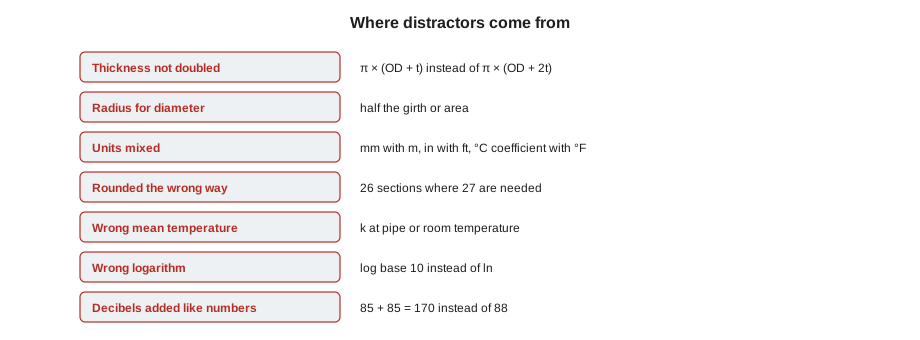
MistakeWriting numbers straight into a formula.
InsteadWrite the formula in symbols first, then substitute.
MistakeMixing millimetres and metres, or inches and feet.
InsteadConvert to consistent units before calculating.
MistakeRounding counts of pieces, spaces or bands down.
InsteadRound up whenever the count must cover the full length.
MistakeUsing log base 10 in the pipe heat-loss formula.
InsteadUse the natural logarithm, ln.
MistakeAdding or averaging decibels.
InsteadUse the logarithmic rules: equal sources add 3 dB; distance doubling subtracts 6 dB.
Summary and key terms
- Read for the unknown, write the formula, make units consistent, estimate, then check against the options.
- Insulated diameter is the pipe's outside diameter plus twice the thickness; girth is π times that diameter.
- Counts of sections, spaces and bands round up, and a run of spaces needs one more band or pin than spaces.
- Flat heat flow is kΔT ÷ t; pipe heat flow uses 2πkΔT ÷ ln(r₂ ÷ r₁), with k at the mean temperature.
- Decibels add logarithmically, and exposure time halves for every exchange-rate step above the limit.
- Trap
- The specific mistake a wrong option in a multiple-choice question is built from.
- Natural logarithm
- The logarithm to base e, written ln, used in the pipe heat-loss formula.
- Exchange rate
- The number of decibels by which the level may rise for each halving of allowed time.
- Labour unit
- The hours a defined quantity of work is expected to take.
- Insulated diameter
- The outside diameter of the insulation: pipe outside diameter plus twice the thickness.
Practice problems
Work each problem on paper first, then reveal the answer to check.
NPS 6 (168.3 mm) with 64 mm insulation. Girth?
Show answer
π × 296.3 = 930.9 mm.
Six-piece 90° mitred elbow: joint and cut angle?
Show answer
90 ÷ 5 = 18° joints, 9° cuts.
k = 0.035 W/(m·K), 25 mm thick: RSI?
Show answer
0.025 ÷ 0.035 = 0.71.
Three sources of 85 dBA each. Total?
Show answer
85 + 10 log₁₀ 3 = 89.8, about 90 dBA.
0.08 f/cc for 6 hours and nothing for 2. TWA?
Show answer
0.48 ÷ 8 = 0.06 f/cc.
Lesson quiz · 5 questions
Score 60% or more to complete this lesson.
Create a free account to save your progress, take quizzes and earn a certificate.