
INS-430 · Lesson 12 of 12 · 18 min
Your career as a journeyperson
▶ Video coming soon A video version of this lesson is on the way.
After the practice exam was marked and the others had gone, Bernie and Erik stayed on for half an hour. She asked him the question she asks every final-year apprentice: "What do you want to be doing in five years?" Erik had not thought much past January. By the time they locked up, he had three answers written in his binder: run a crew, learn to estimate, and never let an apprentice of his make the mistakes he had made in his first year.
This lesson looks past the exam. It covers what the certificate gives you, the further certifications insulators earn, the roles a journeyperson grows into, and the habits that keep a long career healthy. It also brings the program to a close, so it ends with a look back at what the twenty-odd courses before it were for.
What changes when you pass
A pass on the Red Seal exam earns the Ontario Certificate of Qualification for Heat and Frost Insulator with the Red Seal endorsement. Because the trade is not compulsory in Ontario, the certificate is not a licence to work; it is proof of skill, and it is the credential most union agreements, many owners' specifications and many employers ask for when they say "journeyperson". The Red Seal endorsement lets the holder work in the trade in any province or territory without being re-tested, which matters in a trade where big industrial jobs draw crews from across the country. Check Skilled Trades Ontario's rules for the certificate's renewal and fees, which can change.
The pay rate usually changes too. Apprentices earn a rising share of the journeyperson rate as they progress; on completion, the full rate applies. Erik would also become one of the people the company could send to lead a small crew, check an apprentice's work and sign a hazard sheet.
Further certifications
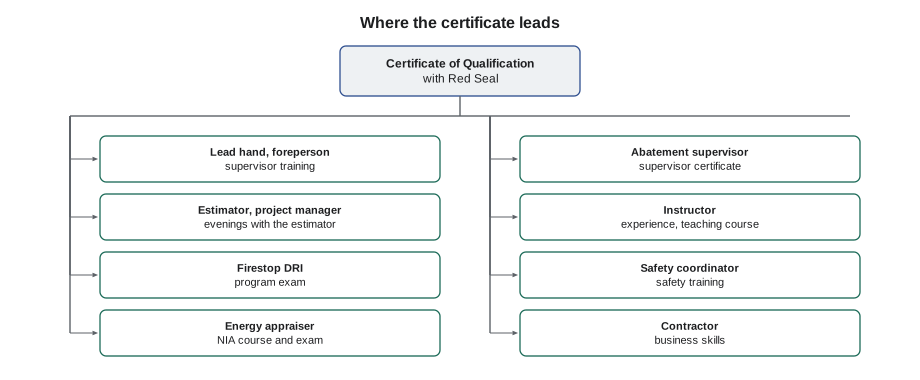
The certificate is the base. Several further credentials appeared in the program, and each opens a kind of work.
- Energy appraisal. The National Insulation Association's Insulation Energy Appraisal Program is a two-day course on surveying a facility, using an infrared camera and the 3E Plus software, and reporting the energy and emission savings from insulation. It ends with a 50-question exam with a pass mark of 70 in 100, and certification lasts three years before recertification. Thea Okerlund's Kellerton audit in INS-410 is the kind of work it leads to.
- Firestop qualification. A company in a firestop contractor program, such as Coldstream in the UL program described in INS-330, must have a designated responsible individual who has passed the program's exam. Rhoda Ingersoll is Coldstream's. The role suits a journeyperson who likes detail and paperwork as much as the tools.
- Asbestos abatement. Coldstream does no abatement, but many insulators work for abatement contractors at some point. In Ontario, Type 3 work needs workers who hold the asbestos abatement worker certificate and supervisors who hold the supervisor certificate, each earned through approved training and an exam.
- Safety credentials. Working at Heights refresher training every three years, the joint health and safety committee certification for committee members, and supervisor training for anyone directing work.
- Equipment and access. Elevating work platform and forklift training, rigging and signalling where the job calls for it.
Erik's own list was short and practical: the energy appraisal course in the spring of 2027, because Kellerton's audit work was growing, and the supervisor training Coldstream gives every new lead hand.
Roles a journeyperson grows into
The program has shown most of these roles through its people.
- Lead hand and foreperson. Bernie's role: running a crew, planning the day, the hazard sheet, quality checks and the toolbox talk. INS-420 covered the skills. A foreperson is a supervisor under the Occupational Health and Safety Act, with the duties that brings.
- Specialist. Marcel on cold work, Wendell on equipment and jacketing, Rhoda on firestopping, Tomasz in the shop. Specialists are the people every crew calls when a job is unusual.
- Estimator and project manager. Raj's role, and the one Priya is learning: takeoffs, pricing, submittals, schedules and changes.
- Instructor. Journeypersons teach in college and training-centre programs and in their own companies' evening sessions, like every session in this program.
- Safety coordinator. Mei's role: training, fit testing, permits and the safety program.
- Contractor. Walt came up as an insulator and founded Coldstream in 1987. Running a business adds estimating, money, people and risk to the trade skills.
Mentoring the next apprentice
The standard lists mentoring as a task of the trade, and the exam asks about it, but the real reason to do it well is that it is how the trade survives. Every journeyperson in this program learned from someone, and Bernie's sayings, Tomasz's backwards elbow and Marcel's cracked insert are all ways of passing on lessons that cost someone a lot to learn. Good mentoring follows a simple pattern: explain the task and why it matters, show it, watch the apprentice do it, give specific feedback, and check again later. It also means letting apprentices stop work when they are unsure, as Devon and Tessa did, and backing them when they do.
Erik had been on the other side of that for four years. His third goal, never to let an apprentice of his make his first-year mistakes, is a mentor's goal. Bernie's advice was to keep his own error log from the exam and use it: "The things you got wrong are the things your apprentices will get wrong. You already know where to look."
A long career
Insulators spend decades on ladders, in plant rooms and around fibres, dust and noise. The habits that keep a career long are the ones this program has repeated.
- Protect your lungs. Treat old insulation as asbestos until the survey says otherwise, control dust and fibres, and wear the respirator that fits. Keep a record of any exposure: diseases from asbestos appear decades later, and a record helps then.
- Protect your hearing. Hearing lost to noise does not come back. Wear protection in plant rooms and near compressors, and get the hearing tests your employer offers.
- Protect your back and your knees. Use lifts and carts, set up access properly instead of reaching, and stay fit for the work.
- Keep learning. Materials, codes and methods change. UL has updated its firestop numbering scheme, as INS-330 noted; the energy codes change every few years; new refrigerants and pipe materials arrive. Read the data sheet every time.
- Keep your records. Hours, certificates, training cards, fit test results and exposure records belong in one place you control.
Erik's plan
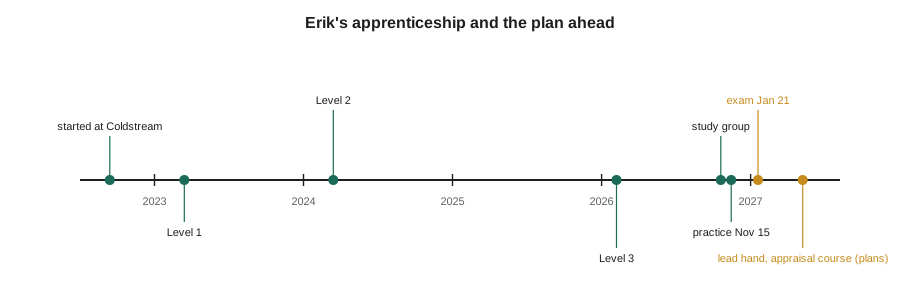
Erik's plan after the practice exam was written as a list in his binder, all of it still ahead of him: the second practice test on January 10; the exam on Thursday, January 21, 2027; results on the portal within about three weeks; then, if he passed, a lead hand's role on one of Bernie's crews in the spring, the energy appraisal course and, in a year or two, evenings with Raj on estimates, the way Priya had spent this fall.
Looking back at the program
The insulator program began with Devon's first day on the Mountview job and has followed Coldstream's crews through a hospital addition, a food plant, an arena, a school bid and a dozen smaller jobs. Every course added a layer: safety and the trade first; heat transfer and materials; pipe, fittings and jacketing; hazardous materials; equipment and ducts; cold and cryogenic work; firestopping and acoustics; calculations, specifications, estimating and planning; and now the exam. The facts in each course were chosen because a journeyperson uses them, and the review lessons in this course were the proof: almost every exam topic had already appeared on a real job in the story.
Bernie's last words to the study group on November 15 were the ones she had heard in her own study group twenty years earlier. "Measure the pipe, not the drawing. Put it on the hazard sheet. And when you're not sure, stop and ask. That's the whole trade. The exam just checks you know it."
Working away from home
Big industrial jobs, such as refinery turnarounds, power plant outages and new mines, draw insulators from across the country for weeks or months, often on rotations with long days. The Red Seal is what makes that possible without re-testing, and it is why many young journeypersons spend a season or two on the road. The work is well paid and teaches a lot quickly, but it is hard on families and on bodies, and the safety demands are high: site orientations, permits, and plant rules that differ from job to job. Bernie did two winters of shutdown work in her twenties and still uses what she learned on them.
Union and open-shop paths
Insulators work both in union shops, where the International Association of Heat and Frost Insulators and Allied Workers represents them and runs training, and in open shops, where the employer sets terms directly. Each path has its own benefits, pension, training and dispatch arrangements, and many insulators work in both during a career. The trade skills, the certificate and the safety rules are the same either way. What matters for a new journeyperson is understanding the agreement or the employment terms that apply on each job: rates, hours, overtime, travel and the process for raising a concern.
A record of your work
Bernie keeps a simple portfolio: photos of jobs she is proud of, the specifications and drawings of unusual work, copies of her certificates and training cards, and a page of notes for each job on what went well and what she would do differently. It began as a habit and became useful when she applied to be a foreperson, when she trained apprentices, and when an owner asked for references. Erik started his the week after the practice exam, with photos of the Kellerton header elbows and the condensate receiver heads he had worked on.
The portfolio also keeps the error log going after the exam. Every job has something that could have gone better, and writing it down is how a journeyperson keeps improving long after anyone is marking the work.
Health and the long view
Bernie's uncle Gerard, whose story INS-230 told, worked in the trade before anyone controlled the hazards. The insulators of Erik's generation work with surveys, respirators, fit tests, dust controls and stop-work rights that Gerard never had. Using them every day, even when nobody is watching and the job is behind, is the most important habit of a long career. Bernie put it simply at the end of the last session: "Your lungs, your ears and your back have to last forty years. Act like it."
The other half of the long view is staying interested. The trade keeps changing: new materials such as aerogels, new refrigerants, energy codes that call for more insulation every few years, and owners who want proof of savings. Insulators who keep learning are the ones who become the specialists, forepersons and estimators the next generation learns from.
Giving back to the trade
Every course in this program was built around people teaching people: Bernie's study group, Tomasz's jacketing nights, Mei's hazmat sessions, Marcel's cold-work evenings, Rhoda's firestop mornings, Raj's evenings with Priya. None of them was paid extra for it. They did it because someone did it for them, and because the crews they lead are better for it. Erik's first chance would come sooner than he expected: in the spring, Tessa would be on his crew, and Devon after her.
That is the real end of the program. The certificate shows that Erik has learned the trade. Teaching it is how he will prove he understands it.
Common mistakes
MistakeTreating the certificate as the end of learning.
InsteadKeep learning: materials, codes and methods change, and new credentials open new work.
MistakeLeaving records scattered or with the employer only.
InsteadKeep your hours, certificates, training and exposure records in one place you control.
MistakeMentoring by telling only.
InsteadExplain, show, watch, give specific feedback and check again.
MistakeIgnoring hearing and lung protection because nothing hurts yet.
InsteadDamage from noise, dust and fibres shows up years later; protect yourself now.
MistakeWaiting to plan the next step until after the exam.
InsteadDecide early which roles and credentials you want, and work toward them.
Summary and key terms
- The Certificate of Qualification with the Red Seal is proof of skill and lets you work anywhere in Canada; in Ontario the trade is not compulsory.
- Further credentials include energy appraisal, firestop qualification, abatement certification or licensing and safety training.
- Journeypersons grow into lead hands, forepersons, specialists, estimators, instructors, safety coordinators and contractors.
- Mentoring follows explain, show, watch, feedback and check, and backs apprentices who stop to ask.
- A long career depends on protecting your lungs, hearing and body, and on keeping your records and your learning current.
- Red Seal endorsement
- The national seal added to a provincial certificate that lets the holder work in the trade across Canada.
- Journey-level
- Having completed the training and met the standard of a trade.
- Designated responsible individual
- The person in a firestop contractor program who has passed its exam and oversees the company's firestop work.
- Energy appraisal
- A survey of a facility's insulation that estimates the energy and emission savings from repairs and upgrades.
- Mentoring
- Teaching an apprentice by explaining, showing, watching, giving feedback and checking.
- Exposure record
- A record of a worker's exposure to a hazard such as asbestos or noise.
Practice problems
Work each problem on paper first, then reveal the answer to check.
Is a Certificate of Qualification needed to work as an insulator in Ontario?
Show answer
No; the trade is not compulsory, but the certificate is widely required by employers, unions and specifications.
What does the NIA energy appraisal exam consist of?
Show answer
50 questions, with 70 in 100 to pass; certification lasts three years.
Who must a firestop contractor program company have on staff?
Show answer
A designated responsible individual who has passed the program's exam.
Name the five steps of good mentoring.
Show answer
Explain, show, watch, give feedback, check again.
Why keep exposure records?
Show answer
Diseases from asbestos and some other hazards appear decades later, and the record helps then.
Lesson quiz · 5 questions
Score 60% or more to complete this lesson.
Create a free account to save your progress, take quizzes and earn a certificate.