
INS-430 · Lesson 6 of 12 · 22 min
Review: jacketing
▶ Video coming soon A video version of this lesson is on the way.
Tomasz Nowicki came up from the shop for the session on Sunday, November 8, carrying a jacketed NPS 4 elbow he had kept for twenty years. It was a fine piece of work in every way but one: the circumferential laps on the outlet side faced uphill. "Rain gets in at every one of those," he said. "Somebody built it beautifully and backwards." He passed it round and asked each person to find the fault. Tessa found it first; she had heard the story at one of his Tuesday jacketing nights.
Jacketing is tested in both the industrial and the commercial areas of the exam, usually as part of a piping, equipment or outdoor question rather than on its own. The facts are few, but they are easy to get backwards, and the distractors are built from exactly those reversals. This lesson reviews INS-220.
Why insulation needs a jacket
A jacket protects the insulation from water, weather, damage and contamination, gives it a cleanable or durable surface, and on cold lines may be part of the vapour retarder system. Most insulation fails because water gets into it, not because of heat, and a jacket that sheds water is the main defence. Wet insulation loses much of its value, and on carbon steel it starts corrosion under insulation (CUI), which is most active roughly between −4 °C and 175 °C (25 °F and 350 °F). Indoors in a clean, dry plant room a factory jacket or a PVC jacket may be enough; outdoors, in washdown areas and wherever there is traffic, metal jacket is the usual choice.
Jacket materials
| Material | Typical use | Points to remember |
|---|---|---|
| Aluminum, smooth or embossed, with a factory moisture barrier | Outdoor and industrial piping and equipment | Typical piping thickness about 0.41 mm (0.016 in); the moisture barrier faces the insulation |
| Stainless steel, Types 304 and 316 | Food plants, washdown areas, corrosive or fire-exposed locations | 316 for more corrosive conditions; used on the Kellerton kettle line and ammonia suction |
| PVC jacket and fitting covers | Indoor commercial piping, fittings under 2 in | Limited to about 66 °C (150 °F) surface; ultraviolet light degrades it outdoors unless the product is rated for it |
| Factory-applied jackets (all-service jacket) | Indoor commercial pipe and duct | Self-sealing laps must be clean, dry and pressed down |
Aluminum and stainless jacketing are covered by their own ASTM specifications, C1729 for aluminum and C1767 for stainless, which set alloys, thicknesses and the moisture barrier. The moisture barrier on aluminum jacket is there to stop galvanic and chemical attack from wet insulation, not to be a vapour retarder; a cold line still needs its own vapour retarder under the jacket.
Measuring and cutting
Jacket is cut from the girth of the insulated pipe plus an overlap. The girth can be worked out from the insulation's outside diameter, but Tomasz's rule from INS-220 is to measure it with a strip of jacket wrapped round the actual insulation, because insulation is never exactly its nominal size and the jacket has thickness of its own. On the Mountview roof heating water line in INS-220, the measured girth of NPS 4 with 51 mm (2 in) mineral wool was 682 mm (26 13/16 in), a little more than the calculated figure.
Worked problem
Jacket cut width for NPS 4
Find the calculated girth of NPS 4 pipe with 51 mm of insulation, and the cut width using the measured girth of 682 mm and a 50 mm lap.
Show solution
- Insulated diameter = 114.3 + 2 × 51 = 216.3 mm.
- Calculated girth = π × 216.3 = 679.5 mm.
- Measured girth = 682 mm; it is larger because of the actual insulation size and the jacket thickness.
- Cut width = 682 + 50 = 732 mm.
Answer: Calculated 679.5 mm; cut 732 mm from the measured girth.
The trap in an exam question is forgetting to double the thickness when finding the insulated diameter, or using the pipe's nominal size instead of its outside diameter. Both give a jacket that will not close.
Laps, seams and shedding water
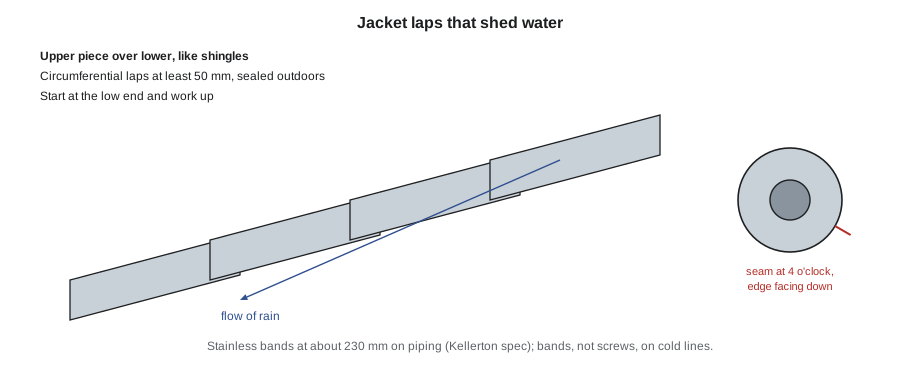
The rules that matter most are about which way the laps face. Water runs downhill and is blown sideways, so every lap must be arranged so that water running over the jacket passes over the edge of the lap, never into it.
- Circumferential laps are at least 50 mm (2 in) and shed water: on a sloped or vertical line, the upper piece overlaps the lower one, like shingles on a roof. That is why jacketing starts at the low end and works uphill, as Devon and Tessa did on the Mountview roof line, starting at the air handling unit.
- Longitudinal seams on horizontal lines are placed on the side, at about the 4 or 8 o'clock position, with the outer edge facing down, so rain cannot run into them and they are out of sight. On a pipe rack the seams face away from the prevailing weather.
- Sealant goes in the circumferential laps outdoors and wherever water or washdown is expected, as the Kellerton rack specification required.
- On vertical lines and equipment, each upper piece laps outside the one below; collars or flashings at the top of a vertical run and at support lugs keep water out of the end.
Fastening
Metal jacket on piping is held with stainless steel bands and seals, or with screws or rivets on equipment and large ducts. The Kellerton rack used stainless bands at 230 mm spacing, a typical figure for piping; the specification sets the spacing on a given job. Screws must never be used on cold lines, because every screw punctures the vapour retarder and becomes a path for moisture. Bands are pulled snug, not so tight that they crush the insulation, and the seals are placed away from the top of the pipe where water would sit.
Worked problem
Bands on a straight run
A straight run of 24 m (80 ft) is banded at 230 mm (9 in) spacing. About how many bands are needed?
Show solution
- 24,000 ÷ 230 = 104.3 spaces.
- Round up to 105 spaces, so 106 bands with one at each end.
- In practice bands also go at every circumferential lap, which the spacing usually already covers.
Answer: About 106 bands.
Metals that touch each other in the presence of water can corrode by galvanic action, the less noble metal wasting away. Aluminum jacket must be kept from contact with copper and from runoff off copper and some treated wood. Stainless bands on aluminum jacket are standard practice and do not cause trouble in normal service, because the band's small area does not drive the reaction strongly.
Elbows, tees, cones and ends
Elbows are jacketed with gores, segments laid out like the mitred insulation segments in lesson 5 and joined with beaded or crimped edges, or with factory-pressed elbow covers. Gores are laid out so their laps shed water, which on Tomasz's backwards elbow they did not. Tees use a pattern for the branch developed by parallel-line layout, and reducers and end caps use cones developed by radial-line layout, the sheet metal methods from SMW-120. Every termination is closed: end caps where insulation stops, collars at supports, and plugs at test points, as on the Kellerton rack.
Metal jacket on long hot runs needs slip joints, because aluminum expands about twice as much as steel for each degree. The Kellerton rack had slip joints about every 9 m (30 ft). Without them, the jacket buckles or pulls apart at the laps as the line heats and cools.
Outdoor and corrosive locations
Outdoors, the sequence is simple: everything sheds water, everything is sealed, and the insulation is dry before it is closed in. Coldstream's habit on the Kellerton rack in INS-220 was to strip the old jacket only as far as could be closed the same day, and to check the pipe under any wet insulation with the plant's inspector before covering it again. In corrosive atmospheres, stainless jacket or a suitably coated jacket replaces plain aluminum, and fasteners are matched to the jacket so that dissimilar metals are not in contact.
PVC jacket and fitting covers
Indoors on commercial piping, PVC jacket and preformed PVC fitting covers are the usual finish, as at Mountview up to NPS 2 and over mitred insulation on larger sizes. The fitting cover goes over an insert of insulation cut to the fitting, and the cover's throat is lapped, tacked or taped, then the joints to the straight jacket are sealed with the maker's solvent-weld adhesive or tape. On cold lines every joint is sealed so the cover is part of the vapour retarder system. PVC softens and distorts if the surface runs hotter than its limit, so a hot line needs enough insulation under it, or a metal finish instead. Coloured PVC is generally for indoor use; outdoors, PVC needs a product rated for ultraviolet light and an appropriate thickness.
Inspecting jacketing
Bernie's jacketing checklist, the one she uses on every inspection walk, is short enough to remember, and an exam question about a jacketing defect is almost always about one of its lines.
- Laps are at least the specified width and shed water, upper over lower.
- Longitudinal seams are on the side, edge facing down, away from the weather.
- Sealant is in the circumferential laps where required, with no gaps at the band seals.
- Bands are at the specified spacing, snug but not crushing, seals off the top of the pipe.
- No screws on cold lines; screws on equipment only where allowed and sealed.
- Every end, support, collar and plug is closed and sealed.
- Slip joints are in place on long hot runs.
- No contact between aluminum and copper; correct fasteners for the jacket metal.
The Kellerton rack inspection in INS-220 found three items: a band seal at 12 o'clock, an unsealed support collar and an unsealed plug. All three were water entry points, and all three were closed the same day.
Repairing damaged jacket
Damage happens: a forklift strikes a line, a ladder dents it, a tradesperson stands on it. A dent that does not open the jacket can often be left, but any tear, opened lap or puncture lets water in and must be repaired. The repair is a patch cut larger than the damage, lapped to shed water and sealed, or, if the insulation underneath is wet or crushed, a full removal of that section back to dry insulation and a new jacket. Taping over a torn metal jacket outdoors is not a repair. The forklift guard angle the Kellerton millwrights fitted at the breeching in INS-310 is the better answer where damage will happen again.
What the exam asks about jacketing
Looking back over the practice questions, Bernie counted the jacketing topics that come up most: the direction of laps on sloped and vertical lines, the position of the longitudinal seam, why screws are not used on cold lines, PVC temperature limits, the moisture barrier's purpose, galvanic contact between aluminum and copper, cut width from girth, and slip joints. Almost every jacketing question in her collection was one of those eight. Erik wrote them on a single card and tested himself on it each morning for a week.
Jacketing equipment and vertical runs
On vertical piping and equipment the water runs straight down the jacket, so every horizontal lap is an overlap of the upper sheet outside the lower one, and every vertical seam faces away from the weather. At the top of a vertical run a rain collar or flashing sheds water away from the end of the insulation, and at nozzles and support lugs the jacket is cut neatly round the projection and flashed with a sealed collar. The outdoor hot water tank in INS-310 showed the cost of getting this wrong: a rain collar cut short and caulked let water in at the top, and the wet insulation and corrosion that followed cost far more than a correct collar. Equipment jacket may be fastened with screws or rivets where the specification allows, always outside the vapour retarder and never on cold equipment.
Common mistakes
MistakeLapping the lower piece over the upper on a sloped line.
InsteadUpper over lower, like shingles; start at the low end and work up.
MistakePutting the longitudinal seam on top of a horizontal pipe.
InsteadPlace it at about 4 or 8 o'clock, edge facing down.
MistakeUsing screws on a cold line's jacket.
InsteadUse bands; screws puncture the vapour retarder.
MistakeCutting jacket from the calculated girth without checking.
InsteadMeasure the girth with a strip on the actual insulation and add the lap.
MistakeLeaving out slip joints on a long hot run.
InsteadAllow for expansion; aluminum moves about twice as much as steel.
Summary and key terms
- Jackets keep water and damage out; most insulation failures and CUI start with water.
- Aluminum jacket's moisture barrier faces the insulation and is not a vapour retarder; stainless is used in washdown and corrosive areas; PVC is limited to about 66 °C (150 °F).
- Cut width is the measured girth plus at least a 50 mm (2 in) lap.
- Circumferential laps shed water upper over lower; longitudinal seams sit at about 4 or 8 o'clock facing down.
- Bands, not screws, on cold lines; slip joints on long hot runs; every end, support and plug sealed.
- Corrosion under insulation
- Corrosion of a pipe or vessel surface under wet insulation.
- Moisture barrier
- A film on the inside of metal jacket that protects it from wet insulation.
- Girth
- The distance around the insulated pipe that the jacket must cover.
- Circumferential lap
- The overlap between two jacket pieces around the pipe.
- Longitudinal seam
- The overlap along the length of a jacket piece.
- Gore
- A tapered segment used to cover an elbow or a curved head.
- Slip joint
- A lap that lets jacket slide as the line expands and contracts.
- Galvanic corrosion
- Corrosion of the less noble of two metals in contact with water.
Practice problems
Work each problem on paper first, then reveal the answer to check.
On a sloped line, which piece of jacket laps over which?
Show answer
The upper piece laps over the lower one.
Where does the longitudinal seam go on a horizontal pipe?
Show answer
At about the 4 or 8 o'clock position, edge facing down.
The measured girth is 540 mm. What is the cut width with a 50 mm lap?
Show answer
590 mm.
Why are screws not used on cold-line jacket?
Show answer
They puncture the vapour retarder.
What temperature limits PVC jacket?
Show answer
A surface temperature of about 66 °C (150 °F).
Lesson quiz · 5 questions
Score 60% or more to complete this lesson.
Create a free account to save your progress, take quizzes and earn a certificate.