
INS-430 · Lesson 8 of 12 · 22 min
Review: cold and cryogenic systems
▶ Video coming soon A video version of this lesson is on the way.
Marcel Ouellet's last Monday evening cold-work session of the fall, on November 9, was a review of the whole series, and Bernie sent Erik to it. Devon brought a cracked piece of a cellular glass hanger insert he had found at Kellerton, and Marcel used it to start the evening. "One crack," he said, holding it up. "Air gets in, water vapour comes with it, it freezes, the crack opens, more air gets in. That's every cold line failure I've ever seen, and I've seen a lot of them." Erik took more notes that evening than at any Sunday session.
Cold work appears all through the exam: in industrial piping and equipment, in commercial chilled water and refrigeration piping, and in the cryogenic task of area E. The principles are the same everywhere, and they are different from hot work in one way that matters more than any other: on a cold system, water vapour moves inward, toward the cold surface, and any path for it to get in will eventually be found. This lesson reviews INS-320 and the condensation-control content of INS-410, and adds a short review of underground insulated systems, a small task of area D.
Why cold systems are different
On a hot line, the insulation is warmer than the air and any moisture in it is driven out. On a cold line the opposite happens. The air outside holds water vapour at a higher pressure than the colder air near the pipe, so vapour is driven inward through any gap, seam or puncture by vapour drive. When it reaches a layer colder than its dew point it condenses, and below freezing it turns to ice. Wet or iced insulation conducts heat far faster, which makes the inside colder still, which draws in more vapour. The failure feeds itself, which is why the Kellerton ammonia suction line in INS-110 carried about 238 kg (520 lb) of ice in a few metres where a hanger clamp had broken the seal.
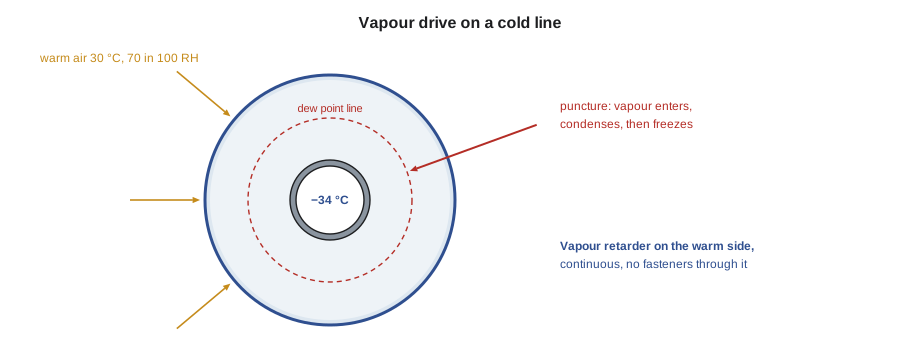
The consequence is the first rule of cold work: the vapour retarder goes on the warm side of the insulation, which on a pipe or vessel is the outside, and it must be continuous. Marcel's specification phrases from INS-320 are worth memorizing: "continuous and unbroken", "no fasteners shall penetrate the vapour retarder".
Dew point and the surface temperature
The dew point is the temperature at which air with a given amount of moisture becomes saturated. Any surface below the dew point gets wet. For a cold line to stay dry, the outer surface of the insulation must stay above the dew point of the surrounding air, with a margin, at the worst conditions the space will see. The Magnus formula from INS-320 gives the dew point from the temperature and relative humidity.
Worked problem
Dew point in an engine room
The design condition in a machinery room is 30 °C and 70 in 100 relative humidity. What is the dew point?
Show solution
- γ = ln(0.70) + 17.62 × 30 ÷ (243.12 + 30).
- = −0.3567 + 528.6 ÷ 273.12 = −0.3567 + 1.9354 = 1.5787.
- Tdp = 243.12 × 1.5787 ÷ (17.62 − 1.5787) = 383.8 ÷ 16.04 = 23.9 °C.
Answer: About 23.9 °C. With a 2 K margin, the insulation surface must stay at or above about 26 °C.
Thickness for condensation control is chosen so that the surface stays above that temperature. INS-410 worked the full calculation; the exam usually asks the reasoning: higher humidity, colder pipe or a jacket with low emittance all call for more insulation. A shiny jacket runs a little colder at the surface than a dull one, which matters on cold work, the opposite of hot work.
Materials and vapour retarders for cold service
Cold service needs insulation that does not absorb water and, ideally, resists vapour itself. Cellular glass is impermeable and strong, and is the standard choice for low-temperature lines such as the Kellerton ammonia suction at about −34 °C (−30 °F). Flexible elastomeric is closed-cell and convenient for chilled water and refrigerant lines, with sealed seams. Polyisocyanurate and phenolic foams have very low conductivity, but need a separate vapour retarder. Fibrous insulation is used on cold work only with great care, because it holds water once vapour gets in.
Vapour retarders are rated by permeance, the rate at which vapour passes through. Jackets for cold service, such as the laminates covered by ASTM C1136, are made with very low permeance; mastic systems reach their rating only at the dry film thickness the maker states, usually in two coats with reinforcing fabric embedded. Marcel's lesson in INS-320 was that workmanship matters more than the permeance of any product: a perfect material with one unsealed seam is a failed system.
- Seal every joint of a cellular glass or foam system, and every lap of the jacket, with the products the maker lists.
- Build vapour stops at intervals, at fittings and at terminations, sealing the insulation to the pipe so that a failure in one section cannot spread along the whole line.
- Never use screws, rivets or staples through the vapour retarder; band the metal jacket instead.
- At every hanger, use a vapour-tight high-density insert and carry the retarder over it.
- On multiple layers, the joints are staggered and the inner layer may be sealed as well as the outer.
Refrigeration and ammonia
Industrial refrigeration uses ammonia in plants like Kellerton and in many arenas, and carbon dioxide in a growing number of systems. Ammonia is toxic and, at high concentrations, flammable. Insulators working in machinery rooms must know the plant's emergency procedures: where the detectors and alarms are, which way to evacuate, and where the escape respirators are kept. Ontario applies CSA B52, the mechanical refrigeration code, through TSSA, and the arena plant at Carrow Park in INS-320 was a registered ammonia plant.
The Carrow Park case in INS-320 showed the commercial side of cold work: brine supply and return headers in a trench, a chiller and surge drum in the plant room, and a dew-point check by Marcel that changed the trench insulation to two layers before the work was done. It also showed the cost of not checking: the old brine return in the ice resurfacer room, outside the scope, was dripping.
Contraction and supports
Cold lines shrink as they cool, and the insulation does not shrink by the same amount, so joints open unless the system is designed to move. Contraction joints are built at intervals in rigid systems, with a compressible filler and an overlapping vapour retarder that can flex. On cryogenic stainless lines the movement is large: INS-320 used a total contraction of about 0.28 in 100 for stainless steel cooled from room temperature to liquid nitrogen.
Worked problem
Contraction of a nitrogen line
A stainless steel line 30 m long is cooled from room temperature to liquid nitrogen temperature. Using 0.28 in 100, how much does it shorten?
Show solution
- Shortening = 30,000 mm × 0.0028.
- = 84 mm.
Answer: About 84 mm.
Cryogenic systems
Cryogenic service, below about −100 °C (−150 °F), covers liquid nitrogen, oxygen, argon and natural gas. Insulation systems are multi-layer, with contraction joints in each layer and a vapour retarder on the outside, or, for the coldest and most critical lines, vacuum-jacketed pipe made in a factory. A vacuum-jacketed line must not be insulated over: frost on one usually means its vacuum has failed, and the fix belongs to the supplier, as Marcel told Kellerton about its nitrogen tunnel freezer line in INS-320. Oxygen service brings one more rule: materials and cleanliness must be suitable for oxygen, because oil and some organic materials can ignite in it.
Underground insulated systems
District heating, chilled water and steam lines are sometimes buried. Most new work uses pre-insulated piping made in a factory: a carrier pipe, polyurethane or similar foam, and a waterproof outer casing, often high-density polyethylene. The insulator's work is the field joints, where the pipe sections are welded: the joint is foamed or fitted with a pre-formed kit and sealed with a heat-shrink sleeve or casing coupling, following the system maker's procedure exactly, because a leaking field joint lets groundwater in and ruins the insulation along the line. Bedding, backfill and drainage are set by the engineer. This program did not give underground systems a lesson of their own, so study the maker's literature and your in-school material for the details.
Finding and fixing wet insulation
Wet insulation on a cold line shows itself as sweating, dripping, frost or ice, stained jackets, or cold spots on an infrared survey; on a hot line, as hot spots and, under the jacket, corrosion. The fix is never to wrap the outside: the wet material is removed back to dry insulation and a sound vapour retarder, the pipe is inspected for corrosion, and the section is rebuilt with vapour stops at both ends. Wet insulation is heavy, and an iced section can bring down a hanger.
Temperature ranges of cold systems
Cold work covers a wide range of temperatures, and the materials and methods change with it. The table brings together the ranges used in INS-320; the specification and the maker's data govern any real job.
| Service | Typical temperature | Usual insulation | Key point |
|---|---|---|---|
| Domestic cold water, storm drains | about 4 to 15 °C (40 to 60 °F) | Glass fibre with sealed jacket, or elastomeric | Condensation control |
| Chilled water | about 4 to 10 °C (40 to 50 °F) | Elastomeric, glass fibre with sealed jacket, phenolic | Continuous vapour retarder |
| Brine and glycol (arenas, process) | about −10 to −5 °C (14 to 23 °F) | Cellular glass, PIR, elastomeric | Vapour stops, sealed inserts |
| Low-temperature ammonia suction | about −34 °C (−30 °F) | Cellular glass, PIR, multiple layers | Contraction joints, no cold bridges |
| Cryogenic (nitrogen, oxygen, LNG) | below about −100 °C (−150 °F) | Multi-layer systems, aerogel, vacuum-jacketed | Contraction, oxygen cleanliness |
Checking a cold installation
Marcel's checklist for a cold line, read out at his last session, has one theme: look for any path for vapour.
- Every joint sealed with the listed sealant, and the jacket laps sealed, before the next layer or finish goes on.
- Vapour stops at the spacing and locations the specification gives, and at every termination.
- No fasteners through the vapour retarder; bands only on the metal jacket.
- Inserts at every hanger, with the retarder continuous over them.
- Mastic at the specified dry film thickness, checked with a wet film gauge as it goes on.
- No insulation closed over a line that is already sweating or frosted; the pipe must be dry when it is covered.
The last point catches people on maintenance work. A cold line insulated while it is wet or iced traps the water, and the new system fails from the inside. Lines are dried, or warmed and dried, before they are closed in.
Marcel ended his last session by holding up Devon's cracked insert again. "If you remember one thing from all of this," he said, "remember that this little crack iced a line from the inside. Seal everything."
Choosing between cold materials
Exam questions often give a cold service and ask for the best material. The reasoning runs in a fixed order. First, temperature: elastomeric for chilled water and moderate refrigeration, cellular glass and PIR for low temperatures, specialist systems for cryogenics. Second, strength: cellular glass where the insulation carries load or may be stepped on. Third, fire: some foams need a fire-resistant jacket in buildings. Fourth, the vapour retarder the material needs on top of it.
Common mistakes
MistakePutting the vapour retarder on the pipe side of the insulation.
InsteadPut it on the warm side, the outside, and keep it continuous.
MistakeUsing screws through the jacket on a chilled water line.
InsteadBand the jacket; every screw is a vapour path.
MistakeWrapping new jacket over wet, iced insulation.
InsteadRemove back to dry, sound insulation, inspect the pipe and rebuild with vapour stops.
MistakeInsulating over frost on a vacuum-jacketed line.
InsteadReport it; frost means the vacuum has failed and the supplier must repair it.
MistakeLeaving out contraction joints on a rigid cold system.
InsteadBuild them at intervals so the insulation can move without opening the retarder.
Summary and key terms
- On cold systems, vapour drives inward and condenses or freezes at the dew point; any gap will eventually be found.
- The vapour retarder goes on the warm side, continuous, with no fasteners through it and vapour stops at intervals.
- The insulation surface must stay above the dew point with a margin; the Magnus formula gives the dew point.
- Cellular glass, elastomeric, PIR and phenolic suit cold work; workmanship matters more than any product's permeance.
- Cold lines shrink; contraction joints let the system move; vacuum-jacketed lines are never insulated over.
- Pre-insulated underground systems depend on sealed field joints made to the maker's procedure.
- Vapour drive
- The movement of water vapour from warm, humid air toward a colder surface.
- Dew point
- The temperature at which air becomes saturated and moisture condenses.
- Vapour retarder
- A layer of low permeance on the warm side of insulation that slows vapour flow.
- Permeance
- The rate at which water vapour passes through a material or layer.
- Vapour stop
- A seal of the insulation system to the pipe that stops moisture travelling along the line.
- Contraction joint
- A joint built into cold insulation to let it move as the pipe shrinks.
- Vacuum-jacketed pipe
- Factory-made pipe insulated by a vacuum between an inner and outer pipe.
- Pre-insulated piping
- Factory-made pipe with insulation and an outer casing, used mainly underground.
Practice problems
Work each problem on paper first, then reveal the answer to check.
Which side of the insulation does the vapour retarder go on?
Show answer
The warm side, which is the outside on a pipe or vessel.
Air at 25 °C and 60 in 100 humidity. Is a surface at 18 °C dry?
Show answer
The dew point is about 16.7 °C, so yes, but only just; with a 2 K margin it is borderline.
Why must no screws go through cold-line jacket?
Show answer
They puncture the vapour retarder.
What does frost on a vacuum-jacketed line usually mean?
Show answer
The vacuum has failed; report it to the supplier.
What is the critical part of a pre-insulated underground system for the insulator?
Show answer
The field joints, sealed exactly to the maker's procedure.
Lesson quiz · 5 questions
Score 60% or more to complete this lesson.
Create a free account to save your progress, take quizzes and earn a certificate.