
INS-430 · Lesson 5 of 12 · 24 min
Review: pipe and fittings
▶ Video coming soon A video version of this lesson is on the way.
In the second half of the session on Sunday, November 1, Bernie emptied a cardboard box onto the table: a short length of NPS 4 steel pipe, a length of 1 in copper tube, three sections of pipe insulation in different sizes, a roll of tie wire and a tape measure. "Which insulation fits the copper?" she asked. Devon, who had made exactly this mistake on his third morning at Mountview, said nothing and smiled. Erik picked the right one on the first try and explained why.
Piping and fittings are the heart of the trade and the heart of the exam. The industrial piping task alone is the largest single task in the standard, and commercial plumbing and mechanical piping is the largest commercial task. Together with fittings, valves and flanges, this is where the most questions come from. This lesson reviews INS-130 and INS-210.
Pipe sizes and insulation sizes
Steel pipe is named by nominal pipe size (NPS), which is not its outside diameter. From NPS 1/8 to NPS 12 the outside diameter is a little larger than the nominal size; from NPS 14 up, the outside diameter equals the nominal size. NPS 4 steel pipe has an outside diameter of 114.3 mm (4.500 in) whatever its wall thickness, because the wall changes the inside, not the outside. Copper tube is named differently: its outside diameter is 1/8 in larger than its nominal size, so 1 in copper is 1 1/8 in outside.
Insulation is made to fit one system or the other. Pipe-size insulation is marked IPS (iron pipe size) and fits steel pipe of that NPS; copper-size insulation is marked CTS (copper tube size). Putting NPS 1 IPS insulation on 1 in copper leaves a gap, because NPS 1 steel is 33.4 mm (1.315 in) outside and 1 in copper is only 28.6 mm (1.125 in). That was Devon's mistake in INS-130. When the size is in doubt, measure the circumference and divide by π.
| Pipe | Outside diameter | Insulation size |
|---|---|---|
| NPS 1 steel | 33.4 mm (1.315 in) | NPS 1 IPS |
| 1 in copper | 28.6 mm (1.125 in) | 1 in CTS (same as NPS 3/4 IPS) |
| NPS 2 steel | 60.3 mm (2.375 in) | NPS 2 IPS |
| NPS 4 steel | 114.3 mm (4.500 in) | NPS 4 IPS |
| NPS 6 steel | 168.3 mm (6.625 in) | NPS 6 IPS |
| NPS 8 steel | 219.1 mm (8.625 in) | NPS 8 IPS |
Worked problem
Identifying a pipe from its circumference
A painted line in the Kellerton boiler house measures 359 mm (14.1 in) around. What size is it?
Show solution
- Diameter = 359 ÷ π = 114.3 mm.
- 114.3 mm is the outside diameter of NPS 4 steel pipe.
Answer: NPS 4 steel pipe.
Applying sectional pipe insulation
Rigid pipe sections are usually 914 mm (3 ft) long and come split lengthwise on one side. They are fitted with the longitudinal joint on the side or underneath, away from the weather and the eye, and with the circumferential joints butted tight. Where a run does not end on a whole section, a filler piece is cut to the remaining length. On multiple layers, every joint in the outer layer is staggered from the joints in the inner layer, longitudinal and circumferential, so that no straight path runs through to the pipe.
Sections are secured before jacketing. On Coldstream's jobs in INS-130, plain mineral wool sections were wired with three ties per section, and the factory-jacketed fibreglass sections were closed with their self-sealing lap and butt strips. Banding is used where the insulation is heavy or the service is rough. Wire is twisted and the ends pushed into the insulation so they cannot cut the jacket.
Worked problem
How many sections?
A straight run of NPS 4 heating water at Mountview is 24 m (80 ft) long between elbows. How many 914 mm (3 ft) sections does it need?
Show solution
- 24 ÷ 0.914 = 26.26 sections.
- Round up to 27 sections; the last one is cut to length as a filler.
- Order a few more for waste and damage, as lesson 4 of INS-420 showed.
Answer: 27 sections, the last one cut as a filler.
Hangers and supports
At every hanger and support the insulation must carry on unbroken, or the line will lose heat there and, on a cold line, sweat or ice. On hot lines the usual method is a shield, a curved sheet metal saddle under the insulation, with a section of high-density insert such as calcium silicate inside it so the hanger does not crush the insulation. On cold lines the insert must also be vapour-tight, and the vapour retarder must run over it without a break. Bernie's rule from INS-110 came from the Kellerton ammonia line: never clamp a hanger directly to a cold pipe, because the clamp becomes a cold bridge and the line ices up from there. At Mountview, Harcourt Mechanical installed the shields with bonded inserts on the chilled water and heating water mains, and Coldstream insulated to them.
Shield length is set by the pipe size and the hanger spacing, because the shield spreads the load over the insulation. Too short a shield, or a soft insert, lets the hanger crush the insulation and tear the jacket.
Elbows: mitred segments and gores
Elbows are insulated with preformed fitting covers, with mitred segments cut from straight sections, or, on larger sizes, with gores. The Mountview specification in INS-130 used PVC fitting covers up to NPS 2 and mitred sections under PVC covers on NPS 3, 4 and 6.
A mitred elbow is built from segments. With two half-pieces at the ends and full pieces between them, an elbow of n pieces has n − 1 joints, so for a 90° elbow each joint turns 90 ÷ (n − 1) degrees and each cut is half that. Each segment's length is measured on three lines: the throat (inside of the bend), the centreline and the heel (outside). The length of a full segment on any line is twice that line's radius times the tangent of half the joint angle.
Worked problem
A five-piece elbow on the Kellerton header
The NPS 8 header has long-radius elbows: centreline radius 1.5 × 203.2 = 304.8 mm. The insulation is 76 mm thick, so its outside diameter is 219.1 + 2 × 76 = 371.1 mm. For a five-piece mitred elbow, find the joint angle, the cut angle and the length of a full segment on the throat, centreline and heel.
Show solution
- Joints = 5 − 1 = 4; joint angle = 90 ÷ 4 = 22.5°; cut angle = 11.25°.
- tan 11.25° = 0.1989.
- Centreline: 2 × 304.8 × 0.1989 = 121.3 mm.
- Heel radius = 304.8 + 371.1 ÷ 2 = 490.4 mm; heel = 2 × 490.4 × 0.1989 = 195.1 mm.
- Throat radius = 304.8 − 185.6 = 119.3 mm; throat = 2 × 119.3 × 0.1989 = 47.4 mm.
- The half-pieces at the ends are half these lengths.
Answer: 22.5° joints, 11.25° cuts; full segment 47.4 mm throat, 121.3 mm centreline, 195.1 mm heel.
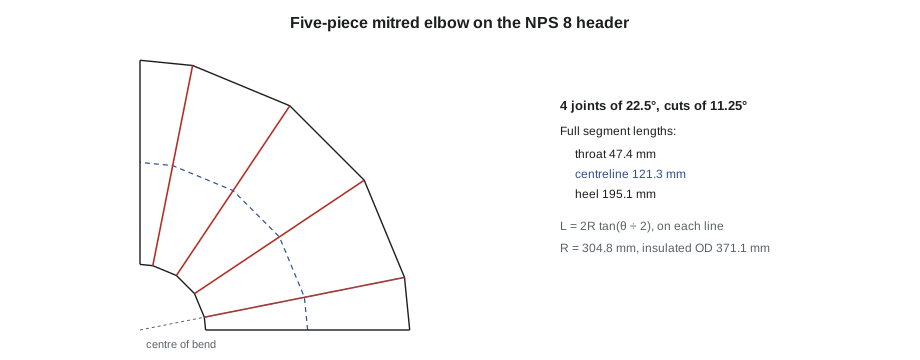
Devon's first try at these elbows, in INS-210, used three pieces, and the joints gaped on the heel because a three-piece elbow on a long-radius fitting turns too sharply at each joint. More pieces make a smoother elbow. When a fitting is too tight to mitre at all, as INS-130 showed for some short-radius elbows, a preformed cover or a gore pattern is used instead.
Tees, reducers, valves and flanges
A tee is insulated by fitting the branch insulation first, cut to a saddle that sits on the main, and then notching the main insulation around it; joints are sealed and banded. A reducer is covered with a cone cut by radial-line layout or with tapered segments; eccentric reducers are installed flat side up on pump suctions to avoid trapping air and flat side down on condensate lines to drain, and the insulation follows the shape.
Valves and flanges need space for maintenance. The insulation on the pipe is cut back from a flange far enough that the bolts can be removed; Coldstream's rule of thumb in INS-210 was the stud length plus about 25 mm (1 in), which gave 140 mm (5 1/2 in) on the NPS 8 header flanges. The fitting is then covered with an oversized box or a removable cover that laps onto the pipe insulation. Valve covers leave the stem and packing gland reachable. The Kellerton standard calls for removable covers on steam valves larger than NPS 2, because bare valves waste heat and permanent covers get torn off and never replaced.
Some fittings are left bare on purpose. Many steam traps must stay uninsulated to work, and a cooling leg before a thermostatic trap has to lose heat. Strainers are insulated so that the screen can still be removed. The exam likes these exceptions.
| Fitting | Usual method | Key point |
|---|---|---|
| Elbow, NPS 2 and under | PVC or preformed cover over insert | Insert sized to the pipe and thickness |
| Elbow, NPS 3 and up | Mitred segments or gores | More pieces on long-radius fittings |
| Tee | Branch saddle, then notch the main | Seal and band the joint |
| Flange pair | Cut back, then a box or removable cover | Cut back about stud length + 25 mm (1 in) |
| Steam valve | Removable cover | Stem and gland stay reachable |
| Steam trap | Often left bare | Follow the trap maker's instructions |
Plumbing piping
Commercial plumbing work brings its own rules. Domestic hot water and recirculation lines are insulated to save energy and to keep water hot enough to control bacteria; Mountview stored hot water at 60 °C (140 °F). Domestic cold water and storm drain lines inside the building are insulated to prevent condensation, so their insulation is sealed like any cold line. Exposed drains and supplies under accessible lavatories are covered so that people in wheelchairs do not burn or scrape their legs. Thicknesses come from the specification and the energy code; at Mountview, domestic hot water up to 1 in got 25 mm (1 in) and larger sizes 38 mm (1 1/2 in), and Devon's mistake of using the thinner size on a larger line cost 40 m (130 ft) of rework in INS-110.
Reading an insulation schedule
Thickness questions on the exam are usually framed around a schedule: a table in the specification that gives the insulation material and thickness for each system and pipe size. Reading one correctly is a matter of matching three things, the system, the size range and the service temperature, and noticing the breaks, where a size moves into the next thickness. The Mountview schedule from INS-130 is a good example.
| System | Pipe size | Thickness | Material |
|---|---|---|---|
| Heating hot water | Up to NPS 1 1/4 | 38 mm (1 1/2 in) | Glass fibre |
| Heating hot water | NPS 1 1/2 and up | 51 mm (2 in) | Glass fibre |
| Chilled water | Up to NPS 1 1/4 | 25 mm (1 in) | Sealed, vapour-retarder jacket |
| Chilled water | NPS 1 1/2 and up | 38 mm (1 1/2 in) | Sealed, vapour-retarder jacket |
| Medium-pressure steam | Up to NPS 3 | 51 mm (2 in) | Mineral wool |
| Medium-pressure steam | NPS 4 and up | 76 mm (3 in) | Mineral wool |
| Domestic hot water | Up to 1 in | 25 mm (1 in) | Glass fibre |
| Domestic hot water | 1 1/4 in and up | 38 mm (1 1/2 in) | Glass fibre |
Two habits avoid most schedule mistakes. First, check the size against the break every time the size changes, which was exactly Devon's mistake with domestic hot water in INS-110: he kept going with the thinner insulation past the break. Second, check the receiving tickets against the schedule before the material goes up, the habit Coldstream added after the chilled water branch in INS-130 was found with 19 mm (3/4 in) instead of 38 mm (1 1/2 in). An exam question that gives a schedule and asks which installation is wrong is usually testing one of those two habits.
Schedules also hide exceptions in their notes: exposed lines in finished rooms, lines in unheated spaces, buried lines and outdoor lines often carry different thicknesses or finishes, and the note is easy to miss.
When a note and the schedule disagree, the job asks the engineer in writing; the exam asks what you would do, and the answer is the same: ask before you install.
Common mistakes
MistakeFitting IPS insulation on copper tube.
InsteadCopper takes CTS insulation; measure the circumference if in doubt.
MistakeLining up joints in a double layer.
InsteadStagger every joint in the outer layer from the inner layer.
MistakeClamping a hanger directly to a cold pipe.
InsteadUse an insert and shield, with the vapour retarder continuous over it.
MistakeUsing too few pieces on a long-radius mitred elbow.
InsteadUse more pieces; each joint turns 90 ÷ (n − 1) degrees.
MistakeInsulating flanges tight to the bolts.
InsteadCut back about stud length plus 25 mm (1 in) and cover with a removable or box cover.
Summary and key terms
- NPS is not the outside diameter; NPS 4 steel is 114.3 mm (4.500 in) outside, and copper is 1/8 in larger than its nominal size.
- IPS insulation fits steel pipe and CTS insulation fits copper tube.
- Sections are 914 mm (3 ft) long, with fillers at the end of a run and staggered joints in multiple layers.
- Hangers need shields and high-density inserts; on cold lines the vapour retarder runs over the insert unbroken.
- A mitred elbow of n pieces has joints of 90 ÷ (n − 1) degrees; segment length is 2R tan(θ ÷ 2) on each line.
- Flanges and valves are cut back for maintenance and covered with removable covers; some traps stay bare.
- Nominal pipe size
- The name of a steel pipe size, which is not its outside diameter for sizes up to NPS 12.
- IPS
- Insulation sized to fit steel (iron) pipe.
- CTS
- Insulation sized to fit copper tube.
- Filler
- A short piece cut to finish a run of pipe insulation.
- Shield
- A curved metal saddle under the insulation at a hanger.
- Insert
- A high-density insulation section inside a shield that carries the pipe load.
- Throat
- The inside, shortest line of a bend.
- Heel
- The outside, longest line of a bend.
- Cutback
- The gap left in pipe insulation at a flange so the bolts can be removed.
Practice problems
Work each problem on paper first, then reveal the answer to check.
What is the outside diameter of NPS 2 steel pipe?
Show answer
60.3 mm (2.375 in).
Which insulation fits 1 in copper tube?
Show answer
1 in CTS insulation (the same size as NPS 3/4 IPS).
A pipe measures 529 mm (20.8 in) round. What is its diameter, and what size is it?
Show answer
529 ÷ π = 168.4 mm; NPS 6.
What is the joint angle of a four-piece 90° mitred elbow?
Show answer
90 ÷ 3 = 30°, with 15° cuts.
Why are some steam traps left bare?
Show answer
They need to lose heat to work; follow the trap maker's instructions.
Lesson quiz · 5 questions
Score 60% or more to complete this lesson.
Create a free account to save your progress, take quizzes and earn a certificate.