
INS-430 · Lesson 2 of 12 · 22 min
A study plan that works
▶ Video coming soon A video version of this lesson is on the way.
At the end of the first session Bernie gave Erik a homework task that had nothing to do with insulation: book the exam. "A date on the calendar turns 'some day' into a plan," she said. Erik logged into the Skilled Trades Ontario portal that evening and, once his final hours were signed off, booked a sitting for Thursday, January 21, 2027. That gave him about thirteen weeks from the first session, and Bernie's plan used every one of them.
This lesson is about how to prepare, not what to know. It covers how much time to plan, how to divide it among the areas of the exam, how to study so that the material stays, and how to use practice questions and an error log. The methods are the ones that research on learning supports and that Bernie had seen work, and they apply to any exam in this trade.
Start with an honest self-rating
The first step is to find out what you already know. Bernie gave Erik the task list from the occupational standard, about 25 tasks and their sub-tasks, and asked him to rate each one: 3 if he could do it and explain it to an apprentice, 2 if he had done it but could not explain every step, and 1 if he had seen it done or only read about it. The rating took an hour. It showed what she expected: mostly 3s on industrial piping, fittings, steam and jacketing; 2s on equipment, firestopping and removable covers; and 1s on commercial ductwork and liner, plumbing in occupied buildings, underground systems, refrigeration of the commercial kind, refractory and spray-applied products.
A self-rating is not a test, and people are usually too generous with themselves on familiar work and too hard on unfamiliar work. That is why the plan also uses a short diagnostic quiz: Bernie had Erik answer the five quiz questions at the end of each of the earlier program courses, sixty questions in all, without notes. His score by area confirmed the rating and added one surprise: he missed three of the five noise questions, which he had thought he knew.
How much time, and where it goes
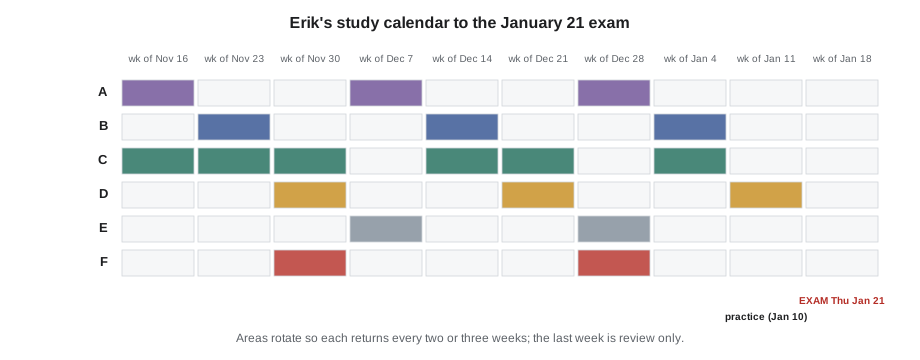
Bernie's rule of thumb for a final-year apprentice who has kept up with in-school training is about 50 to 60 hours of focused study before a trade exam, spread over at least two months, plus the group sessions. Less than that usually means cramming; much more usually means reading without testing. Erik settled on 54 hours between mid-November and the week of the exam: about six hours a week for nine weeks, mostly in one-hour sittings on weekday evenings and a longer block on Sunday mornings.
The plan divides those hours in two steps. The first step shares them out by the exam weightings. The second step moves hours from areas the self-rating marked strong to areas it marked weak, without dropping any area below a minimum.
Worked problem
Sharing 54 hours by weight
Erik has 54 study hours. Share them by the weightings A 12, B 31, C 30, D 12, E 9 and F 6 in 100.
Show solution
- A: 54 × 0.12 = 6.5 h.
- B: 54 × 0.31 = 16.7 h.
- C: 54 × 0.30 = 16.2 h.
- D: 54 × 0.12 = 6.5 h.
- E: 54 × 0.09 = 4.9 h.
- F: 54 × 0.06 = 3.2 h.
- Check: 6.5 + 16.7 + 16.2 + 6.5 + 4.9 + 3.2 = 54.0 h.
Answer: About 6.5, 16.7, 16.2, 6.5, 4.9 and 3.2 hours.
Worked problem
Adjusting for strengths
Erik rated area B strong and area C weak. Bernie moves 5 hours from B to C, and 1 hour from B to D for removable covers and underground systems. What does the plan become?
Show solution
- B: 16.7 − 5 − 1 = 10.7 h, still the third-largest block.
- C: 16.2 + 5 = 21.2 h.
- D: 6.5 + 1 = 7.5 h.
- A, E and F are unchanged: 6.5, 4.9 and 3.2 h.
- Total: 6.5 + 10.7 + 21.2 + 7.5 + 4.9 + 3.2 = 54.0 h.
Answer: A 6.5, B 10.7, C 21.2, D 7.5, E 4.9, F 3.2 hours.
The minimum matters. Bernie never lets a strong area drop below about two thirds of its weighted share, because a strong area is also where the easiest marks are, and those marks have to be collected. "You don't stop practising the things you're good at," she said. "You just stop practising them first."
Study so it stays
Most people study by reading their notes again. It feels productive, because the material looks familiar, but familiarity is not the same as being able to recall it under pressure. Three methods work much better, and Bernie built the plan around them.
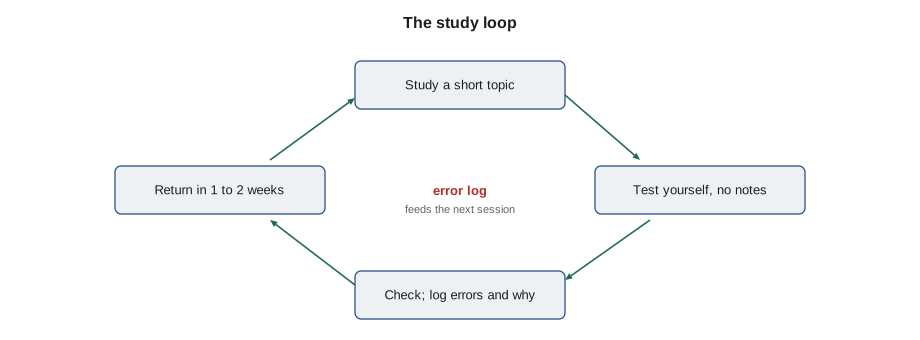
- Retrieval practice. Test yourself instead of re-reading. Close the book and write down the steps of laying out a gore elbow, or the order of the layers on a cold line, then check. Every practice question in this course is retrieval practice.
- Spacing. Come back to each area several times over the weeks instead of finishing it in one block. Erik's calendar rotates the areas so that each one returns every two or three weeks. A little forgetting between sittings makes the next recall stronger.
- Mixing. Once the basics are back, mix topics in a single sitting: a cold-line question, then a duct question, then a calculation. The exam is mixed, and practising that way trains you to recognize what kind of problem you are looking at.
Two more habits help. Explaining a topic to someone else is a strong test of understanding, which is why Bernie had each person in the group teach one short topic each session. And drawing a layout or a detail from memory, then checking it against the earlier course, fixes it better than looking at the figure again.
The error log
The most useful page in Erik's binder was a plain table that Bernie called the error log. Every practice question he got wrong, or got right by guessing, went into it with four entries: the topic, what he chose, the correct answer, and why he went wrong. The reason column is the important one. There are only a few kinds of reasons, and each needs a different fix.
| Kind of error | Example from Erik's log | Fix |
|---|---|---|
| Did not know it | Thought noise doubles every 6 dB on the exposure limit | Re-learn the fact from the course; add a flash card |
| Knew it but misread the question | Answered for a hot line when the stem said chilled water | Underline key words in the stem: hot, cold, outdoor, first, not |
| Calculation slip | Used the radius where the formula needs the diameter | Write the formula before the numbers; check the units |
| Fell for a distractor | Chose the rule from the other country's code | Note the trap beside the question; study the difference |
| Ran out of time or rushed | Guessed the last six questions | Practise pacing with a timer (lesson 11) |
After four weeks the log told a clear story: Erik's commercial knowledge was improving fast, but he kept misreading stems that contained the word "not". That is a habit problem, not a knowledge problem, and it was fixed in a week by circling every "not" and "except" before answering.
Practice questions and practice exams
Practice questions are the backbone of the plan, but they have to be used well. Answer them without notes, under some time pressure, and only then check. Treat a lucky guess as a wrong answer. And do not memorize the practice questions themselves: the real exam will not repeat them. What transfers is the reasoning, so for every question, wrong or right, Erik had to be able to say why the key was right and why each distractor was wrong.
This course gives five quiz questions per lesson, practice questions in each lesson, a set of worked calculation problems in lesson 10 and a full-length practice exam in lesson 11. Bernie added the Red Seal sample questions published for the trade and the end-of-level material from Erik's in-school training. She did not use question banks of unknown origin. "Half of them are wrong and the other half are from some other trade's exam," she said.
The full practice exam goes about two weeks before the real one, close enough to show where things stand and early enough to fix what it finds. Erik's was set for the final group session, Sunday, November 15, as a first check, with a second, shorter one planned for early January.
The last week
The final week is for consolidation, not new material. Erik's plan has short mixed sets each evening, a last pass through the error log, and nothing at all the evening before. Sleep matters more than one more hour of reading: memory consolidates during sleep, and a tired brain misreads stems. Bernie's checklist for the day before is short.
- Read the booking confirmation again: location, start time, what to bring, what not to bring.
- Check the calculator: fresh battery, no stored notes, and the kind allowed.
- Plan the trip with time to spare; arrive early enough to settle.
- Eat a normal meal and stop studying by early evening.
Nervousness is normal and not a sign of weakness. A little of it sharpens attention. What helps most is having practised under exam conditions, so the real thing feels familiar, and having a plan for the hard questions: mark them, move on, and come back.
Using the program's own courses
Bernie did not buy a study guide. The program's courses already held what Erik needed, written around the jobs he knew, and she gave him a map from each area of the exam to the courses that teach it. Each course has a summary and a glossary at the end of every lesson, practice questions with answers and a quiz, so it is already built for retrieval practice. Erik's method was to read a lesson's summary and glossary, close the page, answer the practice questions from memory, and only then open the lesson to check the ones he missed.
| Area | Main courses | Also see |
|---|---|---|
| A Common occupational skills | INS-110, INS-230 | TRD courses, INS-420 lesson 8 |
| B Industrial applications | INS-130, INS-210, INS-220, INS-310 | INS-120, INS-410 |
| C Commercial applications | INS-130, INS-310 lessons 7 to 9 | INS-110 lesson 12, INS-420 |
| D Industrial and commercial | INS-330, INS-340 | INS-320 lesson 12 (trench), lesson 8 of this course |
| E Specialized applications | INS-320, INS-330 lesson 9 | Lesson 9 of this course |
| F Abatement | INS-230 | Lesson 3 of this course |
Studying in a group
A study group helps if it is run well and wastes time if it is not. Bernie's sessions had a fixed shape: fifteen minutes of questions from the week's own study, an hour of review on one topic led by someone in the group, a short break, then mixed practice questions answered alone and discussed together. Each person brought one question they had got wrong that week and explained the trap to the others. The discussion is where the value is: hearing why someone else chose a distractor shows you a way of going wrong you had not thought of. What Bernie would not allow was reading aloud from a book, or a session that turned into stories from the job. "Stories at lunch," she said. "Questions here."
Tessa and Devon, two and three years from their own exams, got as much out of the group as Erik did, for a different reason: they heard what the exam asks before they started the in-school levels that teach it, and they started their own error logs early.
Keeping the plan honest
A plan on paper is easy; keeping it is harder. Erik kept a one-line log of every study sitting: the date, the area, the minutes and the score on that day's self-test. Bernie looked at it each Sunday. It showed when the plan was slipping, usually in the weeks of overtime, and it showed which areas were improving. When a week was lost, the rule was to move the missed hours forward, not to cram them into one night.
Common mistakes
MistakeRe-reading notes as the main way to study.
InsteadTest yourself: retrieval practice builds recall far better than re-reading.
MistakeFinishing one area completely before starting the next.
InsteadSpace the areas and return to each every two or three weeks.
MistakeCounting a lucky guess as a correct answer.
InsteadLog guesses as errors and learn why the key is right.
MistakeDropping strong areas from the plan.
InsteadKeep strong areas at about two thirds of their weighted share; they hold the easiest marks.
MistakeStudying late the night before the exam.
InsteadStop by early evening and sleep; memory consolidates during sleep.
Summary and key terms
- Book or fix the exam date first; it turns preparation into a plan.
- Rate every task honestly and confirm the rating with a short diagnostic quiz.
- Plan about 50 to 60 study hours over at least two months, shared by the weightings and then adjusted for strengths and weaknesses.
- Use retrieval practice, spacing and mixing rather than re-reading.
- Keep an error log that records why each mistake happened, and fix the cause.
- Self-rating
- An honest score of how well you can do and explain each task in the standard.
- Diagnostic quiz
- A short test taken early to find strong and weak areas.
- Retrieval practice
- Studying by recalling material from memory and then checking it.
- Spacing
- Returning to a topic several times with gaps between sittings.
- Mixing
- Practising different kinds of problems in one sitting.
- Error log
- A record of every missed or guessed question, with the reason for the error.
Practice problems
Work each problem on paper first, then reveal the answer to check.
Why does Bernie ask for the exam date first?
Show answer
A booked date turns preparation into a plan with a deadline.
Erik has 40 study hours. How many go to area C by weight?
Show answer
40 × 0.30 = 12 hours.
What is wrong with re-reading notes as the main method?
Show answer
It builds familiarity, not recall; self-testing works better.
Erik keeps missing questions containing "not". What kind of error is that, and what is the fix?
Show answer
A misreading habit; circle "not" and "except" before answering.
When should the full practice exam be taken?
Show answer
About two weeks before the real exam, early enough to fix what it finds.
Lesson quiz · 5 questions
Score 60% or more to complete this lesson.
Create a free account to save your progress, take quizzes and earn a certificate.