
INS-340 · Lesson 6 of 12 · 20 min
Why removable covers are used
▶ Video coming soon A video version of this lesson is on the way.
On Friday afternoon, November 6, 2026, at the end of Kellerton's boiler house outage, Lou Brisebois walked Marcel Ouellet and Devon Marsh through the boiler house looking for bare fittings, as INS-210 described. They found three bare NPS 6 gate valves, four bare NPS 4 valves, fourteen bare flange pairs and two bare strainers, most of them stripped for repairs over the years and never covered again. Lou asked Coldstream to price removable covers for all of them. The following week, while Marcel and Devon insulated the new pressure-reducing valve (PRV) station, they measured its valves and strainer for five covers, numbered KF-BH-031 to 035, and Raj sent the sketches to the blanket fabricator, Pellam Thermal Covers, on Tuesday, November 10. Delivery is promised for Monday, November 30.
Removable covers, often called blankets or removable insulation covers, are insulation covers made to fit a particular valve, flange, strainer or piece of equipment, fastened so they can be taken off and put back without tools or damage. This lesson covers why they are used, where, what they save, what kinds there are, and the questions to ask before choosing them.
The problem with permanent insulation on fittings
Valves, flanges, strainers, steam traps, pressure-reducing stations, expansion joints and the heads of heat exchangers all need maintenance: packing is tightened, gaskets replaced, screens cleaned, bonnets lifted and bolts retorqued. If these items are insulated permanently, with cement, mitred sections or a sealed metal box, the insulation must be cut away for every repair. Two things then happen:
- The insulation is destroyed and not replaced. The maintenance crew is not usually trained or equipped to rebuild it, the insulation contractor is not on site, and the job is closed with the fitting bare. Over the years a plant fills up with bare fittings, as Kellerton's boiler house had.
- Maintenance takes longer and costs more. Cutting off insulation, sometimes with hazardous old materials under it, adds time to every job, and rebuilding it adds more.
A removable cover solves both problems: it comes off in a few minutes, is set aside in a labelled bag, and goes back on when the work is finished. After the outage, Kellerton made it a rule that no valve or flange job could be closed until the insulation was back or a removable cover was on order, as INS-110 recorded.
What removable covers are used for
Covers do several jobs, often at once:
- Energy. A bare fitting on a hot line loses as much heat as a long length of bare pipe. INS-210 showed that a bare NPS 6 Class 150 gate valve on Kellerton's 1,035 kPa (150 psig) steam loses about 1,790 W (6,100 Btu/h), about as much as 1.2 m (4 ft) of bare pipe of the same size.
- Personnel protection. Bare steam valves and flanges are burn hazards at the height people reach. Covers keep the outer surface safe to touch, as lesson 11 explains.
- Process control. Covers keep fluids at temperature in lines where heat loss would cause problems: viscous products that thicken, steam that condenses, or sulphur and asphalt lines that solidify.
- Noise. Removable acoustic covers combine a porous layer and a barrier, like lagging, for valves and flanges on lagged lines, such as the covers made for Compressor No. 5.
- Cold service. Covers on cold valves keep condensation and ice off, but they must seal against moisture, which is much harder with a removable item. Cold covers use closed-cell or vapour-sealed designs with sealed overlaps, and many specifications avoid them on very cold lines in favour of permanent, sealed insulation with access only where unavoidable.
- Inspection. Covers on flanges and fittings can be lifted to check for leaks and corrosion under insulation, which is much harder with permanent insulation.
What a cover saves
The energy case for removable covers on steam systems is usually very strong. A cover typically cuts the heat loss from a bare fitting by about 90 in 100, and the payback, the time for the savings to repay the cost, is often counted in months.
Worked problem
Paying back a cover on a steam valve
A bare NPS 6 gate valve on Kellerton's steam loses about 1,790 W. The steam system runs about 7,550 hours a year. A removable cover cuts the loss by 90 in 100. Kellerton's boilers turn about 0.0304 GJ of the energy in each cubic metre of natural gas into steam, and gas costs about 0.40 dollars per cubic metre (a sample price). If the cover costs about 950 dollars installed (a sample price), what is the simple payback?
Show solution
- Energy lost bare per year = 1,790 W × 7,550 h = 13.5 MWh = 13.5 × 3.6 = 48.6 GJ.
- Energy saved = 48.6 × 0.90 = 43.7 GJ.
- Gas saved = 43.7 ÷ 0.0304 = 1,440 m³.
- Money saved = 1,440 × 0.40 = 576 dollars a year.
- Payback = 950 ÷ 576 = 1.6 years.
Answer: About 1.6 years for this valve; flanges and strainers are cheaper to cover and often pay back faster. The savings continue for the life of the cover, which is often ten years or more if it is looked after.
Energy is not the only saving. Taking off and putting back a cover takes a maintenance worker a few minutes; cutting off and rebuilding permanent insulation on the same valve takes an insulator several hours, and may need a hazardous material check first. Over many maintenance jobs, the labour saving alone can pay for the cover.
INS-210 worked out that the bare items found on November 6 lost about 15.1 kW (51,800 Btu/h) between them, worth about 410 GJ (392 MMBtu) a year. Raj's price for covers on all of them is still being prepared and will be part of the plan for the Christmas shutdown work.
Kinds of removable cover
Removable covers come in several forms, each with a place:
- Flexible blankets. A sewn envelope of fabric with an insulation mat inside, shaped to the item and fastened with straps, lacing or hook-and-loop. They are the most common kind, fit irregular shapes and can be made for nearly any temperature. ASTM C1695 is the fabrication specification for flexible, removable and reusable blanket insulation for hot service, up to about 538 °C (1,000 °F).
- Rigid boxes. Two-piece boxes of rigid insulation inside a metal jacket, held with latches or bands, as INS-210 described for valves and flanges. They are tough, weatherproof and suit outdoor and high-traffic areas, but they are heavier and less adaptable.
- Preformed covers. Moulded or factory-made covers for common sizes of fittings, such as PVC fitting covers or two-piece moulded valve covers, mostly on commercial piping.
- Acoustic covers. Blankets or boxes with a barrier layer and seals, for valves and flanges on lagged lines.
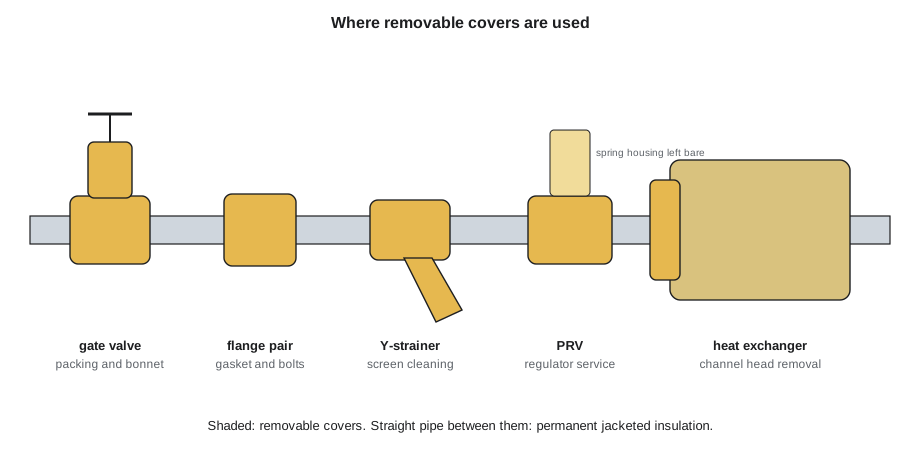
On Kellerton's PRV station, the specification called for flexible blankets with silicone-coated glass fabric outside, because they had to fit the irregular shape of the regulator and its pilot tubing and be easy for maintenance to handle, with aluminum jacket on the straight pipe between them. The two heat exchanger covers, KF-HX-01 and 02, which Wendell Ashby and Priya Lam measured on Monday, November 9, are also flexible blankets, because the exchanger's channel and bonnet are opened every year for cleaning.
Questions to ask before choosing covers
Before a cover is designed, the insulator or the specifier needs answers to a short list of questions. Most cover problems come from skipping one of them:
| Question | Why it matters |
|---|---|
| What is the operating temperature, and the highest temperature it can reach? | Sets the fabrics, insulation and thread; lesson 8 |
| Indoors or outdoors? Wet, oily, chemical, food area? | Sets the outer fabric and whether it must be waterproof or cleanable |
| How often is it opened, and by whom? | Sets the fastening system: quick straps for daily access, lacing for rare access |
| What must stay visible or reachable? | Nameplates, gauges, stems, drains, test points and leak checks need cut-outs or flaps |
| Is it cold, hot, acoustic, or more than one? | Cold needs vapour sealing; acoustic needs a barrier and seals |
| Is there a leak risk from the flange or valve? | Some services need covers that show leaks or drain, or need spray shields instead |
| What surface temperature is required? | Sets the insulation thickness for personnel protection; lesson 11 |
| How will covers be identified and stored? | Every cover needs a tag; lesson 9 |
Flanges on lines carrying hazardous fluids deserve special thought. A cover over a leaking flange can hide the leak, soak up the fluid and, with oils and some organic fluids, create a fire risk, because oil-soaked insulation can ignite at temperatures below the oil's normal autoignition point. Some plants use flange guards or spray shields on such flanges instead of, or under, insulation covers, and some use covers with a drain grommet or a leak-indicating patch at the bottom. Lou's specification for Kellerton allows covers on steam and condensate flanges, where a leak shows up as a plume of steam, but not on the compressor oil lines in the engine room.
Removable covers and the specification
Mechanical insulation specifications often include a section on removable covers that lists the items to be covered, the materials, the fastening, the identification and the documents to submit: a sketch or drawing of each cover, material data sheets and a sample. On new construction, the specification may require covers on all valves above a set size, all strainers and all PRVs, as Kellerton's steam standard requires on steam valves larger than NPS 2. On existing plants, the list usually comes from a survey like the one on November 6.
When the specification is silent, the insulator's job is to raise the question in writing: "The drawings show twelve valves, eight strainers and two PRVs on the steam system. Permanent or removable insulation?" Leaving them permanent by default leads, in a few years, to the bare fittings Lou and Marcel found.
Covers in commercial buildings
Removable covers are not only for plants. Hospitals, universities and office towers have steam and heating hot water systems with the same valves, strainers, pressure-reducing stations and heat exchangers, often in crowded mechanical rooms where maintenance is frequent. Indoor commercial covers are lighter, with fabrics and fastenings suited to clean, dry rooms and lower temperatures, and they are often specified on new construction for every steam valve, strainer and trap station.
On the Mountview Hospital addition, the specification called for permanent insulation on the heating hot water and chilled water fittings, with removable boxes on the larger valves, as INS-210 described, because the systems run at moderate temperatures and are opened rarely. The sterilizer room's medium-pressure steam, by contrast, has a pressure-reducing station that the hospital's maintenance staff service twice a year, and there the specification calls for flexible covers. The choice follows the service and how often the item is opened.
The cost of not covering
Bare fittings cost more than energy. Each one is a burn hazard at working height, a source of heat in a mechanical room that may need extra ventilation, and, on outdoor steam lines, a place where condensate forms and water hammer can start. In the boiler house at Kellerton, the bare fittings found on November 6 also added heat to a room where operators work all day, and Lou counted lower room temperatures in summer as one of the reasons to cover them.
Covers also make inspections easier. Insurance and boiler inspectors, and the plant's own corrosion inspections, need to see flanges, welds and nameplates from time to time. A cover that lifts off in a minute lets the inspector look and then goes straight back on, where permanent insulation would have been cut and, too often, never replaced.
When Raj presents covers to an owner, he puts the energy payback first, but he lists the other benefits too: safety, cooler rooms, faster maintenance and easier inspection. On a typical steam system, any one of them can justify the covers on its own.
Common mistakes
MistakeInsulating serviceable valves and strainers permanently.
InsteadUse removable covers on items maintenance must open, and ask in writing when the specification is silent.
MistakeClosing a maintenance job with the fitting left bare.
InsteadPut the cover back, or order a cover, before the job is closed.
MistakeCovering a leaking flange on an oil line.
InsteadFind and fix leaks first, and use guards or leak-indicating covers where the specification calls for them.
MistakeChoosing a cover without knowing how often it is opened.
InsteadMatch the fastening to the access: quick-release for frequent access, lacing for rare access.
MistakeUsing hot-service covers on cold lines.
InsteadCold service needs vapour-sealed designs, or permanent sealed insulation.
Summary and key terms
- Permanent insulation on serviceable items is destroyed by maintenance and often not replaced; removable covers come off and go back in minutes.
- Covers save energy, protect people, hold process temperatures, reduce noise and allow inspection; cold service needs vapour-sealed designs.
- Covers on steam fittings often pay back in months to a couple of years from energy alone, and also save maintenance labour.
- Common kinds are flexible blankets (ASTM C1695 for hot service), rigid boxes, preformed covers and acoustic covers.
- Before designing a cover, settle temperature, environment, access, what must stay visible, the service type, leak risk, surface temperature and identification.
- Removable cover
- An insulation cover made to fit an item and fastened so it can be removed and replaced without damage.
- Blanket
- A flexible removable cover: a sewn fabric envelope with an insulation mat inside.
- Payback
- The time for the savings from an improvement to repay its cost.
- Flange guard
- A shield around a flange that stops a leak from spraying out.
- ASTM C1695
- The specification for fabricating flexible, removable and reusable blanket insulation for hot service.
- Acoustic cover
- A removable cover with a barrier layer, used on valves and flanges of lagged lines.
Practice problems
Work each problem on paper first, then reveal the answer to check.
A bare valve loses 1,200 W for 8,000 hours a year. How much energy is that in GJ?
Show answer
1,200 × 8,000 = 9.6 MWh = 9.6 × 3.6 = 34.6 GJ.
Why do plants fill up with bare fittings over time?
Show answer
Permanent insulation is cut away for maintenance and not replaced.
Why are cold valve covers harder to make than hot ones?
Show answer
They must seal out moisture, which is difficult on a removable item.
A cover costs 800 dollars and saves 400 dollars a year. What is the simple payback?
Show answer
2 years.
What is ASTM C1695?
Show answer
The fabrication specification for flexible, removable and reusable blanket insulation for hot service.
Lesson quiz · 5 questions
Score 60% or more to complete this lesson.
Create a free account to save your progress, take quizzes and earn a certificate.