
INS-340 · Lesson 12 of 12 · 24 min
Case study: quieting a compressor station
▶ Video coming soon A video version of this lesson is on the way.
This lesson follows the Compressor No. 5 noise job at Kellerton Foods from the first complaint to the final measurement, pulling together the physics, materials and workmanship of the earlier lessons. It is a small job by the standards of a refinery or a gas compressor station, where lagging runs for hundreds of metres (feet) and enclosures are the size of buildings, but every step of the larger jobs is here: a measured problem, a designed solution, careful installation by several trades, and a measured result.
The problem
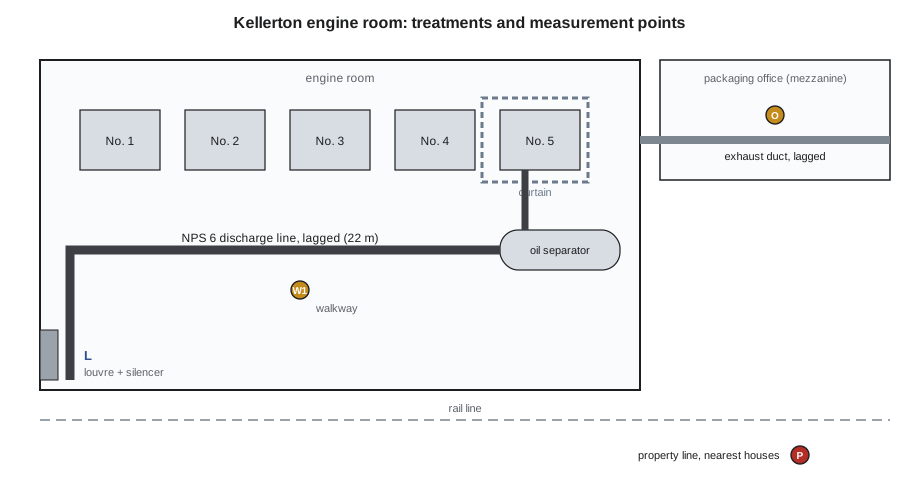
Kellerton's ammonia engine room holds five screw compressors. Compressor No. 5, added in 2026 for two new blast freezers, started on Tuesday, May 19. It is an oil-injected screw compressor whose male rotor has four lobes and turns at about 3,550 rpm, discharging hot ammonia gas at about 80 °C (175 °F) through a short line to its oil separator and from there through an NPS 6 line along the engine room wall to the condenser header.
Within weeks there were three problems:
- Neighbours. Residents across the rail line called about a steady hum at night, and on Thursday, June 18, the city wrote to Lou Brisebois about the complaints.
- Workers. Operators found the walkway past the new machine much louder than before, and a June burn on the bare discharge line showed it was also a touch hazard.
- Office staff. The packaging office on the mezzanine had a new rumble.
Lou hired Corvel Acoustics. Sunniva Hollowell measured on Wednesday night, July 8, at the property line and at a neighbour's back fence, and on Thursday, July 9, in the engine room and the office.
The diagnosis
Sunniva's measurements, in her report of Wednesday, July 22, told a clear story:
- At the property line, the total at night was 52 dBA against a background of 47 dBA, so the plant's own contribution was about 50.3 dBA, with a tone in the 250 Hz band that was easy to hear. She traced it to the 237 Hz lobe-passing frequency of Compressor No. 5, radiated by the discharge piping and the oil separator and escaping through the engine room's intake louvre.
- On the walkway, 1 m (3 ft) from the discharge line, the level was about 95 dBA. The discharge line alone gave about 94.8 dBA, with most of its energy from 250 to 2,000 Hz; the compressor casing gave about 85 dBA at the same point.
- In the office, the duct breakout gave 51 dBA against the office's own 42 dBA.
Her targets were for the plant's contribution at the nearest house to be no more than 45 dBA with no audible tone, for the walkway to be at or below 85 dBA, and for the office to be as quiet as its own ventilation allowed.
The design
Sunniva's report specified a package of treatments, each aimed at one path:
| Treatment | Path it treats | By |
|---|---|---|
| Spring hangers and resilient pads on the discharge line | Structure-borne vibration into the wall | Refrigeration contractor |
| Acoustic lagging on discharge line and oil separator, to tested octave band insertion loss | Airborne noise from piping and vessel | Coldstream |
| Removable acoustic covers on 4 valves, 6 flange pairs and 3 separator connections | Bare gaps in the lagging | Coldstream and Pellam |
| Curtain enclosure around the compressor skid | Airborne noise from the casing | Coldstream, with millwrights for the frame |
| Lagging on the exhaust duct over the office | Duct breakout | Coldstream |
| Silencer behind the intake louvre | Noise escaping through the wall opening | HVAC contractor |
Raj Sandhu priced Coldstream's scope on Tuesday, July 28, with an estimate of 150 crew-hours, and Kellerton awarded it on Friday, July 31. The submittal included the lagging maker's test report, the MLV and curtain data sheets, the cover materials and the hazard plan.
The work
| Date (2026) | Work |
|---|---|
| Week of July 27 | Refrigeration contractor fits spring hangers and pads |
| Tue Aug 4 | Bernie, Wendell and Priya walk down and write the hazard sheet; lagging starts |
| Wed Aug 5 | Wendell measures the valves, flanges and separator connections for covers |
| Thu Aug 6 | Cover sketches sent to Pellam |
| Fri Aug 7 | Discharge line lagging finished; knock test finds one jacket touching a clamp, reset |
| Mon–Tue Aug 10–11 | Oil separator lagged |
| Wed–Thu Aug 12–13 | Curtain enclosure hung and sealed, weighted skirt fitted |
| Fri Aug 14 | Exhaust duct over the office lagged |
| Mon–Tue Aug 17–18 | HVAC contractor installs the intake louvre silencer |
| Wed Aug 26 | Sunniva's after survey, without the valve and flange covers |
| Thu–Fri Aug 27–28 | Covers delivered and installed; operators trained |
| Wed Sept 2 | Final walkway check with covers on |
The crew's day began with the plant's ammonia safety check: Coldstream's crews carry personal ammonia monitors in the engine room, know the escape routes and the plant's alarm, and never break into a refrigerant line or valve, which is the refrigeration contractor's work. Hearing protection was worn throughout; at about 95 dBA on the walkway, Mei Zhou's hazard sheet put the crew in double protection, plugs and muffs, for long tasks beside the running compressor.
The lagging went on as lesson 3 described: 50 mm (2 in) mineral wool, a wrap of 4.9 kg/m² (1 lb/ft²) MLV with taped 50 mm (2 in) laps, and 0.8 mm (0.032 in) aluminum jacket on stainless bands. The knock test on August 7 found one jacket ringing at a clamp, which Priya reset. The curtain went up as lesson 5 described, with its weighted skirt and sealed pipe collars, and the duct as lesson 4 described.
The results
Sunniva's after survey on Wednesday night, August 26, with everything but the covers in place, and her final check on Wednesday, September 2, gave these results:
| Location | Before | After |
|---|---|---|
| Walkway W1 | 95 dBA | 86 dBA on August 26; 84 dBA on September 2 with covers |
| Office | 51.5 dBA | 44 dBA |
| Property line, total at night | 52 dBA (plant 50.3 dBA) | 48.5 dBA (plant 43.2 dBA), tone no longer audible |
| Discharge line jacket temperature | about 80 °C (175 °F) bare | about 32 °C (90 °F) |
Worked problem
What did the lagging do to the discharge line?
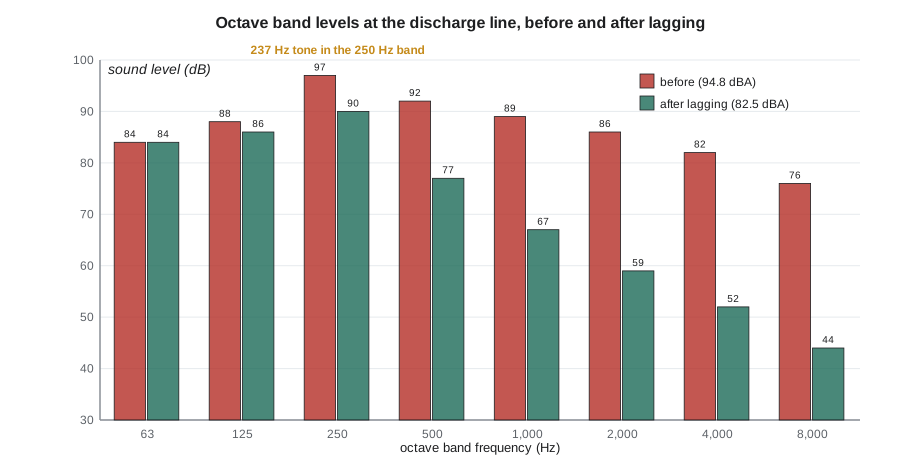
Before lagging, the octave band levels at 1 m (3 ft) from the discharge line were 84, 88, 97, 92, 89, 86, 82 and 76 dB from 63 to 8,000 Hz, which lesson 1 showed is 94.8 dBA. The lagging's insertion loss in those bands was 0, 2, 7, 15, 22, 27, 30 and 32 dB. What is the A-weighted level after lagging?
Show solution
- After levels: 84, 86, 90, 77, 67, 59, 52 and 44 dB.
- A-weighted: 57.8, 69.9, 81.4, 73.8, 67.0, 60.2, 53.0 and 42.9 dBA.
- Total = 10 log (sum of 10^(L/10)) = 82.5 dBA.
Answer: About 82.5 dBA from the pipe, down from 94.8 dBA. After lagging, the 250 Hz band, with the tone in it, dominates; the lagging could not do much more there, which is why the enclosure and silencer were needed too.
Worked problem
Putting the walkway together
After lagging, the pipe gives 82.5 dBA at the walkway and the compressor casing about 85.1 dBA. The curtain is expected to cut the casing's contribution by about 8 dB. What should the walkway read?
Show solution
- Before the curtain: 10 log (10^8.25 + 10^8.51) = 87.0 dBA.
- Casing after the curtain: 85.1 − 8 = 77.1 dBA.
- With the curtain: 10 log (10^8.25 + 10^7.71) = 83.6 dBA.
Answer: About 84 dBA predicted with everything in place, matching the 84 dBA measured on September 2. The August 26 reading of 86 dBA, with the valves and flanges still bare, shows what the covers were worth.
Worked problem
The operator's exposure before and after
An operator spends 2 hours of a shift on the walkway and 6 hours at 80 dBA elsewhere. What was the Lex,8 before (walkway at 95 dBA) and after (84 dBA)?
Show solution
- Before: 10 log [(2 × 10^9.5 + 6 × 10^8.0) ÷ 8] = 10 log [(6.325 × 10⁹ + 0.6 × 10⁹) ÷ 8] = 10 log (8.66 × 10⁸) = 89.4 dBA.
- After: 10 log [(2 × 10^8.4 + 6 × 10^8.0) ÷ 8] = 10 log [(0.502 × 10⁹ + 0.6 × 10⁹) ÷ 8] = 10 log (1.38 × 10⁸) = 81.4 dBA.
Answer: From 89.4 dBA, well over the 85 dBA limit, to 81.4 dBA, under it: an engineering control has done what hearing protection alone could not guarantee.
The city closed its file in September after a follow-up visit at night found the tone inaudible from the street. Coldstream's crew hours came to 164 against the estimate of 150, the difference being the extra afternoon at the curtain skirt around the floor drain and the cover installation day, which had been priced as half a day.
What the job taught
At the close-out meeting, Wendell, Priya, Raj and Lou went through what had worked and what they would do differently:
- Measure first. Sunniva's octave band survey showed that the office problem was the duct, not the compressor, and that the tone needed more than lagging. Without it, the plant might have spent its money on the wrong things.
- Low frequencies are hard. The lagging gave over 20 dB at 1,000 Hz and above, but only 7 dB in the band with the tone. The enclosure, silencer and isolation all contributed to the final result.
- Gaps decide the result. The bare valves and flanges cost about 2 dB at the walkway between August 26 and September 2; the curtain's floor gap would have cost more than a third of its performance if left open.
- Supports and isolation come first. The hangers had to be changed before the lagging covered them; the knock test caught the one bridge the crew made.
- Covers need owners. The covers work only if they go back on after maintenance. The work order line, the storage hooks and the operator training are as much a part of the job as the sewing.
- Noise and safety together. The same lagging that cut the noise ended the burn hazard on the walkway.
Priya wrote the job up for her apprenticeship logbook. Under "what I learned", she put Wendell's knock test, the rule about taping every seam, and a note that she now hears the engine room differently: "You can't see sound, but you can find where it gets out."
Looking ahead, the PRV station and heat exchanger covers from lessons 6 and 7 are due from Pellam on Monday, November 30, and Marcel and Devon plan to install the PRV covers that week, with Kellerton's maintenance crew watching so they can take them off and put them back. Raj's price for covering the remaining bare items in the boiler house is planned to go to Lou before the Christmas shutdown.
Scaling up: the same steps on larger jobs
On a gas compressor station, a refinery or a power plant, the same sequence runs on a larger scale. The acoustic consultant models the whole site, predicts the noise at the property line from each source, and sets insertion loss targets for each pipe, valve, vessel and building. Lagging specifications by ISO 15665 class are common, with Class C or D on large-diameter compressor piping. Enclosures may be whole buildings with silenced ventilation, and removable acoustic covers may number in the hundreds, each tagged and listed.
The insulator's part grows too. Large lagging jobs have their own quality plans: material certificates and test reports in the submittal, mock-ups inspected and approved before production starts, hold points at the porous layer and barrier stages so that the inspector can see what will be hidden by the jacket, and knock tests or infrared checks at the end. Crews are trained on the system before they start, and supervisors check seams, supports and terminations every day, because a fault found after the jacket is on is expensive to fix.
The Compressor No. 5 job had a small version of each of these: the maker's test report in the submittal, Bernie's walk-down, Wendell's daily seam check and knock test, and Sunniva's measurements before and after. The size changes; the steps do not.
Common mistakes
MistakeTreating a noise complaint without measurements.
InsteadMeasure in octave bands at the problem locations, find each path, and design a treatment for each.
MistakeExpecting lagging alone to remove a low-frequency tone.
InsteadCombine lagging with enclosures, silencers and isolation where low frequencies dominate.
MistakeLeaving the valve and flange covers for later.
InsteadCover every gap; bare fittings measurably reduce the result.
MistakeInstalling lagging before the supports are changed.
InsteadFit isolation hangers and pads first; check for bridges after.
MistakeHanding over covers without training or storage.
InsteadTrain the operators, provide storage and tie reinstallation to closing work orders.
Summary and key terms
- The job began with a measured problem: a tone at the property line, high levels on the walkway, an office rumble and a burn hazard.
- Octave band measurements traced each problem to a path: discharge piping and vessel, compressor casing, wall opening and duct breakout.
- The design combined isolation, lagging, removable acoustic covers, a curtain enclosure, duct lagging and a silencer, divided among several trades.
- Results: walkway 95 to 84 dBA, office 51.5 to 44 dBA, plant contribution at the property line 50.3 to 43.2 dBA with no audible tone, and a safe-to-touch jacket.
- The lessons: measure first, expect low frequencies to be hard, close every gap, isolate supports first, and make someone responsible for the covers.
- Partial enclosure
- An enclosure with an open side or top.
- After survey
- Measurements made after a treatment is installed, to compare with the survey before.
- Close-out meeting
- A meeting at the end of a job to review results and lessons.
- Personal ammonia monitor
- A small worn detector that alarms when ammonia is present in the air.
Practice problems
Work each problem on paper first, then reveal the answer to check.
What did the property line measurements show the plant's own contribution to be before the work?
Show answer
About 50.3 dBA: 10 log (10^5.2 − 10^4.7).
Why did the after survey on August 26 read higher at the walkway than the final check?
Show answer
The valve and flange covers were not yet installed.
Which treatment dealt with the office rumble?
Show answer
Lagging the exhaust duct over the office.
Why did the job need more than lagging to remove the tone?
Show answer
Lagging gives little insertion loss at low frequencies such as the 250 Hz band.
Name two things that made the covers likely to stay on after maintenance.
Show answer
Operator training, storage hooks with bags, and a work order line requiring reinstallation.
Lesson quiz · 5 questions
Score 60% or more to complete this lesson.
Create a free account to save your progress, take quizzes and earn a certificate.