
INS-340 · Lesson 5 of 12 · 23 min
Mass-loaded barriers and enclosures
▶ Video coming soon A video version of this lesson is on the way.
Lagging the discharge line dealt with the pipe, but Compressor No. 5 itself still radiated noise from its casing, motor and oil system. A full, walled enclosure was out of the question: the operators needed to see the machine, reach its controls and pull its motor, and the package needed cooling air. Sunniva's answer was a partial enclosure of acoustic curtain, hung from a steel track frame around the skid. The plant's millwrights built the frame the week before, and on Wednesday and Thursday, August 12 and 13, 2026, Wendell and Priya hung and sealed the curtain panels.
Barrier materials and enclosures are among the most effective tools in noise control, and also among the easiest to spoil with a gap. This lesson covers mass-loaded vinyl and other barrier products, how to handle and seal them, how enclosures work and what limits them, and the worked numbers for the Compressor No. 5 curtain.
Mass-loaded vinyl
Mass-loaded vinyl (MLV) is a flexible vinyl sheet loaded with a heavy mineral filler, such as barium sulphate or calcium carbonate, to make it dense and limp. It is the workhorse barrier of pipe and duct lagging, curtains and wall treatments. Typical products:
- Surface density. Most often 4.9 kg/m² (1 lb/ft²), which is about 2.5 to 3 mm (⅛ in) thick, or 9.8 kg/m² (2 lb/ft²) for higher performance. The surface density, not the thickness, sets the transmission loss.
- Facings and reinforcement. Plain sheet; sheet with a scrim reinforcement for curtains and hanging uses; sheet with a foil or fabric face; and composites with a decoupling layer of glass fibre or foam bonded to one side.
- Temperature. Vinyl softens with heat. Typical continuous limits are around 80 to 100 °C (175 to 210 °F), varying by product, and some products stiffen and crack in cold weather. Check the maker's data sheet and keep the barrier on the cool side of the porous layer.
- Fire performance. Some barrier products are tested for surface burning characteristics (flame spread and smoke) and are acceptable in plenums and exposed locations; others are not. The specification and the data sheet decide where a product may be used.
Other barrier materials include sheet lead (rarely used now because of its toxicity, and only by trained workers under lead rules), steel and aluminum sheet with a damping layer, gypsum board, and loaded rubber sheets. For insulators, MLV and MLV composites cover most needs.
Handling and sealing barriers
A roll of MLV is heavy. A roll of 1.2 m × 10 m (4 ft × 30 ft) at 4.9 kg/m² (1 lb/ft²) weighs about 59 kg (120 lb), so it is a two-person lift or a job for a cart. Cut it with a sharp utility knife against a straightedge; it does not fray. Points that make the difference between a barrier that works and one that does not:
- Overlap and tape. Every seam overlaps at least 50 mm (2 in), and is sealed with the barrier tape the maker specifies, pressed down with a roller. Butt joints are taped on both faces where possible.
- Seal penetrations. Cut openings for rods, stems and pipes as small as possible and seal them with tape or a flexible collar of barrier.
- Do not stretch. Stretching thins the sheet and can pull seams open later. Hang or wrap it with a little slack.
- Support it. On vertical surfaces and overhead, MLV needs mechanical support, such as pins, bands, a jacket or a hanging system; adhesive alone often lets go.
- Keep it clean and dry for taping. Dust, oil and cold surfaces stop tape bonding. Wipe and warm the surface if the maker requires it.
How an enclosure works
An enclosure surrounds a noise source with a barrier, so that most of the sound is reflected back inside. Its performance is usually given as insertion loss at the point of interest. Four things set how well it works:
- The transmission loss of the walls. Heavier walls, or walls of two layers separated by an absorber, give more.
- Absorption inside. Without absorption, the reflected sound builds up inside until much more escapes through the walls. Lining the inside with an absorbing layer, such as the fibre face of a curtain composite, prevents this. A rough estimate of the insertion loss of a closed enclosure is the wall's transmission loss plus 10 log of the average absorption coefficient inside, so an absorption coefficient of 0.7 costs about 1.5 dB, while bare reflective walls with a coefficient of 0.05 cost about 13 dB.
- Openings and leaks. As lesson 2 showed, a small opening can cut the transmission loss of the whole enclosure by 10 dB or more. Ventilation openings need silencers or lined, bent ducts; doors need seals; cable and pipe entries need sealing.
- Structure-borne paths. If the machine is bolted rigidly to the floor and the enclosure stands on the same floor, vibration bypasses the walls. The machine sits on isolators, and the enclosure is kept from touching the machine and its piping.
A partial enclosure, such as walls without a roof, or a barrier screen between a source and a listener, gives much less: typically 5 to 10 dB, because sound escapes over the top and reflects off the ceiling. It is still often the right answer where access and cooling make a full enclosure impractical, as at Compressor No. 5, where Sunniva predicted 8 dB at the walkway from the curtain.
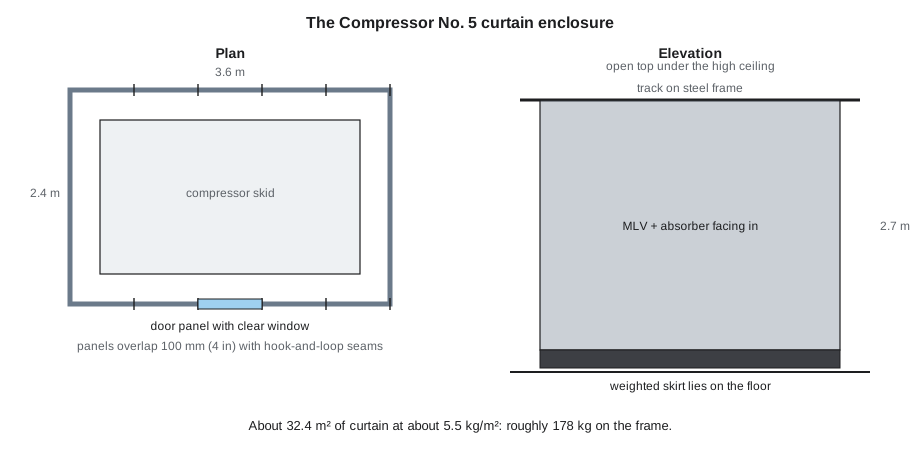
The Compressor No. 5 curtain
The curtain panels came from an acoustic products supplier: 1.37 m (54 in) wide, each a layer of reinforced MLV with a 25 mm (1 in) quilted glass fibre absorber on the inner face, behind a vinyl-coated fabric, for a total surface density of about 5.5 kg/m² (1.1 lb/ft²). Each panel had grommets along the top for hooks on the track, and hook-and-loop strips along both vertical edges so that neighbouring panels overlapped 100 mm (4 in) and sealed together. One panel on the operator's side was a door panel with a clear vinyl window, which gives less transmission loss than the rest but let the operators see the compressor's local panel.
Worked problem
How much curtain, and how heavy?
The track frame is 3.6 × 2.4 m (12 × 8 ft) around the skid, and the curtain hangs 2.7 m (9 ft). What area of curtain is needed, and what does it weigh on the frame?
Show solution
- Perimeter = 2 × (3.6 + 2.4) = 12.0 m.
- Area = 12.0 × 2.7 = 32.4 m².
- Weight = 32.4 × 5.5 = 178 kg, carried on the track frame.
Answer: About 32.4 m² (360 ft²) of curtain weighing about 178 kg (396 lb), before the overlaps. The supplier's panels were 1.37 m (54 in) wide with 100 mm (4 in) overlaps, so 10 panels went round the frame, with the panel widths chosen to put a seam at each corner.
The hardest part was the bottom edge. The skid sat on a concrete housekeeping pad, and the floor around it was uneven, with a floor drain on one side. A curtain that stopped short of the floor would leave a gap all round.
Worked problem
What does a gap at the floor cost?
If the curtain stops 50 mm (2 in) above the floor all the way round the 12 m (40 ft) perimeter, what fraction of the curtain area is open? If the curtain's transmission loss is 25 dB at the frequency of interest, what is the transmission loss of the whole curtain with the gap?
Show solution
- Gap area = 12 × 0.05 = 0.6 m²; curtain area = 32.4 m²; fraction open = 0.6 ÷ 32.4 = 0.0185, about 2 in 100.
- Curtain τ = 10^(−25 ÷ 10) = 0.00316; average τ = 0.98 × 0.00316 + 0.02 × 1 = 0.0231.
- TL = 10 log (1 ÷ 0.0231) = 16.4 dB.
Answer: About 16 dB instead of 25: a gap along the floor throws away more than a third of the curtain's performance in decibels.
Wendell closed the bottom with a weighted skirt: a strip of MLV sewn to the bottom of each panel, 150 mm (6 in) deep, that lay on the floor and followed its unevenness. Around the floor drain, Priya cut the skirt to fit and taped a separate piece over the gap. At the two corners where the skid's oil piping and the discharge line left the enclosure, she cut the panels to fit closely around the lagged pipes and sealed them with barrier collars taped to the curtain, without touching the pipe lagging to the curtain frame.
Ventilation, heat and access
Machines in enclosures need cooling. A compressor motor in a tight enclosure overheats, and a hot enclosure is unsafe to enter. Full enclosures have ventilation openings with silencers, or lined ducts with bends, sized by the designer for the heat the machine gives off. The open top of the Compressor No. 5 curtain let warm air rise out freely; Sunniva checked that the engine room's own ventilation, which the HVAC contractor's work did not reduce, still carried the heat away.
Access is just as important. Every enclosure needs a way in for operators and maintenance, and a way to lift out large parts. Curtain systems are popular because panels can be slid along the track or unhooked; panel walls use removable sections with seals. Doors, windows and panels must be closed and sealed to work, so the enclosure design should make the closed position the easy one. Lou Brisebois added a line to the engine room checklist: "curtain door closed and skirt down".
Barriers on large surfaces
The same barrier materials are used on large surfaces such as vessels, fan housings and walls. On Monday and Tuesday, August 10 and 11, the crew lagged the oil separator of Compressor No. 5, a horizontal vessel of about 760 mm (30 in) diameter and 2.4 m (8 ft) long, with 50 mm (2 in) mineral wool board, a wrap of MLV in sheets overlapped and taped at every seam, and an aluminum jacket. The heads were done in gores, as INS-220 taught for jacketing, with the MLV cut in gores too and every gore seam taped. The separator's sight glass, level transmitter, drain valve and relief valve connection were left accessible behind removable acoustic covers made with the valve covers, covered in lessons 6 to 10.
Screens and barrier walls
Where a machine cannot be enclosed at all, a free-standing barrier screen between it and the listener can help. A screen works by forcing the sound to bend over or around it, and its benefit depends on how far it breaks the line of sight: a screen that just blocks the view gives about 5 dB, and a taller one, close to the source or the listener, can give 10 to 15 dB outdoors. Indoors, reflections from the ceiling and walls cut the benefit, so screens are usually lined with absorber on the source side and used with absorption overhead.
Outdoors, barrier walls protect neighbours from rooftop equipment, cooling towers and yard machinery. They need enough mass, usually at least about 20 kg/m² (4 lb/ft²), no gaps at the base or between panels, and an absorptive face toward the source if the source is close or reflections bounce back toward other receivers. These walls are usually built by other trades, but insulators sometimes install the absorptive facings or the barrier panels on steel frames.
Viewing windows and doors
Windows and doors are the weak points of any enclosure. A clear vinyl window in a curtain gives much less transmission loss than the curtain around it, and a door that does not seal at the floor is a gap. Good practice:
- Keep windows small and use the heaviest clear material practical, such as a thick clear vinyl or laminated glazing in rigid enclosures.
- Seal doors on all four sides, with overlapping flaps and hook-and-loop on curtain doors, and drop seals or gaskets on rigid doors.
- Make the door easy to close. A door that is hard to close will be left open, and then the enclosure gives almost nothing.
Priya's last task on the curtain was to walk around it with the compressor running and a flashlight, looking for light at seams and at the skirt from inside, which shows where sound would escape. She found one spot where two panels did not quite overlap at the top and pulled them together.
Common mistakes
MistakeLeaving a gap at the bottom of a curtain or enclosure.
InsteadClose the bottom with a weighted skirt or seal, and fit closely around pipes and conduits.
MistakeBuilding an enclosure with bare reflective walls inside.
InsteadLine the inside with an absorber, or the reflected sound builds up and escapes.
MistakeLetting the enclosure touch the machine or its piping.
InsteadKeep a clear gap and seal around pipes with flexible collars so vibration does not bypass the walls.
MistakePutting MLV against a surface hotter than its rated limit.
InsteadCheck the data sheet and keep the barrier on the cool side of a porous layer.
MistakeRelying on adhesive alone to hold MLV overhead.
InsteadSupport barrier sheet mechanically with pins, bands, jackets or hanging systems.
Summary and key terms
- Mass-loaded vinyl is a dense, limp barrier, usually 4.9 or 9.8 kg/m² (1 or 2 lb/ft²), sold plain, reinforced, faced or as a composite with a decoupling layer.
- Barrier seams must overlap and be taped, penetrations sealed, and the sheet supported mechanically without stretching.
- Enclosure performance depends on wall transmission loss, absorption inside, openings and leaks, and structure-borne paths.
- Partial enclosures and screens give typically 5 to 10 dB; full, lined, sealed enclosures give much more.
- Enclosures must allow for ventilation, heat and access, and be easy to keep closed.
- Mass-loaded vinyl (MLV)
- A dense, limp vinyl sheet loaded with mineral filler, used as a sound barrier.
- Surface density
- Mass per unit area of a sheet, which sets its transmission loss.
- Enclosure
- A barrier surrounding a noise source to contain its sound.
- Partial enclosure
- An enclosure with an open side or top, or a screen between source and listener.
- Acoustic curtain
- A hanging panel of barrier material, often with an absorbing face, used for enclosures.
- Weighted skirt
- A strip of barrier along the bottom of a curtain that lies on the floor to close the gap.
- Composite
- A barrier product with a bonded decoupling or absorbing layer.
Practice problems
Work each problem on paper first, then reveal the answer to check.
What weighs more: 10 m² (100 ft²) of 4.9 kg/m² (1 lb/ft²) MLV or 5 m² (50 ft²) of 9.8 kg/m² (2 lb/ft²) MLV?
Show answer
They weigh the same, 49 kg (100 lb).
Why do enclosures need absorption inside?
Show answer
Without it, reflected sound builds up inside and more escapes through the walls.
A curtain enclosure has an open top. About what insertion loss can be expected?
Show answer
Typically 5 to 10 dB.
What is the rough insertion loss of a closed enclosure with walls of TL 30 dB and inside absorption coefficient 0.5?
Show answer
30 + 10 log 0.5 = 30 − 3 = 27 dB.
How should a curtain be sealed around a lagged pipe leaving the enclosure?
Show answer
Cut the curtain close around the lagging and seal it with a taped barrier collar, without tying the pipe to the curtain frame.
Lesson quiz · 5 questions
Score 60% or more to complete this lesson.
Create a free account to save your progress, take quizzes and earn a certificate.