
INS-340 · Lesson 1 of 12 · 32 min
Sound, noise and the decibel
▶ Video coming soon A video version of this lesson is on the way.
In May 2026, Kellerton Foods started a new screw compressor in the ammonia engine room, Compressor No. 5, to carry the load of two new blast freezers. Within a month the plant had a problem that had nothing to do with refrigeration. Neighbours on the far side of the rail line began calling the plant at night about a steady hum, and in June the city wrote to Lou Brisebois, the maintenance manager, about the complaints. Inside the engine room, the operators said the new machine was louder than the other four put together.
Lou hired an acoustical consulting firm, Corvel Acoustics, and its engineer, Sunniva Hollowell, measured the noise in July. Her report pointed to the hot gas discharge piping and the oil separator of the new compressor as the main sources, and recommended acoustic lagging, a partial enclosure and removable acoustic covers. Coldstream Insulation did the work in August, with Wendell Ashby leading and Priya Lam, a third-year apprentice, on the crew. This course follows that job, and the removable cover work that Coldstream does every season, from the physics up.
This first lesson covers what sound is, how it is measured, why the decibel scale works the way it does, how to add sound levels, how sound changes with distance, how frequency and A-weighting matter, and the workplace noise rules that apply to insulators and the people they work beside.
What sound is
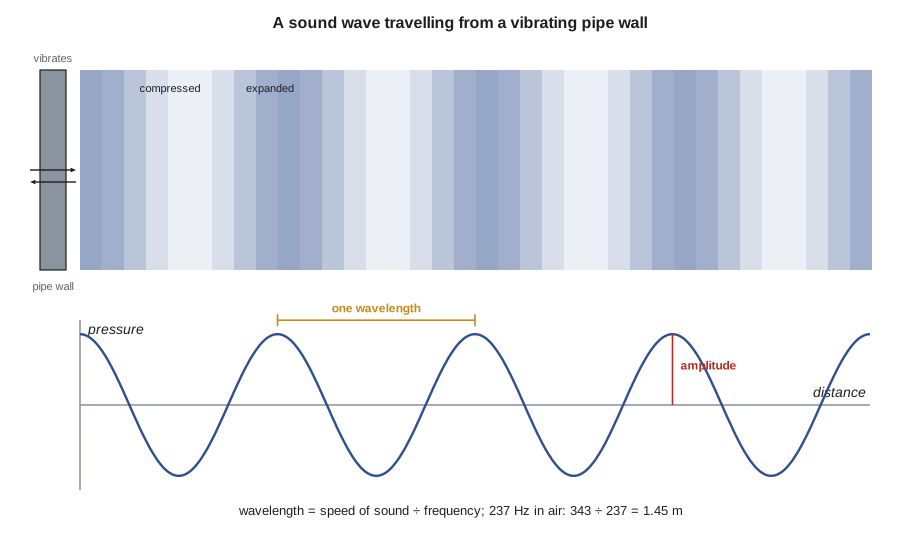
Sound is a pressure wave travelling through air, or through any other material. A vibrating surface, such as the wall of a pipe, a fan blade or a loudspeaker cone, pushes the air next to it, squeezing it slightly and then letting it expand. These tiny pressure changes pass from air molecule to air molecule, outward from the source, at the speed of sound: about 343 m/s (1,125 ft/s) in air at room temperature. The air itself does not travel; only the disturbance does, like a wave moving across a field of grain.
The pressure changes are very small. Normal atmospheric pressure is about 101,000 Pa (14.7 psi). The quietest sound a young person can hear is a change of only 0.00002 Pa, or 20 micropascals, and a sound loud enough to hurt is around 20 to 200 Pa. That huge range, a factor of more than a million between the faintest and the most painful sounds, is why sound is measured on a logarithmic scale.
- Frequency is the number of pressure cycles per second, measured in hertz (Hz). A low hum might be 60 or 120 Hz; a human voice is mostly between about 250 and 4,000 Hz; a hiss of escaping steam is mostly above 2,000 Hz. A healthy young ear hears from about 20 Hz to 20,000 Hz, and hearing at the top end fades with age and with noise damage.
- Wavelength is the distance between one pressure peak and the next. It equals the speed of sound divided by the frequency. Low frequencies have long wavelengths, several metres, and high frequencies have short ones, a few centimetres or inches. Wavelength matters to insulators because thin, light materials do little against long waves, while thick and heavy ones do more.
- Amplitude is the size of the pressure change, which we hear as loudness.
Worked problem
How long is the wave of the compressor tone?
Sunniva's survey found a strong tone at about 237 Hz, the frequency at which the lobes of the compressor's male rotor pass the discharge port. The rotor has 4 lobes and turns at 3,550 rpm. Check the frequency, and find the wavelength in air.
Show solution
- Lobe-passing frequency = lobes × rpm ÷ 60 = 4 × 3,550 ÷ 60 = 236.7 Hz, about 237 Hz.
- Wavelength = speed of sound ÷ frequency = 343 ÷ 236.7 = 1.45 m.
Answer: The tone is at about 237 Hz, with a wavelength of about 1.45 m (4.75 ft), which is long compared with the thickness of any lagging. That is why the low-frequency part of the problem was the hardest to fix.
Noise
Noise is simply unwanted sound. The same sound can be music to one person and noise to another, but on a job site noise means sound that can damage hearing, interfere with speech and warning signals, cause fatigue, or annoy people outside the property. Most industrial noise is broadband, spread over many frequencies, like the roar of a fan. Some has strong tones, single frequencies that stand out, like the whine of a gearbox or the hum of Compressor No. 5. Tones are more annoying than broadband noise of the same level, and many environmental noise rules add a penalty for them.
Noise reaches people by two paths. Airborne noise travels through the air from a vibrating surface. Structure-borne noise travels as vibration through solid materials, such as a pipe, its supports or the floor, and is radiated as airborne sound somewhere else, sometimes far from the source. A pipe that is bolted solidly to a wall can make the wall itself radiate. Lesson 3 shows how acoustic lagging and its supports must deal with both paths.
The decibel
Because the ear responds to a huge range of pressures, and responds roughly to ratios rather than differences, sound is measured in decibels (dB). The sound pressure level (SPL) compares the measured pressure with the reference pressure of 20 micropascals, the threshold of hearing:
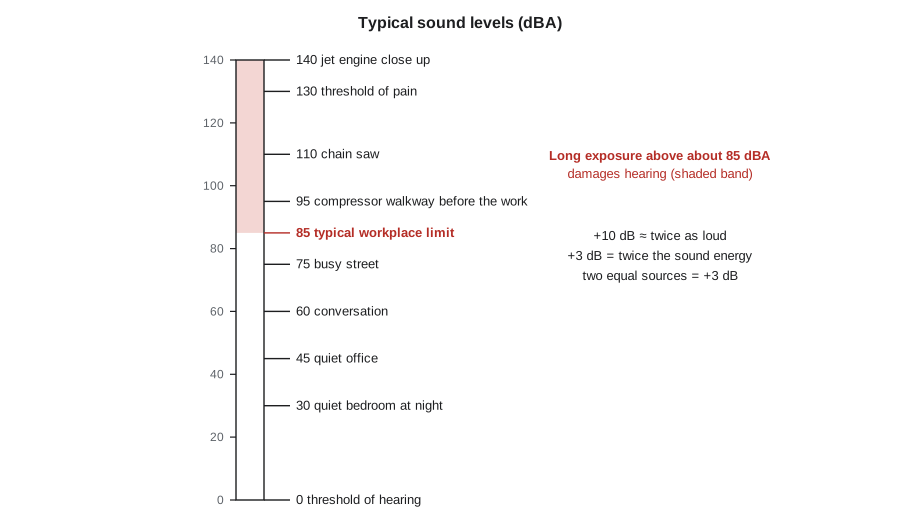
On this scale, the threshold of hearing is 0 dB, a quiet office is about 50 dB, a busy plant floor 85 to 95 dB, and a jet engine close up 140 dB. A few features of the scale matter on every job:
- An increase of 10 dB is a tenfold increase in sound energy, and most people hear it as about twice as loud.
- An increase of 3 dB is a doubling of sound energy, the smallest change most people notice easily outside a laboratory.
- An increase of 6 dB is a doubling of sound pressure.
- A change of 1 dB is hard to hear, but it matters for exposure limits, as the rest of this lesson shows.
Sound power is a different quantity. It is the total acoustic energy a source gives off, in watts, and it does not depend on where you stand. Manufacturers often give a machine's sound power level (Lw) in decibels relative to 10⁻¹² watts. The sound pressure level you measure depends on the sound power, the distance and the room. When Sunniva compared Compressor No. 5 with its data sheet, she used the sound power level; when she checked the walkway beside it, she used sound pressure levels.
Adding sound levels
Decibels do not add like ordinary numbers. Two machines that each make 85 dB at a point do not make 170 dB together; they make 88 dB, because their energies add, and doubling the energy adds 3 dB. The general rule is to turn each level back into energy, add the energies, and turn the total back into decibels:
For quick work in the field, a simpler table does the job. Take the difference between the two levels and add the amount shown to the higher one.
| Difference between two levels | Add to the higher level |
|---|---|
| 0 dB | 3 dB |
| 1 dB | 2.5 dB |
| 2 dB | 2 dB |
| 3 dB | 1.8 dB |
| 4 dB | 1.5 dB |
| 6 dB | 1 dB |
| 10 dB or more | about 0.4 dB or less; the quieter source hardly counts |
Worked problem
Adding the compressor and the pipe
At the walkway beside Compressor No. 5, Sunniva measured 91 dB from the discharge pipe alone (with the compressor's own casing temporarily screened) and 88 dB from the compressor casing alone. What is the total? What would three identical sources of 85 dB add up to?
Show solution
- Total = 10 log (10^9.1 + 10^8.8) = 10 log (1.259 × 10⁹ + 0.631 × 10⁹) = 10 log (1.890 × 10⁹) = 92.8 dB.
- Check with the table: the difference is 3 dB, so add 1.8 dB to 91: 92.8 dB.
- Three sources of 85 dB: 10 log (3 × 10^8.5) = 85 + 10 log 3 = 85 + 4.8 = 89.8 dB.
Answer: About 92.8 dB at the walkway, and 89.8 dB for three 85 dB sources. The louder source sets most of the total, which is why noise control starts with the loudest source.
The same idea works backwards. If a total is known and one part is removed, the remaining part is found by subtracting energies. Sunniva used this at the property line, where traffic and other plants made a steady background of 47 dBA. With Compressor No. 5 running, the total was 52 dBA. The compressor's own part was 10 log (10^5.2 − 10^4.7) = 50.3 dBA. The practical lesson for insulators is that a quiet source next to a loud one can be fixed perfectly without anyone hearing the difference; the loud one must be fixed first.
Distance
Outdoors and away from reflecting surfaces, sound from a small source spreads over a growing sphere. The energy at any point falls with the square of the distance, so every doubling of distance lowers the level by 6 dB:
From a long line source, such as a long run of noisy pipe or a busy highway, the sound spreads over a cylinder instead, and the drop is only 3 dB per doubling of distance close to the line. Indoors, reflections from walls, floors and ceilings build up a reverberant level that hardly changes with distance once you are a few metres from the source. That is why moving away from a machine helps a lot outdoors and much less in a hard-walled engine room, and why the absorptive materials covered in lesson 2 help indoors.
Worked problem
How much quieter four times as far away?
A pump measures 94 dB at 1 m (3 ft) outdoors. Assuming it acts as a small source in a free field, what is the level at 4 m (12 ft)?
Show solution
- Distance ratio = 4.
- Drop = 20 log 4 = 20 × 0.602 = 12.0 dB.
- Level = 94 − 12.0 = 82.0 dB.
Answer: About 82 dB, two doublings of distance at 6 dB each. In a hard-walled room the real drop would be less.
Frequency bands and A-weighting
Noise is rarely one frequency, so sound level meters split it into octave bands, each twice the frequency of the one below: 63, 125, 250, 500, 1,000, 2,000, 4,000 and 8,000 Hz are the standard centre frequencies used in noise control. Finer analysis uses one-third-octave bands. A band analysis shows where the energy is, and that tells the designer which treatment will work, because lagging, barriers and absorbers all work much better at high frequencies than at low ones.
The ear is less sensitive to low frequencies than to the middle range, so a single number that predicts hearing damage and annoyance must weight the bands. The A-weighting curve does this. It cuts the low bands strongly, leaves 1,000 Hz unchanged and lifts 2,000 and 4,000 Hz slightly. Levels measured this way are written dBA (or dB(A)). Workplace noise limits and most environmental limits are in dBA. A C-weighting, which is almost flat, is used for peak levels and for rating some hearing protectors.
| Octave band centre (Hz) | 63 | 125 | 250 | 500 | 1,000 | 2,000 | 4,000 | 8,000 |
|---|---|---|---|---|---|---|---|---|
| A-weighting (dB) | −26.2 | −16.1 | −8.6 | −3.2 | 0 | +1.2 | +1.0 | −1.1 |
Worked problem
A-weighting the discharge pipe spectrum
Sunniva's octave band levels at 1 m (3 ft) from the untreated discharge pipe were 84, 88, 97, 92, 89, 86, 82 and 76 dB in the bands from 63 to 8,000 Hz. What is the A-weighted level?
Show solution
- Apply the corrections: 84 − 26.2 = 57.8; 88 − 16.1 = 71.9; 97 − 8.6 = 88.4; 92 − 3.2 = 88.8; 89 + 0 = 89.0; 86 + 1.2 = 87.2; 82 + 1.0 = 83.0; 76 − 1.1 = 74.9.
- Add the eight weighted levels by energy: 10 log (10^5.78 + 10^7.19 + 10^8.84 + 10^8.88 + 10^8.90 + 10^8.72 + 10^8.30 + 10^7.49) = 94.8 dBA.
Answer: About 94.8 dBA, dominated by the 250 to 2,000 Hz bands. The unweighted total of the same bands is 99.5 dB, because the A-weighting cuts the low bands.
Workplace noise rules
Long exposure to noise damages the tiny hair cells of the inner ear, and the damage is permanent. It builds up slowly, without pain, over months and years, and it often brings tinnitus, a constant ringing. The rules limit a worker's noise exposure, which combines the level and how long the worker is in it, averaged over a normal working day.
In Ontario, O. Reg. 381/15 (Noise) under the Occupational Health and Safety Act sets the limit. It applies to all workplaces under the Act, including construction projects and industrial plants. A worker's exposure must not exceed an equivalent sound level of 85 dBA averaged over 8 hours, written Lex,8, and the regulation uses a 3 dB exchange rate: every 3 dB increase halves the allowed time, so 88 dBA is allowed for 4 hours and 91 dBA for 2 hours. The employer must first protect workers with engineering controls, such as quieter equipment, enclosures and lagging, and with administrative controls such as limiting time in noisy areas. Hearing protection may be used only where those controls are not in place, not practical or not effective, and then the employer must choose suitable protectors, account for the difference between laboratory ratings and real-world protection, and train workers in their fit, use and care.
The exposure level is calculated by adding energy over the shift. For a worker who spends 2 hours at 94 dBA and 6 hours at 80 dBA:
Worked problem
Exposure for an operator beside the compressors
An operator spends 2 hours of an 8-hour shift at 94 dBA near the compressors and 6 hours at 80 dBA in the control room. What is the Lex,8? Is it within the Ontario limit?
Show solution
- Lex,8 = 10 log [(2 × 10^9.4 + 6 × 10^8.0) ÷ 8].
- 2 × 10^9.4 = 2 × 2.512 × 10⁹ = 5.024 × 10⁹; 6 × 10^8.0 = 0.600 × 10⁹; sum = 5.624 × 10⁹.
- Divide by 8: 7.03 × 10⁸; 10 log (7.03 × 10⁸) = 88.5 dBA.
Answer: Lex,8 is about 88.5 dBA, more than 3 dB above the limit of 85 dBA: the operator's exposure is more than double what is allowed, even though only 2 hours are in the noisy area.
For insulators, these rules cut both ways. Coldstream's crews work in noisy plants, so Mei Zhou, Coldstream's safety and training coordinator, includes noise in every hazard sheet for plant work, and the crew wears hearing protection in engine rooms and boiler houses. At the same time, acoustic insulation is one of the engineering controls the rules ask employers to use, so insulators are part of the solution for everyone else's exposure.
Hearing protection only works when it is worn properly and all the time in the noise. Foam earplugs must be rolled down and inserted deep enough to expand in the ear canal; earmuffs must seal around the ear, which safety glasses with thick arms can spoil. Taking protection off for even a short time in a loud area wipes out much of its benefit, because exposure adds up by energy. Priya learned the habit on her first plant job: plugs in at the engine room door, out only outside it.
Measuring noise on a job
Insulators do not usually make the acoustic measurements on which a design is based, but they often hear the results discussed and are sometimes asked to help. A few terms come up:
- Sound level meter. A hand-held instrument that reads sound pressure level, usually with A- and C-weighting and often with octave band filters. It must be calibrated before and after use with an acoustic calibrator.
- Noise dosimeter. A small meter worn by a worker, with the microphone on the shoulder, that records exposure over a shift and calculates Lex,8.
- Leq. The equivalent continuous level: the steady level that would carry the same energy as a varying noise over the measuring time. Exposure limits are based on it.
- Background noise. The noise at a location with the source being studied turned off. A measurement of a source is only reliable if it is at least about 3 dB, and preferably 10 dB, above the background.
Sunniva measured at night, between 11 p.m. and 3 a.m., when traffic was lightest, at three points along the property line and at a neighbour's back fence with permission. In the engine room she measured octave bands at a grid of points on the walkways, with the other compressors running and, for some readings, turned off.
Common mistakes
MistakeAdding decibel levels as ordinary numbers.
InsteadAdd sound energies: two equal levels make 3 dB more, not double the number.
MistakeTreating a 3 dB reduction as small.
InsteadA 3 dB reduction halves the sound energy and doubles the time a worker can safely spend in the area under a 3 dB exchange rate.
MistakeFixing the quieter of two sources first.
InsteadFind the loudest source and treat it first; the quieter one hardly changes the total.
MistakeExpecting distance to help as much indoors as outdoors.
InsteadIndoors, reflections keep levels high; absorption and treatment at the source are needed.
MistakeRemoving earplugs for a few minutes to talk in a loud area.
InsteadStep outside the noise to talk, or use communication earmuffs; short unprotected times add a lot of exposure.
Summary and key terms
- Sound is a pressure wave; frequency is cycles per second, wavelength is the speed of sound divided by frequency, and amplitude is heard as loudness.
- Sound pressure level is measured in decibels relative to 20 micropascals; 10 dB more is ten times the energy and sounds about twice as loud, and 3 dB more is double the energy.
- Sound levels add by energy: two equal levels make 3 dB more, and the loudest source dominates.
- Outdoors from a small source, each doubling of distance lowers the level by 6 dB; indoors, reflections keep levels up.
- Octave band analysis shows where the energy is; A-weighting adjusts levels for the ear's sensitivity and is used in exposure limits.
- Ontario limits exposure to 85 dBA Lex,8 with a 3 dB exchange rate, and requires engineering and administrative controls before hearing protection.
- Frequency
- The number of pressure cycles per second in a sound, in hertz (Hz).
- Wavelength
- The distance between successive pressure peaks of a sound wave: the speed of sound divided by the frequency.
- Decibel (dB)
- A logarithmic unit comparing a sound quantity with a reference value.
- Sound pressure level
- The decibel level of sound pressure compared with 20 micropascals.
- Sound power level
- The decibel level of the total acoustic power a source gives off.
- Octave band
- A frequency band whose upper limit is twice its lower limit, used to analyse noise.
- A-weighting
- A frequency weighting that adjusts levels to match the ear's sensitivity, giving dBA.
- Exchange rate
- The increase in level that halves the allowed exposure time: 3 dB or 5 dB depending on the rule.
- Tone
- A single frequency that stands out from the rest of a noise.
Practice problems
Work each problem on paper first, then reveal the answer to check.
What is the wavelength of a 1,000 Hz sound in air?
Show answer
343 ÷ 1,000 = 0.343 m (1,125 ÷ 1,000 = 1.1 ft).
Two fans each produce 82 dB at a point. What is the total?
Show answer
85 dB: equal levels add 3 dB.
A source makes 70 dB and another makes 60 dB at the same point. What is the total?
Show answer
About 70.4 dB; the quieter source adds only 0.4 dB.
A small source outdoors measures 88 dB at 2 m (6 ft). What is it at 8 m (24 ft)?
Show answer
88 − 20 log 4 = 88 − 12 = 76 dB.
What A-weighting correction applies to the 125 Hz band?
Show answer
−16.1 dB.
Lesson quiz · 5 questions
Score 60% or more to complete this lesson.
Create a free account to save your progress, take quizzes and earn a certificate.