
HSE-353 · Lesson 8 of 12 · 22 min
Leaks: recognizing and responding
Most propane leaks at a station are small: a valve not quite closed on a returned cylinder, a worn valve seat that lets gas seep, a cylinder that was knocked on the way in. Small leaks outdoors usually disperse harmlessly if nothing ignites the gas and nothing traps it. But a leak that is not recognized, or that is handled the wrong way, can grow into a fire, and a leak in an enclosed space can build a flammable mixture very quickly. This lesson covers how to recognize a leak, what to do in the first minutes, and the special cases: a cylinder inside the store, a cylinder in a customer's car, and a leak at the new site's dispenser.
Signs of a leak
Propane leaks can be noticed in several ways, and it is wise not to rely on just one:
- Smell: the rotten-egg or skunk smell of the odorant. Stronger near the source, often strongest in low spots downwind, because the gas is heavier than air.
- Sound: a hiss or whistle from a valve, a fitting or the relief valve. A loud roar means the relief valve has opened or something has broken.
- Sight: frost or ice forming on a valve, a fitting or the cylinder body, which shows liquid boiling off; a visible white mist near a fitting; heat shimmer above the leak on a cold day; bubbles in water or snow around the cylinder; dead or discoloured grass or plants near a long-running leak.
- Touch: a valve or patch of the cylinder that is much colder than the rest. Do not touch a frosted area with bare hands.
- People: a customer saying they smell gas, or someone feeling dizzy or getting a headache near the cage.
Lesson 2 explained why smell alone is not enough: some people cannot smell the odorant well, people stop noticing a smell after a few minutes, and the odorant can fade. A cashier who hears a hiss or sees frost should treat it as a leak even if they smell nothing.
The first minutes: stop, clear, close, move, call, report
Northfield's leak procedure has six steps. They are on a card at the till and inside the cage door, and every cashier walks through them in training.
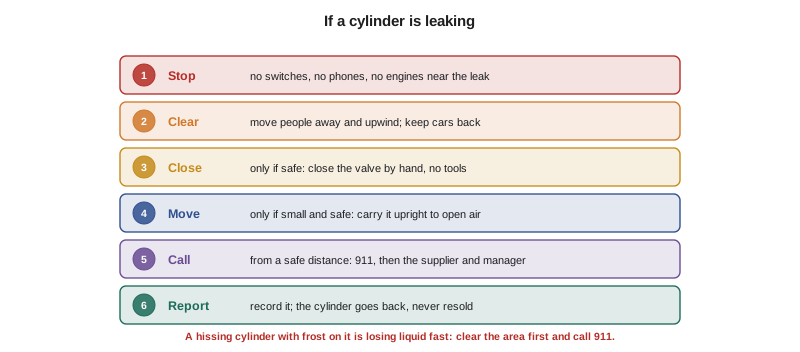
1. Stop anything that could ignite the gas
Do not switch lights or equipment on or off near the leak, do not start or stop a vehicle beside it, do not use a phone close to it, and stop anyone smoking. Switching off can make a spark as easily as switching on. At the forecourt, if gas could reach the dispensers, use the emergency shut-off to stop fuelling, as HSE-350 explained, from the store or from a post away from the leak.
2. Clear the area
Move people away from the leak, uphill and upwind, and keep them away. Ask drivers near the cage not to start their engines, or, if they are already running and well away, to drive off away from the leak. Keep new customers from parking near it. The distance needed depends on the size of the leak: for a small seep from a closed valve outdoors, a few car lengths is usually enough; for a large leak, a hissing relief valve or any leak with a strong smell spreading across the lot, clear the forecourt and the store and wait for the fire department to decide.
3. Close the valve, if it is safe
If the leak is from a cylinder valve that is not fully closed, turning the handwheel clockwise by hand may stop it. Only try this if the leak is small, the gas is not burning, and you can reach the valve without standing in a cloud of gas or touching frosted metal with bare hands. Never use a wrench or any tool on the handwheel, never try to tighten fittings, and never try to stop a leak from the relief valve or a crack in the body.
4. Move the cylinder, if it is small and safe
A small leaking cylinder that is not burning can sometimes be carried, upright, to a safer place: open ground away from the building, the cage, drains, vehicles and people. Wear gloves. Do not carry it through the store, do not put it in a drain or a ditch, do not lay it down, and do not try to move a cylinder that is leaking liquid, is frosted heavily, or is part of a larger leak. If in doubt, leave it where it is and keep people away.
5. Call for help
From a safe distance, call 911 for any leak that cannot be stopped, any large leak, any leak inside a building or vehicle, and any leak with a fire. Then call the supplier's emergency number, which is posted on the cage, and the manager. Tell the dispatcher what is leaking, how big the leak seems, whether it is burning, where it is, and whether anyone is hurt. Meet the fire department at the edge of the cleared area and tell them what you know.
6. Report
Record the leak in the cage log and on Northfield's incident form: what happened, when, what was done, who was called. A cylinder that leaked is tagged and goes back to the supplier; it is never put back in the cage or resold. If anyone was hurt or felt unwell, that is recorded too, and the report goes to the manager the same day.
A cylinder inside the store
Sometimes a customer carries a cylinder into the store, often to pay or because they did not see the sign. If it is not leaking, the cashier asks them politely to take it straight back outside and leave it by the cage. If it is leaking, or there is a smell of gas inside, the situation is more serious, because gas will collect on the floor and around displays and could reach the refrigeration compressors, the coffee machine or a light switch.
- Do not switch anything on or off. Leave the lights and equipment as they are.
- If it is safe and the leak is small, the person holding the cylinder carries it straight out through the nearest door to open ground away from the building.
- Open doors to let air through, if you can do so on the way out.
- Get everyone out of the store and keep them out.
- Call 911 from outside, well away from the building, and do not go back in until the fire department says it is safe.
A leak in a customer's car
Customers occasionally come back to the station, or call, because their car smells of gas after they picked up a cylinder. A leak in a closed car is dangerous because the gas collects inside and the car is full of ignition sources. The advice is:
- Do not start the engine, use the lights, the radio or the power windows, or smoke.
- Open the doors, get everyone out, and move away from the car.
- If it is safe and the leak is small, the driver closes the cylinder valve by hand and lifts the cylinder out, upright, onto open ground away from the car.
- Leave the doors open to air the car out, and call 911 if the smell is strong or the leak cannot be stopped.
- Do not drive the car until the smell has gone.
A leak at the dispenser
At the new site, a leak at the propane dispenser or from a customer's cylinder during filling is handled by the certified attendant under the site's filling procedure. The attendant stops the transfer with the dispenser's emergency shut-off, closes valves if safe, clears people away and calls for help. A cashier who sees a leak at the dispenser and the attendant is not there uses the emergency shut-off, clears the area and calls 911 and the manager. They do not try to work the dispenser.
How fast can a room fill?
The program below estimates how long a small leak inside a closed store room would take to bring the air to the lower flammable limit, if the gas mixed evenly. In reality the gas would collect near the floor first, so a flammable layer would form even sooner there. The leak rates are illustrative: a seep from a valve that is not quite closed, a moderate leak from a damaged valve and a fast leak from a relief valve.
# Time for a leak to bring a closed room to the lower flammable limit (well mixed, no ventilation).
R, T, P, M = 8.314, 288.15, 101_325, 44.1   # J/(mol K), 15 C, Pa, g/mol
LEL = 0.021
room = 6 * 3 * 2.4                          # store room, m3
gas_m3 = room * LEL / (1 - LEL)             # propane needed to reach the LEL
kg_needed = gas_m3 * P / (R * T) * M / 1000

leaks = {"slow seep": 0.005, "damaged valve": 0.05, "relief valve venting": 0.5}   # kg of propane per minute
print(f"room {room:.0f} m3 needs about {kg_needed:.2f} kg of propane to reach the LEL")
for name, rate in leaks.items():
    minutes = kg_needed / rate
    print(f"  {name:22} {rate:5.3f} kg/min -> about {minutes:6.1f} minutes")
print("near the floor, a flammable layer forms sooner, because the gas sinks")room 43 m3 needs about 1.73 kg of propane to reach the LEL slow seep 0.005 kg/min -> about 345.7 minutes damaged valve 0.050 kg/min -> about 34.6 minutes relief valve venting 0.500 kg/min -> about 3.5 minutes near the floor, a flammable layer forms sooner, because the gas sinks
Even the slow seep reaches the lower flammable limit in a small closed room in about six hours, the damaged valve in about half an hour and the relief valve in a few minutes, and near the floor a flammable layer would form well before that. Outdoors, with the air moving, the same leaks would usually disperse. This is the arithmetic behind the rule that cylinders stay outside, and behind the advice to get everyone out of a building where gas can be smelled.
For supervisors: practising the procedure
A leak procedure that has only been read is easy to forget under pressure. Run a short drill a couple of times a year, with an empty training cylinder and a cashier talking through each step out loud: what they would stop, where they would send people, whether they would close or move the cylinder, who they would call and what they would say. It takes five minutes and shows quickly which steps are unclear.
Worked problem
A hiss at the cage
Late on a summer afternoon, a customer tells Tyler that a cylinder in the cage is hissing. Tyler walks out and hears a steady hiss from the valve of one full cylinder, with no frost and a moderate smell. A car is parked, engine running, about 4 m (13 ft) from the cage. What should he do?
Show solution
- Stop ignition sources: he asks the driver of the running car, which is close, to drive slowly away from the cage, and stops anyone else from starting engines or smoking near the cage.
- Clear the area: he asks customers to move away from the cage and the store door, uphill and upwind, and puts a cone or two to keep cars from parking nearby.
- Close: the leak is small, not burning and not frosted, so wearing gloves he unlocks the cage and turns the handwheel clockwise by hand. The hiss continues, so the leak is from the valve itself, not an open valve.
- He does not try to move the full cylinder past other cylinders in the cage. He steps back, calls the supplier's emergency number and the manager, and calls 911 because he cannot stop the leak.
- When the leak is dealt with, he tags the cylinder, makes sure it goes back to the supplier and records the incident.
Answer: Stop ignition sources, clear people and cars away, try to close the valve by hand, call the supplier, the manager and 911 when it cannot be stopped, and record it.
Common mistakes
MistakeTurning off the lights in a room where gas can be smelled.
InsteadLeave switches alone; switching off can spark too.
MistakeUsing a wrench to stop a leaking valve.
InsteadClose the handwheel by hand only, and only if safe.
MistakePutting a leaking cylinder in a drain or ditch.
InsteadMove it, if safe, to open ground away from drains and low spots.
MistakeCarrying a leaking cylinder through the store.
InsteadTake it out by the nearest door to open ground, or leave it and clear the area.
MistakePutting a cylinder that leaked back in the cage once it stops.
InsteadTag it and return it to the supplier.
Summary and key terms
- Leaks show up by smell, hissing, frost, mist, bubbles and people feeling unwell.
- Treat a hiss or frost as a leak even if there is no smell.
- Northfield's procedure: stop ignition sources, clear the area, close the valve if safe, move if small and safe, call, and report.
- Never use tools on a leaking valve, and never move a cylinder into a low spot or through a building.
- A cylinder leaking inside a store or car is a serious emergency: get people out and call 911.
- A small leak in a closed room can reach the flammable limit in minutes.
- Leak procedure
- The written steps staff follow when a cylinder is leaking.
- Emergency shut-off
- A button that stops fuel or propane dispensers in an emergency.
- Ignition source
- Anything that could light the gas, such as a flame, a spark or a hot surface.
- Upwind
- The direction the wind is coming from, where gas is less likely to drift.
- Incident form
- The record of what happened, what was done and who was called.
Practice problems
Work each problem on paper first, then reveal the answer to check.
Give four signs that a cylinder is leaking.
Show answer
For example a gas smell, a hiss, frost on the valve or body, a white mist, bubbles, dead grass, or people feeling unwell.
List Northfield's six leak steps.
Show answer
Stop ignition sources, clear the area, close the valve if safe, move it if small and safe, call for help, report.
When may a cashier try to close the valve on a leaking cylinder?
Show answer
Only if the leak is small, not burning and the valve can be reached safely, by hand without tools.
Where should a small leaking cylinder be moved, if it is safe to move it?
Show answer
Upright, to open ground away from buildings, the cage, drains, vehicles and people.
What should a customer do if their car smells of gas after buying a cylinder?
Show answer
Not start the car or use electrics, get out, close the valve and remove the cylinder if safe, air the car out and call 911 if needed.
What happens to a cylinder after it has leaked?
Show answer
It is tagged and returned to the supplier, never put back in the cage.
Lesson quiz · 5 questions
Score 60% or more to complete this lesson.
Create a free account to save your progress, take quizzes and earn a certificate.