
HSE-353 · Lesson 11 of 12 · 24 min
The hazards of refilling done wrong
Lesson 10 explained who may fill a propane cylinder and what a certified filler checks first. This lesson looks at the other side: what goes wrong when cylinders are filled by the wrong person, by the wrong method, or when they should not have been filled at all. Most of the serious incidents with small cylinders trace back to one of a short list of filling mistakes. Knowing that list helps everyone at the station, including cashiers who never touch the dispenser, because customers ask about these things at the counter every week.
This is still an awareness lesson. It explains why the rules exist and how to answer customers. It does not describe how to fill, decant or adapt anything, and nothing in it should be read as a method. If a customer wants to do something this lesson warns against, the answer is no, with a short reason and a safe alternative.
Why a cylinder is never filled to the top
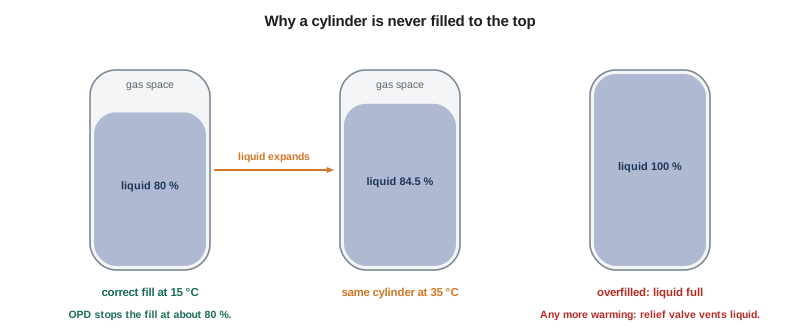
Liquid propane expands a lot as it warms, far more than water does. A barbecue cylinder is therefore filled only partly with liquid, leaving a space of vapour above it. That space is not wasted. It is room for the liquid to grow into on a hot afternoon, in the back of a car or on a sunny patio. The codes set the maximum fill so that, at the highest temperature the cylinder is likely to reach in normal use, the liquid still does not fill the whole cylinder.
For a barbecue cylinder filled by weight, that maximum works out to about 80 % of the inside volume as liquid at a normal filling temperature. The overfill protection device, described in Lesson 3, is a backup that stops the flow at about the same level. Certified fillers do not rely on it, because a float can stick, and because a cylinder can be overfilled by other means. A properly filled cylinder that warms from 15 °C (59 °F) to 35 °C (95 °F) sees its liquid grow from about 80 % to about 85 % of the space. That is fine. The danger begins when a cylinder starts out fuller than it should.
What happens when the space runs out
Once the liquid fills the whole cylinder, any further warming has nowhere to go. A liquid cannot be squeezed much, so the pressure rises very quickly, far faster than in a properly filled cylinder whose vapour space acts as a cushion. The pressure relief valve, also described in Lesson 3, opens to protect the cylinder from bursting. In a properly filled cylinder that valve releases vapour. In a liquid-full cylinder it releases liquid propane, which turns into roughly 270 times its volume of gas as it escapes. Instead of a short hiss, the result can be a large, cold, heavy cloud that spreads along the ground, into a car or under a door.
That is why overfilling and heat together cause so many incidents. The cylinder was usually filled in the morning, at a cool temperature. It went into a closed car or a garage, or sat beside a barbecue in the sun. By mid-afternoon the liquid had nowhere left to go, the relief valve opened, and the gas found an ignition source: a pilot light, a cigarette, a light switch, a car's electrics. The relief valve did its job. The real failure was the fill, hours earlier, and often somewhere else.
The common filling mistakes
The mistakes below are the ones fire services, propane associations and regulators warn about again and again. A station that knows them can spot them in a returned cylinder or a customer's question:
- Filling by the meter, the float or by ear rather than by weight or the fixed liquid level gauge, so the cylinder ends up overfilled.
- Filling a cylinder that has no overfill protection device when one is required, so there is no backup at all.
- Filling a cylinder that is past its requalification date, damaged, corroded or fire-damaged, as Lessons 3 and 4 described.
- Moving propane from one cylinder to another at home, sometimes called decanting, usually from a large cylinder into a small one. There is no way to control the fill, and liquid is handled in the open with no training or protective equipment.
- Refilling single-use camping bottles with an adapter bought online.
- Filling containers that were never meant to hold propane, or that have been modified, painted over or had their markings removed.
- Filling indoors, in a garage, or with a vehicle engine running nearby.
None of these is rare. Online videos make several of them look easy, and adapters for some of them are sold widely. A customer who has watched such a video may honestly not understand why the station refuses to help.
Single-use camping bottles
Small green camping bottles, usually about 1 lb (450 g) of propane, are built as single-use, non-refillable containers. In Canada they are typically marked TC-39M; the marking means the container was approved under Transport Canada's rules for non-refillable cylinders. They are thinner and lighter than refillable cylinders, have no overfill protection device, and their valves were not designed for repeated filling. Refilling them is unsafe, and transporting a refilled single-use cylinder is not allowed under the dangerous goods rules. Some refillable small cylinders are now sold for camping, built to a different specification and clearly marked as refillable, and those should be filled only by a certified filler.
A refilled camping bottle is especially dangerous because of where it ends up: in a tent, a camper, an ice-fishing shack or a cabin, often with a heater or a lantern, and often with people asleep. A leak at a worn valve in a small closed space can produce a flammable mixture quickly, and a heater in a poorly ventilated space also raises the risk of carbon monoxide.
Stations do not fill single-use bottles, do not sell refill adapters, and do not accept refilled bottles back for any purpose except disposal through the proper channel. Lesson 7 described how the cage log records refused and disposed cylinders; a refilled camping bottle that turns up is noted there too.
Home transfers and adapters
Some customers have a large cylinder for a heater or a camper and want to use it to top up small ones at home. Others buy adapters that connect two cylinders together. Whatever the method, a home transfer has the same problems: no scale or approved gauge to stop at the right level, liquid propane handled by someone without training or protective equipment, no control of ignition sources, and a cylinder of unknown fill that then goes into a car or a tent. The station's answer is simple: we cannot help with that, and here is the safe option, such as an exchange cylinder, a fill at a certified dispenser, or a refillable small cylinder filled by a certified filler.
How filling problems show up at the cage
Cashiers at the exchange cage see the results of filling mistakes more often than they might think. Signs that a returned cylinder may have been filled outside the proper system include:
- It is a different brand or colour from the exchange stock, or has a customer's own name or marks on it.
- It is noticeably heavier than an empty should be, which can mean it was never used, or was topped up somewhere unofficial.
- There are signs of tampering at the valve, such as a missing seal, tool marks, tape or an unusual fitting attached.
- It has frost on it on a warm day, or a smell of gas, which can mean it is leaking or overfilled.
- The customer mentions filling it themselves, or asks whether the station takes refilled bottles.
None of these signs proves a cylinder was filled wrongly, and the cashier is not expected to investigate. Lesson 4's four questions still apply: if a returned cylinder is damaged, out of date, tampered with or leaking, it does not go back into the cage. It is set aside in the refused-cylinder area and the supplier is told, as Lesson 7 described. A frosting or smelling cylinder is a leak response from Lesson 8, not an inspection.
Talking to customers about refilling
Customers ask about filling at the counter all the time, and the cashier's answer can prevent an incident later in the day. A few principles help:
- Be honest and short. Explain the reason in one sentence, without lecturing.
- Offer an alternative every time: an exchange cylinder, the dispenser at the new site when a certified filler is on shift, or the name of a requalifier.
- Never suggest a workaround, even jokingly, and never agree to look the other way.
- If a customer insists on doing something unsafe on the lot, such as connecting an adapter or decanting into a camping bottle, ask them to stop, and call the manager. If they will not stop and gas is being released, treat it as a leak under Lesson 8.
At Northfield, Leah gave staff a short set of lines to use, written on a card behind the counter:
- 'We can't fill those small green bottles; they're one-use only. We do have the refillable kind, or a disposal bin for the empties.'
- 'We don't help with moving propane between tanks. It's how a lot of fires start. You can swap here or get it filled at our highway site.'
- 'Sorry, this one's past its date, so we can't take it back into the cage. Here's where it can be checked or recycled.'
How far does a liquid-full cylinder go?
The program below uses a simple, approximate model of how liquid propane's density changes with temperature to show why the fill level matters so much. It estimates the temperature at which a cylinder becomes liquid-full, starting from different fill levels at 15 °C. The numbers are illustrative only: real behaviour depends on the cylinder, the propane mixture and how the temperature changes, and nobody should use this to decide how much to put in a cylinder.
# Illustrative only: at what temperature does a cylinder become liquid-full?
# Simple straight-line model of liquid propane density near room temperature.
rho15 = 0.508          # kg/L at 15 deg C (approximate)
slope = 0.00138        # kg/L lost per deg C of warming (approximate, 0 to 50 deg C)

def density(t_c):
    return rho15 - slope * (t_c - 15)

def liquid_full_temp(fill_fraction_at_15):
    # liquid volume grows as density falls; full when fill * rho15 / density = 1
    return 15 + (rho15 - fill_fraction_at_15 * rho15) / slope

for fill in (0.80, 0.85, 0.90, 0.95, 0.98):
    t = liquid_full_temp(fill)
    print(f"filled to {fill:.0%} at 15 C -> liquid-full at about {t:.0f} C ({t*9/5+32:.0f} F)")

print()
car = 50  # a closed car in summer sun can reach this inside (see Lesson 5)
for fill in (0.80, 0.95):
    share = fill * rho15 / density(car)
print(f"at {car} C, a cylinder filled to {fill:.0%} would need {share:.0%} of its space for liquid")filled to 80% at 15 C -> liquid-full at about 89 C (192 F) filled to 85% at 15 C -> liquid-full at about 70 C (158 F) filled to 90% at 15 C -> liquid-full at about 52 C (125 F) filled to 95% at 15 C -> liquid-full at about 33 C (92 F) filled to 98% at 15 C -> liquid-full at about 22 C (72 F) at 50 C, a cylinder filled to 80% would need 88% of its space for liquid at 50 C, a cylinder filled to 95% would need 105% of its space for liquid
The pattern is the point, not the exact numbers. A cylinder filled correctly stays well clear of liquid-full in any normal weather. One filled to 95 % becomes liquid-full at around the temperature of a warm day, and at the temperature inside a closed car in summer it would need more room than the cylinder has, so the relief valve would be releasing liquid. A few percent of overfill removes almost all of the safety margin the codes build in.
For supervisors: when a customer has already done it
Sometimes the problem is discovered after the fact: a customer mentions they refilled their camping bottles at home, or a cylinder in their car is frosting. Do not argue about what they did. Deal with the immediate hazard first, using the leak steps from Lesson 8 if gas is escaping, and then give clear advice: refilled bottles should not be used or transported and should go to proper disposal. Record the event in the cage log and, if a refilled or tampered cylinder was in the exchange stock, tell the supplier so they can check the rest of the delivery.
Worked problem
The customer with the adapter
On a hot Saturday, a customer at the original store asks Ben to sell him two full exchange cylinders and mentions that he will use one of them to refill his camping bottles at the campground with an adapter he bought online. He asks whether the station sells the green bottles empty so he can fill those too. What should Ben do?
Show solution
- Ben can sell the exchange cylinders; that is a normal sale. He checks the customer's returned empties as usual.
- He explains in one sentence that the small green bottles are single-use only, that refilling them is a common cause of fires in tents and campers, and that the station does not sell empties for refilling.
- He offers the safe options: new single-use bottles, or the refillable small cylinders that a certified filler can fill at the highway site.
- He reminds the customer to carry the cylinders upright in the trunk with the valves closed, and not to leave them in the car in the sun (Lesson 5).
- Because the customer said he plans to use the adapter, Ben mentions it to Raj, who adds a line to the cage log. There is nothing more the station can do once the customer leaves, but the advice may change what he does.
Answer: Sell the exchange cylinders, decline to help with refilling, explain why briefly and offer the safe alternatives.
Common mistakes
MistakeThinking the overfill protection device makes overfilling impossible.
InsteadThe OPD is a backup; correct filling by weight or the fixed gauge is what prevents overfilling.
MistakeBelieving a relief valve venting from a hot cylinder means the valve is faulty.
InsteadThe valve is doing its job; the cause is often heat combined with overfilling.
MistakeTreating single-use camping bottles as refillable if they look fine.
InsteadSingle-use bottles are never refilled, however good they look.
MistakeSuggesting a customer transfer propane at home to save money.
InsteadOffer an exchange or a certified fill instead.
MistakePutting a cylinder that looks tampered with back into the cage.
InsteadSet it aside as a refused cylinder and tell the supplier.
Summary and key terms
- The vapour space above the liquid is room for expansion; correct fills leave about 20 % of the space for it.
- An overfilled cylinder can become liquid-full on a warm day, and its relief valve then releases liquid propane.
- Most filling incidents come from overfilling, filling the wrong cylinders, home transfers and refilled single-use bottles.
- Single-use camping bottles must never be refilled, and stations do not sell refill adapters or empties for refilling.
- Returned cylinders that look tampered with or overfilled are refused and reported to the supplier.
- At the counter, give a short reason and always offer a safe alternative.
- Vapour space
- The gas-filled space above the liquid in a cylinder that allows the liquid to expand.
- Liquid-full
- A cylinder whose liquid has expanded to fill the whole inside, leaving no vapour space.
- Overfilling
- Putting more propane into a cylinder than the codes allow.
- Decanting
- Moving propane from one cylinder to another outside a proper filling system.
- Single-use cylinder
- A non-refillable cylinder, such as a TC-39M camping bottle.
- Refill adapter
- A fitting sold to connect cylinders for unofficial filling; stations do not sell or use them.
Practice problems
Work each problem on paper first, then reveal the answer to check.
Why is a barbecue cylinder filled only to about 80 % liquid?
Show answer
To leave room for the liquid to expand as it warms, so the cylinder never becomes liquid-full in normal use.
What comes out of the relief valve of a liquid-full cylinder that keeps warming?
Show answer
Liquid propane, which turns into a large cloud of gas.
Name three common filling mistakes.
Show answer
Any three of: filling by meter or float, filling cylinders without an OPD or past their date, home transfers, refilling single-use bottles, filling unapproved containers, filling indoors.
What should a cashier say when asked to sell empty camping bottles for refilling?
Show answer
That they are single-use only and cannot be refilled, and offer new bottles or refillable small cylinders instead.
What happens to a returned exchange cylinder with tool marks and tape at the valve?
Show answer
It is refused, set aside in the refused area and reported to the supplier.
In the program, why does a cylinder filled to 95 % become a problem on a warm day?
Show answer
It becomes liquid-full at around a warm-day temperature, leaving no room for further expansion.
Lesson quiz · 5 questions
Score 60% or more to complete this lesson.
Create a free account to save your progress, take quizzes and earn a certificate.