
HSE-353 · Lesson 3 of 12 · 22 min
Cylinders, valves and markings
A barbecue cylinder is a simple-looking object, but it is a pressure vessel built to a government specification, and almost every part of it has a safety job. This lesson goes through the parts a cashier can see, what the markings stamped on the collar mean, and why the valve with the triangular handwheel is the most important single safety feature on a modern cylinder. Knowing these things is what lets a cashier spot a cylinder that should not go back into the cage, and answer customers who ask why their old cylinder cannot be filled.
The parts of a cylinder
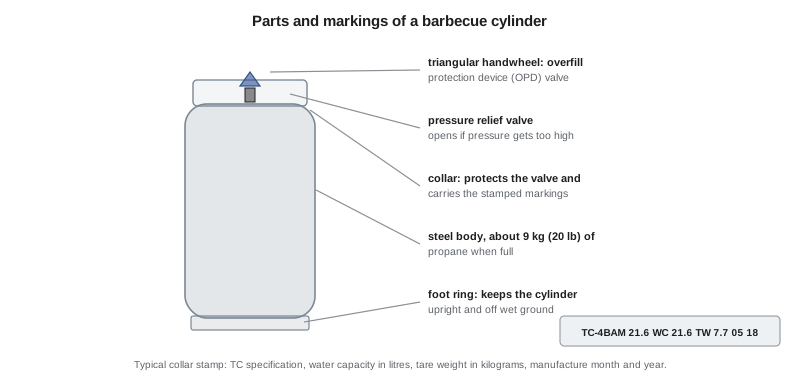
The common barbecue cylinder holds about 9 kg (20 lb) of propane. When full it weighs about 17 kg (37 lb) in total: about 8 kg (17 lb) of steel and 9 kg (20 lb) of propane. Larger cylinders of 14 kg (30 lb), 18 kg (40 lb) and up are used for trailers, construction heaters and forklifts, and very small disposable bottles of about 0.45 kg (1 lb) are sold for camping stoves and torches. The parts are similar across the refillable sizes:
- The body: a welded steel shell, sometimes aluminium on lighter cylinders, painted to resist rust. It is designed for a working pressure well above anything propane reaches in normal use.
- The foot ring: a steel ring welded to the bottom that keeps the cylinder upright, lifts it off wet ground and protects the bottom from damage.
- The collar, or guard ring: a ring welded to the top that protects the valve if the cylinder falls, gives a handle for carrying, and carries the stamped markings.
- The valve: screwed into the top of the cylinder, it combines the shut-off valve, the overfill protection device, the pressure relief valve and, on most cylinders, a fixed liquid level gauge.
The valve and its jobs
The valve on a modern barbecue cylinder does four separate jobs.
The shut-off valve and the handwheel
Turning the handwheel clockwise closes the valve and anticlockwise opens it. When the cylinder is not connected to an appliance, the valve should be fully closed. Customers sometimes leave a valve slightly open after disconnecting a barbecue; most modern valves will not let gas flow unless something is connected, but it is still a bad habit, and a cashier who hears a hiss from a returned cylinder should treat it as a leak.
The overfill protection device
The overfill protection device, or OPD, is a float inside the cylinder connected to a valve. As the cylinder fills, the float rises with the liquid, and when the liquid reaches about 80 % of the cylinder's volume the float closes the filling path. This leaves room above the liquid for it to expand on a hot day without the cylinder becoming completely full of liquid, which is the condition that leads to liquid being forced out of the relief valve, as Lesson 11 explains.
Valves with an OPD have a triangular handwheel, so they can be recognized at a glance. Older valves have a round or star-shaped handwheel and no float. In both countries, codes have for many years required barbecue-size cylinders to have an OPD valve before they can be refilled, so a cylinder with an old round handwheel is no longer filled; it has to have its valve replaced by a qualified shop or be retired. The OPD is a backup, not a fill gauge: certified fillers still fill by weight or with the fixed liquid level gauge, and do not rely on the float to tell them when to stop.
The pressure relief valve
The pressure relief valve is a spring-loaded valve built into the main valve body. If the pressure inside the cylinder rises too high, usually because the cylinder is very hot or overfilled, the relief valve opens and lets gas out until the pressure drops, then closes again. It is set far above normal pressure, typically around 2,600 kPa (375 psi) on common barbecue cylinders, so in normal use it never opens. When it does, it releases a loud, sometimes violent jet of propane that can be lit by any nearby flame. The relief valve protects the cylinder from bursting; it does not make the release safe.
The relief valve must sit in the gas space at the top of the cylinder to work as designed. If the cylinder is lying on its side, the relief valve may sit in the liquid, and if it opens it will release liquid propane, which expands to about 270 times its volume. This is the main reason cylinders must be stored, carried and used upright.
The fixed liquid level gauge
Most cylinders also have a small screw on the valve, called the fixed liquid level gauge or bleeder valve. A tube inside reaches down to the 80 % level. During filling, a certified filler opens this screw; when liquid reaches the end of the tube, a white mist of liquid propane appears, telling them the cylinder is at its maximum level. Customers should never open it. It is a filler's tool, not a way to check how much propane is left.
The outlet connection
The threaded outlet is where the barbecue hose connects. Modern cylinders have a large external thread that the appliance's coupling screws onto by hand. Older cylinders used a smaller left-hand internal thread, called a POL connection, which needs a wrench. Those older valves should be fitted with a plug or cap when not connected, while modern valves generally should not be plugged. The supplier's instructions say which applies to the cylinders in Northfield's cage.
Markings on the collar
Every refillable cylinder sold in Canada carries markings stamped into the collar. They look cryptic, but they tell the cashier and the filler a great deal. The main ones are:
- The specification: TC followed by a code such as 4BA or 4BW, showing that the cylinder was built to a Transport Canada specification and may be filled and used in Canada. Many cylinders are dual-marked with both TC and US DOT specifications.
- The water capacity, marked WC, in litres: the volume of water the cylinder would hold if completely full. A barbecue cylinder is about 21.6 L.
- The tare weight, marked TW, in kilograms: the weight of the empty cylinder, usually including the valve. Fillers weigh the cylinder and add the allowed weight of propane to the tare weight.
- The manufacturer's name or mark and a serial number.
- The date of manufacture: a month and a year, such as 05 18 for May 2018, sometimes with an inspector's mark between them.
- Requalification marks, if the cylinder has been requalified: a month, the requalifier's registered mark, a year and a letter for the test method, such as E for an external visual inspection.
How long a cylinder can be filled
Steel cylinders do not last forever. Rust, dents and wear weaken them, so the rules require each cylinder to be requalified, that is inspected and if necessary tested by a registered requalifier, at set intervals. In Canada, a cylinder must be requalified or replaced 10 years after its date of manufacture, and again at each later interval, under the TDG Regulations and the CSA B339 standard they adopt. It is against the law to fill a cylinder that is out of date or damaged. Transport Canada keeps a public list of registered requalifiers.
The date rules apply to filling, not to owning or using a cylinder. An out-of-date cylinder that is still in good condition can be used until it is empty, but it cannot be filled again until it has been requalified. For an exchange cage, the supplier checks dates at its plant and pulls old cylinders out of the pool, so a cashier does not need to read the date on every empty that comes back. At the new site's dispenser, the certified filler must check the date on every customer cylinder before filling it.
Reading a cylinder's age
The program below works out when a cylinder's next requalification is due from the stamps on its collar, using the Canadian rule of 10 years and the US rules for each test method. A filler would use the same logic before deciding whether a cylinder can be filled today.
# When is a barbecue cylinder due for requalification?
# Canada: 10 years after manufacture or the last requalification.
# US: 12 years after manufacture, then 12 (volumetric test), 10 (proof test 'S') or 5 (visual 'E').
from datetime import date

def due(country, made, requal=None, method=""):
    """made and requal are (month, year); returns (month, year) when requalification is due."""
    m, y = requal if requal else made
    if country == "CA":
        years = 10
    elif requal is None:
        years = 12
    else:
        years = {"": 12, "S": 10, "E": 5}[method]
    return m, y + years

today = (11, 2026)
cylinders = [
    ("CA", (5, 2018), None, ""),
    ("CA", (3, 2014), None, ""),
    ("CA", (6, 2009), (8, 2019), "E"),
    ("US", (4, 2015), None, ""),
    ("US", (2, 2010), (2, 2022), "E"),
    ("US", (9, 2012), (7, 2024), "S"),
]
for country, made, requal, method in cylinders:
    m, y = due(country, made, requal, method)
    ok = (y, m) > (today[1], today[0])
    stamp = f"made {made[0]:02}/{made[1]}" + (f", requalified {requal[0]:02}/{requal[1]} {method}" if requal else "")
print(f"{country}: {stamp:38} due {m:02}/{y} -> {'may be filled' if ok else 'do not fill'}")CA: made 05/2018 due 05/2028 -> may be filled CA: made 03/2014 due 03/2024 -> do not fill CA: made 06/2009, requalified 08/2019 E due 08/2029 -> may be filled US: made 04/2015 due 04/2027 -> may be filled US: made 02/2010, requalified 02/2022 E due 02/2027 -> may be filled US: made 09/2012, requalified 07/2024 S due 07/2034 -> may be filled
Only one of the six cylinders cannot be filled today: the Canadian cylinder made in 2014 that was never requalified, whose 10 years ran out in 2024. The US cylinder that had a visual inspection in February 2022 is still in date, but only until February 2027, so a filler would mention that to the customer. A filler who is unsure reads the stamps again, and if they are worn or unclear, does not fill.
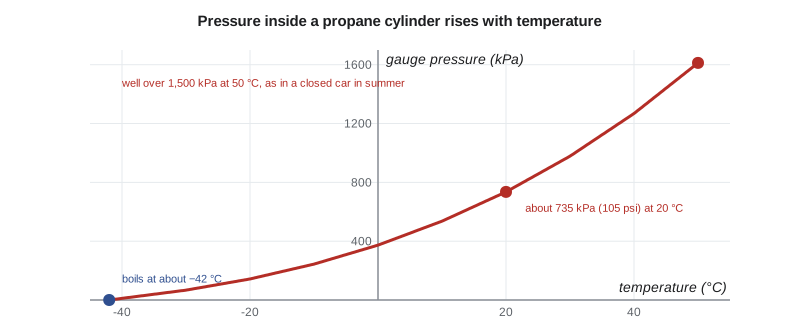
How pressure rises with heat
Lesson 2 explained that the pressure in a cylinder depends on its temperature. The chart below shows how steeply it rises. Between a cool day and a hot one, the pressure more than doubles, and a cylinder in a closed car in summer can reach temperatures where the pressure is several times what it is in a cool garage. A cylinder that is in good condition and correctly filled can handle these pressures; the problems start when it is overfilled, damaged, or heated by a fire.
For supervisors: an old cylinder in the cage
If a cashier finds a cylinder with a round handwheel or very old date stamps in the cage of full exchange cylinders, something has gone wrong at the supplier's end. Do not sell it. Set it aside, tag it and report it to the supplier at the next delivery. It is worth asking the supplier how it happened, because it suggests that checks at the plant were missed.
Worked problem
Reading the collar
At the new site, a customer asks Raj to fill a cylinder stamped TC-4BW, WC 21.6, TW 8.1, with a manufacture date of 07 15 and no requalification marks. The valve has a triangular handwheel. It is November 2026. May Raj fill it?
Show solution
- The TC marking shows it may be filled in Canada, and the triangular handwheel shows it has an OPD valve.
- Made in July 2015, it was due for requalification 10 years later, in July 2025.
- There are no requalification marks, so it is out of date.
- Raj must not fill it. He explains why and tells the customer it can be requalified by a registered requalifier, or exchanged or recycled.
Answer: No: the cylinder is past its 10-year requalification date, so it must be requalified before it can be filled.
Common mistakes
MistakeUsing the float or OPD to decide when a cylinder is full.
InsteadFill by weight or with the fixed liquid level gauge; the OPD is only a backup.
MistakeFilling a cylinder with a round handwheel.
InsteadBarbecue-size cylinders need an OPD valve, with a triangular handwheel, to be refilled.
MistakeFilling a cylinder without reading the date stamps.
InsteadCheck the manufacture and requalification dates every time.
MistakeLaying a cylinder on its side because it fits better.
InsteadKeep it upright so the relief valve stays in the gas space.
MistakeLetting customers open the bleeder screw to see how much is left.
InsteadThe fixed liquid level gauge is a filler's tool only.
Summary and key terms
- A barbecue cylinder has a body, a foot ring, a collar and a valve with several safety functions.
- The overfill protection device stops filling at about 80 % and is recognized by its triangular handwheel.
- The pressure relief valve protects the cylinder from bursting but releases flammable gas when it opens.
- Collar markings show the specification, water capacity, tare weight, manufacture date and any requalification.
- In Canada, a cylinder must be requalified 10 years after manufacture and at each later interval.
- Out-of-date or damaged cylinders must not be filled.
- Pressure rises steeply with temperature.
- Overfill protection device (OPD)
- A float-operated valve that stops filling at about 80 % of the cylinder's volume.
- Pressure relief valve
- A spring-loaded valve that opens to release gas if the pressure gets too high.
- Fixed liquid level gauge
- A small valve with a tube to the 80 % level, used by fillers to see when a cylinder is full.
- Water capacity (WC)
- How much water the cylinder would hold if completely full.
- Tare weight (TW)
- The weight of the empty cylinder.
- Requalification
- Inspection and testing by a registered requalifier that allows a cylinder to be filled for another period.
- Collar
- The ring on top of the cylinder that protects the valve and carries the markings.
Practice problems
Work each problem on paper first, then reveal the answer to check.
How do you recognize a valve with an overfill protection device?
Show answer
It has a triangular handwheel.
Why must the pressure relief valve sit in the gas space?
Show answer
So that if it opens it releases gas, not liquid, which would expand about 270 times.
What do WC and TW on the collar mean?
Show answer
Water capacity and tare weight, the empty weight of the cylinder.
A cylinder was made in March 2017 and never requalified. When must it be requalified in Canada?
Show answer
By March 2027, 10 years after manufacture.
May an out-of-date cylinder in good condition still be used?
Show answer
Yes, until it is empty, but it cannot be filled again until it is requalified.
Who should open the fixed liquid level gauge?
Show answer
Only a certified filler, during filling.
Lesson quiz · 5 questions
Score 60% or more to complete this lesson.
Create a free account to save your progress, take quizzes and earn a certificate.