
HSE-353 · Lesson 12 of 12 · 24 min
Capstone: a propane safety program for the station
The first eleven lessons each looked at one part of handling propane at a station: the gas itself, the cylinders, checking and carrying them, the cage, deliveries and records, leaks and fires, who may fill, and what goes wrong when filling is done badly. This final lesson puts the parts together. A station does not stay safe because each worker remembers a list of rules. It stays safe because the rules are written down, people are trained on them, someone checks that they are followed, and problems found along the way are fixed. That is a propane safety program.
We follow Leah Morin as she reviews propane at both Northfield sites a few months after the highway site opened. She starts with an audit, writes an action plan, and sets up the routines that will keep the program working after the review is over. The same steps work for any station, whether it only runs an exchange cage or also has a dispenser.
What a propane program contains
A propane program for a station does not need to be long. Northfield's fits on a few pages, plus the forms and logs it refers to. It covers:
- Scope and roles: which sites, which propane activities (exchange, filling or both), and who is responsible for what, from the supplier to the cashier.
- The hazards: a short summary of the hazard assessment, drawing on Lessons 2, 3, 8 and 9.
- The cage: location, distances, protection, locking, signs and the daily check, from Lesson 6.
- Receiving and returns: delivery checks, stock counts, the four questions for returned cylinders and the refused-cylinder area, from Lessons 4 and 7.
- Handling and customer guidance: carrying, loading and the words to use at the counter, from Lessons 5 and 11.
- Filling, where it applies: the list of certified fillers, the dispenser key, the register and the rules for refusing a fill, from Lesson 10.
- Emergencies: the leak and fire procedures, emergency numbers, shut-offs and drills, from Lessons 8 and 9.
- Training: who needs which training, how often, and how it is recorded.
- Records: the cage log, stock counts, refusals, training records and incident reports.
- Review: how often the program is audited and updated, and what triggers an early review.
The rules behind the program were set out in Lesson 1: in Alberta, the Safety Codes Act with CSA B149.2 and the Alberta Fire Code for the cage and filling, the TDG Regulations for cylinders on the road, and the OHS Code for hazard assessment, training, WHMIS and emergency planning. The program is how Northfield shows it meets all of them in practice.
Starting with an audit
Leah begins by walking both sites with a checklist and scoring each part of the program from 1 to 5, where 1 means the part is missing or not followed and 5 means it is written, understood and done every time. She asks staff on each shift to show her how they do things, rather than asking whether they do them, because the honest answer usually comes from watching.
Her first audit, at the original store, found a mixed picture:
- Cage location and protection: 4. The cage is in the right place, with bollards, but one bollard was knocked out of line by a delivery truck and not reported.
- Cage locked and signed: 3. Locked at night, but left unlocked for long stretches on busy afternoons, and one sign had faded.
- Stock counts and records: 2. Counts done at deliveries, but not daily, and the log had gaps of several days.
- Returned cylinder checks: 2. Two of four cashiers checked the date and the valve; the others just swapped.
- Leak and fire procedure: 3. Posted, and most staff could describe it, but nobody knew where the cage key spare was kept.
- Training records: 1. Training happened at hire, but there were no records for three of the six staff.
- Customer guidance: 2. Staff gave good advice when asked, but nobody offered it, and there was no counter card.
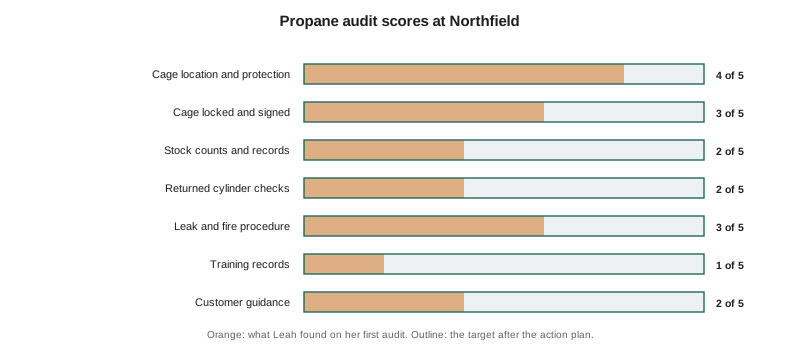
The highway site scored better on records and filling, because it was set up recently with Lesson 10's system, but worse on the cage, which sits closer to the diesel lane than the supplier's drawing showed. Its overnight worker also did not know whether the dispenser's emergency shut-off cut the power to the pump or only closed a valve.
Turning the audit into an action plan
An audit is only useful if it leads to changes. Leah ranks the gaps by how much harm they could lead to and how far the score is from the target, so that the most important fixes come first rather than the easiest ones. The program below shows the calculation she uses: each gap is weighted by how serious the consequences of that part failing could be, and the list is sorted.
# Rank audit gaps so the most important fixes come first.
# score: audit result out of 5; weight: how serious a failure of this part could be (1-5)
audit = [
    ("Cage location and protection",  4, 5),
    ("Cage locked and signed",        3, 3),
    ("Stock counts and records",      2, 2),
    ("Returned cylinder checks",      2, 5),
    ("Leak and fire procedure",       3, 5),
    ("Training records",              1, 2),
    ("Customer guidance",             2, 4),
]
target = 5

ranked = sorted(audit, key=lambda r: (target - r[1]) * r[2], reverse=True)
print(f"{'part of the program':32}{'score':>6}{'weight':>8}{'priority':>10}")
for name, score, weight in ranked:
    print(f"{name:32}{score:>6}{weight:>8}{(target - score) * weight:>10}")

total = sum(s for _, s, _ in audit)
print(f"\noverall: {total} of {target * len(audit)} ({total / (target * len(audit)):.0%})")part of the program score weight priority Returned cylinder checks 2 5 15 Customer guidance 2 4 12 Leak and fire procedure 3 5 10 Training records 1 2 8 Cage locked and signed 3 3 6 Stock counts and records 2 2 6 Cage location and protection 4 5 5 overall: 17 of 35 (49%)
Returned cylinder checks come out on top: the score is low and a missed check could put a damaged or tampered cylinder in a customer's car. Customer guidance and the leak and fire procedure come next. Training records rank only fourth despite the lowest score, because missing paperwork on its own does not hurt anyone, although it does hide whether people were trained. The weights are a judgement, and Leah discusses them with Raj and with Dale from Aspen Propane; the value of the calculation is that it makes the judgement visible and consistent.
The action plan
Each action in the plan has an owner, a date and a way to check it was done. Northfield's first plan looked like this:
- Returned cylinder checks: Raj retrains every cashier on the four questions at the start of their next shift, using a returned cylinder from the refused area. Check: Leah watches each cashier do one swap within two weeks.
- Customer guidance: put the counter card from Lesson 11 at both tills and add two lines on carrying cylinders in cars. Check: the card is in place, and staff use it in a role-play.
- Leak and fire procedure: label a spare cage key in the office key box, add it to the procedure, and run a short leak drill on each shift. Check: drill records for every shift within a month.
- Highway site cage: ask Aspen Propane and the fire department to look at the distance from the diesel lane and move the cage or add protection as they advise. Check: written confirmation from both.
- Dispenser shut-off: have the installer explain and label exactly what the emergency shut-off does, and add it to the overnight briefing. Check: every certified filler can explain it.
- Training records: create a training register for both sites, enter what can be confirmed, and retrain anyone without a record. Check: no blanks in the register.
- Stock counts: move to a daily count at shift change with a two-line entry in the cage log. Check: no gaps in the log in the following month.
- Cage locking and signs: lock the cage after every sale and replace the faded sign. Check: spot checks at random times.
The plan avoids actions that only say 'remind staff'. A reminder fades within weeks. Changes to the work itself, such as a key that lives with the cashier, a counter card, a register with a monthly check or a label on a shut-off, keep working after the reminder has been forgotten.
Training that sticks
Training is the part of most programs that looks fine on paper and fails in practice. Northfield's program sets out four levels:
- Every worker who sells propane: this course or equivalent awareness training at hire, a supervised first week on the cage, and a short refresher every year.
- Shift leads and managers: the same, plus the supervisor notes in each lesson, how to run a drill and how to fill in the cage log and incident reports.
- Certified fillers at the highway site: a recognized filling certificate, site training on the dispenser, and the refresher and transport training intervals from Lesson 10.
- New hires with experience elsewhere: still get Northfield's site training, however long they have worked with propane.
Every piece of training is recorded with the date, the trainer and what was covered, and the register is checked monthly. Training also happens in small doses: Raj uses five minutes at the start of a shift to go over one returned cylinder, one customer question or one drill, which keeps the skills fresh without taking people off the floor for long.
Learning from incidents and near misses
No program is perfect on the first try, and the best source of improvements is what actually happens. Northfield's program asks staff to report not only incidents, such as a leak or an injury, but also near misses and odd events: a customer who tried to bring a cylinder inside, a delivery with a cylinder past its date, a car that bumped the cage. Each report gets a short review: what happened, why, and whether the program needs to change.
In the first three months after the review, the reports led to two changes: a sign at the door asking customers to leave cylinders outside, after three customers carried them into the store, and a check of each delivery's date stamps with Dale before signing, after an out-of-date cylinder arrived in the exchange stock. Neither was in the original program; both came from people on shift noticing something and writing it down.
Working with the supplier and the fire department
The supplier and the fire department are partners in the program, not just inspectors. Aspen Propane provides the cage, the cylinders, signs, training material and an emergency line, and its drivers see dozens of stations a week, so they notice things the station has stopped seeing. The fire department approves or inspects the cage location and the dispenser and will respond if something goes wrong; a pre-incident visit, where crews walk the site and see the cage, the shut-offs and the drains, makes that response faster. Leah invites both once a year, and whenever something significant changes.
Keeping the program alive
Leah sets a simple rhythm so the program does not drift back to where it started:
- Every shift: the daily cage check and the cage log entry.
- Every week: Raj reviews the log, the refused cylinders and any reports.
- Every month: the training register is checked and one drill is run at each site.
- Every year: a full audit with the same checklist, a meeting with the supplier and a visit from the fire department.
- Early review: after any incident, any change to the sites, a new supplier, a new piece of equipment such as a second dispenser, or a change in the rules.
The audit scores give Leah a way to show progress. Six months after the first audit, the original store scored 4 or 5 on every row except stock counts, which sat at 3 because of gaps during a staffing shortage. That gap went into the next action plan with a new owner. A program that finds and fixes its own weak spots is working, even when the scores are not perfect.
Looking back at the course
The twelve lessons followed one product through a station. Propane is stored as a liquid under pressure and becomes a large, heavy, flammable cloud when it escapes. Cylinders are built, marked and dated to keep it contained, and they need checking every time they come back. They are carried upright with the valve closed, kept out of hot cars and buildings, and stored outdoors in a locked, protected cage. Stock and refusals are recorded. Leaks and fires have clear first steps, and the first one is always to keep people away. Only certified workers fill, and most of the worst incidents come from filling done wrongly somewhere else. The program ties it together so that it happens on every shift, not just on the day of the inspection.
For supervisors: the first week back
If you take one thing from this lesson to your own station, start with a short audit using the seven rows Leah used, and pick the top two actions from the ranking. Do them properly, with an owner, a date and a check, before starting on the rest. Small, finished improvements build the habit; a long list of half-finished ones does not.
Worked problem
Ranking two new findings
At the six-month audit, Leah finds two new problems at the highway site: the refused-cylinder area has no sign, so a cashier nearly put a refused cylinder back in the cage (returned cylinder checks, score now 3, weight 5), and the bin of disposal-only camping bottles is overflowing (stock counts and records, score 3, weight 2). Which should come first?
Show solution
- Priority for the refused-cylinder area: (5 − 3) × 5 = 10.
- Priority for the camping bottle bin: (5 − 3) × 2 = 4.
- The refused-cylinder area comes first: a sign and a separate locked shelf take an afternoon, and Raj owns it with a check at the end of the week.
- The bin is still fixed, by arranging a pickup with the supplier, but it does not delay the first action.
Answer: Fix the refused-cylinder area first (priority 10), then the camping bottle bin (priority 4).
Common mistakes
MistakeTreating the program as a binder that sits in the office.
InsteadMake it part of every shift through checks, logs and short training.
MistakeAuditing by asking whether staff follow the procedure.
InsteadWatch them do the task.
MistakeFixing the easiest gaps first.
InsteadRank gaps by seriousness and distance from the target.
MistakeWriting actions that only say to remind staff.
InsteadChange the work itself, with an owner, a date and a check.
MistakeWaiting for the annual audit after an incident or a change.
InsteadReview the program early when something significant happens.
Summary and key terms
- A propane program covers roles, hazards, the cage, receiving and returns, handling, filling, emergencies, training, records and review.
- An audit that watches the work, scored against a target, shows where the program stands.
- Ranking gaps by seriousness and size puts the most important fixes first.
- Good actions change the work and have an owner, a date and a check.
- Training is recorded, refreshed and supported by short sessions on shift.
- Near misses, the supplier and the fire department are all sources of improvement, and the program is reviewed regularly and after any change.
- Propane safety program
- The written rules, training, checks and records that keep propane handling safe at a site.
- Audit
- A planned check of how well the program is followed, done by watching the work.
- Action plan
- A list of fixes, each with an owner, a date and a way to check it was done.
- Priority score
- A way to rank gaps by multiplying the size of the gap by how serious a failure could be.
- Near miss
- An event that could have caused harm but did not.
- Pre-incident visit
- A walk-through of the site by fire crews so they know its layout before an emergency.
Practice problems
Work each problem on paper first, then reveal the answer to check.
List five things a station propane program should cover.
Show answer
Any five of: roles, hazards, the cage, receiving and returns, handling and customer guidance, filling, emergencies, training, records, review.
Why does Leah watch staff do tasks during the audit rather than ask them?
Show answer
Watching shows what actually happens; asking usually gets the answer people think is expected.
Why did returned cylinder checks rank above training records even though training records scored lower?
Show answer
A missed check can directly harm a customer, so it has a higher weight; missing paperwork alone does not hurt anyone.
What three things should every action in the plan have?
Show answer
An owner, a date and a way to check it was done.
Give two events that should trigger an early review of the program.
Show answer
Any two of: an incident, a change to the site, a new supplier, new equipment, a change in the rules.
How can the fire department help the program before any emergency?
Show answer
By inspecting or approving the cage and dispenser and doing a pre-incident visit so crews know the site.
Lesson quiz · 5 questions
Score 60% or more to complete this lesson.
Create a free account to save your progress, take quizzes and earn a certificate.