
HSE-353 · Lesson 10 of 12 · 21 min
Who may fill cylinders in Canada
Filling a propane cylinder looks simple: connect, open, wait, close. That simplicity is misleading. The filler has to decide whether the cylinder may be filled at all, fill it to the right amount by the right method, handle liquid propane that can freeze skin, and deal with a leak or a fire at the dispenser if one starts. Mistakes in filling cause many of the incidents described in this course, especially overfilled cylinders. That is why every set of rules in North America treats filling as a job for trained, qualified people only, and why the new site at Northfield has a list of who may and may not touch the dispenser.
This lesson explains who may do which jobs with propane cylinders, what training and certificates are needed, what a certified filler checks before filling, and how Northfield keeps track of who is qualified. It does not teach filling. That is done in a recognized course with hands-on practice, followed by the employer's own site training.
Four different jobs
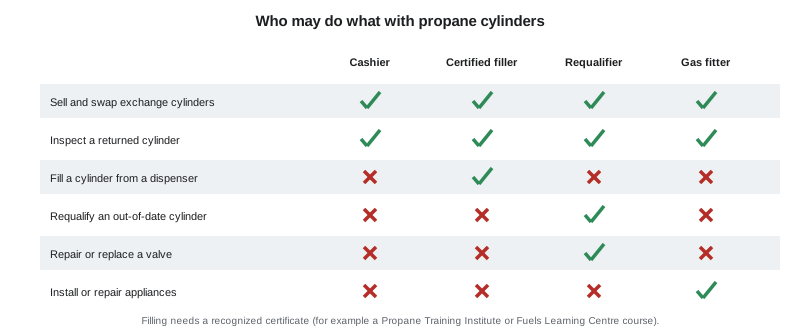
Four kinds of work with cylinders need four different levels of qualification:
- Selling and exchanging sealed cylinders: no special certificate beyond the employer's training, which this course supports. Any trained cashier may do it.
- Filling cylinders from a dispenser: only a person holding a recognized certificate for the kind of filling being done, plus site-specific training from the employer.
- Requalifying cylinders, and repairing or replacing valves: only a requalifier registered with Transport Canada under CSA B339, or a qualified cylinder shop working to the cylinder and valve standards. Not a station job.
- Installing, servicing or repairing propane appliances and piping: only a certified gas fitter. Also not a station job.
The rules for filling
CSA B149.2, adopted in Alberta through the Gas Code Regulation, requires that propane be transferred from one container to another only by a person who holds a certificate from a training course recognized by the authority for the kind of transfer involved. Several provinces publish lists of recognized courses. British Columbia's list, for example, includes the Canadian Propane Association's Propane Training Institute courses for propane pump attendants and cylinder filling, and Fuels Learning Centre courses for filling cylinders at retail filling centres. Courses that include TDG training also cover the transport side. The certificate must be current, and the worker must be able to show it, often as a wallet card, if a safety codes officer asks.
Two things are worth noting. First, the certificate or training is for a kind of transfer: filling cylinders by weight at a retail station is not the same as filling vehicle tanks, forklift cylinders or bulk tanks, and a worker trained for one is not automatically trained for the others. Second, the certificate shows the person has been trained; it does not replace the employer's duty to train them on the site's own dispenser, scale, emergency shut-off and procedures, and to supervise them until they are competent.
A recognized filling course typically covers the properties and hazards of propane, the cylinder specifications and markings, inspection and the reasons to refuse a cylinder, the filling methods and their limits, the dispenser, the scale and the hoses, personal protective equipment, leak and fire response, and the transport rules for cylinders leaving the site. Most include a practical part where the trainee fills cylinders under supervision and is assessed. The course is short, usually a day or less, which is another reason the employer's site training and early supervision matter: a few hours in a classroom do not make someone fluent at a busy dispenser.
What a filler checks before filling
Before connecting anything, a certified filler checks the cylinder. The details are taught in the filling course; in outline, a filler will not fill a cylinder that:
- Is not a refillable cylinder built to a Transport Canada specification, or is a single-use cylinder such as a TC-39M camping bottle.
- Is past its requalification date, as Lesson 3 explained.
- Is damaged, corroded, fire-damaged or has been tampered with, as Lesson 4 explained.
- Does not have an overfill protection device, if it is a barbecue-size cylinder that needs one.
- Has a leaking, damaged or wrong valve, or a damaged relief valve.
- Is to be used for something it was not designed for, or is brought in a way that is unsafe, such as inside a car's passenger area with the engine running.
The filler then fills by one of the methods the code allows: by weight, to no more than the allowed proportion of the cylinder's water capacity, or by volume using the fixed liquid level gauge, never by relying on the OPD float or the dispenser's meter. For propane, filling by weight means a maximum of about 42 % of the water capacity, which for a 21.6 L barbecue cylinder is about 9 kg. Technical Safety BC's guidance spells out these limits and warns against using a float gauge or a meter to decide when to stop.
Filling also involves personal protective equipment, such as gloves and eye protection against liquid propane, controlling ignition sources around the dispenser, keeping the customer and their vehicle at a safe distance and with the engine off, and knowing where the dispenser's emergency shut-off is. These are part of the course and of the site procedure, not things a cashier should pick up by watching.
At Northfield's new site
When the highway site opened, Leah and Raj set up a simple system for the dispenser:
- Only workers on the posted list may fill. At opening, the list had three names: Raj and two overnight workers who had completed the recognized course and the site training.
- A key switch on the dispenser is held by the certified worker on shift. When no certified worker is on shift, the dispenser is switched off and a sign says filling is not available.
- Cashiers who are not certified may sell exchange cylinders from the site's cage, but do not operate the dispenser, do not connect or disconnect hoses, and do not help a customer fill their own cylinder.
- Customers never fill their own cylinders. The dispenser is not self-serve.
- Certificates and training dates are kept in a register, and the manager checks it monthly so that nobody's training lapses without being noticed.
Keeping track of certificates
Certificates and training records only help if they are current. The program below checks Northfield's register of fillers on a given date and flags anyone whose certificate or refresher training has expired or will expire soon, so that the manager can book a course before the worker comes off the list.
# Check the register of workers allowed to fill propane at the new site.
from datetime import date

today = date(2026, 11, 2)
warn_days = 60
register = [
    # name, filling certificate/training valid until, site training date, hazmat or TDG training valid until
    ("Raj",         date(2028, 3, 31), date(2026, 4, 12), date(2027, 6, 30)),
    ("Ben",        date(2026, 12, 15), date(2026, 4, 12), date(2027, 2, 28)),
    ("Nadia",       date(2027, 9, 30), None,               date(2028, 1, 31)),
    ("Tyler",       date(2026, 10, 20), date(2025, 11, 3), date(2027, 5, 31)),
]

for name, cert, site, transport in register:
    problems = []
    for label, until in (("filling certificate", cert), ("transport training", transport)):
        days = (until - today).days
        if days < 0:
            problems.append(f"{label} EXPIRED {until}")
        elif days <= warn_days:
            problems.append(f"{label} expires in {days} days")
    if site is None:
        problems.append("no site training on record")
    status = "may fill" if not any("EXPIRED" in p or "no site" in p for p in problems) else "NOT on the list"
print(f"{name:6} {status:15} {'; '.join(problems) or 'all current'}")Raj may fill all current Ben may fill filling certificate expires in 43 days Nadia NOT on the list no site training on record Tyler NOT on the list filling certificate EXPIRED 2026-10-20
The check shows that only two of the four workers may fill today. Raj is current. Ben may fill but his certificate runs out in six weeks, so Leah books his refresher now. Nadia has a valid certificate from a course but has not yet had the site training on Northfield's own dispenser, so she is not on the list until she has. Tyler's certificate expired in October; until he renews it, he does not fill, however experienced he is. Nadia's case is a common one: a new hire arrives with a certificate from another employer and is keen to start, but the site training on this dispenser, this scale and this emergency shut-off still has to happen first.
Saying no at the dispenser
A certified filler will sometimes have to refuse a fill, and that conversation is part of the job. The customer may have driven a long way, may have filled the same cylinder somewhere else last month, or may simply not believe the cylinder is out of date or damaged. The filler explains the reason once, plainly, shows the customer the date stamp or the damage, and offers what is available: an exchange cylinder from the cage, the name of a requalifier, or the depot for disposal. The filler does not fill 'just this once', and the manager backs the refusal. A filler who is pressured into an unsafe fill carries the risk personally, because the certificate is in their name.
Requalifiers and gas fitters
Customers sometimes ask the station to deal with problems that belong to other trades. An out-of-date cylinder needs a registered requalifier; Transport Canada keeps a searchable list, and many propane suppliers can arrange it. A cylinder with a damaged or old valve needs a qualified shop to replace the valve. A barbecue, heater or trailer system that leaks at its fittings, or needs a new regulator, is a job for a certified gas fitter. A station's staff should never try any of these, even if a customer asks nicely or offers to do it themselves on the lot.
For supervisors: the busy-night temptation
The rule that only certified workers fill is most likely to be broken on a busy evening when the certified worker is on break and a customer is waiting. Make it easy to keep the rule: schedule breaks so that the dispenser is covered or switched off, keep the key with the certified worker, and back up any cashier who tells a customer to wait or come back. A customer who waits ten minutes is a small cost; an uncertified fill that goes wrong is not.
Worked problem
Nadia offers to help
On her second evening at the new site, Nadia, who has a filling certificate from her previous job at a hardware store but has not yet done Northfield's site training, sees a line at the dispenser while Raj is dealing with a delivery. She offers to fill a couple of cylinders to help out. What should Raj say?
Show solution
- Nadia's certificate shows she has been trained in filling, which is good, but the employer must also train her on this site's dispenser, scale, emergency shut-off and procedures before she fills here.
- She is not yet on the posted list, and she does not have the dispenser key.
- Raj thanks her and asks her to tell the waiting customers that filling will resume in a few minutes, and to help at the till.
- He arranges her site training for later that week, after which she is added to the list.
Answer: Not yet: she may fill only after the site training and once she is on the list.
Common mistakes
MistakeLetting any worker fill when the certified worker is busy.
InsteadOnly listed, certified workers fill; otherwise the dispenser waits or is switched off.
MistakeAssuming a certificate from another job is enough.
InsteadSite training on this dispenser is also required.
MistakeUsing the OPD float or the meter to decide when a cylinder is full.
InsteadFill by weight or with the fixed liquid level gauge.
MistakeLetting a certificate lapse without noticing.
InsteadKeep a register and check expiry dates regularly.
MistakeReplacing a valve or fixing an appliance for a customer.
InsteadRefer them to a requalifier, a cylinder shop or a gas technician.
Summary and key terms
- Selling and exchanging sealed cylinders needs employer training; filling needs a recognized certificate or training plus site training.
- Requalifying cylinders and repairing valves are jobs for registered requalifiers and qualified shops.
- Appliance and piping work is for certified gas fitters or technicians.
- CSA B149.2 requires transfer only by holders of a recognized certificate for that kind of transfer.
- Fillers check every cylinder first and fill by weight or the fixed liquid level gauge, never by the float or meter.
- A posted list, a dispenser key and a register of certificates keep filling in qualified hands.
- Recognized certificate
- Proof of completing a training course accepted by the authority for a kind of propane transfer.
- Site training
- The employer's training on its own equipment and procedures.
- Requalifier
- A registered business that inspects and tests cylinders so they can be filled again.
- Gas fitter
- A certified trade worker who installs and repairs gas appliances and piping.
- Filling by weight
- Filling a cylinder until it reaches its tare weight plus the allowed weight of propane.
- Register
- A list of qualified workers with their training and expiry dates.
Practice problems
Work each problem on paper first, then reveal the answer to check.
Which of the four cylinder jobs may a trained cashier do?
Show answer
Sell and exchange sealed cylinders and inspect returned cylinders.
What does CSA B149.2 require of a person who transfers propane?
Show answer
A current certificate from a recognized course for that kind of transfer.
Why is a filling certificate from another employer not enough on its own?
Show answer
The worker also needs site training on this dispenser, scale, emergency shut-off and procedures.
About what proportion of water capacity is the maximum when filling propane by weight?
Show answer
About 42 %.
Who requalifies an out-of-date cylinder?
Show answer
A requalifier registered with Transport Canada.
What happens to the dispenser at Northfield when no certified worker is on shift?
Show answer
It is switched off with the key, and a sign says filling is not available.
Lesson quiz · 5 questions
Score 60% or more to complete this lesson.
Create a free account to save your progress, take quizzes and earn a certificate.