
HSE-353 · Lesson 4 of 12 · 22 min
Checking cylinders at the exchange cage
Every exchange starts with the empty cylinder the customer brings back. Most of them are fine: a few years old, a bit scuffed, valve closed, nothing wrong. But a small share of returns are not fine. Some are damaged, some are leaking, some are not barbecue cylinders at all, and now and then one has been tampered with. The cashier's quick check at the cage is the point where those cylinders are stopped before they go back into the stock and onto the delivery truck with everything else.
The check takes less than a minute, it needs no tools, and it is done with the cylinder upright on the ground outside, beside the cage, never on the counter inside the store. This lesson sets out what to look at, what to refuse, how to handle a refused cylinder and how to talk to a customer whose cylinder cannot be accepted.
Where and when to check
Northfield's rule is simple: the customer leaves the empty cylinder outside, by the cage, and the cashier goes out to it. Cylinders are not brought into the store, even to pay. A customer who walks in carrying a cylinder is asked politely to take it back outside. Lesson 2 showed why: a small leak inside a closed room can build up a flammable mixture faster than anyone would expect.
The check happens before the cage is unlocked and before the full cylinder is handed over. Once an empty is in the cage, it is mixed with the others and it is much harder to find later. At the new site, where cylinders are also filled, the certified filler does a more detailed version of the same check before every fill; Lesson 10 covers that.
The four questions
A practical check comes down to four questions, asked in order. If the answer to any of them is no, the cylinder does not go into the cage.
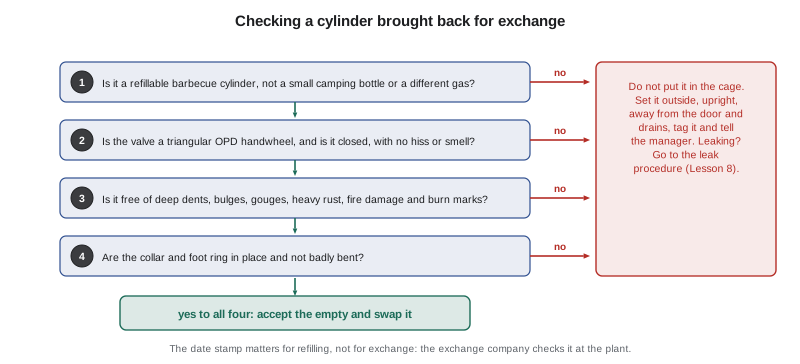
1. Is it the right kind of cylinder?
The exchange program takes back refillable barbecue cylinders of the size it sells, usually 9 kg (20 lb). It does not take:
- Small disposable bottles, about 0.45 kg (1 lb), used for camp stoves and torches. These are single-use cylinders and go to household hazardous waste collection or a depot that accepts them.
- Larger cylinders, such as 14 kg (30 lb) or 45 kg (100 lb) cylinders, unless the program specifically includes them.
- Cylinders for other gases: helium for balloons, oxygen, acetylene, refrigerants, butane cartridges or cylinders from welding shops. These often look different, are a different colour or have different valves, and some are not flammable at all, but none belong in a propane cage.
- Cylinders that have been painted over, have homemade fittings, or have had anything welded or drilled.
If a customer brings the wrong kind of cylinder, the cashier explains what the program accepts and, where possible, tells them where the cylinder can go. Northfield keeps a small card at the till with the local depot's address and the supplier's number.
2. Is the valve right, closed and not leaking?
Look at the handwheel. A triangular handwheel shows an OPD valve, which the exchange program needs. A round or star-shaped handwheel means an old valve; most exchange programs still accept these as empties and replace the valve at the plant, but some do not, so the supplier's instructions decide. Check that the valve is closed: turn the handwheel clockwise by hand, gently, until it stops. Never use a tool on a handwheel, and never force it.
Then listen and smell. A hiss, a rotten-egg smell that is stronger at the cylinder, or frost forming on the valve or the body all mean the cylinder is leaking. Do not put it in the cage. Follow the leak procedure in Lesson 8: keep people away, keep ignition sources away, and if it is safe and small, set the cylinder upright in open air away from the building, the cage, drains and vehicles, and call the supplier's emergency number.
3. Is the body in good condition?
Look all around the cylinder, including the bottom inside the foot ring, where water and rust collect. Refuse a cylinder that has:
- Dents that are deep, sharp-edged, or on a weld seam. A shallow, smooth dent from a knock is common and usually acceptable to the supplier; a sharp crease or a dent you could lay a finger into is not.
- Bulges, where the steel has bulged outward. This is serious: it means the steel has stretched.
- Cuts, gouges or digs into the steel, which thin the wall.
- Heavy rust, scaling or pitting, especially on the bottom. Surface rust on paint chips is common; rust that flakes or leaves pits is not.
- Fire damage: blistered or burnt paint, soot, melted plastic parts, a discoloured collar. A cylinder that has been in a fire may have weakened steel and a damaged relief valve, even if it looks fine otherwise.
- Signs of tampering, such as a valve that has been removed and replaced, a missing or bent relief valve, or added fittings.
The cashier is not expected to judge borderline cases precisely. That is the supplier's job at the plant. The cashier's job is to keep obvious problems out of the cage. When in doubt, set it aside and ask.
4. Are the collar and foot ring in place?
The collar protects the valve if the cylinder falls, and the foot ring keeps it upright and stable. A cylinder with a missing collar, a collar bent down onto the valve, a cracked weld on the foot ring or a foot ring that has been knocked badly out of round should be refused. A cylinder that will not stand upright on its own is also a problem: it may fall in the cage, and a cylinder lying on its side has its relief valve in the liquid.
What about the date?
The date stamps matter for filling, not for exchange. An exchange cylinder that is out of date can still be used up and returned; the supplier checks dates when cylinders reach the plant and requalifies or scraps old ones before refilling. So a cashier at an exchange cage does not refuse an empty just because it is old. A cylinder brought to the new site's dispenser for filling is different: the certified filler must refuse to fill an out-of-date cylinder, as Lesson 3 explained.
Handling a refused cylinder
A refused cylinder still has propane in it, sometimes a lot, so it is handled carefully:
- Keep it upright and outdoors, away from the store door, the cage, drains, vehicles and anything that could ignite gas.
- If it is the customer's cylinder and it is not leaking, the usual course is to give it back to the customer with a clear explanation and advice on where to take it. The customer may also agree to leave it for the supplier to collect and dispose of.
- If the customer leaves it, or if it is an exchange cylinder found damaged in the cage, put a tag on it saying 'Do not sell, damaged' with the date and the problem, and keep it in the place the supplier has agreed, often a marked spot inside the cage or a separate locked enclosure.
- Record it in the cage log and tell Dale at the next delivery so that it goes back to the plant.
- If it is leaking, it is not handed back to anyone. Follow the leak procedure.
Talking to the customer
Refusing a cylinder can lead to an awkward conversation, especially if the customer has driven in for a quick swap. A calm, short explanation usually works best. Focus on safety, not blame, and offer an alternative.
- 'I'm sorry, I can't take this one back. It has a deep dent near the bottom seam, and dented cylinders can't go back into the exchange. I can sell you a new cylinder with propane in it, or you can take this one to the depot on the card.'
- 'This is a helium tank from a party balloon kit, so it doesn't go in the propane exchange. The depot takes them.'
- 'I can hear a hiss from the valve, so I'm going to put this one out on the open lot away from the building and call our supplier. Could you please move your car back from it for a few minutes?'
If a customer becomes angry or insists, the cashier does not argue at length. They repeat the reason once, offer the alternative, and call the manager if needed. Leah's rule is that no exchange is worth putting a damaged cylinder into the cage.
Keeping track of refusals
Northfield records every refused cylinder in the cage log: the date, the reason and what happened to it. Over a season, the log shows patterns, for example a run of rusty cylinders after a wet spring, or a lot of disposable bottles being brought back, which tells Leah that customers need clearer signs. The program below tallies a summer's refusals by reason.
# Tally refused cylinders by reason from Northfield's cage log (illustrative entries).
from collections import Counter

log = [
    ("2026-05-03", "heavy rust on bottom"), ("2026-05-10", "disposable 1 lb bottle"),
    ("2026-05-17", "deep dent"), ("2026-05-24", "disposable 1 lb bottle"),
    ("2026-06-01", "leaking valve"), ("2026-06-08", "heavy rust on bottom"),
    ("2026-06-14", "helium balloon tank"), ("2026-06-21", "disposable 1 lb bottle"),
    ("2026-06-28", "fire damage"), ("2026-07-05", "deep dent"),
    ("2026-07-12", "disposable 1 lb bottle"), ("2026-07-19", "bent collar"),
    ("2026-07-26", "heavy rust on bottom"), ("2026-08-02", "disposable 1 lb bottle"),
]
exchanges = 612   # exchanges over the same period

counts = Counter(reason for _, reason in log)
print(f"{len(log)} refusals in {exchanges} exchanges ({100 * len(log) / exchanges:.1f} %)")
for reason, n in counts.most_common():
    print(f"  {reason:24} {n:2} {'#' * n}")
wrong_type = counts["disposable 1 lb bottle"] + counts["helium balloon tank"]
print(f"wrong type of cylinder: {wrong_type} of {len(log)} -> clearer signs may help")14 refusals in 612 exchanges (2.3 %) disposable 1 lb bottle 5 ##### heavy rust on bottom 3 ### deep dent 2 ## leaking valve 1 # helium balloon tank 1 # fire damage 1 # bent collar 1 # wrong type of cylinder: 6 of 14 -> clearer signs may help
In this season, about one exchange in forty-four led to a refusal, and more than a third of the refusals were cylinders that should never have been brought to the cage at all, mostly disposable camping bottles. That points to a simple fix: a sign on the cage saying what the exchange takes and where other cylinders can go. The rust and dent refusals are the ones that really matter for safety, and the log shows the cashiers are catching them.
For supervisors: training the check
The best way to teach the check is with real cylinders. Ask the supplier for a few retired cylinders with typical defects, such as a deep dent, heavy rust, a round-handwheel valve and a fire-damaged collar, and keep them, empty and purged by the supplier, for training. A new cashier who has handled a fire-damaged cylinder once will recognize the next one.
Worked problem
Three cylinders on a Friday
On a Friday afternoon, three customers return empties at the original store. The first has a triangular handwheel, a shallow smooth dent on the side and some surface rust on paint chips. The second has a round handwheel, but is otherwise in good condition. The third has blistered, blackened paint on one side and a slightly melted plastic cap. Which can Sofia accept?
Show solution
- The first cylinder passes: shallow smooth dents and surface rust on chips are normal wear, the valve is an OPD and it is closed and quiet.
- The second depends on the supplier's instructions. Aspen Propane accepts old-valve cylinders as empties and fits a new valve at the plant, so Sofia accepts it.
- The third has fire damage. Its steel and relief valve may be weakened even if it looks sound, so Sofia refuses it.
- She explains the refusal to the third customer, offers to sell a new cylinder, tags the damaged one if the customer leaves it, and records it in the log.
Answer: Accept the first and, under Aspen's rules, the second; refuse the fire-damaged third cylinder.
Common mistakes
MistakeChecking returned cylinders on the counter inside the store.
InsteadCheck them outdoors, upright, beside the cage.
MistakePutting a doubtful cylinder in the cage to sort out later.
InsteadKeep it out of the cage, tag it and ask.
MistakeUsing a wrench to close a stiff valve.
InsteadClose handwheels by hand only; if it will not close, treat it as a problem cylinder.
MistakeRefusing an exchange empty only because it is out of date.
InsteadDates matter for filling; the supplier deals with old exchange cylinders.
MistakeArguing at length with an angry customer.
InsteadGive the reason once, offer an alternative and call the manager if needed.
Summary and key terms
- Check every returned cylinder outdoors, upright, before it goes into the cage.
- Ask four questions: right kind of cylinder, valve right and not leaking, body in good condition, collar and foot ring in place.
- Refuse disposable bottles, other gases, damaged, fire-damaged, tampered or leaking cylinders.
- Dates matter for filling, not for exchange.
- Keep refused cylinders upright and outdoors, tag them and record them.
- Explain refusals calmly, focus on safety and offer an alternative.
- Return check
- The quick inspection of an empty cylinder before it goes into the exchange cage.
- Disposable cylinder
- A small single-use bottle, about 0.45 kg (1 lb), that must not be refilled or exchanged.
- Bulge
- An outward swelling of the steel, a sign that it has stretched.
- Fire damage
- Blistered or burnt paint, soot or melted parts showing the cylinder has been heated.
- Tag
- A label that marks a cylinder as damaged and not for sale.
- Cage log
- The record of stock counts, refusals and incidents at the exchange cage.
Practice problems
Work each problem on paper first, then reveal the answer to check.
Where should a returned cylinder be checked?
Show answer
Outdoors, upright, beside the cage, never inside the store.
List the four questions in the return check.
Show answer
Is it the right kind of cylinder; is the valve right, closed and not leaking; is the body in good condition; are the collar and foot ring in place?
Give four kinds of body damage that mean a cylinder should be refused.
Show answer
For example deep or sharp dents, bulges, cuts or gouges, heavy rust or pitting, fire damage and signs of tampering.
Should a cashier refuse an exchange empty because it is out of date?
Show answer
No; the supplier checks dates and requalifies or scraps old cylinders at the plant.
What should happen to a damaged cylinder a customer leaves behind?
Show answer
Keep it upright outdoors, tag it as damaged, record it and return it to the supplier.
Why are disposable camping bottles refused at the cage?
Show answer
They are single-use cylinders that are not part of the exchange and must not be refilled.
Lesson quiz · 5 questions
Score 60% or more to complete this lesson.
Create a free account to save your progress, take quizzes and earn a certificate.