
HSE-353 · Lesson 1 of 12 · 21 min
Propane at the station: exchange, refilling and your role
This course is the fourth in the fuel stations track. HSE-350 covered the fuels and fire hazards of a station, HSE-351 covered spills and releases, and HSE-352 covered working alone and late at night. This course is about one product that sits a little apart from the rest: propane in portable cylinders, the kind people use for barbecues, patio heaters, camp stoves and small construction heaters. Almost every station and many convenience stores keep a cage of these cylinders by the door, and the people behind the counter handle them every day.
Propane cylinders look harmless. They are painted white or grey, they sit quietly in a cage, and customers carry them in and out without a second thought. But each full barbecue cylinder holds about 9 kg (20 lb) of a flammable liquid kept under pressure, and that liquid turns into roughly 270 times its own volume of gas when it escapes. A leaking cylinder in a closed car, a cylinder brought into the store, or a cylinder that has been overfilled and left in the sun can turn an ordinary shift into an emergency within minutes.
What this course covers
The course is an awareness course. It explains the hazards of propane, how cylinders and their valves work, how to check, handle and store them, what to do about leaks and fires, and who is allowed to fill a cylinder. It does not train anyone to fill cylinders or to repair valves. Those jobs need their own certified training, and Lesson 10 explains what that looks like. A cashier who finishes this course should be able to run an exchange cage safely, spot a cylinder that should not go back into the cage, answer customers' questions honestly and know when to stop and call for help.
The twelve lessons follow the life of a cylinder at the station:
- Lessons 1 to 3: why propane matters, its properties, and how cylinders, valves and markings work.
- Lessons 4 and 5: checking cylinders that come back, and handling and carrying them safely.
- Lessons 6 and 7: the exchange cage, deliveries, stock counts and records.
- Lessons 8 and 9: leaks, fires and other emergencies.
- Lessons 10 and 11: who may fill cylinders, and the hazards of refilling done wrong.
- Lesson 12: a complete propane safety program for the station.
Northfield and its propane
As in the rest of the track, we follow Northfield Fuel and Market, the invented station on the north side of Red Deer, Alberta. Leah Morin is the manager and Raj Patel is the assistant manager. The original store has a cylinder exchange cage beside the entrance, stocked by an invented supplier, Aspen Propane, whose driver Dale delivers full cylinders and takes the empties away twice a week.
The new 24-hour site on the highway, which opened in HSE-352, adds something the original store never had: a propane dispenser beside the diesel lane, where trained staff fill customers' own cylinders and the propane tanks of a few vehicles and recreational vehicles. That one change brings a new set of rules. At the original store, no one on staff ever transfers propane; they sell and swap sealed cylinders that were filled somewhere else. At the new site, filling happens on the property, and only workers with the right certificate may do it.
So Northfield runs two different propane operations:
- Cylinder exchange: the customer brings back an empty barbecue cylinder, pays, and takes a full one from the locked cage. Nobody at the station fills anything. The cashier's job is to check the returned cylinder, keep the cage locked and counted, and help the customer carry the full cylinder safely.
- Cylinder refilling: the customer's own cylinder is filled at the dispenser by a trained, certified attendant. The attendant checks the cylinder first and may refuse to fill it. A cashier who is not certified does not operate the dispenser, even to help out on a busy evening.
Most stations only do exchange, and most of this course applies to both. Lessons 10 and 11 are where the difference matters most.
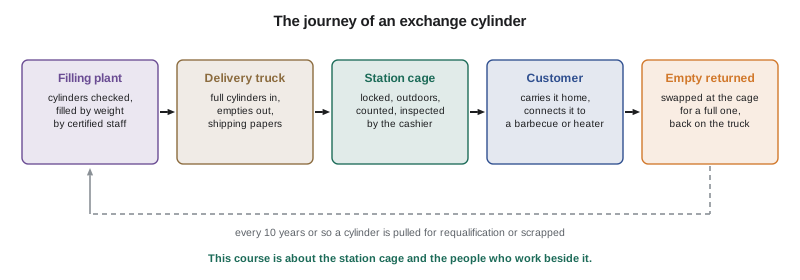
Who is involved
Several people share the job of keeping propane safe at a station, and it helps to know who does what:
- The supplier owns the exchange cylinders, fills them at its plant, inspects them, requalifies or scraps old ones, delivers them, and usually supplies and installs the cage. It also provides signs, training material and an emergency number.
- The station owner and manager are responsible for the site: where the cage sits, that it stays locked and protected, that staff are trained, that procedures exist and that incidents are reported.
- Cashiers and attendants do the daily work: sell and swap cylinders, check returns, keep the cage locked, count stock, watch for leaks and respond to emergencies.
- Certified fillers, where the station fills cylinders, transfer propane at the dispenser under their certificate and the site's procedures.
- Customers own any cylinder they bring for refilling, and they are responsible for getting a cylinder home safely and using it properly. Many of them know very little about propane, which is why the cashier's advice matters.
- Regulators and the fire department set and enforce the rules, approve or inspect the cage location and respond to emergencies.
The rules that apply
In Alberta, propane storage and handling falls under the Safety Codes Act. The Gas Code Regulation adopts CSA B149.2, the Propane storage and handling code, which covers cylinder storage, exchange cages and filling, and the Alberta Fire Code adds rules for storing hazardous materials. Moving cylinders on the road falls under the federal Transportation of Dangerous Goods (TDG) Regulations, which also set the design and requalification rules for cylinders. On top of these, the OHS Code requires the employer to assess the hazards of the work, train workers, provide WHMIS information such as the safety data sheet for propane and plan for emergencies. Municipal Affairs safety codes officers and the local fire department enforce the codes.
The details of each code are long and technical, and the supplier usually takes care of much of it: the cage design, the distances, the cylinders themselves. What a station must get right every day is simpler: keep cylinders outdoors in a locked, protected cage away from doors and drains, check what comes back, keep people trained, keep records, and respond properly when something goes wrong.
Why it matters
Most propane incidents with small cylinders are not dramatic explosions. They are quieter and more common, and they usually come from one of a handful of mistakes:
- A cylinder left in a hot, closed car, which builds pressure until the relief valve opens and vents gas into the car.
- A cylinder carried in the passenger area with the valve not fully closed, so that gas collects and is lit by a cigarette or a spark.
- A cylinder brought into a store, a home or a tent, sometimes to keep it warm or out of sight.
- A cylinder overfilled, often by someone without training, so that the liquid has no room to expand on a warm day.
- A single-use camping bottle refilled with an adapter bought online, then used in a tent or a cabin.
- A damaged or corroded cylinder put back into service because no one looked at it.
Each of these is preventable, and in several of them the person at the counter is the last one who could have prevented it: by refusing a damaged cylinder, by reminding a customer to put the cylinder in the trunk with the lid propped open, or by saying no to a request to fill a cylinder that should not be filled.
Sizing up the cage
One practical way to see why propane deserves attention is to work out how much is sitting in the cage on a busy weekend. The program below estimates the propane on hand at the original store, counting full cylinders and the propane left in returned empties, which are rarely completely empty.
# How much propane is in Northfield's exchange cage?
full_kg_each = 9.0          # a full barbecue cylinder holds about 9 kg of propane
left_in_empty_kg = 0.8      # returned "empties" often still hold some propane (illustrative)
days = {"Fri": (14, 4), "Sat": (8, 10), "Sun": (5, 13)}   # (full, empty) at closing

for day, (full, empty) in days.items():
    kg = full * full_kg_each + empty * left_in_empty_kg
    lb = kg * 2.2046
    print(f"{day}: {full:2} full, {empty:2} empty -> about {kg:5.1f} kg ({lb:5.0f} lb) of propane")

cage_capacity = 18
worst = cage_capacity * full_kg_each
print(f"cage full of full cylinders: {worst:.0f} kg ({worst * 2.2046:.0f} lb)")
print(f"gas from that much propane: roughly {worst / 1.9:.0f} m3 at 15 C")Fri: 14 full, 4 empty -> about 129.2 kg ( 285 lb) of propane Sat: 8 full, 10 empty -> about 80.0 kg ( 176 lb) of propane Sun: 5 full, 13 empty -> about 55.4 kg ( 122 lb) of propane cage full of full cylinders: 162 kg (357 lb) gas from that much propane: roughly 85 m3 at 15 C
Even a modest cage holds well over 100 kg (220 lb) of propane when it is full. Each kilogram becomes about half a cubic metre of gas at normal temperatures, so a cage full of cylinders holds enough propane to make a very large flammable cloud if something goes badly wrong. That is why the codes care so much about where the cage sits, and why the cashier's daily checks matter.
For supervisors: whose cylinder is it?
Exchange cylinders belong to the supplier until they are sold, and the empties go back to the supplier. A customer's own cylinder, brought for refilling, belongs to the customer. The difference matters when something is wrong. A damaged exchange cylinder goes back to the supplier, tagged, in the next delivery. A damaged customer cylinder is handed back to the customer with a clear explanation, or, if the customer agrees, set aside for the supplier to dispose of. Staff should never keep, repair or quietly bin a cylinder that is not theirs.
Worked problem
The Saturday rush
On a hot Saturday in July, Sofia is the only cashier at the original store. A customer asks for two exchange cylinders and then asks whether she can 'just top up' a half-full cylinder he has in his back seat. What should Sofia do?
Show solution
- Sell the exchange cylinders as normal: check the two empties he returns, take two full ones from the cage, and lock the cage again.
- Explain that the original store does not fill cylinders at all, so there is no way to top up his cylinder here; the new highway site has a certified filler on most evenings.
- Point out that the cylinder in his back seat should not be there: on a hot day it should go in the trunk or the truck bed, upright and secured, with ventilation, and go straight home.
- If she smells gas from his car, she follows the leak procedure in Lesson 8 rather than continuing the sale.
Answer: Sell the exchange, explain that no filling is done at this store, and give him clear advice about carrying cylinders in the car.
Common mistakes
MistakeTreating propane cylinders as ordinary stock.
InsteadTreat them as pressurized flammable liquid that needs checks, a locked cage and trained staff.
MistakeLetting any staff member operate the propane dispenser on a busy night.
InsteadOnly certified workers transfer propane.
MistakeAssuming the supplier takes care of everything.
InsteadThe station still controls the cage, the checks, training and the emergency response.
MistakeIgnoring a cylinder in a customer's car.
InsteadGive clear, polite advice; you may be the last person who can prevent an incident.
MistakeThrowing away or repairing a cylinder that is not yours.
InsteadTag it and return it to the supplier or the customer.
Summary and key terms
- A barbecue cylinder holds about 9 kg (20 lb) of flammable liquid under pressure.
- Exchange means swapping sealed cylinders; refilling means transferring propane on site and needs a certificate.
- The supplier, the station, staff, certified fillers, customers and regulators all share the job.
- Codes cover cylinder storage, filling and transport; the employer must also assess hazards, train and plan for emergencies.
- Most incidents come from heat, closed spaces, overfilling, refilling single-use bottles and damaged cylinders.
- The cashier is often the last person who can stop a preventable incident.
- Propane
- A flammable gas stored and sold as a liquid under pressure; also called LPG or LP-gas.
- Cylinder exchange
- Swapping an empty cylinder for a full, sealed one filled elsewhere.
- Refilling
- Transferring propane into a customer's cylinder on site.
- Exchange cage
- A locked, ventilated outdoor enclosure that holds cylinders for sale or exchange.
- Supplier
- The company that owns, fills, inspects and delivers exchange cylinders.
- Certified filler
- A worker who holds the recognized training needed to transfer propane.
Practice problems
Work each problem on paper first, then reveal the answer to check.
What is the difference between cylinder exchange and cylinder refilling?
Show answer
Exchange swaps sealed cylinders filled elsewhere; refilling transfers propane into a cylinder on site.
About how much propane does a full barbecue cylinder hold?
Show answer
About 9 kg (20 lb).
Name three parties who share responsibility for propane safety at a station.
Show answer
For example the supplier, the station manager, cashiers, certified fillers, customers and the fire department.
Give three common causes of propane incidents with small cylinders.
Show answer
For example hot closed cars, cylinders in the passenger area, cylinders indoors, overfilling, refilled single-use bottles and damaged cylinders.
Who may operate a propane dispenser at the new site?
Show answer
Only workers who hold the recognized certificate or training for transferring propane.
What happens to a damaged exchange cylinder?
Show answer
It is tagged, kept out of the cage and returned to the supplier.
Lesson quiz · 5 questions
Score 60% or more to complete this lesson.
Create a free account to save your progress, take quizzes and earn a certificate.