
HSE-353 · Lesson 5 of 12 · 21 min
Handling cylinders and getting them home
A full barbecue cylinder is heavy, awkward and pressurized, and at a busy station it gets lifted, carried and set down many times a day: by the delivery driver loading the cage, by the cashier handing it over, and by customers putting it in their cars. This lesson covers the two kinds of handling risk that come with that. The first is the risk to the worker's body from lifting and carrying. The second is the risk to the cylinder, and everyone near it, from dropping it, rolling it, laying it down or carrying it the wrong way in a vehicle. Most of the advice in the second half of the lesson is for customers, because the trip home is where many small-cylinder incidents happen.
The weight of a full cylinder
A full barbecue cylinder weighs about 17 kg (37 lb): roughly 8 kg (17 lb) of steel and 9 kg (20 lb) of propane. That is not a dangerous weight for one lift, but it is awkward. The weight is high off the ground when it is lifted by the collar, the cylinder is round and slippery when wet, the collar is a small handle, and the load is held away from the body. Larger cylinders are much heavier: a full 14 kg (30 lb) cylinder weighs around 25 kg (55 lb), and a full 45 kg (100 lb) cylinder weighs well over 70 kg (150 lb) and is a two-person or hand-truck job.
Alberta's OHS Code requires the employer to assess the hazards of manual handling and to put controls in place where lifting could injure workers. For Northfield's cage, the main risks are repeated lifting into and out of the cage on a busy weekend, lifting from the bottom shelf, and twisting while handing a cylinder over a car's trunk lip.
Lifting and carrying safely
Northfield's cage has two shelves, and Leah asked the supplier to put full cylinders on the upper shelf where possible, so that cashiers lift from about knee height rather than from the floor. For each cylinder, the safe way to lift and carry is:
- Stand close, with feet apart and one slightly forward, and face the cylinder rather than twisting.
- Bend at the knees and hips, keep the back straight, and grip the collar with one hand and the foot ring or the body with the other if it is easier.
- Lift smoothly with the legs, keeping the cylinder close to the body and upright.
- Carry it upright and close. Do not swing it, and do not carry two full cylinders at once by the collars.
- Set it down upright, gently, on a level surface. Do not drop it the last few centimetres.
- Wear gloves when handling cylinders that are cold, wet or rough, and safety footwear on shifts where cylinders are handled a lot.
Two practices that look quick and easy are not allowed. Rolling a cylinder on its side across the lot puts the valve in the liquid and lets the collar and valve hit the ground. Rolling it on its foot ring, tilted, is common at plants and among experienced drivers, but it takes practice and is not something Northfield's cashiers do with customers watching. And no one drags a cylinder across concrete, which wears the foot ring and can strike sparks.
Never drop, throw or lay down a cylinder
A cylinder is designed to take everyday knocks, but a hard drop onto the valve can crack the valve body, bend the collar into it or open a leak. A cylinder thrown into a truck bed can land on its side or hit another cylinder's valve. A cylinder laid on its side puts the relief valve in the liquid, which, as Lessons 2 and 3 explained, turns any release into a liquid release. The rules for cylinders at the station are therefore simple: upright, set down gently, never thrown, never laid on its side, and never stood on, sat on or used as a step.
Getting the cylinder home
Once the customer has paid and the cashier has handed over the cylinder, the station's direct control ends. But the trip home is where a lot of small-cylinder incidents happen, and a short piece of advice at the cage costs nothing. Customers often put a cylinder on the back seat, lying down, with the windows up, and then stop for groceries on a hot afternoon. Each of those choices adds risk.
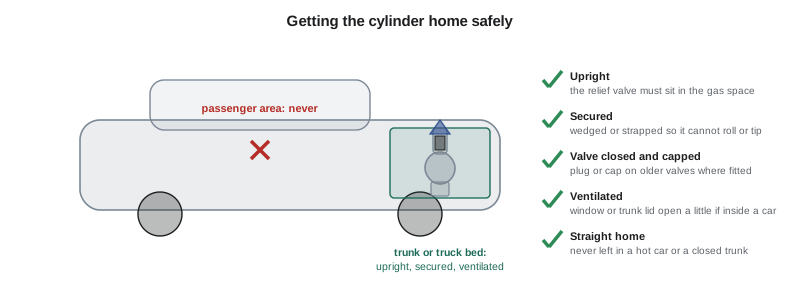
The five habits are:
- Upright: the cylinder stands on its foot ring so the relief valve is in the gas space. A milk crate, a cylinder holder or a box wedged around it keeps it standing.
- Secured: it cannot roll, tip or slide when the vehicle brakes or turns. In a pickup bed, it is strapped to the side or held in a holder, not left loose.
- Valve closed: the handwheel is turned fully clockwise by hand, and older valves have their plug or cap fitted where the supplier says so.
- Ventilated: a pickup bed is open to the air. In a car, the trunk is the better place, with the lid tied slightly open if possible; if the cylinder must go inside the car, a window should be open, and it should never go in the passenger area of a closed car on a hot day.
- Straight home: the cylinder is taken directly to where it will be used or stored and taken out of the vehicle straight away. A cylinder left in a closed car in the sun can reach temperatures where the relief valve opens and releases gas into the car.
Under the TDG Regulations, ordinary consumers carrying a small number of cylinders for their own use are generally covered by an exemption from most of the paperwork and placarding rules, but the safety basics still apply, and the exemption has limits on the number and size of cylinders. A contractor carrying many cylinders for work may fall under the full rules.
How hot does a car get?
The inside of a parked car in the sun heats up quickly. On a 30 °C (86 °F) day, the cabin can reach 50 °C (122 °F) or more within an hour, and surfaces in direct sun get hotter still. A dark trunk is often a little cooler than the cabin but can still get very hot. The program below combines a rough model of a parked car warming up with the pressure curve from Lesson 3 to show what happens to the pressure in a cylinder left inside. The model is simple and illustrative, but the trend is real.
# Rough model: cabin temperature of a parked car in sun, and cylinder pressure.
import math

def cabin_temp(outside_c, minutes):
    """Cabin warms toward outside + 25 C with a time constant of about 25 minutes (illustrative)."""
    rise = 25 * (1 - math.exp(-minutes / 25))
    return outside_c + rise

# Propane pressure, absolute kPa, interpolated from standard tables.
table = [(-20, 244), (0, 474), (10, 637), (20, 836), (30, 1079), (40, 1369), (50, 1713), (60, 2110)]
def gauge_kpa(t):
    for (a, pa), (b, pb) in zip(table, table[1:]):
        if a <= t <= b:
            return pa + (pb - pa) * (t - a) / (b - a) - 101
    raise ValueError(t)

outside = 30
for minutes in (0, 10, 20, 30, 60, 90):
    t = cabin_temp(outside, minutes)
    p = gauge_kpa(t)
    print(f"after {minutes:3} min: cabin about {t:4.1f} C, cylinder about {p:5.0f} kPa ({p * 0.145:4.0f} psi)")
print("compare: about", round(gauge_kpa(15)), "kPa in a cool garage at 15 C")after 0 min: cabin about 30.0 C, cylinder about 978 kPa ( 142 psi) after 10 min: cabin about 38.2 C, cylinder about 1217 kPa ( 176 psi) after 20 min: cabin about 43.8 C, cylinder about 1398 kPa ( 203 psi) after 30 min: cabin about 47.5 C, cylinder about 1525 kPa ( 221 psi) after 60 min: cabin about 52.7 C, cylinder about 1720 kPa ( 249 psi) after 90 min: cabin about 54.3 C, cylinder about 1783 kPa ( 259 psi) compare: about 636 kPa in a cool garage at 15 C
In the model, the cylinder's pressure goes from around 1,000 kPa (145 psi) to about 1,800 kPa (260 psi) in an hour and a half, nearly three times what it would be in a cool garage. A correctly filled cylinder in good condition can take this, which is why a short drive home is fine. But a cylinder that was overfilled, has a weak relief valve, or is left for an afternoon is in a different position, and in a car with the windows up there is nowhere for any released gas to go. That is the real reason for 'straight home'.
At home: storing cylinders
Customers often ask where to keep a cylinder at home. The answer is the same as for the station: outdoors, upright, in a shaded, ventilated place, away from doors, windows, basement openings, drains and anything that could ignite gas. Cylinders should not be kept in a house, an attached garage, a basement or a shed with an appliance that has a pilot light, and a spare cylinder should not be stored under or beside the barbecue it serves. Disconnected cylinders should have the valve closed. In winter, a cylinder can stay outside; propane does not freeze at any temperature people will meet, although pressure will be low on very cold days.
Words that work at the counter
Cashiers do not need to deliver a lecture. Two or three sentences, said while handing over the cylinder, cover most of it:
- 'Keep it standing up in the trunk with the lid propped open, or strapped in the truck bed. Not on the seat, please.'
- 'Take it straight home and get it out of the car. It's hot today, and it shouldn't sit in a closed car.'
- 'Store it outside in the shade, standing up, away from doors and windows.'
If a customer is clearly about to put a cylinder on the back seat of a closed car on a hot day, it is worth saying so directly. Most people are glad to be told.
For supervisors: delivery days
Delivery days carry the most lifting at the cage, because the driver unloads full cylinders and loads empties. Agree with the supplier who does what: at Northfield, Dale loads and unloads, and the cashier only counts and signs. If a driver asks staff to help unload, the same lifting rules apply, and the supplier's own procedures, such as using a hand truck for larger cylinders, should be followed.
Worked problem
Four cylinders for a food truck
A customer runs a small food truck and wants to buy four full barbecue cylinders at once, carrying them in the back of a hatchback. Sofia is on her own. How should she handle the sale and the advice?
Show solution
- Four full cylinders weigh about 68 kg (150 lb) in total. Sofia lifts and carries them one at a time, from the upper shelf where possible, upright and close to her body.
- A hatchback has no separate trunk, so the cylinders will share the air space with the driver. She advises standing them upright in crates or holders, wedged so they cannot tip, with a window open, and driving straight to the truck.
- Because this is for a business, she mentions that carrying several cylinders for work may come under the transport rules, and suggests the customer check with the supplier, who can advise on quantities and paperwork.
- She does not help load the vehicle by lifting cylinders over the back bumper at an awkward angle; she sets each cylinder down beside the car and lets the customer place it.
Answer: Carry one at a time, give clear advice on upright, secured, ventilated carrying and going straight there, and point the business customer to the supplier about the transport rules.
Common mistakes
MistakeRolling a cylinder on its side across the lot.
InsteadCarry it upright, or use a hand truck for heavy cylinders.
MistakeCarrying two full cylinders at once by their collars.
InsteadCarry one at a time, close to the body.
MistakePutting a cylinder on the back seat of a closed car.
InsteadUpright in the trunk or truck bed, secured and ventilated, never the passenger area.
MistakeStopping for errands with a cylinder in a hot car.
InsteadGo straight home and take it out of the vehicle.
MistakeStoring a spare cylinder in the garage or basement.
InsteadStore it outdoors, upright, in the shade, away from openings and drains.
Summary and key terms
- A full barbecue cylinder weighs about 17 kg (37 lb); larger cylinders need a hand truck or two people.
- Lift with the legs, keep the cylinder upright and close, and set it down gently.
- Never roll, drop, throw, drag or lay down a cylinder.
- For the trip home: upright, secured, valve closed, ventilated and straight home.
- Heat in a parked car raises cylinder pressure sharply.
- At home, cylinders are stored outdoors, upright, in the shade, away from openings and drains.
- A few clear sentences at the counter prevent many incidents.
- Manual handling
- Lifting, carrying, pushing or pulling loads by hand.
- Hand truck
- A two-wheeled trolley used to move heavy cylinders upright.
- Passenger area
- The part of a vehicle where people sit, which should never carry a cylinder.
- Ventilated
- Open to the outside air so that any leaked gas can escape.
- Cylinder holder
- A rack or crate that keeps a cylinder upright in a vehicle.
Practice problems
Work each problem on paper first, then reveal the answer to check.
About how much does a full barbecue cylinder weigh?
Show answer
About 17 kg (37 lb).
Why should a cylinder never be rolled on its side?
Show answer
The relief valve ends up in the liquid and the valve and collar can be damaged.
List the five habits for carrying a cylinder home.
Show answer
Upright, secured, valve closed, ventilated and straight home.
Where should a cylinder never be carried in a car?
Show answer
In the passenger area of a closed car.
Why is leaving a cylinder in a hot car dangerous?
Show answer
The pressure rises sharply with heat and the relief valve may release gas into the car.
Where should customers store a spare cylinder at home?
Show answer
Outdoors, upright, in the shade, away from doors, windows, basement openings and drains.
Lesson quiz · 5 questions
Score 60% or more to complete this lesson.
Create a free account to save your progress, take quizzes and earn a certificate.