
HSE-332 · Lesson 2 of 12 · 27 min
Law, regulators and standards for facilities and pipelines
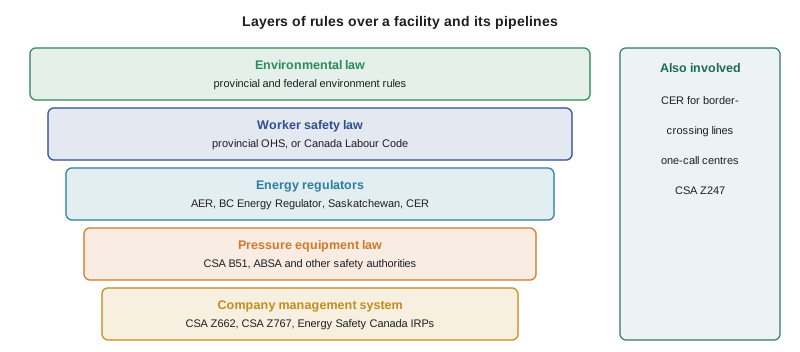
Facilities and pipelines sit under more layers of rules than almost any other workplace. A worker at a gas plant is protected by occupational health and safety law like any other worker. The plant itself is licensed and inspected by an energy regulator. Its pressure vessels and piping are registered under pressure equipment law. Its emissions are regulated by environmental agencies, and the pipelines that leave it may be regulated by a different agency again, depending on where they go. On top of the law sit codes and standards, most written by industry and standards bodies, that the law often adopts by reference. This lesson maps those layers so that you know whose rules apply to the job in front of you.
HSE-330 introduced the two kinds of regulator in oil and gas: the worker safety regulator, who protects people at work, and the energy regulator, who licenses and oversees wells, facilities and pipelines. This lesson builds on that map with the rules that matter most for facilities and pipelines: pressure equipment law, process safety rules, pipeline regulation and the standards that sit behind them. It does not cite clause numbers, because these change; your employer's procedures should point you to the current requirements.
Worker safety law
Each province has its own occupational health and safety act, regulation and code, enforced by provincial inspectors. In Alberta, the OHS Act, Regulation and Code apply to batteries, compressor stations and gas plants, with requirements for hazard assessment, H2S, confined spaces, lockout, fall protection, noise and emergency response. British Columbia's Workers Compensation Act and OHS Regulation, enforced by WorkSafeBC, and Saskatchewan's Employment Act and OHS Regulations play the same role there. Federally regulated work, such as some interprovincial pipeline operations, falls under the Canada Labour Code Part II and its regulations instead. The general duties are the same everywhere: employers must ensure, as far as reasonably practicable, the health and safety of workers; supervisors must know the hazards and protect their crews; workers must follow the rules, use their protective equipment and report hazards, and they have the right to know, to participate and to refuse unsafe work.
Energy regulators
Energy regulators license facilities and pipelines and set technical rules for how they are designed, built, operated and abandoned. In Alberta, the Alberta Energy Regulator (AER) licenses batteries, compressor stations, gas plants and most pipelines within the province under the Oil and Gas Conservation Act and the Pipeline Act. Its directives cover topics such as flaring and venting (Directive 060), emergency preparedness (Directive 071), noise (Directive 038), measurement and pipelines (Directive 077, a reference tool for pipeline requirements). In British Columbia, the BC Energy Regulator plays the same role, and in Saskatchewan the Ministry of Energy and Resources regulates wells, facilities and provincial pipelines. Pipelines that cross a provincial or national border are federally regulated by the Canada Energy Regulator (CER) under the Canadian Energy Regulator Act and its Onshore Pipeline Regulations and Pipeline Damage Prevention Regulations.
Pressure equipment law
Separators, treaters, scrubbers, boilers, pressure piping and relief valves are pressure equipment, and every province has a law requiring that such equipment be designed, registered, built, inspected and repaired to the CSA B51 Boiler, Pressure Vessel and Pressure Piping Code and the ASME codes it references. Each design receives a Canadian registration number (CRN) in each province where it is used. In Alberta, ABSA, the delegated safety authority under the Safety Codes Act, administers pressure equipment safety: it registers designs, certifies inspectors and welders, and authorizes owners' integrity management programs. Technical Safety BC and Saskatchewan's Technical Safety Authority do the same in their provinces. For workers this means that vessels carry nameplates with their maximum allowable working pressure, that only qualified people may repair or alter pressure equipment, and that relief devices must be tested and maintained on schedule.
Process safety rules
Canada has no single federal process safety regulation for oil and gas. Instead, process safety expectations come from several sources: energy regulator requirements for safety and loss management systems, pressure equipment integrity programs, provincial OHS duties to assess and control hazards, and the CSA Z767 process safety management standard, most recently updated in 2024, which many operators follow voluntarily or as a condition of their own management systems. The CER requires federally regulated pipeline companies to run management systems that include safety, security, environmental protection and emergency management. Lesson 7 explains what process safety management means for a facility worker, and HSE-311 covers it in depth.
Pipeline regulation
Provincial pipelines are regulated by the provincial energy regulator. In Alberta the Pipeline Act and Pipeline Rules require licences, design to the CSA Z662 Oil and Gas Pipeline Systems standard, integrity management programs, inspections and incident reporting, and they set a controlled area of 30 m (100 ft) on each side of a pipeline within which ground disturbance requires the licensee's involvement. Federally regulated pipelines fall under the CER, whose Pipeline Damage Prevention Regulations set a prescribed area of 30 m (100 ft) on each side of the centreline, require anyone planning ground disturbance there to make a locate request and obtain the pipeline company's consent, and control vehicle crossings. CSA Z662, which covers design, materials, construction, operation, maintenance and abandonment, is adopted by reference by provincial and federal regulators, and CSA Z246.1 covers pipeline security management.
Codes and standards
Behind the law sit codes and standards written by technical committees. They tell engineers how to design and test equipment and tell operators how to inspect and maintain it. Some are adopted into law; others become mandatory because a company's own management system or a contract requires them. Workers rarely read them directly, but they shape almost every procedure in a facility.
| Topic | Common Canadian references | What they cover for workers |
|---|---|---|
| Pressure vessels and piping | CSA B51, ASME BPVC Section VIII, ASME B31.3 | Design pressure, nameplates, repair rules, inspection |
| Pipelines | CSA Z662, CSA Z246.1 | Design, operation, integrity, security |
| Process safety | CSA Z767 | Management system elements for hazardous processes |
| Relief and flares | API 520, 521 and 526 as referenced by CSA and regulators | Relief sizing, flare design, radiation limits |
| Sour service materials | NACE MR0175/ISO 15156 | Materials resistant to sulphide stress cracking |
| Industry practices | Energy Safety Canada IRPs, CAPP guides | Agreed practices for sour gas, flaring, isolation and more |
Inspections, enforcement and reporting
Different regulators inspect for different things. A worker safety inspector may look at gas detection, confined space permits, guarding, training records and hazard assessments. An energy regulator inspector may look at flare logs, emergency response plans, pipeline patrol records, relief valve test dates and the integrity of buried lines. A pressure equipment inspector looks at vessels, piping and relief devices. All of them can issue orders, and serious non-compliance can lead to shutdowns, prosecutions and fines.
Reporting rules also overlap. A single event, such as a pipeline rupture that injures a worker and releases sour gas, may have to be reported to the worker safety regulator, the energy regulator, the environmental regulator and local authorities, each with its own timeline. Facility emergency response plans should list who calls whom and how quickly. The program below checks an invented incident against a simple reporting matrix to show how quickly the obligations pile up; the triggers and times are illustrative.
# Illustrative reporting checklist for an invented incident.
incident = {"worker_hospitalized": True, "sour_gas_release": True,
            "pipeline_rupture": True, "liquid_to_water": False}

matrix = [
    ("Worker safety regulator", "worker_hospitalized", "as soon as possible"),
    ("Energy regulator", "pipeline_rupture", "immediately by phone, then written"),
    ("Energy regulator", "sour_gas_release", "immediately"),
    ("Environment ministry", "liquid_to_water", "as soon as possible"),
    ("Federal fisheries authority", "liquid_to_water", "as soon as possible"),
]
calls = [(who, when) for who, trigger, when in matrix if incident[trigger]]
for who, when in dict.fromkeys(calls):
    print(f"Notify {who:30s} {when}")
print(f"{len(set(w for w, _ in calls))} agencies to notify; check the site ERP for exact rules")Notify Worker safety regulator as soon as possible Notify Energy regulator immediately by phone, then written Notify Energy regulator immediately 2 agencies to notify; check the site ERP for exact rules
Even with only three triggers, the crew must notify three agencies with different timelines, while also managing the emergency itself. That is why reporting is assigned to specific roles in the emergency response plan, and why the people on the scene should focus on safety and leave notifications to those roles.
Who holds which duty
Duties overlap, and it helps to be clear about who is responsible for what. The licensee or operator of a facility or pipeline holds the energy regulator's licence and is responsible for its design, operation and integrity. The employer of each worker is responsible for that worker's safety, training and equipment. Where several employers work on one site, a prime contractor or controlling employer coordinates them, as HSE-330 explained. Engineers who design or approve equipment hold professional duties. Supervisors must know the hazards and direct work safely. Workers must follow procedures, use their equipment, report hazards and refuse work they believe is dangerous. When an incident happens, investigators will ask what each party knew and what each did; doing your own part well is the best protection for you and for those around you.
Worked problem
Whose rules apply at Kettle Creek?
A contractor crew is replacing a relief valve on the discharge scrubber at Larchwood's Kettle Creek compressor station in Alberta. The station is licensed by the AER, the scrubber is registered with ABSA and the station connects to a provincial gathering line. Which rules apply to the job?
Show solution
- Worker safety: Alberta's OHS Act, Regulation and Code apply to both the contractor's and Larchwood's workers, including hazard assessment, lockout, H2S and confined space rules.
- Coordination: Larchwood, or a designated prime contractor, coordinates the work on the multi-employer site.
- Pressure equipment: the replacement valve must be a registered design suitable for the service, set and tested by an authorized facility, and installed under Larchwood's ABSA-authorized integrity program.
- Energy regulator: the AER licence and directives apply to the station's operation, flaring during the blowdown and any reportable release.
- Company rules: Larchwood's permit to work, isolation and management of change procedures apply, covered in HSE-333 and Lesson 7.
Answer: Several layers apply at once. The crew does not need to memorize every rule, but it must follow the permit and procedures that turn those rules into practice, and stop if the job does not match them.
How standards change and why it matters to you
Codes and standards are revised every few years, usually after incidents, research or new technology show that the old rules were not good enough. A revision may tighten inspection intervals, change the materials allowed in sour service, add requirements for leak detection or change how relief systems must be sized. Regulators then adopt the new edition, sometimes with a transition period, and companies update their procedures. Workers feel these changes indirectly: a new inspection task appears on the work order system, a valve type is no longer allowed, a form gains a new field. When a procedure changes, ask why. The answer is often an incident somewhere else that nobody wants to repeat.
Industry practices fill gaps between formal standards. Energy Safety Canada's industry recommended practices, CAPP guides, API recommended practices and GPA Midstream guidance capture what experienced operators have learned about tasks such as sour gas handling, flaring, isolation and fatigue. They are not law unless a regulator or contract makes them so, but inspectors and courts often treat them as evidence of what a reasonable operator would do. A company that ignores a widely used practice will have to explain why its own approach is at least as safe.
What the rules mean on a work day
For a field operator or maintenance worker, all of these layers come down to a handful of practical questions before any task. Is the equipment I am about to touch registered and within its rated pressure and temperature? Is there a permit, and does it match what I see? Has the hazard assessment identified the gas, pressure, temperature and chemical hazards, and are the controls in place? Do I have the training and authorization this task requires? Who do I call if something unexpected happens, and is anyone else working nearby whose work could affect mine? If the answer to any of these is unclear, the rules give you the right, and the duty, to stop and ask.
Workers also have a role in improving the rules. Joint health and safety committees and worker representatives can raise concerns about procedures, equipment and training, and inspectors take complaints from workers seriously. Near-miss reports from the field are one of the main sources of the lessons that later become company procedures and industry practices. A report that a relief valve tag was missing, or that a line was found pressurized after it was signed off as isolated, may prevent a serious incident at another site.
Common mistakes
MistakeAssuming only one regulator oversees a facility.
InsteadExpect worker safety, energy, pressure equipment and environmental regulators to have a say.
MistakeRepairing or altering a pressure vessel because the fix looks simple.
InsteadLeave pressure equipment repairs to qualified, authorized people under the integrity program.
MistakeTreating standards as optional reading for engineers only.
InsteadRecognize that procedures are built on standards that the law or the company makes mandatory.
MistakeCalling every agency yourself during an emergency.
InsteadFocus on safety and let the roles named in the emergency response plan make the notifications.
MistakeBelieving a pipeline right-of-way is just a strip of grass.
InsteadRemember that ground disturbance near a pipeline requires locates and the operator's involvement or consent.
Summary and key terms
- Facilities and pipelines are covered by worker safety law, energy regulation, pressure equipment law, environmental law and company standards at once.
- Provincial OHS law or the Canada Labour Code protects workers; the AER, BC Energy Regulator, Saskatchewan ministry and CER license facilities and pipelines.
- Pressure equipment must meet CSA B51 and be registered and inspected through bodies such as ABSA.
- Process safety expectations come from regulators and CSA Z767 rather than a single federal rule.
- CSA Z662 governs pipeline design and operation, and a 30 m zone on each side of a pipeline controls ground disturbance.
- One incident may trigger reports to several agencies, which emergency plans assign to specific roles.
- Licensees, employers, coordinators, supervisors and workers each hold distinct duties.
- Licensee
- The company that holds the energy regulator's licence for a well, facility or pipeline.
- Pressure equipment
- Boilers, pressure vessels, pressure piping and fittings that hold fluids above atmospheric pressure.
- Maximum allowable working pressure
- The highest pressure at which a vessel may operate at a stated temperature, shown on its nameplate.
- Registration
- Acceptance of a pressure equipment design or item by the authority in a jurisdiction.
- Process safety management
- A management system for preventing fires, explosions and toxic releases from hazardous processes.
- Prescribed area
- The zone on each side of a federally regulated pipeline in which ground disturbance requires consent.
- Integrity management
- A program to identify, assess and reduce threats to pipelines and equipment.
- Adopted by reference
- Made legally binding because a regulation names a standard.
Practice problems
Work each problem on paper first, then reveal the answer to check.
Name two kinds of regulator that may inspect the same gas plant.
Show answer
Any two of: worker safety, energy, pressure equipment and environmental regulators.
Which body administers pressure equipment safety in Alberta?
Show answer
ABSA, under the Safety Codes Act.
Which standard governs oil and gas pipeline systems in Canada?
Show answer
CSA Z662.
Which regulator oversees pipelines that cross provincial borders?
Show answer
The Canada Energy Regulator.
What is shown on a vessel nameplate that limits how it can be operated?
Show answer
Its maximum allowable working pressure at a stated temperature.
What does CSA Z767 cover?
Show answer
Process safety management systems.
How wide is the prescribed area around a federally regulated pipeline?
Show answer
30 m on each side of the centreline.
Why does the emergency plan assign notifications to specific roles?
Show answer
So people on scene can focus on safety while required reports are made on time.
Who holds the energy regulator's licence for a facility?
Show answer
The licensee or operator.
What should a crew do if the job does not match the permit or procedure?
Show answer
Stop and check before continuing.
Lesson quiz · 5 questions
Score 60% or more to complete this lesson.
Create a free account to save your progress, take quizzes and earn a certificate.