
HSE-332 · Lesson 6 of 12 · 27 min
Tanks, flares and vapour hazards
Tanks and flares look like the simplest equipment in a facility. A tank is a steel can that holds oil or water; a flare is a pipe that burns gas. Yet tanks and flares are involved in a large share of the deaths, fires and explosions at oil and gas facilities, because they are where hydrocarbon vapours meet air and where pressure meets equipment that cannot hold much of it. Workers gauge tanks, load trucks, change hatches, light pilots and work near flare stacks every day. This lesson explains how tanks and flares work, how they fail and how to work around them safely. HSE-330 introduced flammable atmospheres, vapour density and the tank gauging deaths investigated by NIOSH; this lesson builds on that foundation with the equipment itself.
Atmospheric and low-pressure tanks
Most oil, condensate and produced water at field facilities is stored in vertical steel or fibreglass tanks designed for pressures of only a few kilopascals, often less than 7 kPa (1 psi). Larger terminals use bigger atmospheric tanks, some with floating roofs that ride on the liquid to reduce vapour space. Because these tanks can hold so little pressure, both overpressure and vacuum can damage them. Pumping liquid in pushes vapour out; pumping liquid out or a sudden cooling rainstorm draws air in; gas blowby from upstream, described in Lesson 3, can split a tank in seconds; and a blocked vent during pump-out can suck a tank in on itself.
Tanks are protected by several fittings, each with a safety role:
- Thief hatch: a lid on the roof used for manual gauging and sampling, which also acts as an emergency pressure and vacuum relief on many tanks. It must seal properly and be closed except when in use.
- Pressure-vacuum relief valve: lets vapour out when pressure rises and air in when it falls, within set limits.
- Emergency vent or manway relief: a large hatch that lifts under severe overpressure, for example in a fire.
- Vent line to vapour recovery or flare: collects tank vapours to reduce emissions and odour.
- Flame arrestor: a mesh or plate element on vents that stops a flame travelling back into the tank.
- Level gauges and high-level alarms: prevent overfilling, which can spill oil and push liquid into vent and flare lines.
- Grounding and bonding connections: control static electricity during loading.
When these fittings are missing, stuck or left open, tanks emit vapour, draw in air or fail. A thief hatch left open allows vapour to vent at head height on the tank roof; a corroded flame arrestor may not stop a flash-back; a plugged pressure-vacuum valve may let the tank collapse during pump-out. Hatches and vents should be part of every round.
Tank vapours and gauging
The vapour space above crude oil and condensate is often rich in light hydrocarbons, well above their upper explosive limit inside the tank, and it may contain H2S and benzene. When a thief hatch is opened, especially just after the tank has been filled from a separator, a burst of concentrated vapour can rise out at the worker's face. Hydrocarbon vapours at high concentration displace oxygen and act as anaesthetics, and they can cause sudden cardiac arrhythmia; NIOSH and OSHA linked several deaths of workers found on or near tank hatches to this exposure. HSE-330 described those deaths and the 2016 hazard alert. The main controls are to eliminate manual gauging where possible with remote level gauges and sample systems, to avoid opening hatches when tanks are being filled, to stand upwind and back from the hatch, to wear and watch a four-gas monitor, to use respiratory protection as assessed and never to work on a tank roof alone.
Vapour also spreads at ground level. Heavier-than-air hydrocarbon vapours released from a hatch or vent can flow down the tank wall and collect in low areas, ditches and the inside of firewalls and berms, as HSE-330 explained. A truck idling near a tank battery during loading can be an ignition source for vapours that have flowed to it. Loading areas are designed with ignition source controls, and drivers and operators follow loading procedures that keep engines and phones away from vapour zones.
Static electricity and lightning
Flowing hydrocarbons generate static charge, especially when liquids are pumped fast, splash-filled into a tank or flow through filters. A charged liquid or a charged person or truck can discharge as a spark into a flammable vapour space. Controls include bonding the truck to the tank and grounding both before loading, starting flow slowly until the fill pipe is submerged, using bottom loading or submerged fill pipes, avoiding plastic buckets and synthetic clothing in vapour zones, and allowing charge to relax before gauging or sampling after filling. Fibreglass tanks need special grounding arrangements because the tank itself does not conduct.
Lightning is a major cause of tank fires. A strike near or on a tank can ignite vapours at vents and hatches, especially on tanks with open hatches or failed seals. Tank batteries are grounded and some have lightning protection, and many companies stop loading, gauging and roof work when lightning is within a set distance.
Tank fires
Tank fires range from a small flame at a vent to a full-surface fire on a large tank. Small fires at vents can sometimes be extinguished by closing the vent or snuffing the flame, but only by trained responders under the emergency plan. Full-surface fires on crude oil tanks can lead to a boilover, where water at the bottom of the tank is heated by a hot zone travelling down through the oil, turns to steam and ejects burning oil high into the air and well beyond the tank. Boilovers have killed firefighters at large tank fires. Field workers should never approach a burning tank; they should raise the alarm, shut in what they can from a safe place and evacuate as the emergency plan directs.
Flares and combustors
Flares safely burn gas that cannot be conserved or that must be released in an emergency. An elevated flare carries gas up a stack to a tip where pilot flames ignite it. Enclosed combustors burn gas inside an insulated chamber, which hides the flame and can improve combustion. Every flare system has the same main parts:
| Part | Purpose | Hazard if it fails |
|---|---|---|
| Flare header | Collects gas from relief valves, blowdowns and vents | Blocked header disables relief protection |
| Knockout drum | Removes liquids before the gas reaches the tip | Liquid carryover gives burning liquid falling from the stack |
| Liquid seal or flame arrestor | Prevents flame from travelling back into the header | Flashback into the header or knockout drum |
| Purge gas | Keeps a small continuous flow so air cannot enter the stack | Air entry forms an explosive mixture inside the stack |
| Pilots and igniter | Keep the flare lit | Flame-out releases unburned gas, including H2S |
| Tip and stack | Mix gas with air and burn it at height | Radiation and burning debris near the base |
A flare that goes out is a serious hazard at a sour facility. Unburned sour gas released at the tip may not disperse safely and can reach the ground at toxic concentrations, especially in calm or stable weather. Flares at sour facilities have pilot monitoring and alarms, and some have automatic re-ignition. When an operator sees a flare out, the response is to treat the area downwind as a possible H2S zone, alert the control centre and follow the procedure for relighting, which normally requires the gas flow to be reduced and the area checked before ignition is attempted.
Burning liquid falling from a flare, sometimes called flaming rain, happens when the knockout drum overfills or liquid slugs enter the flare header. It can start grass fires around the stack and burn anyone below. High-level alarms and shutdowns on knockout drums, and keeping liquids out of flare systems, prevent it.
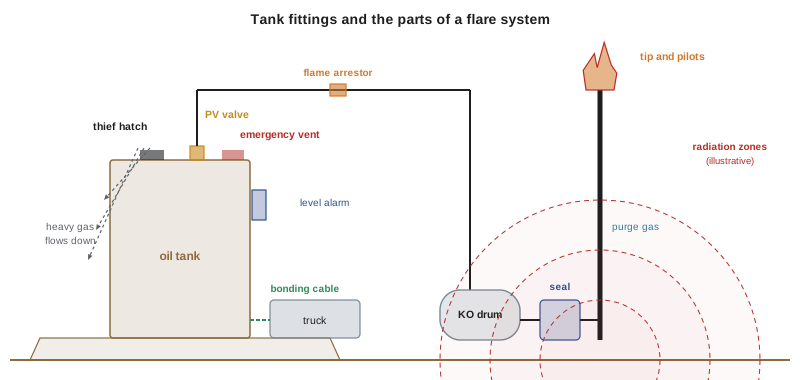
Flare radiation
Flames radiate heat. Near a large flare during an emergency blowdown, radiation can be intense enough to burn exposed skin in seconds. Engineers locate flares and set sterile areas so that radiation at places where people may be stays below limits that depend on how long a person would be exposed. API 521 gives commonly used guidance values, for example around 1.6 kW/m² (about 500 Btu/h·ft²) for continuous exposure of personnel with appropriate clothing and higher values for brief exposures with escape routes. The program below uses the simple point-source model to estimate radiation at different distances from an invented flare. It is a teaching approximation only; real flare studies use more detailed models.
# Point-source flare radiation estimate (teaching approximation only).
# q = tau * F * Q / (4 * pi * D^2)
import math

gas_rate_kg_s = 25.0          # emergency blowdown rate, invented
lhv_kj_kg = 46_000           # lower heating value of the gas, approximate
F = 0.2                      # fraction of heat radiated, assumed
tau = 0.9                    # atmospheric transmissivity, assumed
flame_height_m = 30.0        # height of flame midpoint above grade, assumed

Q = gas_rate_kg_s * lhv_kj_kg                # kW released
for x in (30, 50, 75, 100, 150):
    D = math.hypot(x, flame_height_m)        # slant distance to flame midpoint
    q = tau * F * Q / (4 * math.pi * D ** 2)
    print(f"{x:>4} m from base: about {q:5.2f} kW/m2  ({q*317:6.0f} Btu/h ft2)")
print(f"Total heat release: {Q/1000:.0f} MW")30 m from base: about 9.15 kW/m2 ( 2901 Btu/h ft2) 50 m from base: about 4.84 kW/m2 ( 1536 Btu/h ft2) 75 m from base: about 2.52 kW/m2 ( 800 Btu/h ft2) 100 m from base: about 1.51 kW/m2 ( 479 Btu/h ft2) 150 m from base: about 0.70 kW/m2 ( 223 Btu/h ft2) Total heat release: 1150 MW
In this invented case, radiation falls quickly with distance. Near the base during a large release it is high enough to cause pain on exposed skin within seconds, and only at about 100 m does it fall to the level commonly used for continuous exposure of people with appropriate clothing. That is why flare areas are fenced, why work near flares is scheduled when the flare is lightly loaded or isolated, and why maintenance on flare stacks and tips requires the flare to be taken out of service under a permit.
Venting and vapour recovery
Some facilities still vent gas directly from tanks, pneumatic devices, compressor seals and dehydrators. Vented gas is a fire and toxic hazard near the vent and a large source of methane emissions. Regulators in both countries have tightened rules on venting and flaring over the past decade, requiring vapour recovery, low-bleed or air-driven pneumatics, leak detection and repair programs and limits on routine flaring. For workers, the safety consequences are mostly good: fewer vents mean fewer vapour clouds. But vapour recovery units add compressors, piping and control systems that can fail, and a vapour recovery system that draws too hard can pull a vacuum on tanks. Operators should know how their tanks are connected and what happens to tank pressure when a vapour recovery unit trips or restarts.
Worked problem
Loading condensate at the Pinecrest battery
A truck arrives to load condensate from the Pinecrest tanks on a warm, still afternoon. The driver wants to open the thief hatch to check the level by hand because the remote gauge reading looks low. A thunderstorm is building to the west. What should the operator and driver do?
Show solution
- Check the storm: if lightning is within the company's stop-work distance, suspend loading and roof work until it passes.
- Resolve the level question without opening the hatch: check the remote gauge against the separator dump records or ask the control centre, and only gauge manually under the company's procedure if it is truly necessary.
- If manual gauging is required, stand upwind and back from the hatch, wear a four-gas monitor and the assessed respiratory protection, do not open the hatch while the tank is being filled, and have a second person watching from the ground.
- Bond the truck to the loading connection and ground it before loading, and start flow slowly until the fill pipe is submerged.
- Keep engines, phones and other ignition sources away from vent and hatch areas, and watch for vapour drifting into the bermed area on the still afternoon.
Answer: Lightning, vapour exposure at the hatch and static during loading are the main hazards. The safest approach avoids opening the hatch, controls static and stops work when lightning approaches.
Common mistakes
MistakeLeaving a thief hatch open after gauging.
InsteadClose and latch hatches immediately, and report hatches that will not seal.
MistakeOpening a hatch while the tank is being filled.
InsteadWait until filling stops and use remote gauging wherever possible.
MistakeStarting truck loading at full rate without bonding.
InsteadBond and ground first and start slowly until the fill pipe is submerged.
MistakeRelighting a flare without reducing flow and checking the area.
InsteadFollow the relight procedure, treat the downwind area as a possible H2S zone and check gas levels first.
MistakeWorking at the base of a flare during a blowdown.
InsteadStay out of the flare area while it is loaded and work on the stack only after it is taken out of service.
Summary and key terms
- Field tanks hold only a few kilopascals and can be damaged by overpressure, vacuum and gas blowby.
- Thief hatches, pressure-vacuum valves, emergency vents, flame arrestors, level alarms and bonding points each protect the tank.
- Tank vapour can be rich in hydrocarbons, H2S and benzene; remote gauging and hatch controls prevent exposures like those in the NIOSH deaths.
- Static and lightning are major ignition sources at tank batteries, controlled by bonding, slow starts and stopping work in storms.
- Tank fires can escalate to boilover; field workers raise the alarm and evacuate rather than approach.
- Flare systems rely on knockout drums, seals, purge gas and pilots; flame-out at a sour facility can release toxic gas.
- Flare radiation falls with distance, which is why flare areas are controlled and stack work requires the flare to be out of service.
- Thief hatch
- A lid on a tank roof used for gauging and sampling, which often also relieves pressure and vacuum.
- Pressure-vacuum relief valve
- A tank fitting that vents vapour on high pressure and admits air on vacuum.
- Flame arrestor
- A device that stops a flame travelling back through a vent or line.
- Bonding
- Connecting conductive objects so they stay at the same electrical potential.
- Boilover
- The violent ejection of burning oil when water at the bottom of a burning tank turns to steam.
- Knockout drum
- A vessel that removes liquids from gas before it reaches a flare.
- Purge gas
- A small continuous gas flow that keeps air out of a flare stack.
- Flame-out
- Loss of the flame at a flare tip, releasing unburned gas.
Practice problems
Work each problem on paper first, then reveal the answer to check.
Why can pumping liquid out of a tank damage it?
Show answer
It can draw a vacuum if the vents are blocked, collapsing the tank.
Name three fittings that protect a field tank.
Show answer
Any three of: thief hatch, pressure-vacuum valve, emergency vent, flame arrestor, level alarm, bonding point.
What exposure did NIOSH link to deaths at tank hatches?
Show answer
High concentrations of hydrocarbon vapours and low oxygen when hatches were opened.
What is the best control for manual gauging hazards?
Show answer
Eliminating manual gauging with remote gauges and sample systems.
Why start loading slowly until the fill pipe is submerged?
Show answer
To reduce splashing and static charge generation.
What is a boilover?
Show answer
Burning oil ejected when water at the bottom of a burning tank flashes to steam.
What does a flare knockout drum prevent?
Show answer
Liquid carryover and burning liquid falling from the stack.
Why is purge gas needed in a flare stack?
Show answer
To keep air out and prevent an explosive mixture inside the stack.
What should an operator assume when a sour flare goes out?
Show answer
That the downwind area may contain toxic H2S.
In the program, how does radiation change with distance?
Show answer
It falls roughly with the square of the slant distance.
Lesson quiz · 5 questions
Score 60% or more to complete this lesson.
Create a free account to save your progress, take quizzes and earn a certificate.